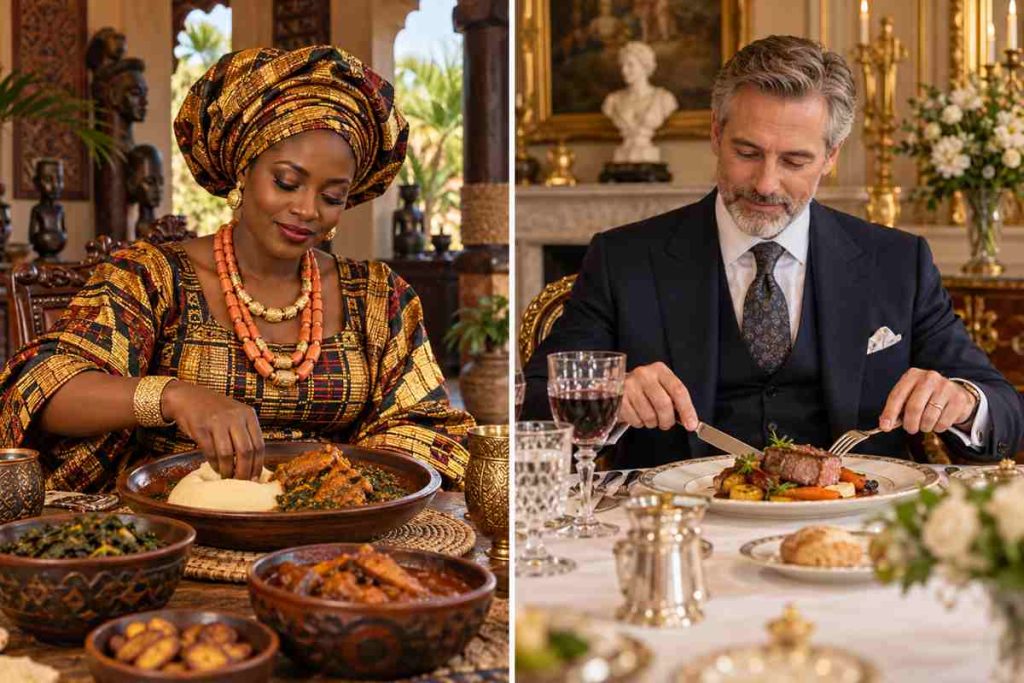
Different cultural dining traditions, neither a measure of superiority nor inferiority.
“One race’s definition of civilisation should never be mistaken for evidence that it is superior to others.” — Daniel Nkado
One of the most enduring expressions of racial power is the assumption that certain societies possess greater authority than others to determine what it means to be civilised.
Across different periods of history, standards associated with predominantly white societies have been presented not simply as cultural preferences, but as universal measures of human advancement. Other ways of living have consequently been described as primitive, backward, inferior or in need of correction.
This raises an important question: Who gets to define civilisation, and why should one society’s cultural standards automatically become the measure of another’s?
Civilisation is not the exclusive inheritance of any racial group. It is part of humanity’s collective history, shaped by different societies through knowledge, innovation, institutions, cultural practices and social organisation.
Understanding this distinction is important for examining racism, colonial mentality and the relationship between cultural authority and institutional power.
What Does Civilisation Actually Mean?
Civilisation is commonly associated with the development of complex societies, including systems of governance, organised settlements, economic exchange, knowledge production and cultural institutions.
However, the word also carries a moral meaning in everyday language. A person described as civilised is often assumed to possess superior manners, values or social behaviour.
These meanings should not be confused.
A society may possess advanced infrastructure, sophisticated technology and powerful institutions without necessarily demonstrating superior ethical conduct.
Similarly, a community’s customs may differ considerably from those of an economically dominant society without being inherently inferior.
Technological development, economic power, cultural difference and moral responsibility are not interchangeable measures of civilisation.
Recognising this distinction allows societies to acknowledge genuine achievements without treating those achievements as evidence of racial superiority.
How Civilisation Became a Language of Colonial Power
The connection between civilisation and racial hierarchy became particularly consequential during European colonial expansion.
Some colonial authorities presented their political and cultural systems as superior to those of the populations they governed.
In French colonial history, the mission civilisatrice, or civilising mission, supplied an ideological justification for empire. Colonisation was represented as a project of improvement, even while colonial rule involved coercion, unequal political power, and the denial of self-determination, overseeing several forms of harm and dehumanisation directed at indigenous people.
Historian Alice L. Conklin has examined how this supposed civilising mission became central to French imperial ideology.
The contradiction is significant.
A society could claim the authority to “civilise” others while simultaneously denying those populations the dignity, equality and political rights associated with civilisation itself.
This demonstrates why claims of cultural superiority must be examined alongside the power relationships through which they are promoted.
A dominant society’s ability to impose its standards does not, by itself, establish the moral superiority of those standards.

African Societies Had Civilisations Before European Colonisation
The historical record contradicts any suggestion that African societies lacked organised civilisations before European colonial expansion.
Across the continent, different communities developed political institutions, agricultural systems, architectural traditions, commercial networks, philosophical ideas and forms of education.
Great Zimbabwe, built by ancestors of the Shona people between the eleventh and fifteenth centuries, demonstrates sophisticated stone construction and extensive commercial connections.
Timbuktu, particularly during the fifteenth and sixteenth centuries, became an important centre of scholarship, religious education and trans-Saharan trade.
These examples represent only part of Africa’s diverse history.
UNESCO’s General History of Africa documents the continent’s extensive intellectual, political, economic and cultural development across different historical periods.
The purpose of recognising these achievements is not to claim that African civilisations were flawless or superior to all others.
It is to reject the historical distortion that civilisation existed elsewhere and was subsequently delivered to Africa.
African societies were participants in the development of human civilisation, not merely recipients of it.
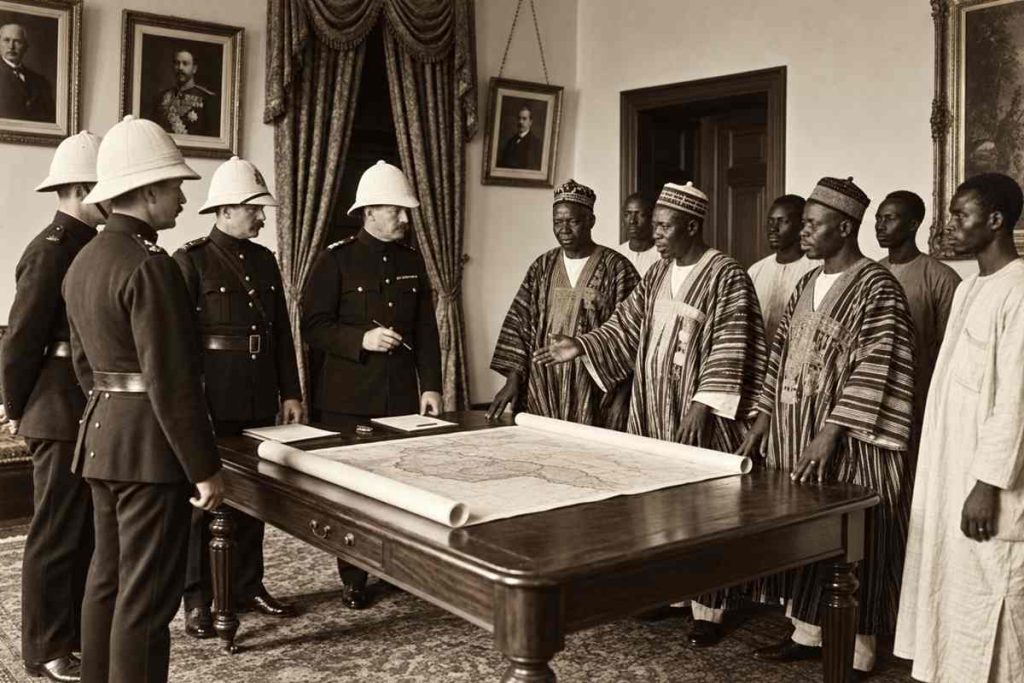
A historical reconstruction of African leaders and European colonial officials negotiating under unequal political authority, illustrating how colonial power influenced the governance and cultural autonomy of African societies.
Africans Were Building Civilisations Before Colonial Overhaul
Before colonial rule, African societies had developed their own systems of governance, trade, education, justice, communal responsibility and cultural organisation.
These systems were not perfect, but they emerged from African experiences, environments, values and understandings of human life.
Africans were building civilisations designed to work for African people long before colonial powers began restructuring our societies according to foreign interests and priorities.
My grandfather once said: “We were destroyed when the white man visited.”
The wisdom in his regret is too profound to overlook.
His words speak to something beyond the loss of political independence: the disruption of indigenous knowledge, institutions, cultural confidence and the ability of African societies to determine their own paths of development.
Colonialism did not introduce civilisation to a people without one. It interrupted and transformed civilisations that already existed.
The Colonial Myth That Africa Should Be Grateful for European Civilisation
Colonial narratives have often portrayed African societies as “backward” until Europeans arrived to introduce civilisation.
Rather than acknowledging how colonialism disrupted the development of existing African societies and institutions, these narratives frequently present European intervention as a gift for which Africans should remain grateful.
This expectation of gratitude rests on a deeply flawed assumption: that European civilisation was inherently superior, and that African societies were incapable of developing their own without European intervention.
But the truth is that African societies were already evolving, just as European societies were.
Developing vs Developed: A Faulty Civilisation Ranking
Even today, the distinction between developed and developing countries can reinforce the same misleading assumptions of racial superiority when economic advancement is confused with cultural superiority.
These classifications may describe measurable differences in infrastructure and income, but they should never imply that one society has completed the process of civilisation while another is still struggling to attain it.
Every society is continually evolving. No society has reached a final state of civilisation, and no level of economic development gives one race the authority to determine the cultural worth of another.
How Colonialism Reshaped African Attitudes Towards Sexuality
This argument can also help explain how European colonisation influenced modern African attitudes towards homosexuality.
African societies had their own understandings of sexuality, gender, relationships and moral conduct before colonial rule. These understandings were neither uniform nor necessarily free from prejudice.
But colonial authorities introduced foreign legal and moral frameworks that redefined certain sexual practices as criminal, immoral or contrary to civilisation.
The disruption was not simply the introduction of new ideas. It was the imposition of foreign interpretations through institutions of power, without allowing African societies to determine the direction of cultural change on their own terms.
In my view, this is one way colonisation may have interrupted the independent evolution of African understandings of sexuality.
A people cannot fully determine their cultural future when another society has assumed the authority to define their morality.
The Difference Between Cultural Influence and Cultural Superiority
Cultures influence one another through migration, trade, education, religion, technology and everyday human interaction.
There is nothing inherently wrong with adopting practices from another society.
A Nigerian may admire the efficiency of public transportation in England. A European may appreciate African approaches to communal responsibility. People across different societies may adopt useful ideas from one another.
The problem begins when cultural influence is interpreted as proof of inherent superiority.
For example, English proficiency may provide practical advantages in international education and communication. But speaking English does not make a person inherently more intelligent, capable or civilised than someone who speaks Yoruba, Igbo, Hausa or another language.
Similarly, Western professional dress may be appropriate in particular workplaces without becoming an objective measure of human dignity or competence.
The usefulness of a cultural practice does not establish the superiority of the people associated with it.
This distinction is especially important in societies where colonial history has influenced education, administration, language and perceptions of social status.
How Colonialism Disrupted the Evolution of African Cultures
Culture naturally evolves as people adapt their ways of living, institutions and values to changing circumstances.
But when external powers impose their own systems on a society, they can interrupt that natural evolution, displace existing institutions and redirect development away from the needs and priorities of the people.
In my view, this is one of the most damaging consequences of European colonisation in Africa.
Colonialism did not simply introduce foreign ideas. It imposed new structures of power that reshaped African societies, often without allowing Africans to determine which changes served their own interests.
The problem was not cultural change itself. It was the loss of control over how that change occurred, whose interests it served and what existing knowledge was discarded in the process.

A contemporary African community engaging in collective decision-making, illustrating cultural independence, self-determination and the continuing evolution of African civilisation.
Defending Cultural Identity Does Not Mean Defending Every Tradition
Rejecting racial superiority does not require accepting every cultural practice as equally beneficial or morally defensible.
African societies, like societies everywhere, contain traditions and institutions that deserve appreciation, alongside practices that require examination, reform or rejection.
Cultural identity must never become an excuse for discrimination, homophobia, violence, coercion or the denial of human rights.
UNESCO’s 2001 Universal Declaration on Cultural Diversity recognises cultural diversity as part of humanity’s common heritage while making clear that cultural differences cannot justify violations of globally recognised human rights.
This provides an important distinction.
No race has the exclusive authority to define civilisation, but every society remains accountable for how it treats human beings.
We can evaluate institutions by how well they protect dignity, justice, safety, freedom and equal rights, without assuming that one racial group’s customs represent the natural standard for everyone else.
The objective is neither cultural supremacy nor uncritical cultural relativism.
It is the development of standards that can be examined, challenged and justified without relying on claims of racial superiority.
Civilisation Should Not Be Confused With Racial Superiority
The history of human development is not a story of one race creating civilisation while others followed.
It is a history of different populations developing knowledge, building institutions, exchanging ideas, confronting challenges and influencing one another.
Some societies have achieved greater technological and economic development at particular points in history. Those achievements deserve recognition and can provide valuable lessons.
But technological advancement does not confer exclusive moral authority over humanity.
Neither does economic dominance transform the cultural preferences of powerful societies into universal truths.
For Black and African communities, recognising this distinction is essential to cultural confidence and informed participation in the wider world.
It becomes possible to appreciate another society’s achievements without diminishing one’s own cultural identity.
It also becomes possible to criticise harmful practices within one’s community without accepting the assumption that another race is inherently superior.
Civilisation should be understood through humanity’s collective achievements and the ethical responsibilities of societies, not through racial ownership.
No race has the exclusive right to define it.
References and Further Reading
1. Conklin, Alice L. (1997). A Mission to Civilize: The Republican Idea of Empire in France and West Africa, 1895–1930. Stanford University Press. https://books.google.com/books/about/A_Mission_to_Civilize.html?id=v6T78YHsTq8C
2. UNESCO. General History of Africa.
https://www.unesco.org/en/general-history-africa
3. UNESCO World Heritage Centre. Great Zimbabwe National Monument. https://whc.unesco.org/en/list/364
4. UNESCO World Heritage Centre. Timbuktu.
https://whc.unesco.org/en/list/119
5. Human Rights Watch (2008). This Alien Legacy: The Origins of “Sodomy” Laws in British Colonialism.
https://www.hrw.org/report/2008/12/17/alien-legacy/origins-sodomy-laws-british-colonialism
6. Human Dignity Trust. Nigeria: Criminalisation of LGBT People.
https://www.humandignitytrust.org/country-profile/nigeria
7. UNESCO (2001). Universal Declaration on Cultural Diversity.
https://www.unesco.org/en/legal-affairs/unesco-universal-declaration-cultural-diversity
