The Mechanics of Social Isolation in Black Queer Spaces
Social exclusion in UK Black queer communities often follows a predictable and escalating pattern that may not be obvious to ordinary or less-informed observers.
Shaped by minority stress, shame sensitivity, status anxiety, and the wider pressures of white-centred power structures, this age-old format of social exclusion often begins with a visible difference or perceived norm violation. This is the social trigger point.
An individual may become marked as a target for openly expressing vulnerability, challenging racism, diverging from dominant masculine codes, disrupting long-standing desirability and respectability norms, or coming into conflict with a group-celebrated icon of desirability or masculinity.
This trigger point is then amplified through gossip and in-group signalling, with private messages, side comments, and whispers positioning the person as a social problem. The third stage marks a decisive turning point, as the group moves exclusion into public view through call-outs, pile-ons, overt public shaming, or cold-shouldering.
By working together to exclude a target, the group often experiences a short-lived rush of in-group solidarity, with participants appearing almost robotic in their conduct: unthinking, unquestioning, and emotionally detached.
This article breaks down the five stages of social freeze-out and explains why this form of lateral violence damages both the individual and the wider community.
A Brief Note to Readers
A significant part of this article draws on lived experience. Readers may therefore encounter personal testimony alongside accounts of targeted isolation, reputational harm, and coordinated group exclusion. Some may find this material unsettling, and careful reading is encouraged.
Personal testimony is not offered here as a diversion from analysis, but as part of it. In communities where shame is routinely used to enforce silence, naming harm publicly can itself become a form of resistance.
The aim is therefore not to turn private pain into a spectacle, but to make visible how group exclusion operates in UK Black queer spaces, how some people are pressured to participate in it, and how silence allows these patterns to continue.
Clarifying Scope
To clarify, this article does not suggest that all conflicts in Black queer spaces are abusive, deliberate, coordinated, or fuelled by collective malice. Conflict is natural in any community.
The concern here is a specific toxic pattern: when a person’s difference, visibility, or dissent becomes the basis for gossip, social ostracism, reputational damage, and eventual collective exclusion.
- The Mechanics of Social Isolation in Black Queer Spaces
- The 5 Stages of Social Freeze-Out in UK Black Queer Spaces
- Beyond The Five Stages: When Exclusion Fails
- Group Exclusion as White Supremacy’s Strategy of Containment
- 5 Reasons Joining in to Exclude a Target Feels Good to Some Black Queer Men:
- Why Group Exclusion Backfires on Both Individuals and the Community
- References
The 5 Stages of Social Freeze-Out in UK Black Queer Spaces
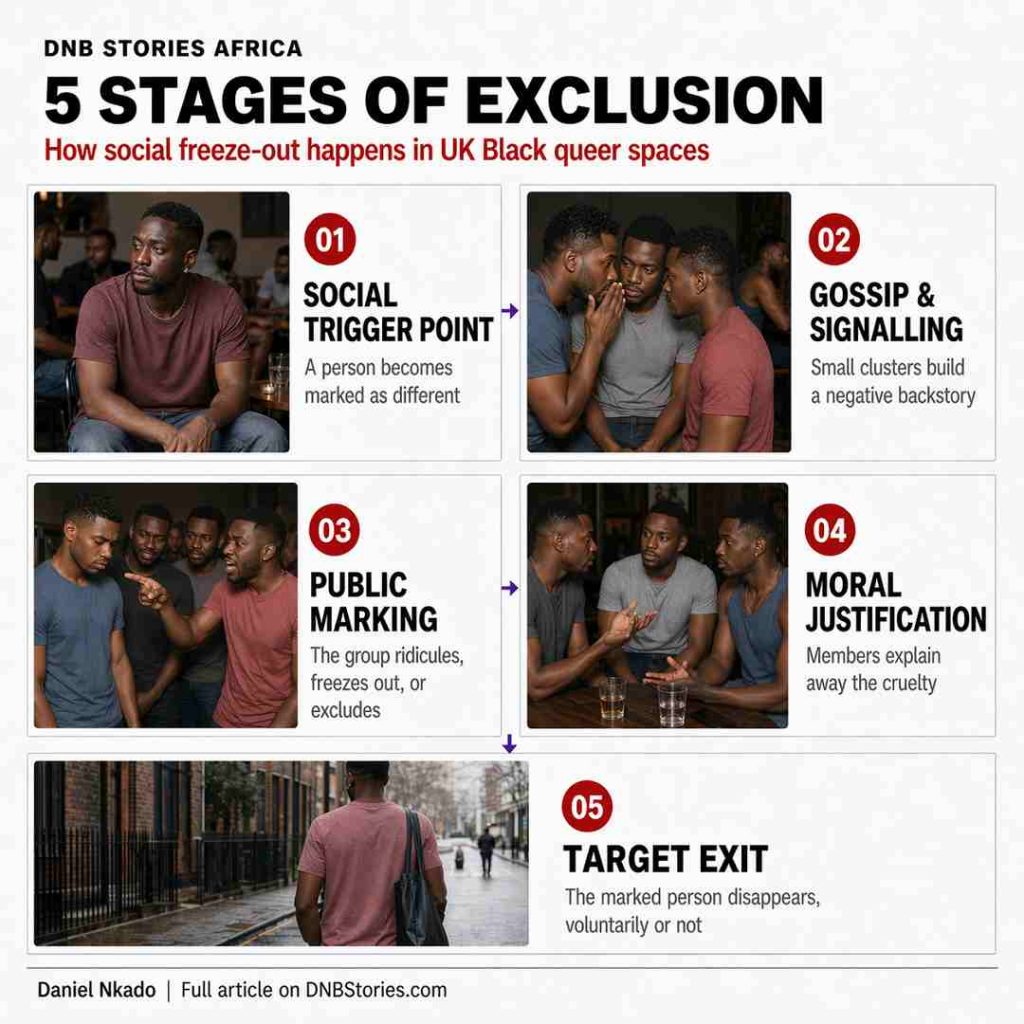
Group exclusion rarely happens all at once, but it often follows a recognisable pattern. In UK Black queer spaces, the group may first mark a target as different, then turn him into the subject of round-the-clock, hair-salon-level gossip, publicly shame him, rationalise him as the problem, before finally pushing him out.
Social Trigger → Gossip and In-Group Signalling → Public Shaming and Cold-Shouldering → Rationalising the Harm → Exclusion and Exit.
Stage 1: Trigger Point Observed – Target Named
It begins when someone refuses, or simply fails, to follow the group’s unwritten rules. This person may be more outspoken, too visible, more authentic in their style and manner, or simply different in ways the group is not used to. This places a quiet target on their back as the odd one out.
It might be a Black queer man with a softer-presenting style among a group that worships hypermasculinity, or someone standing up to a shame attack or racist joke in a mixed-minded group, or a person challenging body hierarchy and proposing new ways to measure value. This initial difference subtly marks them as “other.” Bystanders may exchange side-eyes, small jokes, or coded reactions, signalling that the person has been flagged as deviant. This is the social trigger point, or stage one.
Stage 2: Backhand Gossip and In-group Signalling
Behind the scenes, small clusters begin discussing the person. Minor quirks or ordinary human mistakes—often ones the gossipers repeatedly make themselves—are magnified through in-group re-sharing or reposting. In a group chat, a few members might privately label the individual “messy,” “weird,” or “too much.” At an event, others may whisper critiques about their behaviour, appearance, or social style. These signals circulate quietly, building a shared backstory in which the person becomes a legitimate target for ridicule, scrutiny, or eventual exclusion.
In my case, the process was driven largely through people closest to me—often other Black men of African origin and UK-born Nigerians.
Stage 3: Public Marking, Shaming and Cold-Shouldering
The group signalling then escalates from quiet whispers to a public exclusion move. Online, this may take the form of a direct call-out or a coordinated pile-on of critical comments. Offline, it can appear as open confrontation or collective cold-shouldering, such as deliberately ignoring the target at the next meet-up.
At this point, the person is marked and officially positioned as the problem. The in-group experiences a rush of solidarity as it unites against the target, replacing genuine belonging with performative bonding.
In my case, an online call-out appeared too risky. The terrain and framing were too unpredictable, so additional tactics seemed to be introduced once the process began taking too long. What followed ranged from subtle group manipulation to falsified notes, chats, images, and voice recordings—effectively turning my experience into a real-life case study.
Seeing how far the group appeared willing to go was very instructive: it revealed how much energy Black queer men can invest in suppressing one of their own, often in service of the very structures of white supremacy that continue to hold down the community.
Stage 4: Rationalisation and Lock-In
Once cruelty becomes open and public, group members often engage in moral disengagement to protect their self‑image.
The group downplays and rebrands the harm: “We’re just holding him accountable.” Members shift blame onto the target — “he brought it on himself by being annoying” — or frame the cruelty as necessary for the greater good: “we need to keep our space safe from drama.” This rationalisation locks in the target’s pariah status.
Leaders or moderators frequently remain silent or tacitly endorse the exclusion by failing to intervene, signalling that the ostracism is acceptable. Over time, the group’s hostility hardens into the new norm.
Once the group perceives the target as eliminated, or the major organisers declare the work complete, boredom returns. Members quietly wait for a new target to restart the makeshift bonding ritual— even though this ritual rests on a hollowed-out, self-consuming coordination. As they say, a starving man will eat the wolf.
When belonging is scarce, even cruelty can start to look like family dinner.
Research shows that when moral disengagement becomes collectively shared—such as through rationalising harm, blaming the target, or reframing exclusion as “doing something good for the community”—it increases the likelihood of both bullying and victimisation within the group (Thornberg et al., 2021).
Stage 5: Exclusion and Exit of the Target
Finally, the group pushes the target out. Members may ban him from a group chat, exclude him from future meet-ups, or make communal spaces so hostile that he withdraws on his own. The outcome is the same: social isolation. Internally, they may grapple with disbelief and confusion—a persistent sense of “what did I do to deserve this?”—layered on top of other stress points they may already be carrying.
At this point, the community has lost a member—often someone with great potential for collective growth, but rendered a target by dynamics shaped by white supremacy rather than by genuine communal need. For the person pushed out, there can even be a grim sense of relief: the recognition that there was never a real community to mourn in the first place!
This is one way oppression reproduces the familiar divide-and-conquer logic in modern Black queer spaces: keep Black people divided, suspicious of one another, and distracted from collective power (Bulhan, 1985).
“A friend to all is a friend to none.” — Aristotle.
Beyond The Five Stages: When Exclusion Fails
Exclusion is typically intended as punishment. The unspoken expectation is that the target will struggle, shrink, fall back in line, show remorse, abandon their work for change, or quietly disappear. Isolation is deployed to reaffirm the clique’s superiority. But exclusion is an unstable tool. Sometimes, pushing someone to the margins releases them instead. Some targets are unpredictable, and in those cases, exclusion can add power to wings rather than clip them.
Freed from the constant pressure to perform or conform, the target may begin to thrive—finding more authentic relationships, expressing themselves without restraint, or succeeding in spaces beyond the clique’s reach. When this happens, the exclusion fails. This resilience poses a psychological threat to the group. Ostracism is an exercise of power; if the target is not diminished by it, the group’s authority collapses.
Within marginalised communities—where many people suppress parts of themselves to maintain respectability, secure status, or protect sexual desirability—watching someone succeed without paying that price can be deeply unsettling. It forces an unspoken question: Why are we shrinking ourselves to belong, if they can flourish outside the fold?
The Pivot to Control or Wing-Clipping
To resolve this rupture, the group’s objective shifts. Passive exclusion gives way to active containment. The aim becomes reasserting dominance and “humbling” the individual who has outgrown them. At this stage, exclusion escalates into sabotage. Whisper networks expand into smear campaigns.
Reputations are quietly poisoned. Access to shared spaces, events, or mutual connections is restricted. Vulnerabilities disclosed during the target’s time as an insider are weaponised. The group is no longer content to keep the person out—it moves to clip the very wings their exclusion helped grow, determined to prove that no one leaves the fold and survives unpunished.
The next section uses my own experience as a case study to show how the exclusion framework can play out in real time.
Personal Case Study: Falsification, Sexual Shaming, and Reputational Harm
Using myself as a case study was useful because it showed how these dynamics operate in real time. In many exclusion campaigns, the target is not only criticised; they are actively rewritten. Falsifications are circulated, smear narratives are repeated, and strategic shaming is deployed to weaken the person’s identity, stability and credibility.
Ambush triangulation then becomes part of the machinery: the target is placed in staged or hostile situations designed to provoke a reaction, which can later be reframed as “evidence” of instability, guilt, or social unfitness. In this way, reputational damage is manufactured first, then treated as proof of itself.
In my case, I watched in disbelief as lies, taunts, and distortions piled up around me. The smear campaign became deeply personal: “he’s destroying relationships,” “he’s a druggie,” “he’s performing for attention,” “he’s a bottom,” “he is telling our tops to become bottoms,” “he is destroying masculinity,” “he doesn’t get hard” — as if I owed anyone an erection.
Even some men I had considered friends joined in, shaming me for struggles I had already been honest about. Thank God for honesty, because you cannot truly shame a man who knows and acknowledges his own truth.
The Role of ‘Friends’ in Harming a ‘Friend’
The angles of attack included my struggle with drug use, without them realising that their exclusion was pushing me to confront and overcome those very struggles with even greater discipline. One of the main instigators even called me under the pretence of concern. I swallowed my pride and gave him sincere advice about intimacy in his relationship, choosing to treat his request as genuine despite my awareness of his repeated attempts to compromise me, both at his event and during his visit to my home.
In that moment, I felt a strange mixture of hurt and resolve. Before hanging up, I calmly left him with a Ghanaian proverb we both knew: he could continue with his schemes, but every night, as he retreated into whatever he called peace, he would keep meeting himself standing next to his god at the finish line. Yoruba Nigerians have a similar saying, too. My friend from my NYSC days, Seun — slim and gorgeous — used to say something close to it.
It was my way of saying that I refused to become bitter. Whatever story he told himself, and whatever version of events he retrieved from his mind for peace, he would still have to face himself and his own inner judge. I would not be there to carry his conscience for him. My honesty mattered more than any petty scheme designed to soothe a wounded ego on life support.
The Important Work of Dr Reginald on Black Queer Masculinity
A qualitative study by Black queer studies scholar Dr Reginald A. Blockett and colleagues examines how Black queer male college students navigate and resist hegemonic masculinity within their communities.
Their study is directly relevant to group exclusion dynamics because it shows how rigid masculine norms can produce subtle ostracism, policing pressure, and gatekeeping against those who do not conform. Blockett’s work helps illuminate how Black queer men marked as “too soft” or who fall outside expected codes may become marginalised within their own communities under the weight of broader oppressive norms.
No Excuse for Betrayal: Some People Had Been Waiting
Victims of group exclusion, group harm, or group cruelty should never make the mistake of assuming that certain actors behaved as they did because they were misled or lied to. That is a dangerous misreading. Genuine love resists harm. True care seeks clarity and pushes back against injustice.
When someone chooses a side without making even a minimal effort to understand what is happening, the issue is rarely simple confusion. More often, it is long-suppressed resentment finally finding an outlet. Victims should treat this behaviour as life‑saving information: it reveals who was waiting for an opportunity to act, not who was merely misled.
Group Exclusion as White Supremacy’s Strategy of Containment
This scenario shows how organised group exclusion can operate, especially when shaped by white racial hierarchy. Black queer men who challenge harmful group norms may be labelled as criminal, unstable, or dangerous, subjected to heightened scrutiny, or informally policed. These pressures can cut people off from support, education, care, and community — key foundations for safety and power for Black queer men.
In more severe cases, exclusion can increase vulnerability to precarious survival economies, including drug dealing, transactional sex, or escorting. In this way, exclusion is not merely about upholding unwritten social codes; it can function as a containment strategy that blocks access to the resources, relationships, and opportunities needed to build lasting influence, safety, and power.
No matter where one stands in the exclusion dynamic—whether as a participant, bystander, or target—the damage spreads. Group harm trains Black queer men to fear one another. And when that happens, what does shared race mean if the person who looks like you begins to feel more dangerous than the person who does not?
How White Supremacy Uses Black Queer Men To Punish Its Targets
Most of the time, targets of exclusion and reputational destruction pose no real danger to Black communities; they only threaten oppressive systems of power. Calls for Black education, inclusive masculinities, collective solidarity and power, and long-term strategies for growth are often reframed as violations of “Black codes.”
Yet these so-called “Black codes” were not organically produced. They were installed and enforced by white-centred power structures, functioning for centuries to keep Black men occupied and distracted from chasing institutional power and getting involved in systems that more reliably predict better outcomes for Black success.
What could strengthen the community is recast as betrayal, so that any resistance to this installed social device is punished while the distraction it produces is preserved.
Racial Surveillance in the UK: Why Black Queer Men Carry Particular Focus
The scrutiny placed on Black queer men can be especially intense because their position is politically relevant. If systems worked as they should, Black queer men would have every reason to pursue knowledge, enter institutions, build collective power, and challenge authority from within.
Containment interrupts that possibility. It separates the person capable of directing attention toward the right struggles from the community by marking him as unstable, morally suspect, or socially deviant.
Sponsored Exclusion in Black Queer Spaces
In some cases, a wealthy, influential, or otherwise powerful figure may sponsor or quietly back the exclusion. The group may follow the same mechanics of freezing out the marked target, but those behind the campaign rarely distribute rewards evenly.
Some participants may receive direct benefits, while organisers keep others engaged through empty promises, access, proximity, sexual attention, or the hope of future gain. The more status or influence a person holds within the group, the higher the stakes become, and the greater the bid required to secure their participation.
Public Humiliation Is a Killer
Publicly marking or humiliating a target can carry serious psychological consequences.
A recent systematic review found that experiences of public humiliation are associated with significantly worse mental-health outcomes, including anxiety, depression, PTSD symptoms, and suicidal ideation (Li et al., 2024).
This is why, when someone says they cannot forgive public humiliation or simply “let it slide,” they are often speaking from the weight of that impact.
Some Good News: Public Humiliation Can Foster Growth
Public humiliation wounds first, but growth can still follow. Research suggests that people can develop resilience or post-traumatic growth after experiences of humiliation when they are able to process the harm, make meaning from it, and regain a sense of control (Li & Hu, 2022).
In this sense, surviving humiliation and group cruelty can become a source of resilience rather than only a site of injury. Severe humiliation may harden a person’s emotional skin, helping them face future challenges with greater steadiness rather than panic.
A 2026 study on post-humiliation recovery suggests that humiliation can lead to either self-destruction or self-recovery, depending on how the person processes the emotional aftershock.
When the injured person is able to confront the experience, reappraise it, and rebuild their narrative, humiliation can become a turning point that strengthens discernment and resilience rather than only a site of injury (Goldsby & Kuratko, 2026).
5 Reasons Joining in to Exclude a Target Feels Good to Some Black Queer Men:
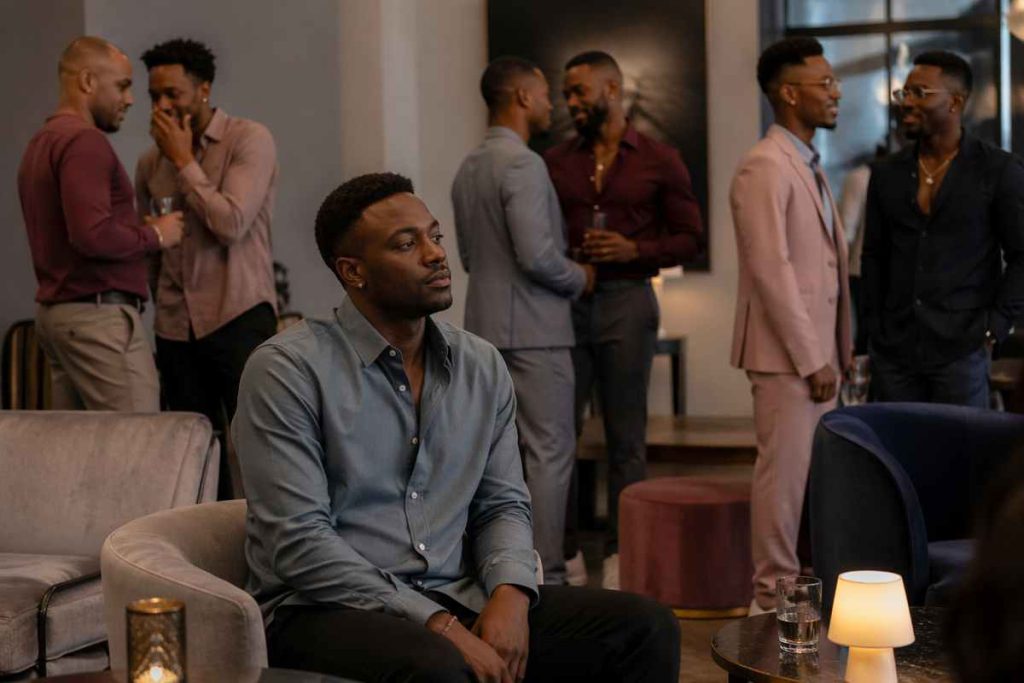
Group exclusion in Black queer spaces is a false fix that ends up hurting everyone. It keeps Black queer men constantly distracted by gossip, public shaming, and cold-shouldering each other — draining energy that could have gone into more constructive endeavours. While it may offer participants a brief sense of unity or control, this form of cruelty ultimately backfires. It creates lasting harm, fear, and isolating divisions. Real strength comes from solidarity, empathy, and accountability — not from scapegoating your own.
i. Momentary Feeling of Power
Excluding someone produces a short-lived sense of dominance that counters underlying feelings of inferiority and insecurity. For a person who often feels marginalised or powerless, flipping the script by making someone else the target can be briefly empowering – a false high that masks their own shame.
ii. False Sense of Belonging or Community
For a group long starved of genuine community, bonding against a target can produce a form of performative solidarity that briefly feels like the real connection people have been craving. When true belonging is scarce, shared hostility can masquerade as bonding.
The group experiences a rush of unity through shared hostility, creating an illusion of camaraderie and loyalty. But this false cohesion relies on very relationally corrosive methods: gossip, distortion, triangulation, setups, and the betrayal of perceived friendship in service of an artificial bond (Williams, 2007).
Deep down, and often without fully conscious awareness, the mind continues to register that this is not genuine trust or real safety. That is how the psyche begins to lose confidence in us and in our actions, generating inner confusion and instability.
Because exclusion dynamics rarely involve equal knowledge or shared motives, the conscious mind is left in a loop, trying to fill in gaps and resolve contradictions as they surface. Nobody fully trusts the story they are being given. And the more unethical the role a person is pressured to play, the greater the psychological strain and internal fracture it can produce, even as they continue to perform it. In the end, this kind of false bonding creates more cracks than it repairs.
iii. Group Cruelty as a Form of Emotional Discharge
Many Black queer men struggle with healthy emotional regulation under the intersecting pressures of masculinity, desirability, body image, appearance, racism, and wider structural strain. In the absence of genuine community—spaces where people can express difficult emotions and still be held with care—many end up bottling up, suppressing, or displacing what they truly feel.
Cruelty can begin to feel attractive as a form of release or a way of discharging suffocating “ugly” emotions, even though it is a redirection rather than regulation. Instead of calming distress, it multiplies it, deepening moral and relational damage while leaving the original emotions unresolved.
iv. Participation as Price for Conditional Safety
By actively aligning with the dominant norms and partaking in excluding perceived violators, some Black queer men hope to secure their own safety within the hierarchy. When a strong sense of self is lacking, compounded by chronic shame and rejection sensitivity, the mere thought of becoming the next target can trigger paranoia.
In this context, obedience to the hierarchy can override any conscious thought or feeling, as participation offers a temporary sense of security. Siding with the majority — and its unwritten rules about respectability or masculinity — becomes a plea for protection. By proving they are “one of us,” they avoid being singled out.
This sense of safety—“thank goodness it’s not me,” no matter how false it is—can feel perversely comforting in a hostile environment.
v. Personal Vendetta Outlet
Group exclusion can provide cover for settling private grievances by reframing personal resentment as collective judgment. If someone harbours a hidden grudge, envy, or unresolved bitterness, joining a group attack on that person can feel deeply satisfying. It allows them to punish the target under the protection of group consensus, transforming private vindictiveness into apparent communal work. At the individual level, this often carries a perverse sense of satisfaction: finally, they are getting what they deserve.
Why Group Exclusion Backfires on Both Individuals and the Community
a. Individual Harm
The short-term relief of projecting pain quickly turns corrosive. Rather than healing trauma, cruelty redirects it and, in the process, deepens shame, anxiety, chronic self-criticism, and emotional instability. It weakens a person’s trust in their ability to survive adversity. What feels like release in the moment can return as moral injury and identity fracture.
b. Relational Damage
A community built on the shared exclusion of others teaches its members one brutal lesson: your belonging here lasts only as long as you stay in line. True belonging means being seen, held, and having your place kept for you without needing to change or suppress who you are. Any form of belonging that demands self-erasure is not belonging at all. It is a hellish trap.
c. Community Fragmentation
Exclusion normalises fear, self-shrinking, performance, and emotional guardedness. When genuine belonging is replaced by conditional acceptance—where people are valued only as long as they conform—it produces a constant stress around belonging itself.
When belonging—the very thing meant to relieve stress—starts generating more of it, the result is a culture of chronic vigilance, quiet paranoia, and psychological trauma. This form of toxic belonging explains why people can be surrounded by others and still feel profoundly alone. Even after the excluded target is gone, the emptiness remains.
d. Loss of Collective Power
Lateral conflict drains energy that Black queer communities could otherwise direct toward care, solidarity, wealth generation, and the building of collective power. It weakens the community’s organising capacity, internal cohesion, and wider social influence by turning the minds of Black queer men away from more productive work capable of bringing genuine progress.
Real-World Example of Group Exclusion in the UK
In a Black queer social scene in South London, unwritten rules around “Black masculinity” are often used to avoid sustained learning, challenge, or critique. Darnell, a newer member, repeatedly posts about what Black queer men lose when they reject education and critical thinking. This becomes the social trigger point.
In side chats, a few members begin labelling him “oversensitive,” “dramatic,” or “too white.” Soon, someone screenshots Darnell’s message into the main chat with a sarcastic comment: Here we go with this dude again –🙄. Several members pile on with mockery.
At the next community event, Darnell is cold-shouldered by other Black queer men, including people he had assumed were his friends. Stunned and lost for words, he goes quiet. After he disengages, others rationalise the outcome by saying, We just prefer no drama; he didn’t vibe with us. Eventually, Darnell stops posting altogether and leaves the area, feeling hurt and unwelcome.
The space carries on without him, but the atmosphere has changed. Members become more careful not to step out of line. Vigilance, chronic fear, and quiet paranoia replace anything resembling belonging.
References
- Blockett, R. A., Hutchings, Q. R., Brown, J., & Patton Davis, L. (2025). Black queer men transgressing masculine normativity. The Journal of Higher Education, 96(2), 173–196. https://doi.org/10.1080/00221546.2024.2330850
- Bulhan, H. A. (1985). Frantz Fanon and the Psychology of Oppression. In Path in Psychology. Springer US. https://doi.org/10.1007/978-1-4899-2269-4
- Goldsby, M. G., & Kuratko, D. F. (2026). How humiliation reconstructs (or ruins) the entrepreneurial self. Small Business Economics. https://doi.org/10.1007/s11187-026-01199-3
- Li, Q., & Hu, J. (2022). Post-traumatic Growth and Psychological Resilience During the COVID-19 Pandemic: A Serial Mediation Model. Frontiers in Psychiatry, 13. https://doi.org/10.3389/fpsyt.2022.780807
- Meyer, I. H. (2003). Prejudice, social stress, and mental health in lesbian, gay, and bisexual populations: Conceptual issues and research evidence. Psychological Bulletin, 129(5), 674–697. https://doi.org/10.1037/0033-2909.129.5.674
- Thornberg, R., Wänström, L., Gini, G., Varjas, K., Meyers, J., Elmelid, R., Johansson, A., & Mellander, E. (2021). Collective moral disengagement and its associations with bullying perpetration and victimization in students. Educational Psychology, 1–15. https://doi.org/10.1080/01443410.2020.1843005
- Wendy Wen Li, Heward, C., Merrick, A., Astridge, B., & Leow, T. (2024). Prevalence of experiencing public humiliation and its effects on victims’ mental health: A systematic review and meta-analysis. Journal of Pacific Rim Psychology, 18. https://doi.org/10.1177/18344909241252325
- Williams, K. D. (2007). Ostracism. Annual Review of Psychology, 58(1), 425–452. https://doi.org/10.1146/annurev.psych.58.110405.085641
Frequently Asked Questions—1
Group exclusion is a form of lateral violence in which Black queer men come together to socially isolate and push an individual out of their own community. Also known in the UK as “freezing someone out,” it often begins with subtle microaggressions, gossip, and cold shoulders before escalating into public shaming, gatekeeping, and full social ostracisation.
Exclusion often mirrors the biases of mainstream society. Individuals who violate unwritten community rules—such as resisting respectability politics or defying hyper-masculine norms—are flagged as “deviant.” This triggers clique behaviour, where the target is quietly frozen out behind the scenes before facing overt, public rejection.
White supremacist structures rely heavily on divide-and-conquer tactics. By creating conditions in which safety, desirability, status, wealth, and belonging feel scarce, they encourage Black queer men to see one another as competitors rather than kin. In that climate, some Black men may begin policing each other or even selling out their conscience to uphold hierarchies of respectability, masculinity, class, body image, and proximity to whiteness — especially when they believe they benefit from those hierarchies.
Frequently Asked Questions—2
Yes. Sometimes, being pushed to the margins actually sets the target free. Removed from the exhausting pressure to conform, the individual may thrive and find more authentic, supportive spaces. When a target flourishes independently, it exposes the clique’s lack of actual power and entirely undermines their attempt to “humble” the victim.
Healing starts by recognising that exclusion reflects the group’s internalised fears, not your personal worth. Victims can reclaim their power by decentralising the toxic clique and investing in spaces that offer genuine affirmation. Treat the ostracisation as painful but necessary clarity on who truly values you, using it as a catalyst to build a life on your own terms.
Targets often comfort themselves by assuming friends were manipulated or lied to by the clique. However, genuine friends will seek clarity or show hesitation before inflicting harm. Complicity usually stems from a bystander’s own status anxiety, hidden resentment, or desire for group approval. Acknowledging that they made a conscious choice to participate is a difficult but vital step in moving forward.
Communities can interrupt exclusion by refusing gossip, questioning pile‑ons, and addressing harm early through clarification rather than shaming. Strong leadership, clear norms against public humiliation, and repair‑focused responses help prevent isolation from becoming normal and keep community bonds genuine and intact.