
A man can appear physically powerful while remaining psychologically vulnerable to the threat of masculine devaluation.
He can possess an impressive physique, command considerable social and sexual attention and embody several conventionally celebrated masculine qualities, yet remain susceptible to manipulation through the fear of being perceived as less of a man.
Through the Racialised Masculinity Shame Box, I examine what happens when the conditions under which Black men receive masculine recognition are shaped not only by prevailing gender expectations but also by the power dynamics of an existing racial hierarchy.
The Racialised Masculinity Shame Box is an extension of my Shame Box Framework, introduced in Black & Shameless: Shame Literacy for Black People. It also forms part of my broader work on what I describe as the deliberate fragilisation of Black manhood.
- What Is the Racialised Masculinity Shame Box?
- The Deliberate Fragilisation of Black Manhood
- Anatomy of the Racialised Masculinity Shame Box
- The Selective Approval of Black Masculine Power
- Masculinity Shame as an Instrument of Behavioural Control
- The Psychological Cost of Living Inside the Box
- The Racialised Masculinity Shame Box in Black Queer Spaces
- Shame Literacy: The Pathway Out of the Box
- From Conditional Masculine Recognition to Self-Defined Manhood
- How the Racialised Masculinity Shame Box Connects With the Masculinity Anchors Model
- Black & Shameless: Shame Literacy for Black People
- FAQs
What Is the Racialised Masculinity Shame Box?
The Racialised Masculinity Shame Box is a conceptual framework illustrating how masculine recognition for Black men can be made conditional upon conformity to racially approved expressions of manhood.
It examines how racial, cultural and interpersonal expectations can create restrictive boundaries around Black masculinity and its expression, with shame serving as an instrument for enforcing conformity.
Within racialised social environments, a Black man may be encouraged to embody particular expressions of masculinity while being discouraged from exploring others.
He may be rewarded for his physical strength but discouraged from exercising intellectual or political authority.
A Black man may be celebrated for his sexual performance but subjected to ridicule when he exercises sexual freedom.
He may be encouraged to compete aggressively for masculine recognition within his own community while encountering social resistance when he challenges established racial hierarchies.
The issue is not necessarily the masculine qualities themselves. It is the external prescription of where, when, how and against whom those qualities may be expressed.
The Deliberate Fragilisation of Black Manhood
I use the term fragilisation deliberately.
There is an important distinction between describing a person’s masculinity as fragile and examining the social processes through which their sense of masculine legitimacy is made fragile.
The former can suggest an inherent personal weakness. The latter directs attention towards the conditions that produce and sustain that vulnerability.
When a Black man is repeatedly taught that his masculine legitimacy depends upon conformity to external expectations, the threat of losing that legitimacy can become a source of considerable psychological pressure and a potential instrument of behavioural control.
His manhood becomes something he feels compelled to continually demonstrate, defend and protect.
Research on precarious manhood, including the work of social psychologists Joseph Vandello and Jennifer Bosson, examines how manhood can operate as an insecure social status requiring repeated public confirmation.
The Racialised Masculinity Shame Box introduces an additional dimension to this discussion: the operation of racial power within the conditions of masculine recognition.
Conditional Masculine Recognition and the Social Control of Black Men
The Racialised Masculinity Shame Box raises several practical questions that are central to understanding the relationship between Black masculinity, racial hierarchy and social control:
- Who determines what constitutes acceptable Black masculinity?
- Which expressions of Black masculine power are celebrated, and which are punished?
- What social mechanisms are used to enforce conformity to these expectations?
- Who benefits when Black men become psychologically dependent upon external masculine validation?
These questions shift the analytical focus from Black masculinity itself to the social conditions under which it is recognised, rewarded, restricted and potentially manipulated.
These questions are central to examining the fragilisation of Black manhood.
Where such vulnerability is knowingly cultivated or exploited to obtain compliance, I describe this as deliberate fragilisation. This does not require every person enforcing masculine expectations to be consciously participating in a coordinated process. Social norms can also be inherited, internalised and reproduced without an awareness of their wider implications.
Anatomy of the Racialised Masculinity Shame Box
The framework contains several interconnected components that illustrate how shame can regulate masculine identity and behaviour.
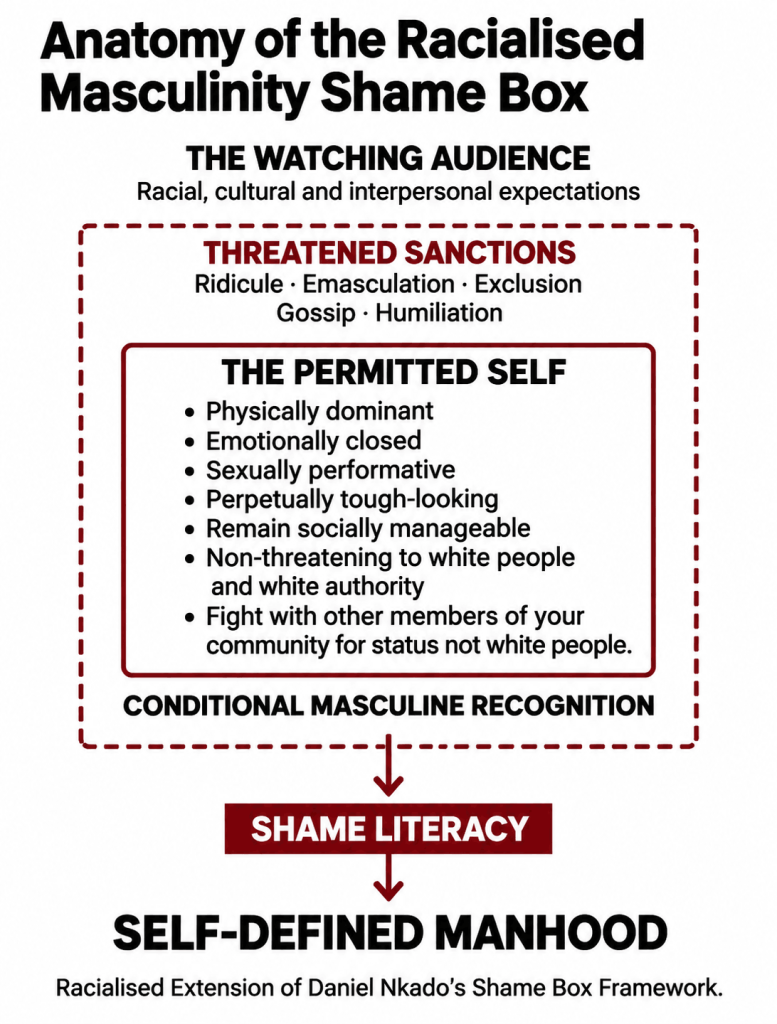
1. The Watching Audience
The Watching Audience represents the individuals, communities, institutions and wider social environments whose approval or disapproval can influence a Black man’s perception of his masculine legitimacy.
This audience may include family members, friends, sexual partners, colleagues, social groups, media institutions and people occupying positions of racial or institutional authority.
Importantly, the expectations of a racialised social hierarchy do not have to be communicated exclusively by white people.
Black individuals who have internalised particular racialised expectations of manhood may also participate in enforcing them against other Black men.
Over time, the Watching Audience may become psychologically internalised. A man can begin to police his own behaviour even when nobody is physically watching him.
2. Threatened Sanctions
The boundaries of the Shame Box are maintained through actual or anticipated social punishment.
These sanctions may include:
- Ridicule
- Emasculation
- Exclusion
- Gossip
- Humiliation
- Withdrawal of social or sexual recognition
The effectiveness of these sanctions depends partly on the value the targeted individual attaches to the recognition being threatened.
When masculine recognition becomes deeply intertwined with personal worth, even a relatively minor suggestion of masculine inadequacy can produce significant emotional discomfort.
That discomfort can subsequently be exploited to influence behaviour.
3. The Permitted Self
At the centre of the Racialised Masculinity Shame Box is what I describe as the Permitted Self.
This represents a restricted version of Black manhood that conforms to the expectations of a particular racialised social environment.
Within this box, conformity may revolve around a controlled prescription of manhood that encourages Black men to:
- Be physically dominant.
- Remain emotionally closed.
- Be sexually performative.
- Appear perpetually tough.
- Remain socially manageable.
- Remain non-threatening to established white authority.
- Direct masculine competition for status primarily towards other members of their community.
These characteristics describe the pressures examined by the framework, not inherent qualities of Black men or universal expectations across Black communities.
Indeed, one of the most revealing features of the Racialised Masculinity Shame Box is the contradiction between some of its demands.
A Black man may be expected to appear powerful while remaining socially manageable.
He may be encouraged to demonstrate toughness while being discouraged from exercising that toughness in resistance to racial injustice.
He may be celebrated for the appearance of masculine power while being punished for its independent exercise.
4. Conditional Masculine Recognition
Conditional Masculine Recognition is the social reward attached to conformity.
As long as the individual performs an approved version of masculinity, he may receive recognition, desirability, acceptance or status.
However, the conditions attached to that recognition can become apparent when he deviates from the prescribed role.
A man who has been celebrated for his masculinity may suddenly find that same masculinity questioned because he expresses vulnerability, rejects a sexual expectation, refuses to participate in a confrontation or challenges an established authority.
This raises an important question:
Was his masculinity genuinely being respected, or was it just his conformity being rewarded?
The Selective Approval of Black Masculine Power
One of the most insidious aspects of this contraption is the encouragement of masculine competition and dominance within the Black community, while expressions of masculine freedom beyond these prescribed boundaries can attract social punishment.
In such environments, masculine power may be more readily tolerated when its exercise does not threaten established racial hierarchies.
A Black man may be celebrated as an athlete, entertainer, or symbol of physical strength, yet face far more resistance when asserting authority, challenging institutional inequality, or refusing a subordinate social or political position.
There is also a documented racial dimension to how physical strength itself is interpreted.
A 2017 study by Wilson, Hugenberg and Rule found that participants tended to perceive young Black men as larger, stronger and more physically threatening than young white men.
Research published under the title Criminalized Masculinities also examined how young Black men in Chicago adapted their masculine presentation in response to the threat of police scrutiny.
These studies illustrate how the social consequences of masculine expression can be shaped by race, context and institutional power.
They also demonstrate why Black masculine expression cannot always be understood through gender expectations alone.
The same masculine characteristic that attracts admiration in one social environment may attract suspicion, hostility or even punishment in another, depending on the prevailing racial and social power dynamics.
Masculinity Shame as an Instrument of Behavioural Control
The danger of conditional masculine recognition becomes particularly apparent when the threat of losing that recognition is deliberately used to manipulate behaviour.
This is where the Racialised Masculinity Shame Box intersects with my work on strategic shame.
Consider a hypothetical situation in which a Black man refuses to participate in an unnecessary physical confrontation.
Rather than respecting his decision, another individual questions his masculinity, suggesting that a real man would fight to defend whatever notion of honour the manipulator has framed as being under threat.
The manipulation lies in presenting an otherwise unnecessary confrontation as a test of masculine legitimacy, thereby turning a rational decision to exercise restraint into a perceived failure of manhood.
Without sufficient Shame Literacy, the targeted individual may feel compelled to demonstrate his manhood by participating in a confrontation he had already decided was unnecessary.
His behaviour has been altered through the threatened withdrawal of masculine recognition.
Similar mechanisms can operate in sexual relationships, friendships, workplaces and social gatherings.
A man may be pressured into sexual activity he does not want, discouraged from seeking emotional support or manipulated into competing with another Black man whose success poses no actual threat to him.
In each instance, the desire to protect masculine recognition can interfere with the freedom to make an independent decision.
The fragilisation of Black manhood makes the threat of masculine devaluation an instrument of social control.
The Psychological Cost of Living Inside the Box
Living within restrictive masculine expectations can create considerable psychological tension.
A man may find himself continuously negotiating between what he genuinely feels, what he wants to do and what he believes he must demonstrate to remain socially recognised as masculine.
This can contribute to emotional suppression, excessive self-monitoring and performative behaviour, difficulties seeking support, unnecessary interpersonal conflict and dependence on external validation.
Research published in 2026 under the title Performing Strength: Racialized Masculinity in the Lived Experiences of Black Men at Risk of Suicide examines the emotional pressures experienced by Black men navigating intersecting racial and masculine expectations.
The study highlights the tensions between emotional needs, perceived social expectations and the pressure to appear resilient.
Although these experiences vary across individuals, communities and cultural environments, they invite an important reconsideration of the relationship between masculine performance and psychological wellbeing.
A Black man should be able to express sadness without feeling that his manhood has diminished.
He should be able to reject sexual attention without experiencing that decision as masculine failure.
He should be able to celebrate another Black man’s success without interpreting it as a reduction of his own worth.
And he should be able to exercise restraint without feeling compelled to prove that he is capable of aggression.
The Racialised Masculinity Shame Box in Black Queer Spaces
The framework also offers a lens for examining masculine recognition within some Black queer social and sexual environments.
Racialised sexual fetishisation can attach particular expectations to Black male bodies, sexual behaviour and masculine presentation.
A Black queer man may discover that his perceived desirability is conditional upon performing a particular racialised version of masculinity.
He may be expected to embody physical dominance, emotional distance, a particular sexual confidence or a prescribed sexual role.
His freedom to behave differently may be constrained by the possibility of ridicule, rejection or masculine devaluation.
The apparent celebration of his masculinity does not necessarily translate into respect for his individuality.
There is a fundamental difference between appreciating a Black man’s authentic masculine expression and demanding a performance of masculinity that satisfies an externally constructed racial fantasy.
I explore related historical and cultural questions in my earlier article, Impact of Slavery on Black Gay Masculinity and Desire.
Shame Literacy: The Pathway Out of the Box
Shame Literacy provides a pathway out of this box.
It enables Black men to recognise externally imposed masculine expectations, resist shame-based behavioural manipulation and reclaim the freedom to define their own manhood.
A Shame-Literate Black man can begin to interrogate the conditions attached to masculine recognition.
He can ask himself:
- Is this how I genuinely want to express my masculinity?
- Am I acting from personal conviction or fear of masculine devaluation?
- Whose approval am I attempting to secure?
- Why does another person’s questioning of my masculinity require a change in my behaviour?
- Would I make the same decision if nobody were watching?
- Am I sacrificing my safety, dignity or freedom to maintain a perceived masculine image?
These questions help create psychological distance between external expectations and personal decision-making.
Shame Literacy does not eliminate racism, discriminatory institutions or the material consequences of social exclusion. However, it can help reduce the extent to which externally imposed judgements become internalised as legitimate assessments of personal worth.
From Conditional Masculine Recognition to Self-Defined Manhood
The objective is not to replace one set of masculine expectations with another.
It is to liberate Black masculinity from the external conditions used to manipulate and control it.
Black men should remain free to embrace physical strength, muscularity, assertiveness, emotional expressiveness, gentleness, sexual confidence, intellectual ambition and other qualities that reflect their authentic individuality.
There should be no requirement to abandon traditionally masculine characteristics to demonstrate psychological liberation. Equally, there should be no requirement to perform those characteristics to retain masculine legitimacy.
Self-defined manhood is not another prescribed version of Black masculinity. It is the freedom to determine one’s own relationship with masculinity without being psychologically held hostage by the threat of emasculation.
The ultimate objective is not to create a different box.
It is to remove the box.
How the Racialised Masculinity Shame Box Connects With the Masculinity Anchors Model
The Racialised Masculinity Shame Box also connects with another conceptual framework developed in my work on Black masculinity — the Masculinity Anchors Model (MAM).
While the Masculinity Anchors Model examines how masculine recognition is socially obtained, negotiated and maintained, the Racialised Masculinity Shame Box examines how the conditions of that recognition can be racially prescribed, enforced through shame and exploited as instruments of social control.
A particularly important consideration is the selective elevation and devaluation of masculine anchor references within racialised social environments.
Certain expressions of Black masculinity may attract considerable social recognition, while others may be discouraged or punished, particularly when their expression challenges established racial power arrangements.
The same masculine reference that earns a Black man recognition when expressed within socially — and, in some cases, racially — prescribed boundaries may become a source of social devaluation when expressed beyond those boundaries.
Where masculine recognition becomes dependent upon the continuous performance of externally approved masculine references, the threat of withdrawing that recognition can become an instrument of behavioural manipulation.
This is one of the mechanisms through which the fragilisation of Black manhood can be produced, sustained and deliberately exploited.
While contextual competence, as described in the Masculinity Anchors Model, enables a Black man to recognise the masculine expectations operating within a particular social environment, Shame Literacy enables him to recognise when those expectations are being used to manipulate him.
The objective is not merely to become more competent at navigating externally imposed masculine expectations but to develop the psychological freedom to decide whether to conform to them.
Understanding the rules of a room does not create an obligation to surrender one’s personhood to the room.
Black & Shameless: Shame Literacy for Black People
The Racialised Masculinity Shame Box is a conceptual extension of Daniel Nkado’s Shame Box Framework, introduced in Black & Shameless: Shame Literacy for Black People. It is presented as an analytical and educational framework rather than a clinically validated psychological assessment tool.
Explore racialised shame, masculine shame, strategic shame and psychological liberation in Black & Shameless: Shame Literacy for Black People.
Available on Amazon.
FAQs
The Racialised Masculinity Shame Box is a conceptual framework developed by Daniel Nkado to examine how masculine recognition for Black men can be made conditional upon conformity to racially prescribed expectations, with shame serving as an instrument of enforcement.
The fragilisation of Black manhood describes the processes through which a Black man’s sense of masculine legitimacy can become vulnerable to external judgement, conditional recognition and shame-based manipulation.
Racialised shame can restrict masculine self-expression by rewarding certain expressions of Black masculinity while discouraging or punishing others, particularly within unequal racial power arrangements.
The Masculinity Anchors Model examines how masculine recognition is socially obtained, negotiated and maintained. The Racialised Masculinity Shame Box examines how the conditions of that recognition can be racially prescribed, enforced through shame and exploited for social control.
Shame Literacy can help Black men recognise externally imposed masculine expectations, resist shame-based behavioural manipulation and reclaim the psychological freedom to define and express their own manhood.
The Racialised Masculinity Shame Box was developed by Nigerian writer and social researcher Daniel Nkado as an extension of his Shame Box Framework, introduced in Black & Shameless: Shame Literacy for Black People.
About the Author
Daniel Nkado is a Nigerian writer and social researcher whose work examines Black identity, shame, masculinity, racism, social power and belonging. He is the founder of DNB Stories Africa and the author of Black & Shameless: Shame Literacy for Black People.