Introduction: The Familiar Defence of Slavery
One of the most common responses to discussions about the transatlantic slave trade is the assertion that “Africans sold their own people into slavery.”
The statement contains a historical truth: some African rulers, merchants and political elites participated in the capture and sale of enslaved people to European slave traders.
But acknowledging this historical fact is not the same as accepting it as a valid defence of European enslavement.
The transaction was not the end of the atrocity.
European slave traders transported millions of captive Africans across the Atlantic, while European colonial societies and enslavers developed and maintained systems of forced labour, racialised violence and hereditary slavery that treated Black human beings as property rather than as people.
The horrors associated with transatlantic slavery included the separation of families, forced transportation, sexual violence, physical abuse, compulsory labour and the legal reduction of human beings to commodities.
These were not merely incidental consequences of African participation. They were integral parts of a system financed, operated, defended and sustained by powerful commercial and political interests across the Atlantic world.
The question, therefore, is not simply whether some Africans participated.
A few Africans did.
But why is African participation so frequently invoked as though it absolves European traders and colonial enslavers of responsibility for the atrocities they committed and perpetuated?
1. African Participation Does Not Excuse European Enslavement
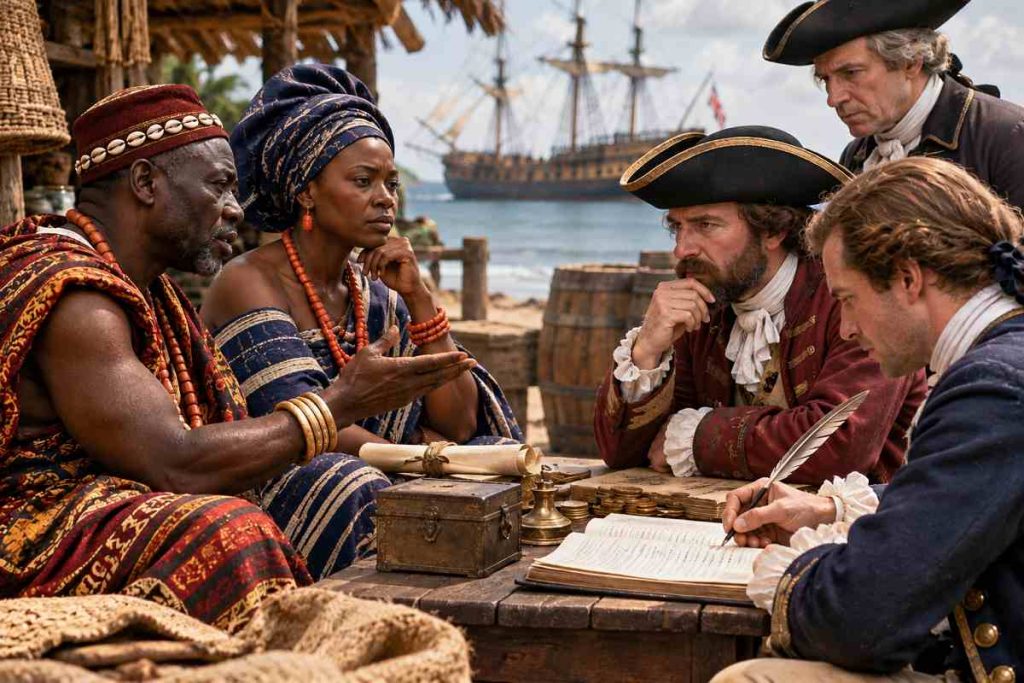
Indeed, some African political authorities and traders profited from capturing and selling people. But many others resisted participation, challenged the trade or became victims themselves.
European traders, meanwhile, developed extensive maritime networks to transport enslaved Africans to colonies in the Americas, where plantation economies demanded large supplies of coerced labour.
According to the SlaveVoyages research project, approximately 12.5 million enslaved Africans were forced aboard transatlantic slave ships, with approximately 10.7 million surviving the crossing.
These figures describe an enormous system of forced human transportation, not an isolated commercial arrangement between African sellers and European buyers.
The suffering also began before captives reached European ships. Slave raiding, kidnapping, forced marches and family separation occurred within Africa, and African perpetrators bear responsibility for their involvement.
This brings us to another important question: What did different African participants actually know about the fate awaiting those they sold across the Atlantic?
Knowing that someone was being sold into slavery did not necessarily mean knowing the full extent of the brutality awaiting them.
2. The Problem With Saying “Their Own People”
Another problem with the familiar statement is that it presents Africans as though they constituted one unified political and social community.
Africa was not a single country. During the centuries of the transatlantic slave trade, the continent contained numerous kingdoms, societies, political systems and communities with different relationships to one another.
People frequently identified with particular kingdoms, communities and cultural groups rather than a single continental identity. Some people were captured during conflicts between rival political communities. Others were kidnapped, sold to settle debts or enslaved following accusations of wrongdoing.
These distinctions do not excuse African perpetrators, but they help establish that the historical circumstances in which enslavement occurred were far more complex than the simplistic assertion that Africans merely sold their own people.
3. What Did African Sellers Actually Know?
This is one of the questions I believe deserves greater attention in discussions about African participation in the slave trade.
What did different African sellers understand about the fate awaiting enslaved people across the Atlantic?
It would be historically irresponsible to claim that all African sellers were ignorant of the suffering involved. Some knowingly participated in violent systems of capture and enslavement. However, this does not rule out the possibility that others possessed limited knowledge of the full extent of the brutality, labour systems and legal conditions awaiting captives in distant European colonies.
The fact that an African merchant knew a person was being sold into slavery does not necessarily establish that the merchant understood the full nature of racialised plantation slavery in the Americas, particularly given that systems of enslavement in many African societies differed significantly from the racialised, hereditary chattel slavery that developed in European colonies.
A person could be responsible for selling a captive while remaining unaware of particular atrocities the captive would subsequently face. Knowing that someone is being sent into bondage is not necessarily the same as knowing the full extent of the brutality and dehumanisation awaiting them.
At the same time, limited knowledge of conditions overseas does not erase responsibility for knowingly selling another human being. These are two separate moral and historical questions.
4. Olaudah Equiano and the Uncertainty of Enslaved Africans
An important historical account comes from Olaudah Equiano, whose autobiography, The Interesting Narrative of the Life of Olaudah Equiano, was published in 1789.
In his description of being aboard a slave ship, Equiano recounts asking fellow African captives what would happen to them. They informed him that they were being taken to the country of the white people to work.
For a moment, this explanation offered some reassurance.
However, Equiano’s narrative subsequently describes the terror he experienced aboard the vessel, including the brutal treatment of captives, the suffocating conditions and the deaths of enslaved people during the voyage.
His account is important because it illustrates the difference between being told that one is travelling somewhere to work and understanding the conditions that such work might involve.
Equiano’s narrative also illustrates how what was communicated to a captive could differ significantly from both what the captive understood and the reality that ultimately awaited him.
If some captives did not fully understand what awaited them, we should avoid assuming that everyone involved in their capture, sale and transportation possessed identical knowledge.
This does not mean African sellers were innocent. It means historical responsibility should be examined with attention to what particular individuals knew, intended and actually did.
5. Igbo Oral Histories and the Question of Deception
I grew up in Igboland, where my grandparents sometimes spoke about what they described as the “white man’s deception.”
These accounts form part of my understanding of how historical experiences can survive through family conversations and community memory, even when they are not formally documented in academic publications.
An Igbo expression captures some of the uncertainty surrounding the fate of those taken away:
“Ha duuru iri abụọ, akpọghachite abụọ — gịnị mere iri na asatọ fọdụrụ?”
“They took twenty and returned two — what happened to the remaining eighteen?”
This expression reflects a troubling question preserved in community memory: What actually happened to the people taken away who never returned?
It suggests that aspects of the slavery process were shrouded in uncertainty, particularly concerning the fate of those transported to distant lands.
While it does not establish what every African participant knew, it challenges the assumption that everyone involved possessed full knowledge of what awaited those taken away.
Go to the White Man’s Land to Work, Make Money and Return Home
In some Igbo oral accounts of slavery, including stories passed down by elders in my community, families reportedly sold their sons as punishment for stubbornness or perceived wrongdoing.
According to some of these accounts, there were beliefs or assurances that those taken away would go to the white man’s land, work, earn money and eventually return home.
Although preserved through oral testimony passed down across generations, these stories present such expectations as part of a broader history of deception attributed to white slave traders and enslavers.
There is also independently documented Igbo oral testimony concerning deception in the sale of children.
In Igbo Worlds: An Anthology of Oral Histories and Historical Descriptions (1978), historian Elizabeth Isichei published testimony attributed to Nkwonto Nwuduaku of Enugwu-Ukwu, interviewed in 1974.
The testimony describes different circumstances through which people became enslaved, including kidnapping, warfare, punishment, debt and the sale of children. It also recounts instances in which children were taken to markets without being informed that they had been sold.
These accounts provide evidence that deception was one of the mechanisms through which Africans were captured, sold and subjected to enslavement.
African Oral Testimony and the Problem of Historical Interpretation
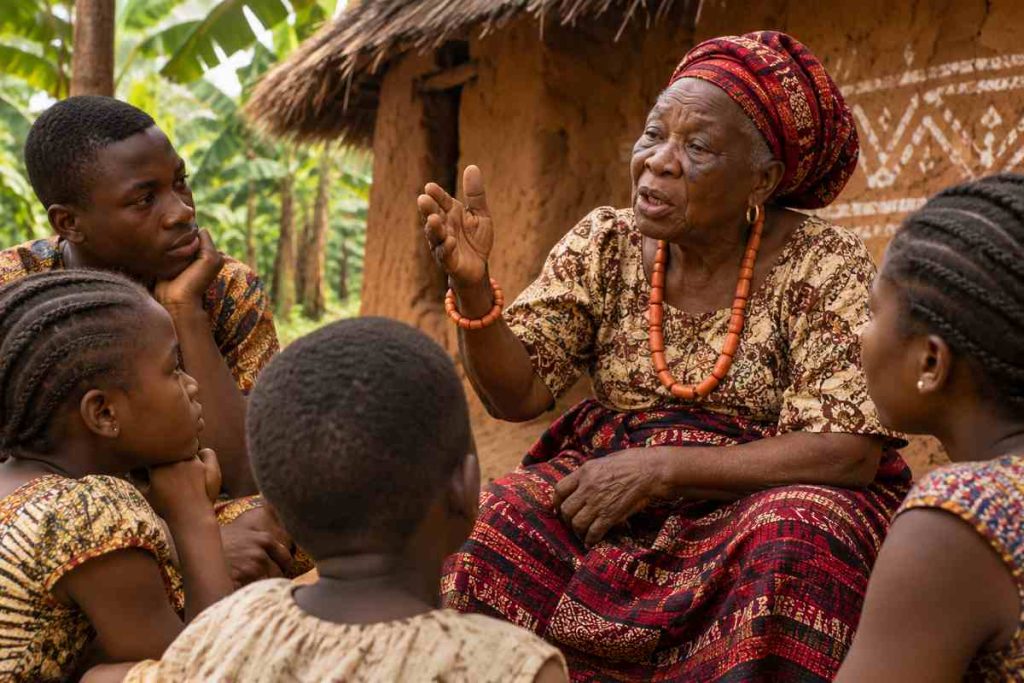
An important distinction must also be made between an African person’s oral testimony and the interpretation supplied by the historian who records or publishes it.
African oral histories should not be dismissed merely because they were not originally preserved in European written archives.
Neither should transcribed oral accounts be treated as beyond scrutiny, particularly when they have been translated, interpreted or documented by European writers, as these processes can introduce linguistic inaccuracies, cultural misunderstandings or interpretative biases.
The proper approach is to examine who supplied the account, when it was recorded, what historical period it concerns, and whether other testimony or documentary evidence supports it. The work of African historians such as Adiele Afigbo and G. Ugo Nwokeji is particularly valuable in this regard.
Their scholarship demonstrates the importance of examining southeastern Nigerian history through African social structures, commercial relationships, oral traditions and locally grounded historical evidence.
6. The Troubling Role of Christianity and Religion
Religion also played a troubling role in the history of transatlantic slavery.
Some European Christian institutions preached salvation, compassion and human dignity while accommodating, defending or benefiting from systems of enslavement.
Christianity was sometimes invoked to give moral legitimacy to exploitation.
Historian Katharine Gerbner’s research on Christianity and Atlantic slavery documents how Christian institutions participated in slaveholding and how religious arguments were used to defend the institution.
However, the history is not uniform. Other Christians opposed slavery and actively campaigned against it. European Christianity did not operate as one single organisation with one consistent position throughout the entire history of slavery. In some African regions, organised missionary expansion occurred after the Atlantic trade was already well established, and some missionaries actively opposed enslavement.
Nevertheless, a serious moral contradiction remains. Professing Christian compassion did not prevent some European individuals and institutions from participating in the brutal dehumanisation of other human beings.
Christianity and African Trust of the Europeans
It is also worth considering how Christian teachings about compassion and salvation could have encouraged some Africans who encountered European Christians to trust them more readily — a trust that became tragically misplaced.
7. The Journey to the White Man’s Land
There is another historical context worth examining when discussing African perceptions of journeys abroad.
Not every African who travelled to Europe during the period of Atlantic contact was enslaved. Some travelled for education, diplomacy, religious training or other purposes.
In the Kingdom of Kongo, for example, King Afonso I sent young people to Portugal for Christian education.
His son Henrique studied abroad and eventually returned to Kongo in 1521 as a bishop. Similar accounts of Africans travelling to Europe for education or religious training and subsequently returning home also exist in other parts of Africa, including West Africa.
One documented example is Philip Quaque, a young Fante man from the Gold Coast (present-day Ghana), who travelled to England for religious education in 1754 and returned in 1766 as an ordained Anglican priest.
This demonstrates that some African journeys to Europe involved education and eventual return rather than permanent enslavement — a historical reality that further complicates our understanding of how some African sellers may have perceived the fate of those they sold to Europeans.
This documented history illustrates why we should be cautious about assuming that all African societies understood European destinations in exactly the same way.
Knowledge of distant countries was not distributed equally. While some African political elites maintained sustained diplomatic and commercial relationships with Europeans, other communities had far more limited contact and, consequently, potentially less knowledge of what awaited those transported overseas.
The existence of European-African contact did not mean everyone understood the same things about Europe, overseas labour or the transatlantic slave trade.
8. What Happened After the Sale?
Whatever an African seller understood, the atrocities committed after European slave traders acquired captives remain a separate matter of responsibility.
The Middle Passage involved extreme overcrowding, shackling, disease, starvation, physical violence and death. Enslaved women and girls were also subjected to sexual violence during Atlantic voyages. Those who survived were subsequently sold into plantation labour, domestic servitude and other coercive systems in the Americas.
According to historical research, European colonial societies increasingly developed systems of racialised chattel slavery in which human beings could be legally treated as property.
In several colonies, enslaved status could also be inherited.
For example, a Virginia law enacted in 1662 established that a child’s enslaved or free status would follow that of the mother.
This helped institutionalise hereditary enslavement and enabled enslavers to claim ownership over children born to enslaved women.
Colonial authorities created such laws. African merchants who sold captives along the West African coast did not enact them.
The distinction is significant.
An African seller might have participated in delivering someone into the Atlantic trade, but that does not make the seller the author of every colonial law, plantation regime or subsequent act of violence imposed upon the captive and their descendants.
Those who created, enforced and benefited from these systems must be held responsible for their own actions.
The existence of an African participant does not make the European enslaver innocent.
9. African Resistance and the Problem of Collective Blame
African participation in the transatlantic slave trade was not universal. Some African rulers and communities resisted slave raiding and challenged the trade’s destructive effects.
Other forms of resistance emerged across Africa and throughout the Atlantic world, including opposition to slave raiding, escape, rebellion and collective struggles against enslavement.
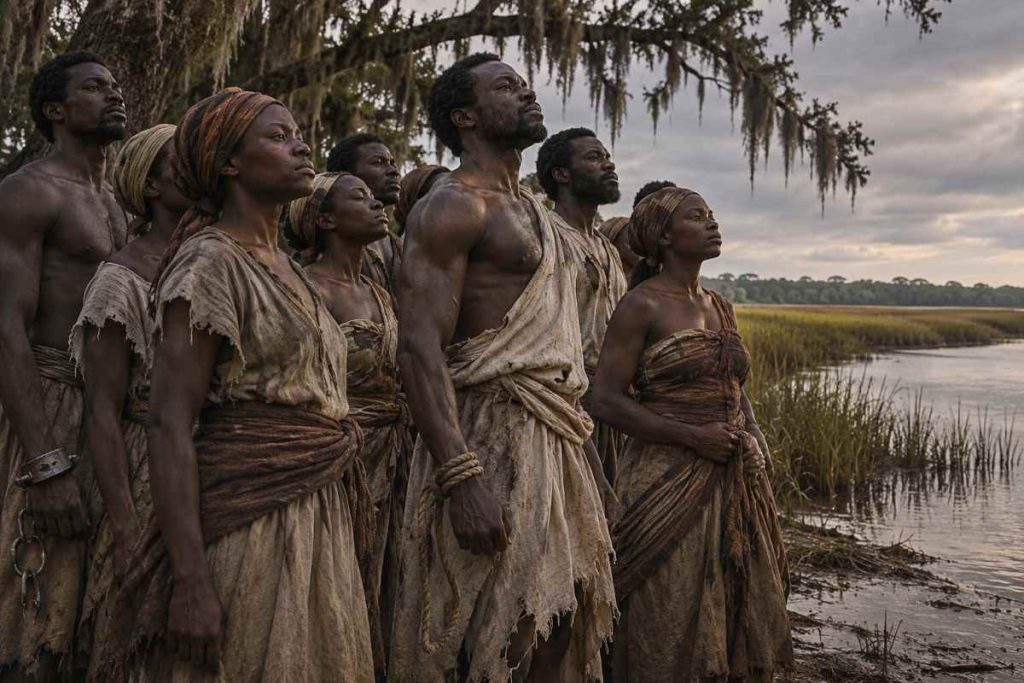
One notable example is the 1803 Igbo Landing rebellion at Dunbar Creek on St. Simons Island, Georgia, where a group of enslaved Igbo Africans revolted against their captors.
Historical accounts and Gullah Geechee oral traditions recount how some subsequently chose death by drowning rather than submit to enslavement.
These experiences also complicate the suggestion that Africans collectively sold themselves into slavery.
The millions of people captured, transported and enslaved were not interchangeable with those who profited from their suffering.
Their families did not become collectively guilty because some African rulers or merchants participated in the trade.
Historical responsibility belongs to identifiable actions, institutions and perpetrators. It cannot reasonably be assigned to an entire continent.
Conclusion: The Existence of an African Participant Does Not Make the European Enslaver Innocent
The history of transatlantic slavery is complex. Some African rulers, merchants and intermediaries participated in the capture and sale of enslaved people. Some profited from the trade. Others fought and resisted it. Some became victims themselves.
African participation must be acknowledged. But it should never be used to justify the atrocities committed by European traders, colonial authorities and enslavers.
The historical record also leaves important questions about what different African participants knew, what some captives were told, and how memories of deception survived in African communities.
Yet even if an African seller knowingly participated in enslavement, the European enslaver remained responsible not only for purchasing another human being but also for subjecting that person to such extreme brutality and dehumanisation that the treatment would be considered unconscionable even if inflicted upon an animal.
You cannot use the wrongdoing of African sellers to excuse the atrocities committed by European traders and enslavers.
References & Further Reading
The following historical records, academic publications and research resources provide further context for the issues examined in this article.
- Transatlantic Slave Trade: Historical Data
SlaveVoyages Consortium. Trans-Atlantic Slave Trade Database — Estimates.
https://legacy.slavevoyages.org/assessment/estimates - African Participation and Resistance
Lowcountry Digital History Initiative, College of Charleston. African Participation and Resistance to the Trade.
https://ldhi.library.cofc.edu/exhibits/show/africanpassageslowcountryadapt/introductionatlanticworld/african_participation_and_resi - Igbo Oral Testimony and Enslavement
Isichei, Elizabeth (1978). Igbo Worlds: An Anthology of Oral Histories and Historical Descriptions. Philadelphia: Institute for the Study of Human Issues, pp. 30–34.
https://www.historians.org/resource/slavery-among-the-igbo - Slave Trading in the Bight of Biafra
Nwokeji, G. Ugo (2010). The Slave Trade and Culture in the Bight of Biafra: An African Society in the Atlantic World. Cambridge University Press.
https://www.cambridge.org/core/books/the-slave-trade-and-culture-in-the-bight-of-biafra/467869AF263C934A31DDDDDEC9CB38A2 - Igbo History and Cultural Interpretation
Afigbo, Adiele E. (1981). Ropes of Sand: Studies in Igbo History and Culture. Ibadan: University Press, in association with Oxford University Press.
https://wellcomecollection.org/works/yjcehmmb - Olaudah Equiano’s Account of Enslavement
Equiano, Olaudah (1789). The Interesting Narrative of the Life of Olaudah Equiano, or Gustavus Vassa, the African.
https://anthology.lib.virginia.edu/work/Equiano/equiano-interesting-narrative - King Afonso I of Kongo’s Correspondence
Afonso I of Kongo (1526). A Letter from King Afonso I to King João III of Portugal.
https://religionandslavery.org/ps%3A-afonso-i-to-portugal - Royal Museum for Central Africa. The Kongo Kingdom.
https://www.africamuseum.be/en/discover/history_articles/kongo-kingdom - Christianity, Race and Atlantic Slavery
Gerbner, Katharine (2018). Christian Slavery: Conversion and Race in the Protestant Atlantic World. University of Pennsylvania Press.
https://www.pennpress.org/9780812224368/christian-slavery - Early Christian Missionary Activity in Igboland
Diocese on the Niger. About Us — History of the Diocese.
https://dioceseontheniger.org/about-us/ - Virginia General Assembly (1662). “Negro womens children to serve according to the condition of the mother.”
https://encyclopediavirginia.org/primary-documents/negro-womens-children-to-serve-according-to-the-condition-of-the-mother-1662 - Igbo Landing and Resistance to Enslavement
Georgia Historical Society (2022). Ibo Landing: The Legacy of Resisting Enslavement.
https://www.georgiahistory.com/ghmi_marker_updated/ibo-landing-the-legacy-of-resisting-enslavement/