The Social Training of Black Queer Desire
Imagine realising that your community’s unwritten rules about who is desirable, acceptable, or “too much” were never truly its own. In British Black queer life, intra‑community exclusion—when a group singles someone out and quietly pushes him out of the nest—often functions as a regulatory practice rather than a spontaneous rupture.
The person targeted is typically misnamed as “dramatic,” “cold,” “weird,” or “shady.” Sometimes he is simply called “too much,” which could mean too visible, too soft, too needy, too femme, or too proud.
When Power Hides in Language
The real violence lies not just in the exclusion itself, but in the language that justifies it. That language transforms a strategic social device into an alleged personality defect, thereby preventing further questions.
The label becomes the whole explanation. It is accepted as a conclusion rather than an opening question. And once that happens, no one asks the only question that matters: what larger social order made this person appear to be a problem in the first place?
This is why the real issue gets missed. When a group of otherwise deeply reflective individuals capable of making their own decisions is seen exhibiting a Stepford-like pattern, that is not random. It is social training.
What is often dismissed as “personal preference” or “drama” in Black queer spaces is frequently shaped by a deeper racial order. This article examines how white power governs Black queer life through respectability, objectification, exclusion, and the social conditioning of desire.
What Does White Power Mean in this Article?
Here, white power does not refer only to explicit or organised racism. It names the wider white-dominant order: the cultural and institutional systems that hold and regulate social power. Black queer men often encounter this hierarchy from within as much as from outside.
George Yancy’s work helps clarify the racial structure at stake here. He argues that Black men live under a constant white gaze that does not simply observe, but distorts, disciplines, and renders Black presence hypervisible as a problem to be managed (Yancy, 2013).
White supremacy amplifies its hold on Black queer life by rewarding and exploiting fractures that already exist within African, Caribbean, and global Black queer communities—such as femmephobia, religious conservatism, colourism, DL secrecy, the worship of hypermasculinity, rigid sexual‑role hierarchies*, and economic vulnerability.
Dual Forces of Control: Respectability and Consumption
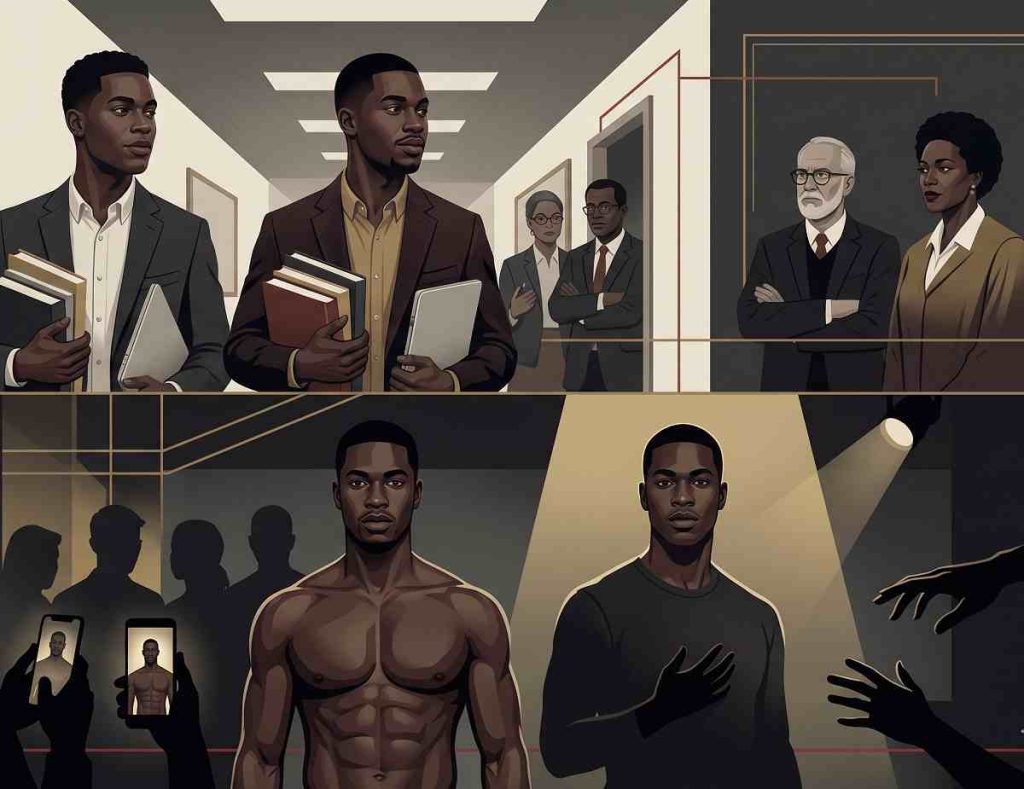
This order of power is not singular. It is divided, but aligned. On one side sits the mainstream respectability bloc, enforcing conventional masculinity, conformity, and social legibility. Its work is disciplinary: to keep Black queer men intelligible within white norms of propriety, gender, and acceptability. In doing so, it preserves white culture as the recognised standard.
On the other side—smaller, but often more active—is the underground objectification bloc. Its task is more direct: to keep the value of Black queer men confined to their bodies. Its method, however, is more insidious. It rarely presents itself as an enemy. Instead, it appears as a friend, helper, or benefactor, offering money, gifts, accommodation, access, protection, or substances in exchange for access, compliance, and dependency.
Where the respectability bloc polices behaviour and presentation, this bloc polices worth itself. It operates through a racial-capitalist logic that converts Black queer life into extractable value. It renders Black queer bodies desirable without dignity, hypervisible without protection, and accessible without belonging.
Racial Stress in White Neighbourhoods
The work of Smith et al. (2011) shows that Black men in predominantly white settings frequently experience what the researchers describe as a “racial battle fatigue”—a persistent stress linked to racial microaggressions, social issues, and the continuous need to adjust their self-perception. Importantly, their research indicates that education does not eliminate this strain. Even as Black men ascend in institutional roles, their stress levels may not decrease (Smith et al., 2011).
Mills et al. help sharpen this point by demonstrating that predominantly white institutions do not simply test Black students academically but also wear them down racially through a cumulative pattern of racism, double consciousness, assimilation pressure, negotiated support, and fatigue. This shows that even for educated Black queer men, institutional inclusion often comes with its own exhausting costs (Mills et al., 2025).
The Mainstream Respectability Bloc Above
Wingfield’s work on racialised feeling rules is especially useful here because it shows that institutions rarely treat “workplace professionalism” as neutral. They build it around white comfort and white behavioural standards. In these environments, Black queer men rarely get to express their genuine emotions openly.
Her work shows that workplace settings often force Black men to regulate frustration, self-presentation, and emotional expression far more carefully than their white counterparts in order to remain legible, credible, and employable. This exhausting daily performance does not arise from free choice. It functions as a survival tactic and marks the unspoken price Black queer men pay to appear competent, non-threatening, and worthy of staying in the room (Wingfield, 2010).
Kimberly A. Blockett also brings into focus another devastating truth. Black queer men in white and hetero-cisnormative institutions often have to labour actively to create community and survive exclusion. In these spaces, there is no default safety and belonging for Black men (Blockett, 2017).
The Underground Objectification Bloc
The underground objectification bloc operates on three core principles:
a. Simulated Care: It mimics concern, tenderness, or rescue without surrendering control. Its aim is not to nurture Black queer life, but to stabilise access to it.
b. Conditional Support: Help is offered, but never freely. Money, shelter, gifts, protection, opportunities, or emotional reassurance are extended in ways that create obligation, compliance, or dependency.
c. Consumable Intimacy: Closeness is permitted only so long as it remains usable. Desire, affection, and access are welcomed only when they can be consumed one-sidedly. Demands for mutual respect or recognition of equal personhood often trigger punishment.
What is framed as generosity is, in practice, a mechanism of containment: it secures proximity while refusing equality.
Managing Threats To Control
Together, the respectability bloc and the objectification bloc organise and control Black queer value, deciding which forms of Black queer existence are tolerable and which are exploitable. They also manage perceived threats through a shared logic. In this system, a “threat” is anything that challenges control: softness that refuses shame, visibility that demands respect, intimacy that exceeds consumption, or community solidarity that resists division. What cannot be disciplined is objectified; what cannot be objectified is pushed out.
Power does not always rule by direct instruction. Often, it rules by normalising. Black queer men are raised inside a social order that teaches them, often without naming itself, what kind of man is desirable, what kind of body is respectable, what kind of emotion is weakness, and what kind of visibility is “too much.”
The Ultimate Exploitation: How Black Queer Life is Put to Use
Recognising this dual mechanism of control helps explain why those who defy the system—those labelled “too much” or “out of line”—are so often scapegoated. It also prepares Black queer men to examine how the language of “drama” and personal blame disguises systemic power as personal weakness, to keep it hidden.
More strikingly, it reveals how Black queer men can be manoeuvred into enforcing white power as though it were their own will.
Managed Minds, Consumed Bodies: Sorting Black Value
The system allows the emotionally deep and expressive Black queer man who pursues education and professional work to remain above ground, provided he stays within the lines of respectability—useful to the system, obedient to white authority, but never permitted to outgrow the hierarchy or eclipse the white boss. His proximity to power is conditional, tightly supervised, and carefully capped.
By contrast, the system routes the well-endowed, hypermasculine, and sexually desirable Black queer man underground, especially after steering him away from any form of “white” learning. There, the order values him not for any professional worth, but for his body and masculine performance. It does not govern him through respectability. It governs him through consumption: circulating him, accessing him, and extracting from him, while never recognising or protecting him as an equal.
In these encounters, the order compels him to perform “Black masculinity” as spectacle for an audience to watch and consume.
Yuzyk and Lim show that Black queer desire is not merely private feeling, but something disciplined through heteronormativity, racial capitalism, and the social organisation of whiteness itself (Yuzyk, 2026; Lim, 2024).
Divide To Conquer: Modern Queer Edition
The system works hard to prevent these two versions of Black queer life from being in the same room together. Because if they did, each could illuminate what the other has been denied.
One could name the terms of respectability; the other could expose the terms of objectification. And in that recognition, a solidarity capable of resisting any form of division could begin to form.
The Role of Proxies and Gatekeepers
White supremacy does not always need to police Black communities directly. Instead, it often outsources its work through aligned incentives. By offering conditional access to limited power, status, and recognition, the system encourages some Black men to function as proxies—managing, dividing, and disciplining their peers in order to secure their own precarious rewards. In this way, the architecture of white power is preserved from within.
The more troubling part is that many of these proxies are not necessarily conscious conspirators. Often, they are simply responding to the rewards attached to proximity to the establishment. In practice, they become gatekeepers: absorbing dominant norms, then enforcing them within their own communities in order to protect their status. By upholding the system’s rules in exchange for a share of its benefits, they reinforce the very hierarchies that marginalise others, giving white power a self-sustaining foothold inside the community.
How Am I Consumed If I Am the Top?
There is a common assumption that physical dominance equals structural power—that if a Black queer man is the penetrative partner, he has somehow inverted the racial hierarchy.
However, Travis M. Foster’s work helps expose this illusion. White desires to erotically submit to a non-white man—such as a Black man—do not disrupt white supremacy. It remains fully organised within it, through what Foster calls “white supremacist submission” or the plasticity of the white body in other literature (Foster, 2023).
Plasticity of the White Body
These fantasies often rest on the idea that sexual contact with Black men can remake the white body—a form of sexual consumption, or what bell hooks famously described as “eating the other.” Within this logic, white subjects treat marginalised bodies as a “spice” or cultural commodity to liven up white sexual experience.
These encounters follow a similar pattern. They strip the Black man of his humanity and reduce him to a tool, a kind of crucible the white subject uses for sexual self-transformation.
For the white man, the arrangement carries no real power risk for one clear reason: he imagines his body as high-status and pliable—free to experiment, transgress, and then return safely to privilege. He casts Black bodies merely as the instruments of gaining this transformative experience. The scene may temporarily rearrange erotic roles, but it does nothing to unsettle whiteness’s claim to structural power.
“White supremacist submission” and the extractive, consumptive use of Black bodies in racially charged erotic encounters name a structural dynamic, not a universal rule. They describe how intimacy can be shaped by white supremacist incentives even when framed as submission, desire, or transgression. This does not mean all interracial encounters follow this script; many are consensual, negotiated, and affirming. The intervention is about making visible a pattern that power rewards—not reducing every encounter to harm.
Black Bodies are Consumed and Still Put at Risk
Although these encounters do nothing to dismantle racial hierarchy or equalise the racial order of power, they expose the Black partner to two significant forms of risk.
First, it can damage his reputation within his immediate community, where others may cast him as someone who sold his body for money. This framing is often deliberate. In some cases, the white partner later circulates the story through triangulation, gossip, or banter-dressed humiliation. The intention here is to mark the transaction publicly to ensure the Black man incurs some cost.
Second, the encounter can deepen the Black man’s internalisation of the idea that his primary value lies in his body. He may return home, set aside a university registration form, and sign up to RentMen instead—folding himself more tightly into the same economy of extraction.
This logic clarifies why apparent erotic reversal is not the same as structural reversal. The Black top may appear to dominate the scene while still being consumed by the structure.
Preference as Social Control: How Hierarchy Hides Inside Desire
That recognition poses a serious threat to the racial order of power. So the system works to ensure that these two figures are structured not to desire one another. The emotionally expressive, educated figure is harder to manage: his curiosity, reflexivity, and capacity to learn make his attachments unstable and his loyalties difficult to secure.
By contrast, the system manipulates the hypermasculine, highly desirable figure more easily, in part by making him more responsive to incentives and repeatedly teaching him that softness, visibility, and authenticity undermine masculinity.
In hating and shaming the emotionally expressive, educated figure, a crack appears, conditioning him to avoid proximity to the hypermasculine “trade” as a strategy of safety.
This is one way power disguises itself as preference. What appears as personal taste is often the residue of social conditioning; what looks like petty exclusion is often hierarchy performing routine maintenance.
Zeiher’s work is useful here because it shows that desire is never simply “personal,” but a socially mediated feeling shaped through fantasy, ideology, and representation. These forms of representation teach people what to want long before that wanting is felt as their own.
Black Queer Men Are Taught What to Desire
Desire does not arise from nowhere. It is coached through repetition. Apps, pornography, nightlife, peer banter, mainstream queer media, and dating culture do not simply reflect what people want; they teach Black queer men who to want, what to respect, what to discard, and what to punish—often at the expense of their own well-being. I call this the pawning of Black queer life.
When Black queer men repeatedly find themselves drawn to hardness, “masc” presentation, emotional reserve, and partners who signal proximity to dominant status—while tenderness, mutual care, and honesty are devalued or even punished—we should ask a harder question: whose interests does this behaviour truly serve?
We continue to measure worth through hypermasculinity, DL performance, dominant-top hierarchies, and heteronormative conformity. But we almost never pause to ask what this way of life has actually delivered to the community—beyond fear, internal conflict, and the continuous reproduction of old wounds.
In many cases, a social map has already been laid down. White power does not merely exclude Black queer men from the dominant narrative; it also trains them to recognise that centre within their own spaces, orbit around it, and at times protect it. This is sophisticated power preservation.
It Goes Beyond Desire
This architecture of control extends far beyond the bedroom. White supremacy shapes Black queer life not only through desire, but through taste, work, ambition, and the ordinary rhythms of everyday living. The system does not simply influence who we touch; it also polices how we move, what we value, what we produce, and how much space we are allowed to take up.
The establishment depends on marginalisation to preserve order. For that reason, its deepest threat is not merely survival, but unshrinking defiance. When marginalised people refuse to bend—when they reclaim their labour, insist on ownership of what they create, and achieve visible, uncompromising success—they introduce a new and destabilising possibility. They force power to confront something it fears most: that its authority can be challenged, bypassed, and ultimately weakened without ever being granted the dignity of permission.
Black Communities Punish What White Power Already Targets
White power works through Black queer communities to punish whatever threatens its hierarchy. The target is not random. He is often the person already closest to what white heteropatriarchal culture punishes: political clarity, emotional openness, unapologetic Blackness, tenderness without shame, and queerness that refuses to shrink. Some forms of intracommunity cruelty are not accidental misbehaviour. They are white power echoed through Black mouths.
And There Goes the Lack of Trust
When a community reproduces the same ranking logic as the outside world, trust thins. Vulnerability becomes harder. Friendship becomes strategic. Affection becomes guarded. The room may be full, but emotionally it’s empty. That is the tragedy of this kind of upkeep: it weakens solidarity over time.
This article does not end with a sermon about healing, a checklist for better behaviour, or another plea for bridge-building. Not every article owes the reader a cure. Today, I am simply telling the truth.
References
- Blockett, R. A. (2017). “I think it’s very much placed on us”: Black queer men laboring to forge community at a predominantly White and (hetero)cisnormative research institution. International Journal of Qualitative Studies in Education, 30(8), 800–816. https://doi.org/10.1080/09518398.2017.1350296
- Foster, T. M. (2023). White supremacist submission. TSQ: Transgender Studies Quarterly, 10(3–4), 426–448. https://doi.org/10.1215/23289252-10900942
- Lim, G. (2024). Consuming whiteness/disciplining desire. In D. Callander, P. Farvid, A. Baradaran, & T. A. Vance (Eds.), Sexual racism and social justice: Reckoning with white supremacy and desire (pp. 206–241). Oxford University Press. https://doi.org/10.1093/oso/9780197605509.003.0011
- Mills, K. J., Quaye, S. J., McKinney, N. J., Jones, H. V. J., & Allen-Stills, N. (2024). Investigating Racial Battle Fatigue Among Black College Students Using Photo-Elicitation Methodology. Journal of Student Affairs Research and Practice, 1–15. https://doi.org/10.1080/19496591.2024.2420127
- Smith, W. A., Hung, M., & Franklin, J. D. (2011). Racial Battle Fatigue and the MisEducation of Black Men: Racial Microaggressions, Societal Problems, and Environmental Stress. The Journal of Negro Education, 80(1), 63–82. https://www.jstor.org/stable/41341106
- Wingfield, A. H. (2010). Are Some Emotions Marked “Whites Only”? Racialized Feeling Rules in Professional Workplaces. Social Problems, 57(2), 251–268. https://doi.org/10.1525/sp.2010.57.2.251
- Yancy, G. (2013, September 1). Walking while Black in the “white gaze.” The New York Times.
- Yuzyk, S. (2026). Disciplining desire: Rethinking racial capitalism through Black queer resistance. Sociology Compass, 20(1), e70158. https://doi.org/10.1111/soc4.70158
- Zeiher, C. L. (2012). Between the subject and the social: Signifying images of desire and ideological subjectivities. International Journal of Žižek Studies, 6(2).