
Meaningless Sex Creates a Cycle of More Meaningless Sex
Sexual activity can feel pleasurable in the moment, but it can also leave a person feeling empty or isolated when it repeatedly occurs without emotional connection, shared values, or mutual care.
Many Black gay men recognise this feeling, even if they have not always had the language to describe it. The core issue here is not merely a lack of sex or greater difficulty finding partners for quick hook-ups. Often, the opposite pattern emerges: an intensified pursuit of sex under conditions of diminished meaning. This should not be mistaken for abundance or freedom.
More often, it reveals a deeper consequence of scarcity, in which meaningful intimacy becomes harder to access, or even less actively desired, among Black queer men. Under such conditions, some queer men may respond by seeking more sex or dialling up intensity, using quantity and force to manage a deeper problem of meaning and connection. What looks like sexual freedom can, in truth, be a mask for a deeper form of lack.
This article uses connection scarcity not as a clinical diagnosis, nor simply to mean a shortage of sexual contact, but as an analytical term for a real or perceived social condition in which affirming sexual and relational connection feels unfamiliar, unstable, unsafe, or unreachable.
This argument is developed through one central framework: The Economics of Black Queer Desire (EBQD). The claim is simple. A larger system shapes Black queer desire, creating pressure; that pressure produces a loop of insecurity and proof-seeking; and the most practical response is to build other ways of feeling valued and connected.
- Meaningless Sex Creates a Cycle of More Meaningless Sex
- What Connection Scarcity Actually Means in Black Queer Culture
- The Economics of Black Queer Desire
- Desirability as Self-Worth: When Proof Stops Working
- EBQD and Chemsex Crisis in Western Queer Spaces
- Breaking Out of the Black Queer Market System
- The DNB System of Black Queer Resilience
- References
- Frequently Asked Questions—1
- Frequently Asked Questions—2
What Connection Scarcity Actually Means in Black Queer Culture
Connection scarcity is easy to misunderstand. It does not simply mean “no sex” or even “low sex.” In Black queer life, scarcity often coexists with high sexual visibility, frequent app use, and repeated sexual contact. What makes it “scarcity” is not the volume of sexual activity, but the shortage of intimacy that feels full, stable, and whole—the kind that does not send someone back into the app two or three days later, or even sooner.
Scarcity here is better understood as a social condition rather than a private defect. In Black queer spaces shaped by structural pressures, desire can drift away from what genuinely nourishes and toward what feels more accessible, less risky, and more readily rewarded. The stronger the structure, the stronger the effect.
Ego Protection Over Genuine Intimacy
If expressing authentic, vulnerable desire triggers fears of losing respect or masculine credibility, the psyche will often naturally drift towards paths of least emotional risk, even if this means using bodies and avoiding the self to keep feelings tightly compartmentalised. Under this logic, the depth and meaning of intimacy are reduced to the purely visual — defined by what is seen rather than what is felt.
While this skilled detachment may project power on the surface, its long-term cost is a deep scarcity of genuine intimacy. The human need for genuine human connection remains, and when it is persistently unmet, it can harden into cruelty and resentment. It becomes easier to harm others without feeling it because the emotional faculty that enables mutual recognition has been sealed away.
If the part of the self that allows a person to truly “see” others and be “seen” in return is buried in an abyss, others may gradually stop registering as fully human and begin to appear as mere sexual objects, functions, or threats.
How Scarcity Retrains Desire
What appears on the surface as confidence, aloofness, or sexual freedom may instead reflect a deeper survival pattern shaped by deprivation, insecurity, and the need for constant reassurance.
Over time, this pattern can evolve into a cycle of proof-seeking, marked by heightened fixation on body image and appearance, overdependence on and overinterpretation of masculine ranking, weakened capacity for mutual recognition, emotional instability, and the use of humiliation to maintain status.
The body-first logic did not end with slavery; its echo persists in altered form across social and erotic economies that privilege visible bodily value over interior human depth.
There is a difference between being desired and being known, between being wanted and being held, between the use of bodies and genuine intimacy. No amount of disguise can transform stimulation into nourishment. Desire without mutual recognition does not resolve hunger; it only deepens repetition while the real need remains unmet.
The Economics of Black Queer Desire
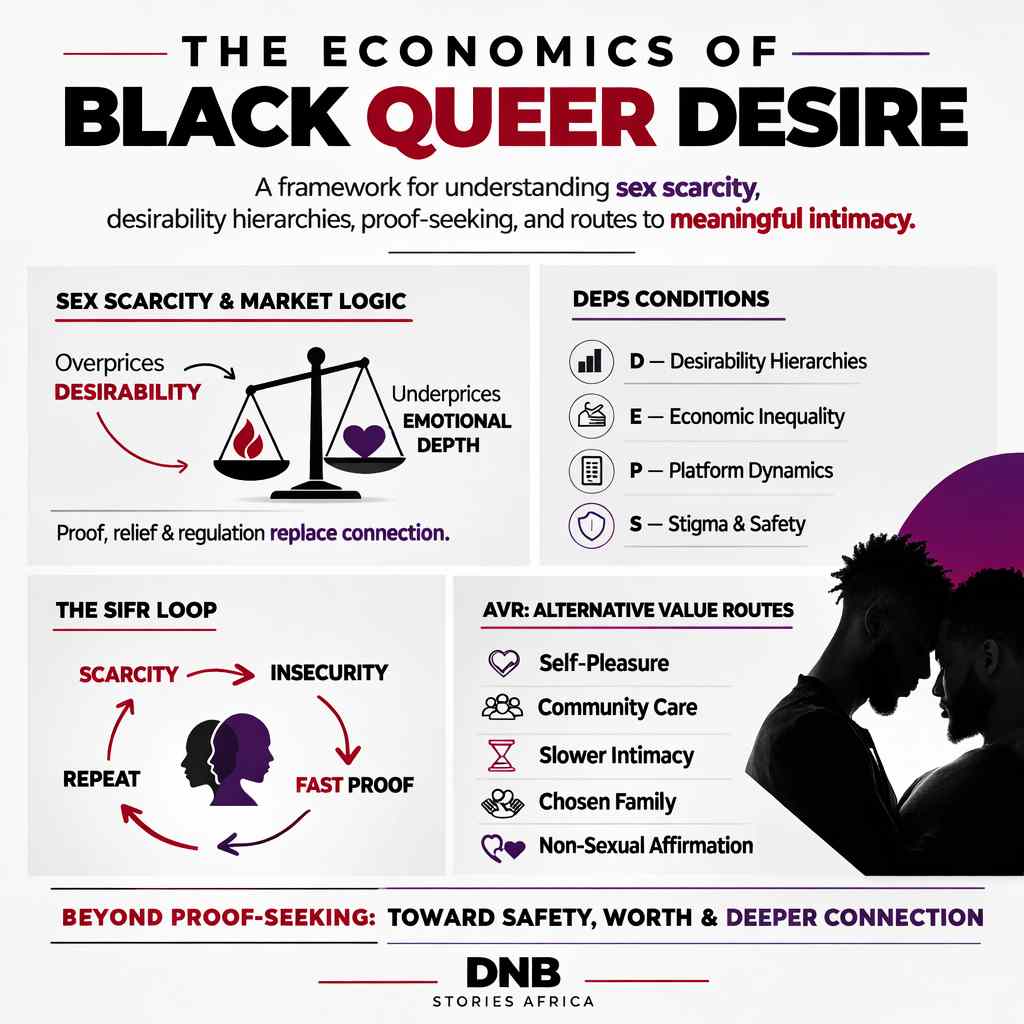
The Economics of Black Queer Desire is a framework I developed to explain how structural pressures within a particular social environment shape Black queer desire, transforming it from a personal preference into a socially regulated economy of value, access, and belonging.
The framework explains how a wider social market, not just personal feeling, controls Black queer sexual life. Structural pressures create connection scarcity. Scarcity produces insecurity and a need for constant reassurance. This insecurity can then drive repetitive proof-seeking through sex, attention, masculinity buffering, and desirability games. To interrupt the cycle, individuals and communities need to create alternative routes to worth, intimacy, and emotional regulation.
The framework does not claim that Black queer desire is inherently broken. Instead, it argues that desire adapts to its environment. When systems consistently favour bodies over depth, quick proof over trust, and desirability over safety, desire gradually aligns with these terms.

The Core Thesis of EBQD
Daniel Nkado’s Economics of Black Queer Desire makes four core claims:
1. The Black Queer Desire Market (BQDM)
First, there is a system that operates like a market: a wider social and erotic environment in which Black queer people pursue connection, sex, validation, and belonging. This is the Black Queer Desire Market (BQDM). BQDM operates as a sexual marketplace where desirability becomes the measure of worth, and attention serves as the currency for ranking bodies.
The economics of a sexual marketplace are simple, even when their consequences are painful: attention serves as currency, desirability equals market value, and bodies inevitably outrank personhood.
Emotional depth and sound intellect are undervalued because they demand a slower, riskier emotional investment with no immediate visual return. In a space defined by scarcity, chasing proof and status trumps the risk of genuine emotional connection.

2. DEPS: The Structural Pressures
Second, four structural conditions shape the Black Queer Desire Market: Desirability hierarchies, Economic inequality, Platform dynamics, and Stigma or safety conditions. Together, these form the DEPS structure.
i. Desirability Hierarchies: Layered systems of value that rank people according to racialised and non-racialised traits, including race, straight association, body type, masculinity, age, class signals, sexual role, and broader aesthetic norms.
ii. Economic Inequality: Material differences in income, housing, time, mobility, and privacy that affect who can access intimacy-supporting conditions.
iii. Platform Dynamics: The sorting, ranking, and reward systems built into apps and digital spaces that shape visibility, attention, and erotic competition.
iv. Stigma and Safety Conditions: The social risks of discrimination, shame, violence, disclosure, and emotional harm that shape how safely intimacy can be pursued.
3. The SIFR Loop: The Adaptive Symptom
Third, repeated exposure to these pressures can generate an adaptive proof-seeking loop: the SIFR loop.
This is the core loop. Under conditions of connection scarcity, the repeated pursuit of sex does not necessarily signal comfort or sexual freedom. It can instead reveal a deeper instability. A person may keep seeking sex not because he feels deeply fulfilled by it, but because the encounter briefly soothes an underlying insecurity. What looks like abundance may, in truth, be a conditioned response to a deeper, often unexplainable emotional lack.
S — Scarcity of affirming intimacy. Meaningful, reciprocal and emotionally safe connections feel limited, unstable, unsafe, unfamiliar, or out of reach.
I — Insecurity. A deeper question constantly emerges beneath the surface: Do I still matter? Am I wanted? Is it me? Is anyone “violating” me?
F — Fast proof. Sex, taps, messages, app attention, masculinity praise, and other quick signals provide temporary reassurance without addressing the deeper emotional need underneath.
R — Repeat. Because that reassurance fades, the cycle begins again. Proof becomes emotional regulation.
In the absence of meaningful intimacy, Black queer men may continue chasing quick proof that they still matter and are not being sidelined. This proof can come through sex, attention, taps, masculine validation, or simply being chosen. But the reassurance fades quickly once loneliness returns. Then the cycle starts again.
Desirability as Self-Worth: When Proof Stops Working
When a person relies on sexual attention, masculine recognition and repeated selection to stabilise his sense of worth, the collapse of that system removes his primary route to feeling valuable. Once desirability can no longer regulate his emotions—or does so with steadily diminishing force—the underlying deprivation begins to surface. This triggers what I describe as a desirability crash: the sudden exposure of deep insecurity, often accompanied by intense panic over status loss.
Some Black gay men respond by escalating their pursuit of proof—seeking more sex, more attention and more masculine buffering. Others withdraw, becoming colder, more cynical or more punitive. Some resort to more extreme measures, including social cruelty: using gossip, shaming, humiliation, emotional manipulation and other forms of social harm to defeat perceived competitors and preserve their position on the top shelf of the desirability market.
These responses emerge from the same underlying crisis: a mind trained to depend on external erotic signals for internal steadiness may eventually descend into psychological and social chaos when those signals weaken or disappear.
Panic Breeds Cruelty
Resentment grows quickly in conditions of status loss and anxiety. Knowing the inner humiliation of low status, a person will often fight viciously for rank rather than risk becoming what he once mocked, degraded, or cast beneath him. Yet some forces exceed individual cruelty. When a broader social recalibration is underway, no amount of shaming, exclusion, or hierarchy-making can hold it back for long.
EBQD and Chemsex Crisis in Western Queer Spaces
Daniel Nkado’s Economics of Black Queer Desire (EBQD) framework explains how multiple structural forces combine to turn queer social spaces into sexual marketplaces where attention functions as visible proof of social value and social value becomes closely tied to desirability.
Within this context, chemsex ceases to be understood only as a means of enhancing sexual pleasure and begins to function as a tool for navigating and surviving the pressures of the Black Queer Desire Market. It can help proof-chasers gain access, increase confidence and endurance, reduce inhibition, and remain sexually responsive enough to meet the market’s intense and repeated demands.
Breaking Out of the Black Queer Market System
The solution isn’t to dismantle the whole system alone but to create alternative routes to worth, regulation, and connection beyond market logic. Since DEPS is structural and beyond individual control, people will find it easier to interrupt the SIFR behavioural loop than to dismantle DEPS.
The goal isn’t to defeat the entire system, but to weaken its hold on us by breaking the cycle in which structure becomes behaviour.
The Intervention: AVR—Alternative Value Routes
If SIFR names the loop, then AVR names the interruption. AVR refers to the alternative value routes through which Black queer people can build worth, recognition, regulation, safety, and connection outside the unstable rewards of the sexual marketplace. These routes do not require a person to dismantle the whole system alone. They work by weakening the behavioural loop at the point where structure becomes a lived habit.
This matters because most individuals cannot directly remove desirability hierarchies, economic inequality, platform dynamics, or stigma and safety pressures. These forces are too structural. What people can often do, however, is reduce their dependence on the loop those forces produce. They can create other ways of feeling seen, held, regulated, valued, and connected.
In this framework, AVR includes any practice, space, or relationship that interrupts the market’s proof logic and restores other forms of value.
Possible AVR routes include:
- Self-pleasure as non-market affirmation
A way of reclaiming the body from shame without depending on external selection[1]. - Community care and mutual support
Trusted friendships, chosen family, mutual-aid circles, and non-sexual Black queer spaces that generate belonging outside erotic ranking. - Slower relational practices
Delayed meetings, clearer boundaries, paced disclosure, trust building, and more intentional approaches to intimacy. - Decommodified intimacy
Forms of closeness not organised around quick sexual visibility, competition, or sexual proof. - Non-sexual affirmation and touch
Being known, respected, and emotionally held in ways that do not depend on sexual access or sexual participation. - Alternative value infrastructures
Reading groups, workshops, artist circles, healing spaces, chosen-family structures, and community rituals that attach value to mind, character, care, and contribution.
The point of AVR is not abstinence, moral purity, or withdrawal from pleasure. It is to create enough alternative value that sex no longer has to carry the full burden of proof. Once worth, affirmation, and regulation begin to come from other sources, the loop weakens. Sex can then become less about emergency reassurance and more about choice, pleasure and connection.
AVR does not destroy the market overnight. But it reduces the market’s hold on individuals by making it less necessary as the only source of value negotiation, emotional steadiness, or a sense of belonging.
The DNB System of Black Queer Resilience
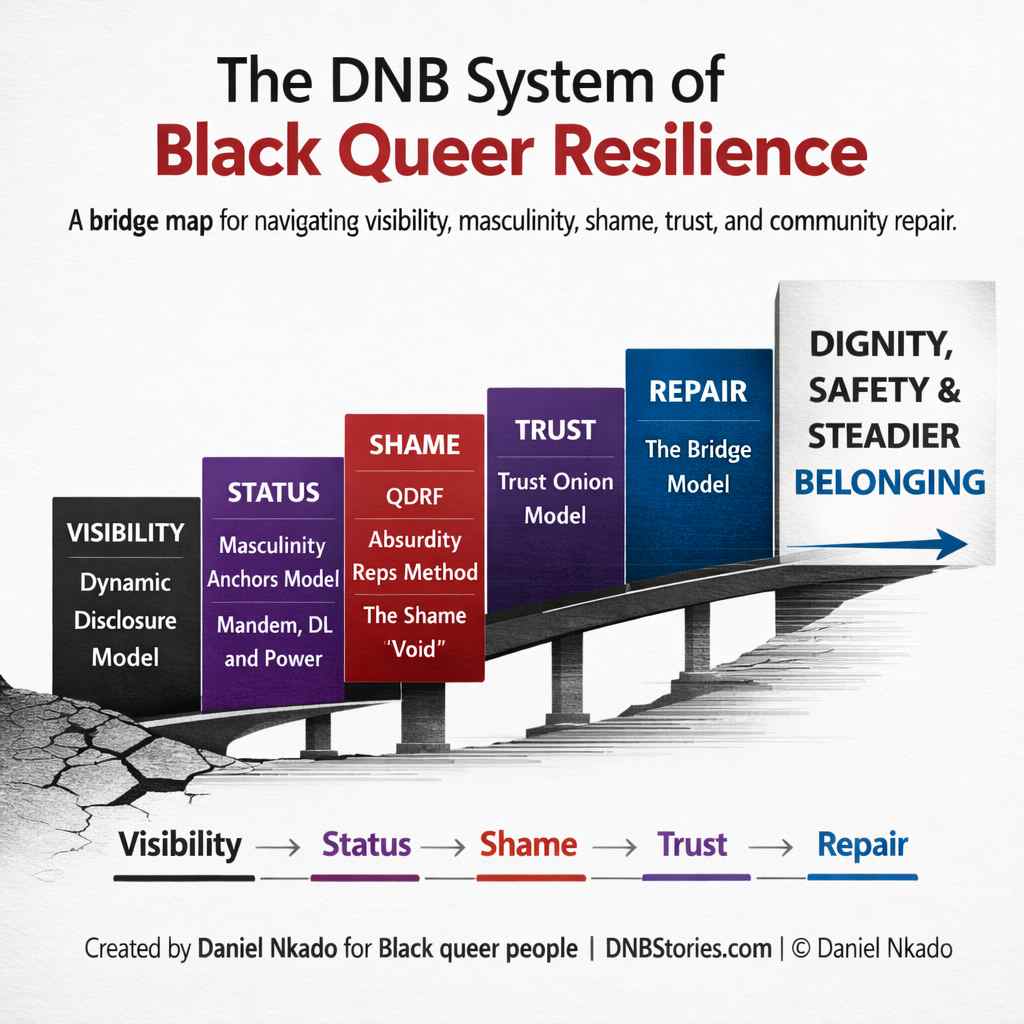
Within the wider DNB Stories ecosystem, AVR is supported by several intersecting tools and models of Black queer resilience:
- The Shame ‘Void’ and ARM (Absurdity Reps Method): Addresses validation hunger and provides real-time methods for shame disruption.
- Trust Onion and The Bridge Model: Helps to structure chosen-family safety, community accountability, and layered access.
- Masculinity Anchors, Dynamic Disclosure and Mandem, DL, and Power: Maps how masculinity and safety operate in different spaces.
- QDRF addresses sexual rejection and how to build dating resilience.
Taken together, these frameworks form a cohesive resilience system for Black queer life rather than a scattered collection of ideas. They offer practical routes beyond proof-seeking and back toward safety, trust, and deeper connection.
Black Bodies Over Black Minds: The Modern Queer Edition
The Economics of Black Queer Desire does not pathologise frequent sex, nor does it suggest that casual sex is inherently unhealthy. It takes a more structural view and asks a narrower question: under what conditions does sexual pursuit become organised less around connection and more around proof, relief, and regulation?
When Black queer men repeatedly move through spaces where vulnerability feels unsafe, desirability carries excessive social weight, and erotic appeal operates as the clearest currency, the body can begin to feel like the primary site of value negotiation. This is how social conditions begin to retrain Black queer desire, reproducing a modern echo of slavery-era body-over-mind logic.
Ultimately, if desire can be socially organised, it can also be socially repaired.
References
- brown, a. m. (2019). Pleasure Activism. AK Press. https://adriennemareebrown.net/book/pleasure-activism/
- Choi, S. K., Wilson, B. D. M., Shelton, J., & Gates, G. J. (2021). Black LGBT Adults in the U.S. Williams Institute.
- Khanolkar, A. R., et al. (2022). Lived experiences and their consequences for health in ethnic minority LGBTQ+ people in the UK. King’s College London. https://www.kcl.ac.uk/news/report-shows-the-experiences-of-lgbtq-ethnic-people-in-the-uk
- Lorde, A. (1978/1984). Uses of the Erotic: The Erotic as Power. https://uk.sagepub.com/sites/default/files/upm-binaries/11881_Chapter_5.pdf
- Meyer, I. H. (2003). Prejudice, social stress, and mental health in lesbian, gay, and bisexual populations. https://psycnet.apa.org/doi/10.1037/0033-2909.129.5.674
- UCL Urban Laboratory. (2017). LGBTQ+ nightlife spaces in London. https://www.ucl.ac.uk/bartlett/urban-lab/research/research-projects/lgbtq-nightlife-spaces-london
- Wade, R. M., Bouris, A. M., Neilands, T. B., & Harper, G. W. (2021). Racialised Sexual Discrimination (RSD) and Psychological Wellbeing among Young Sexual Minority Black Men (YSMBM) Who Seek Intimate Partners Online. Sexuality Research and Social Policy. https://doi.org/10.1007/s13178-021-00676-6
Frequently Asked Questions—1
The Economics of Black Queer Desire is a framework developed by Daniel Nkado to explain how structural pressures shape Black queer desire. It argues that desire is shaped not only by personal preference, but also by a wider social environment that distributes visibility, value, access, and safety unevenly.
The Black Queer Desire Market (BQDM) is a sexual marketplace in which Black queer people seek validation, intimacy, connection, and belonging. In this environment, desirability becomes the measure of worth, while attention acts as the currency used to rank bodies.
DEPS stands for Desirability Hierarchies, Economic Inequality, Platform Dynamics, and Stigma and Safety Conditions. These are the structural pressures that shape the market before any individual choice is made.
Frequently Asked Questions—2
SIFR is the adaptive loop that can emerge under sex scarcity: It stands for Scarcity, Insecurity, Fast Proof, and Repeat. It describes how limited or unstable intimacy can produce insecurity, which then drives the search for quick reassurance through sex, attention, taps, messages, or validation.
No. The framework does not pathologise frequent sex or suggest that casual sex is inherently unhealthy. It focuses on understanding the conditions that push queer people to pursue sex more for proof, relief, and regulation than for connection.
Because it often happens without emotional connection, shared values, or mutual care. In this sense, sex provides temporary reassurance of desirability without resolving the deeper loneliness, insecurity, or scarcity beneath.
No. The framework treats these patterns as adaptive responses to structural conditions, not as evidence of moral failure or emotional deficiency. Its purpose is to reduce shame by naming the conditions and identifying more sustainable routes to safety and connection