
For Black Queer Men, Sex Is Not Always Just Sex
When we say some DL Black queer men “chase sex more,” the statement can easily become careless, moralising, or unfair.
So I have to be extra careful with this particular topic.
The question is not really about frequency, but about what sex is doing. This article uses well-established research to explain what happens when sex becomes one of the only places where a hidden self can feel seen.
Under conditions of secrecy, fear, concealment, and emotional restriction, sex can become overloaded. It can begin to carry needs that should normally be spread across friendship, dating, public affection, community, romance, emotional intimacy, spiritual safety, and honest self-expression.
For some Black queer men living on the down low, sex may stop being only about pleasure.
It may become a route to recognition and release. Evidence of being wanted, seen, and heard. A route to presenting the hidden self, even briefly, without having to explain too much.
That does not mean every DL Black queer man behaves this way. It does not mean openly queer men are automatically healthier. It does not mean sex is the problem.
The issue is not sex itself.
The issue is what happens when a person’s wider emotional and social life is blocked, and sex becomes one of the few available places where buried human needs can breathe.
What Does “DL” Mean?
“DL” means “down low.” In Black queer and Black sexual culture, the term is often used to describe men who have sex with men while publicly presenting as heterosexual or while keeping their same-sex desire highly secret.
The term carries history, stigma, and controversy. In high-risk settings, including some African countries where same-sex relations are criminalised, being DL can function as a necessary survival strategy. It may help people navigate stigma, intense homophobia, family rejection, social punishment, and the risk of violence.
However, some Black queer men, especially those living in safer Western countries, may also use DL identity and its associated secrecy differently. In these cases, performing DL-coded secrecy may become a way to feel superior, claim proximity to straightness, signal distance from queerness, or increase perceived masculine and social status.
This distinction matters.
For some, DL life is protection.
For others, it can become performance, hierarchy, or avoidance.
But this article will not focus mainly on that distinction. Its focus is to understand the emotional architecture of concealment and how secrecy can affect the sexual, emotional, and social lives of Black queer men who fall under the DL tag.
What Are Human Needs and Why Are They So Important?
Human needs are not just hobbies, preferences, or passing moods.
They are the biological, psychological, emotional, social, and spiritual requirements that shape human behaviour, motivation, and well-being.
Core human needs include:
- Safety
- Belonging
- Recognition
- Touch
- Autonomy
- Affection
- Visibility
A person can deny these needs publicly, but the body still carries them.
A man may say, “I don’t need anyone.”
But the need to be known does not disappear.
He may say, “It’s only sex.”
But the need to be wanted does not disappear.
He may say, “I don’t do feelings.”
But the need for connection does not disappear.
He may say, “I am not gay like that.”
But the need to be recognised does not disappear.
This is the important point: human needs do not vanish simply because a person refuses to name or acknowledge them.
They may go quiet. They may go quiet, go underground, or even become disguised as something else.
But human needs never disappear.
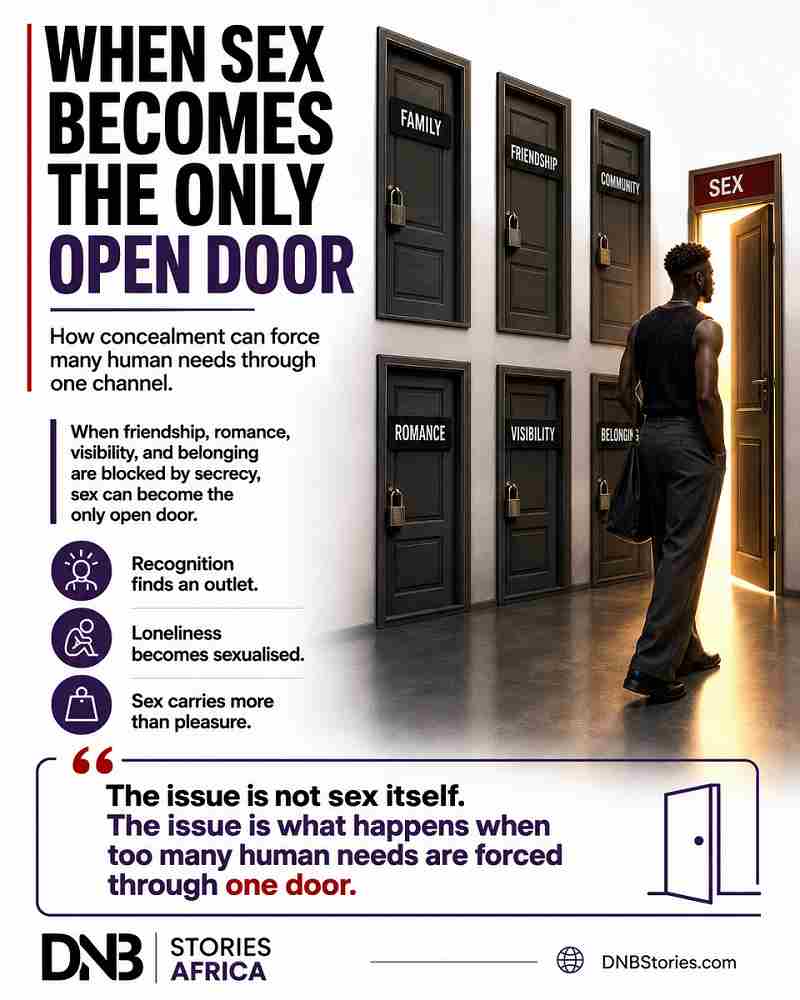
When these needs have no open, stable, affirming place to go, they may start entering through the few open doors familiar to Black queer men. For some closeted or DL Black queer men, one of those doors is sex.
Concealment Can Intensify the Need for Recognition
Concealment is not neutral. Hiding part of the self can require constant monitoring: what to say, what not to say, who knows what, which photo to delete, which app to hide, which friend to avoid, which voice note could expose you, which look lasted too long, which rumour is moving.
This creates pressure.
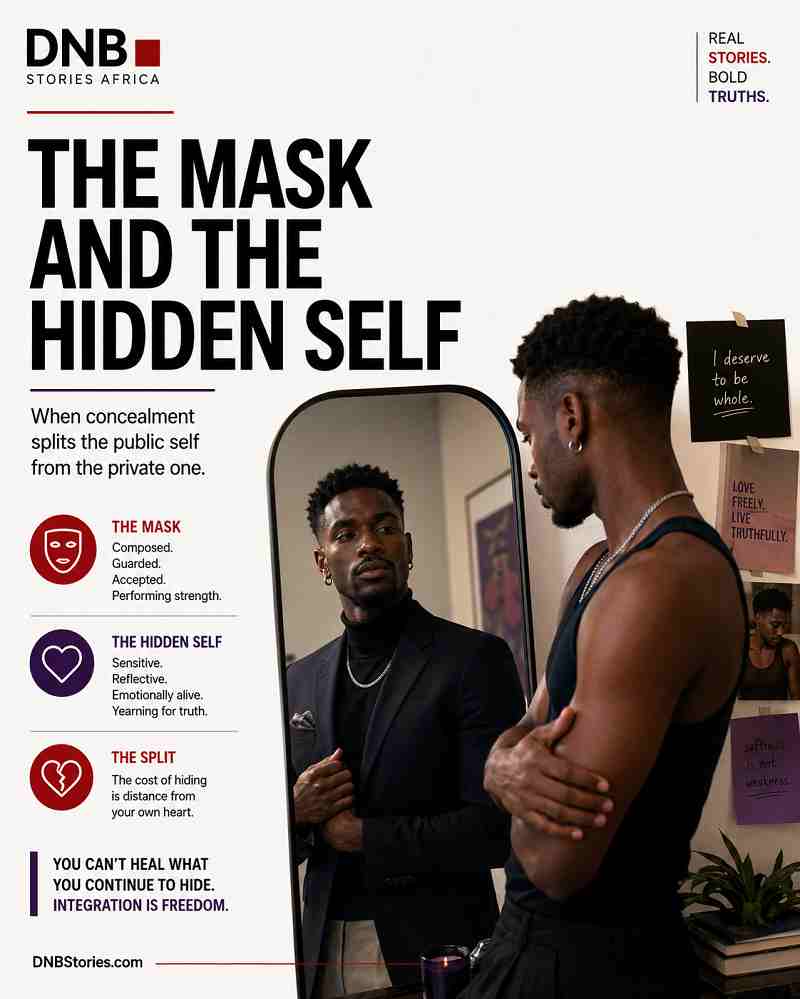
A person living under high concealment may become split between the public self and the hidden self. The public self performs safety. The hidden self carries desire, longing, tenderness, shame, curiosity, fear, and hunger for recognition.
Over time, the hidden self may begin to crave moments where it can finally appear.
Sex can become one of those moments.
For a brief moment, another person sees the real person beneath the mask and desires him there — not the performance, not the public role, not the version built for safety, but the hidden self that has been waiting to be recognised.
This is why sex can become emotionally powerful under secrecy.
It is no longer only about pleasure.
It is proof.
Proof that the hidden self exists.
Proof that the hidden self can be wanted.
Evidence that the hidden self is not just shame.
How Minority Stress Further Complicates the Issue
Minority stress theory argues that sexual minority people often experience additional stress because of stigma, prejudice, discrimination, expectation of rejection, concealment, and internalised shame.
For Black queer men, this stress can be layered.
There may be racism in wider society.
Homophobia in family, religious, ethnic, or community spaces.
Anti-Blackness in queer spaces.
Masculinity policing among men.
Sexual racism on dating apps.
Fear of being feminised, mocked, exposed, or socially punished.
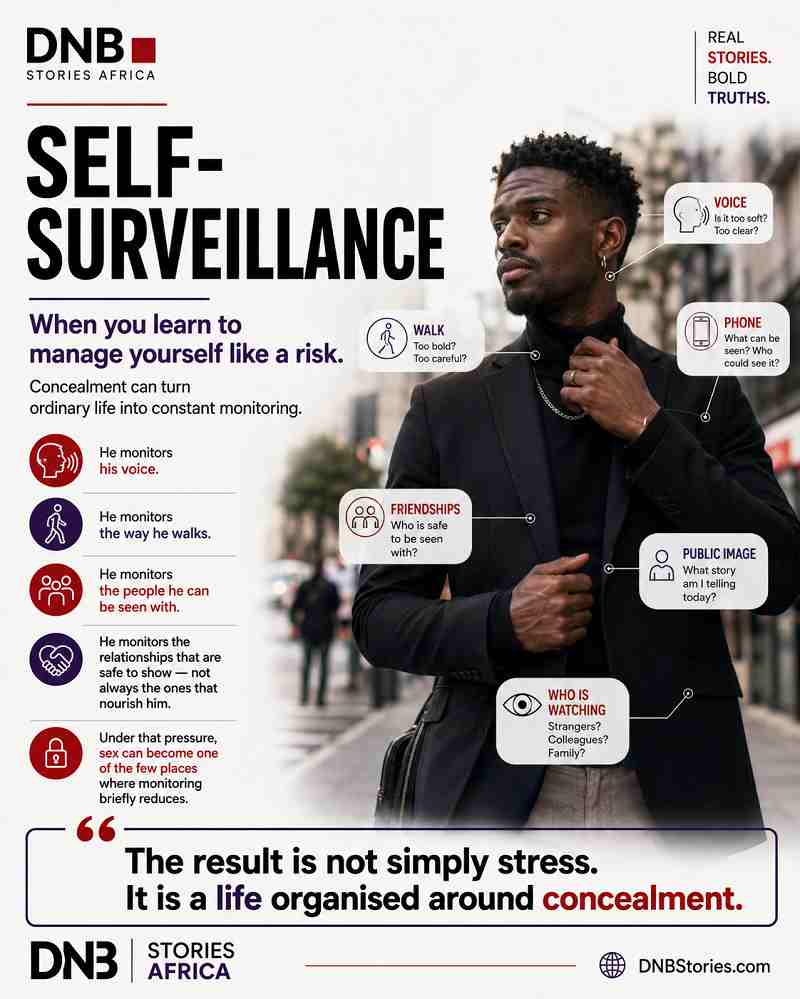
The result is not simply “stress.” It is a social environment where the person may learn to manage himself like a real risk.
He monitors his voice, the way he walks, the people he befriends, the partners he can be seen with, and the relationships that are safe to show — not necessarily the ones that genuinely nourish him.
Under that kind of pressure, sex can become one of the few spaces where monitoring temporarily reduces. Even if the encounter is secret, risky, rushed, or emotionally incomplete, it may still offer a temporary release from the burden of constant self-surveillance.
This is one reason some DL Black queer men may appear to pursue sex intensely. The pursuit may not simply be lust. It may be a search for temporary relief from a life organised around concealment.
Sex as a Substitute for Public Intimacy
Openly queer people can still experience loneliness, rejection, racism, fetishisation, and emotional harm. Openness does not automatically create peace.
But openness can make certain forms of intimacy more possible.
An openly queer man may be able to date publicly, introduce a partner to friends, post a soft launch, attend queer events, build queer friendships, talk about heartbreak without inventing gender-neutral lies, or say, “I miss him,” without turning the sentence into a security operation.
A DL man may not have those options.
He may not be able to say, “I am lonely.”
He may not be able to say, “I want a boyfriend.”
- “I want to be held.”
- “I want tenderness from another man.”
So the language of need may become sexualised.
Instead of “I want intimacy,” it becomes “Send location.”
Instead of “I want to be seen,” it becomes “Send pics.”
Rather than saying “I want closeness,” it becomes “Are you free tonight?”
Instead of “I want to stop feeling invisible,” it becomes “Let’s link.”
This does not mean the sexual desire is fake. The desire may be completely real.
But it may be carrying more than desire.
It may be carrying loneliness, curiosity, fear, shame, tenderness, masculinity performance, emotional hunger, and the need for honest presentation.
Why Recognition Matters So Much
Recognition is not vanity.
To be recognised is to have some part of the self accurately seen and responded to.
For Black queer men, recognition can be complicated. Many are either erased, fetishised, feared, mocked, hypersexualised, masculinised, feminised, or reduced to stereotypes. A DL man may experience an even sharper version of this because he cannot easily ask to be recognised in public as queer, bisexual, gay, questioning, fluid, or emotionally complex.
So he may resort to seeking recognition in private sexual spaces only.
In those spaces, someone sees and responds to his real self.
Someone confirms that what is hidden is still real.
This is one reason secrecy can make sexual attention feel unusually powerful. A compliment is not just a compliment. A touch is not just a touch. A man who wants him may feel like a brief escape from invisibility.
This is also why rejection can feel more destabilising for DL men. If sex is carrying too many human needs, then sexual rejection can feel like rejection of the whole hidden self.
That is the danger of overloading sex.
Sex can hold desire.
Sex can hold pleasure.
It can hold a connection.
But sex cannot safely hold a whole person’s unmet need for identity, belonging, recognition, affection, and self-worth all by itself.
The “No Feelings” Performance
Some DL men protect themselves by insisting everything is “just sex.”
No feelings, kissing, cuddling, sleepovers, public contact, or emotional language.
This can be a genuine boundary, but it can also be a defence mechanism.
When a person is afraid of what his desire means, he may try to keep the encounter purely physical so that it does not threaten his public identity. The more emotionally intimate the encounter becomes, the more dangerous it may feel.
Sex can be compartmentalised, but tenderness is harder to compartmentalise.
A person can tell himself, “I just had sex.”
It is harder to tell himself, “I wanted to be held by another man and felt safe there.”
This is why some DL encounters may become sexually intense but emotionally restricted. The body is allowed to speak. The heart is told to keep quiet.
But the heart does not always obey.
Why This Can Create Repetition
If the deeper need is recognition, then one sexual encounter may not resolve it for long.
The encounter may produce relief, but only briefly.
Afterwards, the man returns to secrecy. He returns to the public role, to the group chat where women are discussed performatively. He returns to family expectations, church, mosque, work, gym, neighbourhood, barbershop, friendship circles, or masculine environments where disclosure feels dangerous.
The hidden self goes back underground.
Then the need rises again—often too quickly.
This can create a cycle:
Secrecy produces emotional pressure.
Sex offers temporary recognition and release.
The encounter ends.
The person returns to concealment.
The need builds again.
Another encounter is sought.
From the outside, this can look like “chasing sex.”
From inside, it may feel like chasing oxygen.
The Role of Shame
Shame is different from guilt.
Guilt says: “I did something wrong.”
Shame says: “Something is wrong with me.”
A DL Black queer man raised in environments where same-sex desire is treated as disgusting, sinful, weak, foreign, feminine, demonic, shameful, or incompatible with Black masculinity may carry a deep conflict between desire and self-respect.
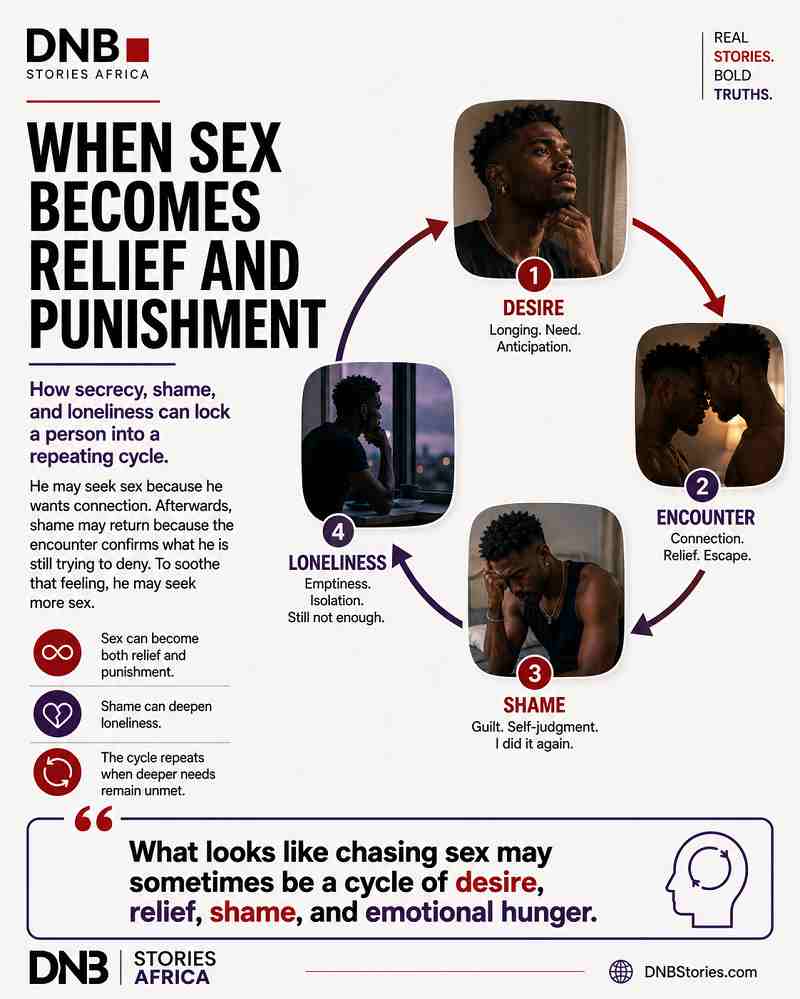
Sex can then become both relief and punishment.
He may seek sex because he wants connection.
Afterwards, he may turn to self-judgement because the encounter confirms what he is still trying to deny.
To soothe that new feeling, he may seek more sex, because shame often deepens loneliness.
Then more shame follows because the secrecy continues.
This cycle can be emotionally exhausting.
It can also make honest intimacy difficult because the person may fear that being truly known will expose the very part of himself he has learned to hide.
How This Can Spill Over Into Control, Manipulation, and Rejection Sensitivity
When a person lives under prolonged concealment, the need for recognition does not disappear. It becomes pressurised.
If that person has few safe places to be seen honestly, the need to feel chosen, desired, respected, and emotionally secure may become exaggerated. Sex may become one outlet. But the same pressure can also spill into control, manipulation, jealousy, secrecy games, and extreme sensitivity to rejection.
This is not because DL Black queer men are inherently controlling or manipulative—that would be a harmful stereotype.
The more accurate point is this: when a person is forced to hide important parts of himself for a long time, he may begin to relate to intimacy through fear, scarcity, and control rather than openness, trust, and emotional regulation.
1. Concealment Can Create a Scarcity Mindset Around Attention
If a man cannot openly date, openly desire, openly claim someone, or openly receive affection, attention can begin to feel scarce.
Every reply matters too much.
Every delay feels like abandonment.
A small perceived shift in tone becomes evidence. Every new person near the object of desire feels like competition.
This is how ordinary intimacy can become overcharged.
A person who is emotionally starved may begin to treat attention like survival currency. Instead of seeing affection as something that can be shared, negotiated, or built over time, he may experience it as something that must be secured, monitored, defended, or extracted.
That scarcity mindset can easily become controlling.
He may want to know who you are talking to.
He may test your loyalty or use triangulation to create jealousy and see how much pull he has over you.
Under conditions of masculinity performance and DL secrecy, a Black queer man may withdraw affection to regain power.
He may act indifferent while secretly watching everything.
The underlying fear is often: “If I am not in control of this connection, I may disappear.”
2. Secrecy Can Make Control Feel Like Safety
When someone lives in secrecy, control can begin to feel like protection.
Control the phone, control the story, control who knows, control who is seen with whom, control screenshots, control emotions, control how close people get, control what is named and what is not.
In this structure, vulnerability feels dangerous because vulnerability can reveal inner wants. Tenderness feels risky because tenderness can expose need. Honest conversation feels threatening because it may force the person to admit what he has been avoiding.
So instead of saying, “I am afraid,” he may become controlling.
Instead of saying, “I feel insecure,” he may become manipulative.
Instead of saying, “I need reassurance,” he may create a test.
Rather than say, “I like you,” he may provoke jealousy to see whether you react.
The behaviour may look powerful from the outside, but it often grows from fear.
3. Rejection Sensitivity Can Become Heightened
Rejection sensitivity means a person strongly expects, notices, fears, or reacts to rejection, sometimes even when the rejection is unclear or imagined.
For someone living under concealment, rejection may not feel like a simple “no.”
It can feel like confirmation of the shame he already carries.
A delayed message may feel like humiliation.
A cancelled plan may feel like being discarded.
A partner’s emotional distance may feel like exposure.
A sexual rejection may feel like proof that the hidden self is unwanted.
This is why rejection can trigger disproportionate responses: anger, withdrawal, gossip, retaliation, sudden coldness, sexual competition, or attempts to make the other person jealous.
The surface reaction may be pride.
The deeper wound may be: “I showed you a part of me I hide from the world, and you still did not choose me.”
That kind of wound can be very destabilising when the person has not built other sources of self-worth, belonging, and emotional safety.
4. Manipulation Can Become a Substitute for Emotional Honesty
Manipulation often appears where honest asking feels too risky.
A person who cannot say, “I want you to choose me,” may try to make you jealous.
A person who cannot say, “I feel replaceable,” may accuse you of betrayal.
When a Black queer man cannot say, “I need reassurance,” he may disappear to see if you chase him.
When he cannot say, “I am hurt,” he may start a rumour.
A Black queer man who cannot say, “I feel powerless,” may gather allies, screenshots, or social witnesses.
This is how unmet needs become strategy.
The person may not experience himself as manipulative. He may experience himself as protecting his dignity, testing loyalty, or staying ahead of embarrassment. But the effect on others can still be harmful.
Fear does not cancel impact.
Concealment may explain the behaviour, but it does not excuse cruelty.
5. The Hidden Self Can Become Possessive
When the hidden self finally finds someone who sees it, that person can become emotionally overimportant.
This can create possessiveness.
Not always because of love.
Sometimes, because the other person has become the container for a buried identity.
The DL man may not only be attached to the person. He may be attached to how he feels when that person sees him. Desired. Masculine. Real. Chosen. Unashamed. Alive.
So when that person pulls away, dates someone else, refuses secrecy, demands honesty, or stops providing sexual validation, the response may feel extreme.
To the outside world, it may look like romantic drama.
Psychologically, it may feel like identity panic.
The person is not only losing a lover or sexual partner. He may feel as if he is losing one of the few mirrors where his hidden self appears.
6. Triangulation Can Become a Way to Regain Power
Triangulation occurs when someone brings a third person into a dynamic to create jealousy, competition, confusion, insecurity, or a sense of control.
For someone with high rejection sensitivity, triangulation can become a way to avoid feeling powerless.
Instead of saying, “I feel unwanted,” he may try to make sure you see someone else wanting him.
Instead of saying, “I am afraid you are losing interest,” he may stage attention with another person.
Rather than admit hurt, he may make you compete.
This creates emotional theatre.
The goal is not always the third person. Sometimes the third person is only a prop. The real aim is to produce a reaction from you, restore control, and reverse the feeling of rejection.
This is where sexual secrecy, attention scarcity, and emotional immaturity can become dangerous together. The person is no longer simply seeking intimacy. He is managing his insecurity by projecting it onto other people’s emotions.
7. The Need to Control the Narrative Can Become Obsessive
A person living with secrecy may become highly invested in narrative control.
- Who knows what?
- Who said what?
- Who has screenshots?
- Who can expose him?
- Who can embarrass him?
- Who can contradict his public image?
This can produce evidence-mining behaviours: baiting people into messages, recording conversations, collecting screenshots, cropping context, or using private information as social insurance.
Again, this is not unique to DL men. Anyone with insecurity, shame, and power anxiety can do this.
But secrecy can intensify it because exposure feels catastrophic.
If a person believes his social survival depends on controlling the story, he may begin to treat people less like human beings and more like potential threats, witnesses, or sources of evidence.
That is how intimacy becomes surveillance.
8. Control Is Often a Failed Attempt at Safety
At the root of many controlling behaviours is a frightened nervous system trying to prevent loss, exposure, shame, abandonment, or humiliation.
But control does not create real safety.
It creates tension, fear and resentment.
It makes the other person less free.
Control may secure compliance, but it cannot create love.
It may produce silence, but it cannot create trust.
It may prevent exposure for a while, but it cannot produce inner peace.
The tragedy is that the more a person controls others to protect the hidden self, the less capable he becomes of receiving genuine intimacy.
9. What Healing Requires
Healing begins when the person learns to separate need from control.
Instead of “I must make you prove you care,” he learns to say, “I need reassurance.”
Instead of “I must make you jealous,” he learns to say, “I feel insecure.”
Rather than say “I must control the story,” he learns to say, “I am afraid of exposure.”
Instead of “I must punish you for rejecting me,” he learns to say, “This rejection hurts, but it does not destroy me.”
This requires emotional literacy, safer friendships, shame reduction, therapy where possible, and spaces where the person can be recognised without turning every connection into a survival test.
For DL Black queer men, this healing must also be culturally realistic. Not everyone can come out publicly. Not everyone is safe to disclose. But even without public disclosure, a person can still build more honest private spaces, practise emotional accountability, and stop using other people as tools to manage fear.
The goal is not forced visibility.
The goal is self-possession.
A person who is secure in himself does not need to control others.
10. The Core Point
When secrecy blocks recognition, the need to be seen can become desperate.
When intimacy feels scarce, attention can become currency.
In these situations, rejection can feel like exposure, and minor disappointment can feel like humiliation.
When honest asking feels unsafe, manipulation can become a substitute language.
And when the hidden self has nowhere stable to live, sex, control, jealousy, and narrative management may all become attempts to solve the same wound.
The wound is not desire.
The wound is the absence of safe recognition.
And until that deeper need is addressed, the person may keep trying to control others, when what he really needs is a life in which he no longer has to disappear from himself.
Sex Is Not the Enemy
Sex is not the enemy.
Desire is not the enemy.
Casual sex is not automatically unhealthy.
Hookups can be pleasurable, affirming, consensual, joyful, healing, exploratory, and honest. For many queer people, sexual freedom is part of reclaiming the body from shame.
The issue is not whether someone has sex.
The issue is whether sex is being forced to do the work of everything else.
Sex becomes strained when it has to replace friendship.
- Replace romance.
- Replace community.
- Replace self-acceptance.
- Replace emotional honesty.
- Replace therapy.
- Replace belonging.
- Replace being known.
When sex becomes the only place where a person feels real, it can become compulsive, not because the person is morally weak, but because the underlying need has not been met elsewhere.
What Healthier Recognition Can Look Like
For DL Black queer men, the answer is not always immediate public disclosure. Coming out can have real risks. Some people face family rejection, housing insecurity, violence, religious condemnation, immigration vulnerability, job loss, or community exile.
So the answer cannot be simplistic.
A safer approach is to expand the number of places where the hidden self can breathe.
That might mean one trusted friend.
A private support group.
Anonymous counselling.
A culturally competent therapist.
A safer queer friendship.
A private journal.
A sexual-health clinic that treats him with respect.
A community space where he does not have to perform heterosexuality.
A gradual movement toward self-honesty.
The goal is not to force visibility.
The goal is to reduce emotional starvation.
The more places a person has to be seen safely, the less pressure sex has to carry alone.
For DL Black Queer Men:
If this article describes you, the point is not to shame you.
The point is to ask a gentler but more honest question:
What am I really looking for when I look for sex?
Pleasure?
Power?
Release?
Proof?
Tenderness?
Masculine validation?
A place to stop pretending?
A place to feel wanted?
Somewhere to feel like my hidden self exists?
There is nothing wrong with wanting sex. But if sex is the only place where you feel seen, then your need is bigger than sex.
You deserve more than secret recognition.
You deserve spaces where your whole self does not have to disappear when the encounter ends.
Conclusion: What Looks Like Chasing Sex May Be Chasing Recognition
Some DL Black queer men may seem to chase sex more because secrecy can intensify the need for recognition and honest self-presentation.
When a person cannot openly belong, openly desire, openly date, openly name himself, or openly seek tenderness, sex may become one of the only available routes to feeling visible and wanted.
But sex alone cannot carry the entire weight of the hidden self.
The deeper need is not always more sex.
Sometimes, the deeper need is a life where the body, the name, the desire, the heart, and the public self are no longer forced to live in separate rooms.
Frequently Asked Questions
No. That would be a stereotype. The issue is not nature. The issue is context. Concealment, stigma, loneliness, and blocked access to open intimacy can make sex carry more emotional weight.
No. It is saying that secrecy has consequences. Some DL men are navigating real fear, family pressure, religious shame, violence, or social punishment. Others may perform secrecy for status, using distance from queerness as a way to feel superior, closer to straightness, or more socially protected. Both realities can exist. Understanding the pressure behind secrecy does not mean excusing harm, dishonesty, manipulation, or emotional neglect.
No. Coming out is not equally safe for everyone. Safety, housing, immigration status, family dependence, culture, religion, and violence risk all matter. The better goal is not forced visibility. The better goal is safer self-honesty and more supportive spaces.
References
- Arnold, E. A., Rebchook, G. M., & Kegeles, S. M. (2014). “Triply cursed”: Racism, homophobia and HIV-related stigma are barriers to regular HIV testing, treatment adherence and disclosure among young Black gay men. Culture, Health & Sexuality, 16(6), 710–722. doi:10.1080/13691058.2014.905706
- Baumeister, R. F., & Leary, M. R. (1995). The need to belong: Desire for interpersonal attachments as a fundamental human motivation. Psychological Bulletin, 117(3), 497–529. doi:10.1037/0033-2909.117.3.497
- Bond, L., Wheeler, D. P., Millett, G. A., LaPollo, A. B., Carson, L. F., & Liau, A. (2009). Black men who have sex with men and the association of down-low identity with HIV risk behavior. American Journal of Public Health, 99(S1), S92–S95. doi:10.2105/AJPH.2007.127217
- Ford, C. L., Whetten, K. D., Hall, S. A., Kaufman, J. S., & Thrasher, A. D. (2007). Black sexuality, social construction, and research targeting “The Down Low” (“The DL”). Annals of Epidemiology, 17(3), 209–216. doi:10.1016/j.annepidem.2006.09.006
- Huang, Y.-T., & Chan, R. C. H. (2022). Effects of sexual orientation concealment on well-being among sexually marginalized groups: How and when does concealment hurt? Journal of Counseling Psychology, 69(5), 630–641. doi:10.1037/cou0000623
- Lapinski, M. K., Braz, M. E., & Maloney, E. K. (2010). The down low, social stigma, and risky sexual behaviors: Insights from African Americans who have sex with men. Journal of Homosexuality, 57(5), 610–633. doi:10.1080/00918361003712020
- Meyer, I. H. (2003). Prejudice, social stress, and mental health in lesbian, gay, and bisexual populations: Conceptual issues and research evidence. Psychological Bulletin, 129(5), 674–697. doi:10.1037/0033-2909.129.5.674
- Pachankis, J. E., Mahon, C. P., Jackson, S. D., Fetzner, B. K., & Bränström, R. (2020). Sexual orientation concealment and mental health: A conceptual and meta-analytic review. Psychological Bulletin, 146(10), 831–871. doi:10.1037/bul0000271