
Reputational Damage as the Pro-Max of Social Freeze-Out
Social freeze-out is not simply “being left out.” In close Black queer communities, it describes a deliberate pattern of exclusion, silence, gossip and reputational damage used as a form of social punishment.
For Black queer people in the UK, the impact of being “frozen out” can be especially serious because community spaces often carry more than social value. These circles may function as sources of safety, intimacy, access to the scene, recognition, social status, cultural familiarity, and relief from isolation. When someone is pushed out of such a space, they may lose not only friends but also access to belonging and protection, which can affect everyday social life.
When Black People Reproduce Inherited Systems of Harm
This article explains the “Triad of Reputational Destruction” as three interlinked forces that an exclusionary Black queer group uses to attack a person’s identity, credibility, and stability. Echoing the slavery-era creation of Black caricatures, the goal is to reduce the person from a full human being into a distorted figure that the group can mock, control, exclude, and harm without conscience.
Some scholarly work allows us to understand group-coordinated exclusion and reputational destruction as part of slavery’s afterlife: the persistence of white supremacist dehumanising logics beyond the formal institution of slavery itself. Inside intimate Black queer spaces, this means Black people can sometimes become agents of inherited systems of dehumanisation against one another, even when no white perpetrator is present in the immediate scene (Hartman, 2007; López et al., 2023).
- Reputational Damage as the Pro-Max of Social Freeze-Out
- An Echo of Racial Caricature-Making in Black Queer Spaces
- The Triad of Reputational Destruction in Black queer spaces
- How the Triad Creates a Trap for the Target
- Social Freeze-Out as Straight-Passing Labour
- Signs That Reputational Destruction Is Going On
- 1. Unexplained Coldness and Enemies Hiding As Friends
- 2. Your Words Are Dismissed in the Moment
- 3. Use of Ad Hominem: Playing the Man Instead of the Ball
- 4. Humiliation Dressed As Intimacy
- 5. The DARVO Move
- 6. Constant Gaslighting Designed To Weaken Stability
- 7. Vague Warnings: People Receive Warnings to Stay Away From the Target
- 8. Target Is Reduced to Loaded Social Labels for Easy Signalling
- 9. Group-Coordinated Manipulation Begins to Show
- 10. Triangulation
- Black Queer Men and the Puppet-and-Patron Dynamic
- How Dark Triad Traits Can Fuel the Puppet-and-Patron Dynamic
- How Bystanders Can Interrupt the Pattern
- By Becoming a Bridge Builder, You Save Yourself First
- What Targets of Social Isolation and Reputational Destruction Can Do
- Conclusion: Building Safer Black Queer Spaces
- References
An Echo of Racial Caricature-Making in Black Queer Spaces
This article does not argue that all modern Black queer social conflict is identical to slavery-era racial propaganda.
Rather, it identifies a structural echo. In some modern Black queer community contexts, reputational destruction can reproduce the same logic of slavery-era caricature-making, where a targeted person is stripped of complexity and reduced to a simplified, distorted figure that the group can reject, mock, or treat as entertainment without visible conscience or guilt.
How Social Freeze-Out and Reputational Harm Connect
Social freeze-out happens when a group deliberately ignores, avoids, excludes, or treats a person as socially unsafe without offering a fair process for clarification or repair. It can happen quietly: people stop replying, stop inviting, stop acknowledging, or begin acting cold without explanation.
In more severe cases, social freeze-out moves from silent exclusion into reputational attack. This usually happens when simple exclusion is not enough to control the target’s social position. The person may have higher visibility, stronger social standing, or a reputation that the group feels they need to undermine to justify the exclusion.
In some cases, escalation happens when the freeze-out fails to produce the desired submission. The target does not shrink, plead for forgiveness, or trade compliance for a fragile return to the group. Instead, isolation makes them more focused, more visible, or more determined. At that point, the group may respond by attacking their reputation.
The message becomes clear: if they cannot make you disappear, they will try to make you socially irrelevant.
The Triad of Reputational Destruction in Black queer spaces
Not every conflict in Black queer spaces is abusive, coordinated, or malicious. Conflict happens in every community.
The concern here is a more specific form of group-coordinated harm: when a person is not merely disagreed with, but turned into a target for collective social rewriting, discrediting, and exclusion. In this pattern, the issue is no longer ordinary disagreement. It becomes a social process through which a person’s identity, credibility, and emotional stability are reshaped to justify or accelerate their exclusion.
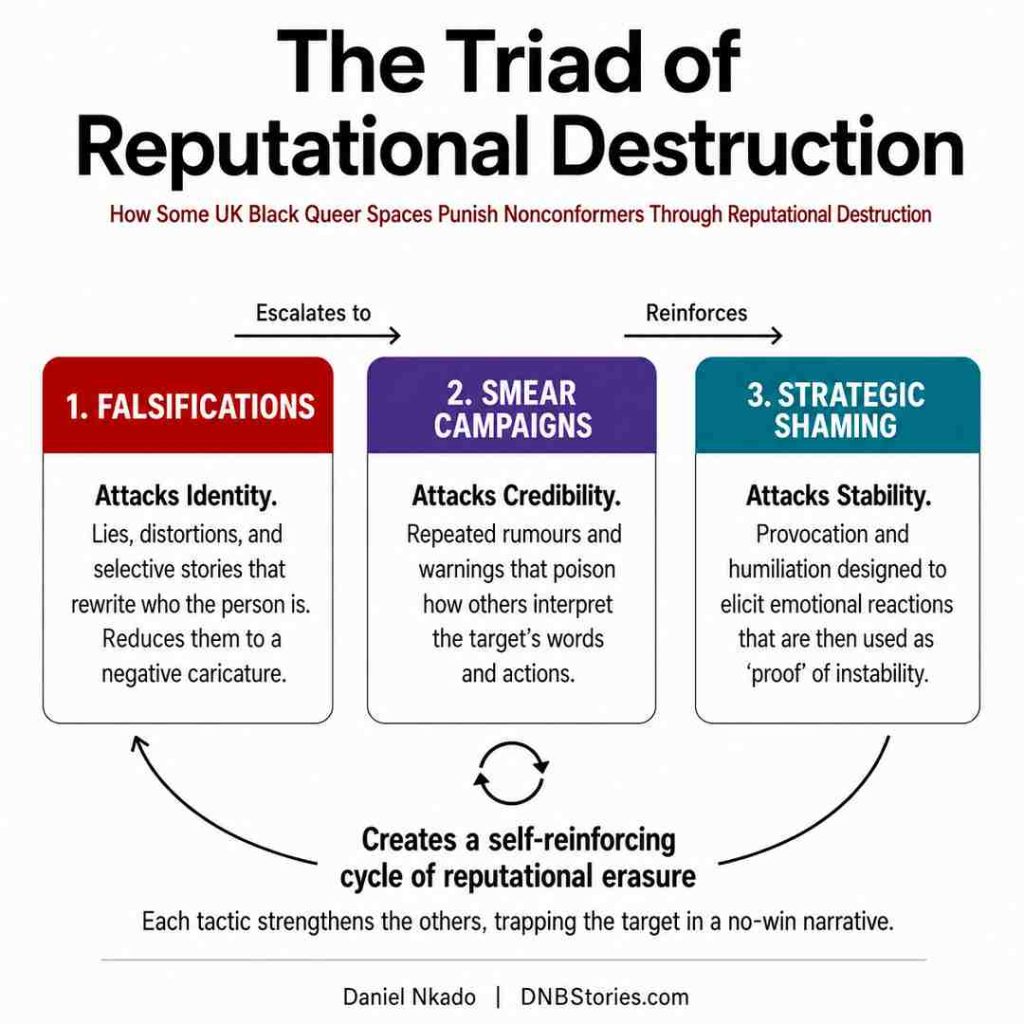
This article names a pattern of three logics used to destroy the reputation of a marked target. I call this pattern the Triad of Reputational Destruction: three connected parts of a reputational attack, each serving a different but cumulative function in rewriting a person’s story to fit the group’s motives. Together, these tactics can escalate social exclusion into reputational erasure.
- Falsifications — attacks identity
- Smear campaigns — attacks credibility
- Strategic shaming — attacks emotional stability
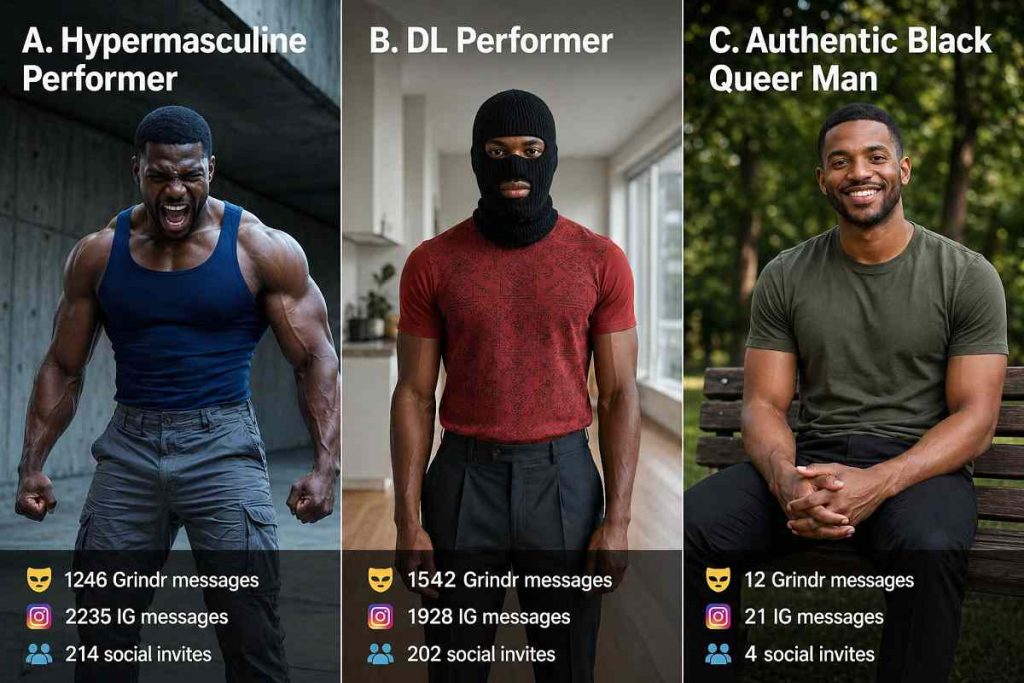
1. Falsifications: Attacking Identity
Falsifications are lies, distortions or selective stories used to rewrite who a person is. This is the first stage of the triad. The target is no longer treated as a full person with context, history, complexity and positive contributions. Instead, they are reduced to a simplified negative identity.
This may involve describing them as “dangerous,” “unstable,” “fake,” “jealous,” “predatory,” “bitter,” “attention-seeking,” or “disloyal” without clear evidence or any fair opportunity to respond.
Sometimes the accusation may contain a small piece of truth that has been exaggerated beyond recognition. At other times, the stories may simply all be false and fabricated. Either way, the function is the same: to make the person easier to reject.
Character-assassination scholarship defines character assassination as the deliberate destruction of a person’s reputation through attacks on character (Moore et al., 2025). In Black community settings, this can happen informally through gossip, private warnings, group chats, social media hints or selective retellings of a conflict.
2. Smear Campaigns: Attacking Credibility
If falsification attacks who the person is, a smear campaign attacks what the person stands for.
A smear campaign is the repeated spread of damaging claims, rumours or warnings designed to undermine trust in the target. The target may be described as someone who “always lies,” “twists stories,” “plays victim,” “causes drama”, “acts weird,” or “cannot be trusted.” The purpose is to poison the listener’s interpretation before the target has a chance to speak.
This resembles what argumentation scholar Douglas Walton (2006) calls “poisoning the well”: a pre-emptive attempt to bias an audience against someone before they can present their position.
In everyday community life, this means the target’s words are discounted in advance. Their explanation becomes “manipulation”, and their hurt becomes “performance.” Their evidence becomes “obsession”, and their silence becomes “guilt.”
In tight communities, reputation travels quickly. A few private messages can reshape how many people interpret one person. The target may notice subtle changes: people become colder, invitations stop, eye contact changes, mutual friends become vague, and spaces that once felt warm begin to feel hostile. Nobody has formally accused them, but everyone seems to know something.
This is why smear campaigns are so effective. They not only damage reputation; they damage access to defence. The person is socially tried, convicted, and sentenced by a court they were never allowed to enter.
3. Strategic Shaming: Attacking Stability
Strategic shaming is the third part of the triad of reputational destruction in Black queer spaces. It targets the person’s emotional stability. This happens when people provoke, humiliate, ignore, mock, gaslight, laugh at, or publicly embarrass a person until the person reacts. The same people then use that reaction as evidence to support the false story that the person acts “weirdly” or is always “dramatic.”
The logic here becomes: “See for yourself, guys. Look how dramatic they are. I told you.”
This is one of the most damaging forms of intracommunity cruelty in Black queer communities because it creates distress and then treats the distressed response as proof that the target deserved the cruelty. It is particularly sad because the people often used to carry out this harm are usually the people the victim sees as friends or has given a level of access into their lives.
It follows the cruel logic of “beating a person and then denying them the right to cry” — one of the most inhuman things a person can do to another. The group harms the target, then refuses to let them appear hurt by the harm done to them. The target must move through their pain quietly, gracefully, and with perfect emotional control, or others will use that pain to confirm the story that they are unstable.
Hurting A Person Just To Mine For Evidence
People keep their phones ready to record. They activate voice recorders and disguise shaming and humiliation as banter to provoke a reaction. They stage phone disappearances, deny obvious facts, and use gaslighting tactics to destabilise the target. Fingers hover over screenshot buttons while they type humiliating messages, waiting for the target to reply in a way they can save, circulate, and present as evidence.
The National Domestic Violence Hotline explains that when someone is pushed to a breaking point, they may defend themselves or respond strongly, and an abusive person may then use that reaction to frame the survivor as the abusive one (National Domestic Violence Hotline, n.d.).
How the Triad Creates a Trap for the Target
The triad works by damaging three things a person needs in order to remain socially relevant:
- their identity — who people believe they are.
- their credibility — whether people believe what they say.
- their stability — the way people interpret their emotions.
Each part of the Triad strengthens the others until the target is trapped within a closed, deliberately constructed social narrative. Falsifications create a damaging story about who the person is. Smear campaigns make it harder for others to believe the person’s account or defence. Strategic shaming then provokes or magnifies the person’s emotional response, using that response as supposed proof that the damaging story was true all along.
The intention is to create a no-win situation for the target. If he stays silent, the rumours go unchallenged. If he defends himself, his defence is dismissed as manipulation, denial, or “drama.” Then, if he shows hurt, anger, or distress, that reaction is treated as evidence of instability rather than a response to exclusion and reputational harm. This is how social freeze-out becomes reputational erasure. The person is no longer seen in his full humanity, history, character, or contributions, but through the caricature the group has built around him.
Reputational Destruction Echoes Slavery Era’s Caricatures of Black Men
This logic is so dangerous because it echoes a longer racial history in which Black people have been reduced to images and social caricatures that trap Black identities inside mocking frames: the Mammy, the Sambo, the Pickaninny, the Coon, the Brute, Jezebel, Uncle Tom, Aunt Jemima and Rastus.
These figures were not neutral images. They are tools of social control used by white supremacists to render Black people easier to mock, fear, dismiss, exploit or punish. In a modern community context, reputational caricature can work in a related way. It replaces a full person with a simplified figure that the group can reject without guilt.
Social Freeze-Out as Straight-Passing Labour
Büttner, Rudert, and Kachel (2025) identify ostracism as an understudied and particularly painful form of discrimination against lesbian, gay, and bisexual people. Their findings suggest that people often exclude lesbian, gay, and bisexual individuals when they perceive them as violating heteronormative gender expectations.
In their experimental work, the researchers found that participants were more likely to see less gender-conforming people as targets of ostracism, regardless of those people’s actual sexual orientation (Büttner et al., 2025).
For Black queer male social life, this research is especially relevant because it suggests that exclusion can function as a way for some Black queer men to perform proximity to heteronormative masculinity. By punishing the person marked as “too visible,” “too expressive,” “too difficult,” or “too nonconforming,” the group signals its own allegiance to the dominance of straight masculinity.
It also points to a harder truth: some Black queer men have not yet fully confronted the shame they attach to queerness. Rather than naming and processing this shame, they manage it through straight-coded performance, hypermasculine fronting or “total top” hierarchies. This can compel them to reject, punish or show hostility toward anyone whose visibility makes concealment—or remaining on the DL—more difficult.
Some Black queer men would rather disappear entirely than admit they are queer.

In many cases, it is queer men invested in DL performance, strategic secrecy and concealment, or straight-passing labour who become the harshest enforcers—especially when some of them know nothing about straightness.
The faker the persona, the more intense the performance.
Signs That Reputational Destruction Is Going On
This section translates theory into practical recognition by outlining the signs that may alert a target to reputational destruction in progress.
Remember this: being targeted for exclusion or reputational destruction does not mean you are broken. Sometimes it means your presence carries power, and you have refused to make yourself smaller for people who needed you diminished.
1. Unexplained Coldness and Enemies Hiding As Friends
Messages go unanswered, invitations stop, and familiar people begin acting distant, but no one clearly tells you what happened. When you raise a concern with someone you treat as a friend, and they are part of the scheme, they may dismiss it, give a dry “mm-mm” response, or change the topic.
Sometimes they will coat further humiliation in a performance of concern: “But I don’t really see you as that dramatic.”
Statements like this do three things at once. First, they minimise what you are saying by refusing to engage with the actual pattern. Second, they quietly introduce a negative label — dramatic — while pretending not to fully apply it to you. Third, they make the speaker appear caring or neutral—in order to maintain access to you—while reinforcing the very smear being built around you.
This is how reputational destruction often hides inside friendship language. The person sounds concerned, but the effect is to dismiss your reality, plant doubt about your stability, and keep the group narrative intact.
2. Your Words Are Dismissed in the Moment
Responses like “mm-mm,” sighs, awkward silences, mock concern, amused disbelief, side looks when you are speaking in a group, shaming smiles, sneers, and inferences dropped strategically to humiliate. These are used to shrink what you are saying without openly challenging it.
When you speak in a group, a look of side-eye and subtle contempt can appear. People exchange glances, smirk, roll their eyes, or look away when you are talking, especially when you are saying something serious, useful, or personally important.
3. Use of Ad Hominem: Playing the Man Instead of the Ball
A key sign of reputational destruction is the use of ad hominem attacks— what many people call “playing the man instead of the ball.” Rather than addressing the actual issue, behaviour, evidence, or argument, the group shifts attention onto the target’s character, interests, personality, friendships, or past struggles.
The question stops being, “What happened?” and becomes, “This is what happens when someone doesn’t have many friends, you know.” Or the person avoids the real issue entirely and moves to something irrelevant: “Why do you like Taylor Swift so much anyway? That girl sounds like white noise.”
The goal is a three-strike force: to distract, diminish, and provoke. Instead of answering the point, they attack the person making it. Instead of engaging the evidence, they ridicule the target’s taste, history, interests, or personality. This turns a real concern into a character trial. Once the group is laughing at the person, they no longer have to deal with the person honestly about what the person said. He is now a caricature.
4. Humiliation Dressed As Intimacy
A cruel person might disguise humiliation as affection: “My love, did you really write this article, or is it all ChatGPT?”
The statement wears affection like makeup, but beneath it is malice, raw and red as palm oil.
It sounds playful, even intimate, but its function is to humiliate. Rather than engage the article’s argument, evidence, or craft, the speaker questions authorship, undermines intelligence and credibility, and casts suspicion on a colleague’s intellectual contribution without engaging the work itself.
This is how ad hominem fallacy often operates in intimate or community settings: not as open disagreement, but as a soft insult disguised as concern, banter, or closeness.
5. The DARVO Move
If group-coordinated verbal attacks, shaming, humiliation dressed as banter, or ad hominem attacks successfully provoke the target into a reaction, the next move is often DARVO: deny the original harm, attack their response, and reverse the victim and offender. Suddenly, the people who baited, humiliated, excluded, or smeared him present themselves as the injured party, while his understandable reaction is reframed as abuse, aggression, or instability.
6. Constant Gaslighting Designed To Weaken Stability
The goal of constant gaslighting is to undermine the target’s stability and generate evidence of it. The target is told they are imagining things, being too sensitive, misreading the room, overthinking everything, or “making everything about themselves”, even when what they experienced remains vivid and unmistakable in their memory.
The aim is to make the target distrust their own perception. Once the target begins to question what they clearly see and feel, the group can continue the harm while portraying the target as paranoid, dramatic, or unstable. The deeper the harm, the more emotional evidence the group can extract and use against him.
7. Vague Warnings: People Receive Warnings to Stay Away From the Target
Vague warnings begin circulating. People are told to “be careful” around the target, “watch out” for him, or “keep their distance,” but the claims remain vague. No one names a specific harm, provides clear evidence, or gives the target a fair chance to respond.
In more severe cases, edited videos, voice notes, screenshots, or selective message extracts may be circulated without context to create suspicion and frame the target as dangerous, unsafe, or criminal.
8. Target Is Reduced to Loaded Social Labels for Easy Signalling
The target’s character is reduced to a set of loaded social labels. Words like “dangerous,” “unstable,” “fake,” “toxic,” “manipulative,” “jealous,” or “dramatic” begin replacing any fair discussion of what the person actually did. These labels work as shortcuts. They allow people to signal agreement with the group narrative without examining evidence, context, or motive.
Once the label sticks, the person no longer has to be understood. They only have to be managed, avoided, mocked, or removed. This is how reputational destruction simplifies a human being into a social warning sign.
The position shifts from “What happened?” to “You know how he is.” People believe stories about you without checking with you. Others accept one-sided accounts, screenshots, voice notes, or rumours without asking for context or hearing your version.
9. Group-Coordinated Manipulation Begins to Show
Group-coordinated manipulation becomes evident when different people start repeating the same phrases, mirroring the same behaviours, using the same labels, or responding to the target with the same coldness, as if a shared script has been circulated behind his back. The language, methods, or displays may vary slightly, but the emotional pattern is the same.
When multiple people begin echoing identical remarks, repeating the same labels, and mirroring similar behaviours or actions toward the target, it can suggest that the harassment is no longer isolated. It has become socially organised, group-reinforced, or guided by a shared script.

These coordinated behaviours are not always neat in execution. They often involve people acting out scripts they neither fully understand nor designed themselves — scripts handed to them by others to perform.
10. Triangulation
Triangulation happens when someone avoids direct communication with the target and instead routes their grievance, story, or accusation through third parties.
In Black community settings, this allows one person to control the narrative first, recruit sympathy, manufacture the appearance of a consensus, and isolate the target before the target has a fair chance to respond. Because it often appears as “venting,” “seeking support,” or “sharing concern,” triangulation gives the instigator plausible deniability while quietly turning others, sometimes without their realising it, into co-participants in reputational harm.
Black Queer Men and the Puppet-and-Patron Dynamic
The mechanics of the Triad of Reputational Destruction in Black queer contexts, as described in this article, are grounded in research on social ostracism, reputational harm, group exclusion, and relational aggression. In some Black queer male social contexts, especially those shaped by hypermasculine performance, anti-intellectualism, and status anxiety, these tactics may be intensified by outside influence or by socially powerful individuals who understand group behaviour well.
This creates a troubling contradiction. Some Black queer men may dismiss education, theory, and sustained learning as “too academic,” “too white,” or irrelevant to Black life, while still being drawn into social scripts designed by people who understand narrative control, reputation management, and group psychology.
In such cases, the person carrying out the freeze-out may not be the true architect of the harm. They may simply have been turned into instruments of a strategy they did not design, performing a form of “unpaid social work” for someone else’s agenda — social labour they have been conditioned not to question, examine, or try to decode.
I call this the Puppet-and-Patron Dynamic: a system in which one person performs the visible cruelty while another quietly benefits from it. The puppet carries the gossip, exclusion, shaming, or reputational attack. The patron supplies the motive, protection, reward, or social permission. This allows the main beneficiary of the harm to remain partially hidden while others do the public work of punishment.
How Dark Triad Traits Can Fuel the Puppet-and-Patron Dynamic
The Triad of Reputational Destruction explains the tactics at work: falsification, smear campaigns, and strategic shaming.
The Puppet-and-Patron Dynamic explains how these tactics are distributed across a group, with some individuals performing the visible harm while others benefit from it or quietly direct it from behind the scenes.
Dark Triad traits—narcissism, Machiavellianism, and psychopathy—explain how group composition can determine why certain actors may be especially drawn to this arrangement.
- Research on Dark Triad traits shows that narcissistic tendencies can protect a fragile self-image by framing harm as moral superiority.
- Machiavellian traits can facilitate strategic manipulation, outsourcing reputational violence to others while maintaining plausible deniability.
- Psychopathic traits, when present, may reduce emotional brakes by lowering empathy and remorse, making it easier to instrumentalise people as tools rather than peers.
Importantly, this is not a diagnosis of individuals, nor is it a claim that these traits inevitably produce group harm. Rather, Dark Triad research helps clarify why, in some contexts, reputational destruction becomes organised through proxy actors: why some people are willing to orchestrate exclusion without appearing at the centre of it, and why others are recruited to carry out harm that ultimately serves interests beyond their own.
Positioned here, the framework does not divert from the social mechanism; it sharpens it. It explains why the Puppet-and-Patron Dynamic may be psychologically attractive to certain actors, and how systems of power can exploit those tendencies to keep harm decentralised, deniable, and self-sustaining.
The Triad of Reputational Destruction Is Not the Same As Dark Triad:
The Triad of Reputational Destruction is my framework for describing tactics of social harm. It should not be confused with the psychological concept known as the Dark Triad, which refers to narcissism, Machiavellianism, and psychopathy. The connection here is not the name, but the behavioural logic. Certain personality tendencies can make reputational manipulation, control, and social punishment more attractive to some actors.
When Reputational Destruction Becomes a Power Move
Research on the Dark Triad traits — Machiavellianism, narcissism, and psychopathy — links these three traits to manipulation, callousness, gossip, cyberbullying, and relational aggression (Gholami et al., 2025).
These studies suggest that people higher in these traits may be more likely to use indirect aggression, including spreading rumours, social exclusion, malicious humour, online harassment, and manipulation of peer networks, to damage the reputations of people they perceive as threats (Heym et al., 2019).
While this does not mean every person who gossips or excludes others has a dark personality profile, it does show that reputational harm can become a strategy for social dominance when manipulation and low empathy are present (Kircaburun et al., 2021).
Research on ostracism shows that exclusion can threaten a person’s sense of belonging, self-esteem, control and meaningful existence (Williams, 2007; Zadro et al., 2004). LGBTQ+ people may experience ostracism not only as ordinary interpersonal rejection, but also as part of wider stigma, discrimination and minority stress (Meyer, 2003; Riggle, 2025).
How Bystanders Can Interrupt the Pattern
Social freeze-out and reputational destruction depend on participation, silence, and passive agreement. They grow when people accept one-sided stories, repeat rumours, or distance themselves from a target without asking fair questions or hearing the person’s own version of events. Bystanders do not need to become investigators or force reconciliation, but they can refuse to become carriers of reputational harm. A simple pause can interrupt the pattern: How do we know this is true? Has anyone spoken directly to him? Is this a genuine safety issue, or are we being pulled into social punishment? Who benefits from making this person appear dangerous, unstable, or unworthy of belonging?
What has this person actually done, and who is really threatened by their presence, visibility, or refusal to shrink — Black queer people themselves, or the white-supremacist power structures that benefit when Black queer men are kept busy fighting each other?
The most important intervention is to slow the spread of unverified claims and restore context where it has been removed.
Do not pass on rumours, screenshots, labels, voice notes, or warnings without evidence. Be especially careful with loaded terms like “dangerous,” “unstable,” “narcissistic,” “messy”, or “manipulative,” which can turn conflict into character destruction. If a targeted person reacts with hurt, anger, or distress, ask what happened before the reaction.
Do not look only at the video, screenshot, or voice note presented as “proof”; ask why it is being shown to you, what context has been removed, and what the person sharing it stands to gain from damaging your relationship with the target.
Always ask questions. In many cases, the person presented as the villain may be the true victim. A healthier community is not one where harm is ignored, but one where concerns are handled with truth, fairness, proportion, and care rather than reputational destruction.
How Daniel Nkado’s Bridge Model Interrupts Group-Coordinated Reputational Destruction:
In my Bridge Model framework, this is where “Group Norms” and “Bystander Interrupts” become crucial. Harmful freeze-outs, reputational destruction, and other forms of group cruelty in Black queer spaces do not survive through one person’s actions alone. They survive because the surrounding group allows certain behaviours to become normal.
When gossip without evidence, exclusion without explanation, name-calling and social labelling without accountability, and refusal to speak against unfair treatment become accepted group habits, cruelty begins to look like community culture.
Remember: It is them today; tomorrow, it may be you. They may survive what the group does to them, but you may not survive it when the same machinery turns on you.
By Becoming a Bridge Builder, You Save Yourself First
When gossip, vague warnings, screenshots, social coldness, and social labelling go unchallenged, they become group norms. A bystander interrupt breaks that norm by slowing the story down, asking for context, and refusing to reward cruelty or reputational harm. This is why Bridge Builders have important work to do.
Bridge building is not only about protecting the target. It is also about protecting the community conditions that may one day protect you. When you interrupt gossip, question unfair exclusion, and refuse to participate in reputational harm, you are not merely defending someone else. You are helping to build a culture where no one can be casually destroyed by silence, rumour, or group cruelty. It is them today; tomorrow, it may be you.
If you are targeted by group isolation and reputational damage, please do not start seeing yourself through the eyes of those harming you. Exclusion can distort your self-image, but their story is not your truth. Choose dignity. You may not be able to control gossip or group harm, but you can protect your safety, your self-respect, and your sense of self.
What Targets of Social Isolation and Reputational Destruction Can Do
- Name the pattern. Notice repeated signs: cold behaviour, no invites, ignored messages, gossip, group manipulation, gaslighting and triangulation, side eyes, dismissive responses, humiliation dressed as banter, club entry denial, and pile‑ons.
- Don’t take the labels on. Words like “unstable,” “messy,” “weird,” or “dramatic” are often used to justify pushing you out. They are not who you are.
- Pause before responding. You don’t need to explain yourself publicly or straight away. Quick, emotional replies can be used against you. If you do speak, keep it calm and factual.
- Write things down. Keep dated notes of what happened, who was present, what was said, and any evidence you may need later.
- Don’t make excuses for friends who join in harming you. It hurts the most when people you treated as friends join in mocking, humiliating, baiting, or making you feel unsafe. But you must remember this: your safety comes before any friendship, especially one fueled by toxicity. A friendship that requires you to tolerate harm is not something to protect. Cut the access.
- Stop arguing with people who twist your words. If nothing you say is heard fairly, step back. You don’t owe endless explanations.
- Set boundaries. Leave chats, block or mute harassment, step back from social media when needed, and avoid spaces where you are likely to be ambushed, mocked, or baited.
- Find support elsewhere. Look for other friends, groups, therapy, or community spaces where you’re treated with respect.
- Save proof if it gets serious. Keep evidence if things turn into threats, harassment, or risks to work or safety.
Conclusion: Building Safer Black Queer Spaces
A genuinely safe space is not one where conflict never happens. Rather, it is one where disagreements can arise and be handled fairly, without being engineered into punishment or weaponised into group-coordinated social annihilation. Black queer communities need room for disagreement, mistakes, boundary-setting, and repair, but they equally need safeguards against reputation-based punishment.
Safer community practices that promote peace and solidarity include:
- Direct communication before picking sides.
- Proportionate responses to harm.
- Evidence over rumours and gossip.
- Authenticity over performance.
- Accountability without humiliation.
- Repair without coercion.
- Boundaries without character assassination.
- Brotherly love over hypermasculinity worship.
- Duty and care for each other over desirability.
The goal is not forced closeness. The goal is to ensure that conflict does not become a licence for cruelty, and that no one’s humanity is destroyed just to protect a clique.
References
- Büttner, C. M., Rudert, S. C., & Kachel, S. (2025). Ostracism experiences of sexual marginalised groups: Investigating targets’ experiences and perceptions by others. Personality and Social Psychology Bulletin, 51(10), 2015–2030. https://doi.org/10.1177/01461672241240675
- Eisenberger, N. I., Lieberman, M. D., & Williams, K. D. (2003). Does rejection hurt? An fMRI study of social exclusion. Science, 302(5643), 290–292. https://doi.org/10.1126/science.1089134
- Feinberg, M., Willer, R., & Schultz, M. (2014). Gossip and ostracism promote cooperation in groups. Psychological Science, 25(3), 656–664. https://doi.org/10.1177/0956797613510184
- López, D. J., Chandler, C., Whitfield, D. L., Adams, B., Burdick, J., & Friedman, M. R. (2023). Intracommunity violence among Black LGBT young adults. Journal of Interpersonal Violence, 38(7–8), 5341–5367. https://doi.org/10.1177/08862605221113025
- Meyer, I. H. (2003). Prejudice, social stress, and mental health in lesbian, gay, and bisexual populations: Conceptual issues and research evidence. Psychological Bulletin, 129(5), 674–697. https://doi.org/10.1037/0033-2909.129.5.674
- Moore, M. J., Romann, L. R., Tucker, R. V., & Hintz, E. A. (2025). Character assassination as a communicative phenomenon: A retrospective review of concept development and extensions. Annals of the International Communication Association, 49(3), 205–215. https://doi.org/10.1093/anncom/wlaf010
- National Domestic Violence Hotline. (n.d.-a). What is reactive abuse? https://www.thehotline.org/resources/what-is-reactive-abuse/
- Riggle, E. D. B. (2025). Understanding the potential impact of ostracism on LGBTQ health disparities. New Ideas in Psychology, 78, Article 101159. https://doi.org/10.1016/j.newideapsych.2025.101159
- Walton, D. N. (2006). Poisoning the well. Argumentation, 20(3), 273–307. https://doi.org/10.1007/s10503-006-9013-z
- Williams, K. D. (2007). Ostracism: The kiss of social death. Social and Personality Psychology Compass, 1(1), 236–247. https://doi.org/10.1111/j.1751-9004.2007.00004.x
- Zadro, L., Williams, K. D., & Richardson, R. (2004). How low can you go? Ostracism by a computer is sufficient to lower self-reported levels of belonging, control, self-esteem, and meaningful existence. Journal of Experimental Social Psychology, 40(4), 560–567. https://doi.org/10.1016/j.jesp.2003.11.006
The Dark Triad Section Citations
- Gholami, M., Thornberg, R., Kabiri, S., & Yousefvand, S. (2025). From Dark Triad personality traits to digital harm: Mediating cyberbullying through online moral disengagement. Deviant Behavior. https://doi.org/10.1080/01639625.2025.2453445
- Heym, N., Firth, J., Kibowski, F., Sumich, A., Egan, V., & Bloxsom, C. A. J. (2019). Empathy at the heart of darkness: Empathy deficits that bind the Dark Triad and those that mediate indirect relational aggression. Frontiers in Psychiatry, 10, Article 95. https://doi.org/10.3389/fpsyt.2019.00095
- Kircaburun, K., Jonason, P. K., Griffiths, M. D., Aslanargun, E., Emirtekin, E., Tosuntaş, Ş. B., & Billieux, J. (2021). Childhood emotional abuse and cyberbullying perpetration: The role of dark personality traits. Journal of Interpersonal Violence, 36(21–22), NP11877–NP11893. https://doi.org/10.1177/0886260519889930
Frequently Asked Questions
The Triad of Reputational Destruction describes three connected tactics used to damage a target’s reputation: falsifications, smear campaigns, and strategic shaming. Falsifications attack identity, smear campaigns attack credibility, and strategic shaming attacks emotional stability. Together, they can turn social exclusion into reputational erasure.
Signs include sudden coldness, vague warnings, repeated labels like “unstable” or “dangerous,” humiliation dressed as banter, gaslighting, edited screenshots or voice notes being circulated, people repeating the same phrases and behaviours and the target’s emotional reaction being used as “proof” against them. A key sign is when the person is no longer treated as a full human being, but as a caricature.
Using evidence instead of rumours and gossip ensures that decisions are based on what actually happened, not on hearsay, bias, or social pressure. Rumours and gossip can be incomplete, exaggerated, or false, and acting on them can unfairly damage someone’s reputation. Evidence-based conflict resolution protects fairness, reduces group manipulation, and helps communities avoid punishing people without proper context or accountability.
Bystanders can interrupt social freeze-out and group cruelty by refusing to spread unverified claims, asking fair questions, restoring missing context, and avoiding social labelling like “messy,” “unstable,” or “toxic.”