
Intro: A Practical Doctrine for One-to-One Conflict
Interpersonal conflict is inevitable, but responding under pressure often makes it worse. In environments shaped by status, hierarchy, restraint, and indirect dominance, generic conflict advice can miss the real issue: not just what happened, but the broader forces shaping the conflict itself.
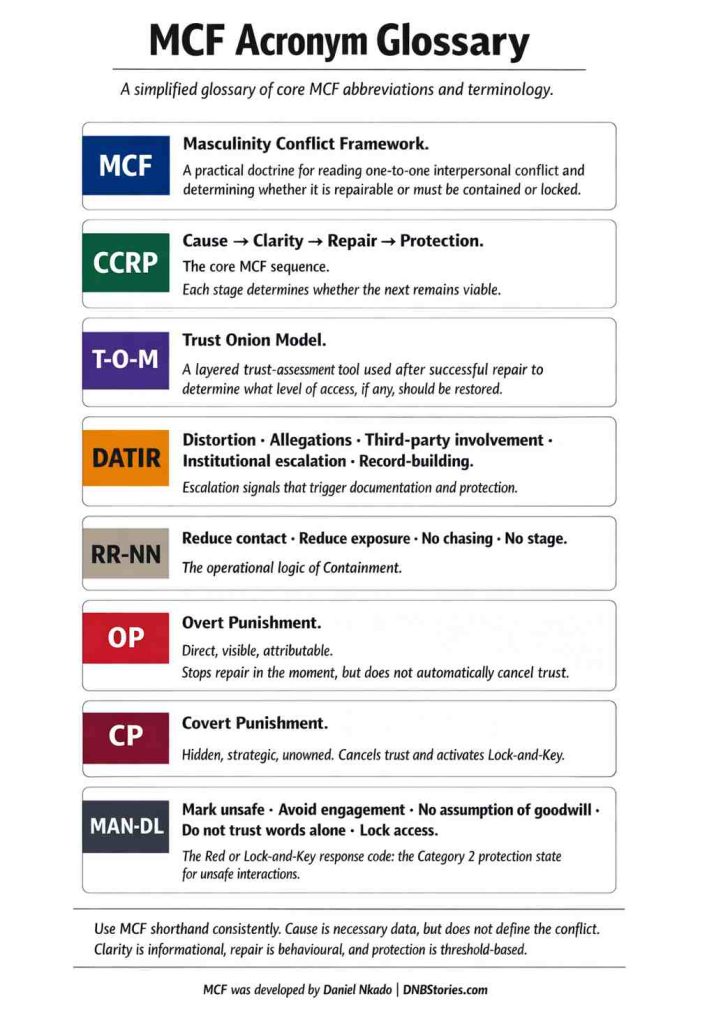
The Masculinity Conflict Framework (MCF) is a practical doctrine for reading and responding to one-to-one interpersonal conflict. It is a risk-reduction and decision-support tool for navigating one-to-one tensions. It is not a guide for winning arguments, public score-settling, clique warfare, or crowd dynamics.
I developed MCF through close analysis of conflict in Black queer and other male-coded, status-sensitive environments. This origin grounds the framework in lived, relational, and power-aware experience. The framework itself, however, is not biologically restricted to men. It is most effective where hierarchy, image control, restraint, and indirect dominance shape conflict.
- Intro: A Practical Doctrine for One-to-One Conflict
- MCF As A Risk‑Reduction Conflict Tool
- MCF Sequence: Cause → Clarity → Repair → Protection
- Step 1: Cause
- Step 2: Clarity
- Step 3: Repair
- Step 4: Protection
- MCF: Quick Scoring Summary
- Why MCF Works
- Frequently Asked Questions—1
- Frequently Asked Questions—2
- References
MCF As A Risk‑Reduction Conflict Tool
The Masculinity Conflict Framework (MCF) is a structured way of asking three important questions that clarify how to respond when conflict arises, especially unexpectedly:
a. Is there a real cause for this conflict?
b. Does this person genuinely want repair, or are they trying to win or retaliate?
c. When do I stop trying to fix things and start protecting myself?
MCF is not a universal formula for handling all disagreements. It is not a dominance tool or a revenge-calculating system. It is not designed for mob conflict, public confrontation, or audience-driven disputes. MCF is for one-to-one conflict, where the interaction can still be read in sequence. Its purpose is to help distinguish repairable from non-repairable conflict, as mistaking one for the other can invite retraumatisation. As a harm-reduction tool, MCF helps prevent this.
MCF Sequence: Cause → Clarity → Repair → Protection
The framework moves through four stages:
Cause → Clarity → Repair → Protection
This sequence matters because parties often place the greatest emphasis on the perceived cause of conflict while undervaluing what follows. In MCF, cause is treated as useful data, not as a standalone determinant of outcome.
Step 1: Cause
At the cause stage, MCF asks whether there is a real interpersonal cause and whether the conflict is being carried in a language of blame or inquiry.
0 — No cause
There is no real interaction and no natural basis for conflict.
No conflict means no action is required.
1 — Ego-based
The conflict is being carried as a power move or a winning move. Typical signs include accusations, absolutes, a confrontational posture, and a focus on what you did rather than on what happened to the relationship.
2 — Non-ego-based
The conflict reflects genuine relational strain. Typical signs include curiosity, “what” and “how” questions, “we” language, sadness over the damaged relationship, and practical concern for what can be clarified or repaired.
In MCF, cause is an early read, not a final verdict. Clarity is the true test.
Peer-reviewed research on conflict supports MCF’s early attention to language posture. Studies suggest that I-statements, such as “I feel …” can reduce perceived hostility, while blame-heavy you-talk has been linked to more dysfunctional conflict behaviour and greater risk of relational aggression (Rogers et al., 2018[4]; Pettit et al., 2024)[3].
Step 2: Clarity
Clarity sits at the centre of the Masculinity Conflict Framework. Seek clarity privately even if a rupture occurs in public. This removes scene influence that can contaminate the signal. In cases of public confrontation, acknowledge the issue and clearly state that you will address it later in private.
If They Refuse Private Discussion:
If the other party refuses private follow-up and insists on continuing the public callout, treat the public interaction itself as an active clarity test. Public rupture degrades the signal and raises the clarity threshold. Where clarity is forced to happen on-stage, remain silent and observe. They either pass clarity unaided, or you move to protection. Any punishment or mobilisation signal triggers immediate protection. Any DATIR signal activates immediate documentation and protection.
Core Principle of Clarity Level
Clarity is successful only if it produces usable information, not punishment. Apology is not a threshold for clarity. In MCF, clarity is informational, not emotional.
2 — Welcomed and completed
The conversation produces real, honest, and useful information.
1 — Avoided
An attempt to obtain clarity is met with evasiveness, stalling, stonewalling, or withdrawal.
0 — Bad faith
Punishment appears, or it becomes clear that the interaction was about targeting rather than resolution.
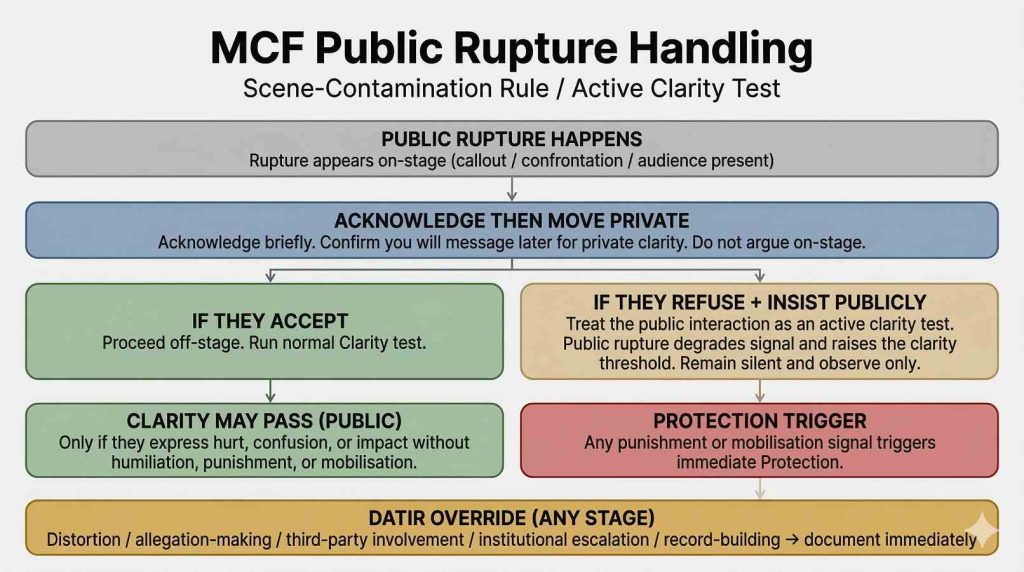
DATIR Clause
At any moment—public or private—if you notice any sign of DATIR, begin documentation and move to protection. In MCF, DATIR is regarded as punishment. It initiates a move to protection and also triggers documentation.
DATIR stands for:
- Distortion
- Allegation‑making
- Third‑party involvement
- Institutional escalation
- Record‑building behaviour
Step 3: Repair
Offer repair only when Clarity is successful—meaning it produces real, honest, and usable information without punishment. Clarity establishes a repair position but is not part of the Repair stage and does not resolve the conflict. Repair must be mutually agreed and completed in behaviour to resolve the conflict.
No framework can force truth at Clarity; MCF instead ensures that withheld truth cannot produce trust, proximity, or reopen access. Performative clarity may pass Clarity, but it cannot pass Repair. If repair behaviour contradicts clarity or introduces punishment → Lock.
2 — Welcomed and completed
Repair is accepted and carried through in behaviour.
1 — Avoided
Repair is verbally entertained but not enacted. The interaction stays stuck in delay, deflection, or endless talk.
0 — Bad faith
Repair loses credibility when deception, punishment or any form of insincerity appears.
Repair Competence = Trust Material
If the repair is completed competently, the person may be considered a Possible Trust Asset (PTA). Use the Trust Onion Model to complete the trust assessment and determine whether they are fit for inner-circle access.
Successful Clarity ≠ conflict resolution.
Successful Repair = conflict resolution.
Trust-repair research[2] suggests that acknowledgement must be accompanied by accountability and observable behavioural follow-through for repair to be credible, which aligns with MCF’s repair logic (Sharma et al., 2022[5]; Giacobbi & Lalot, 2025) [1].
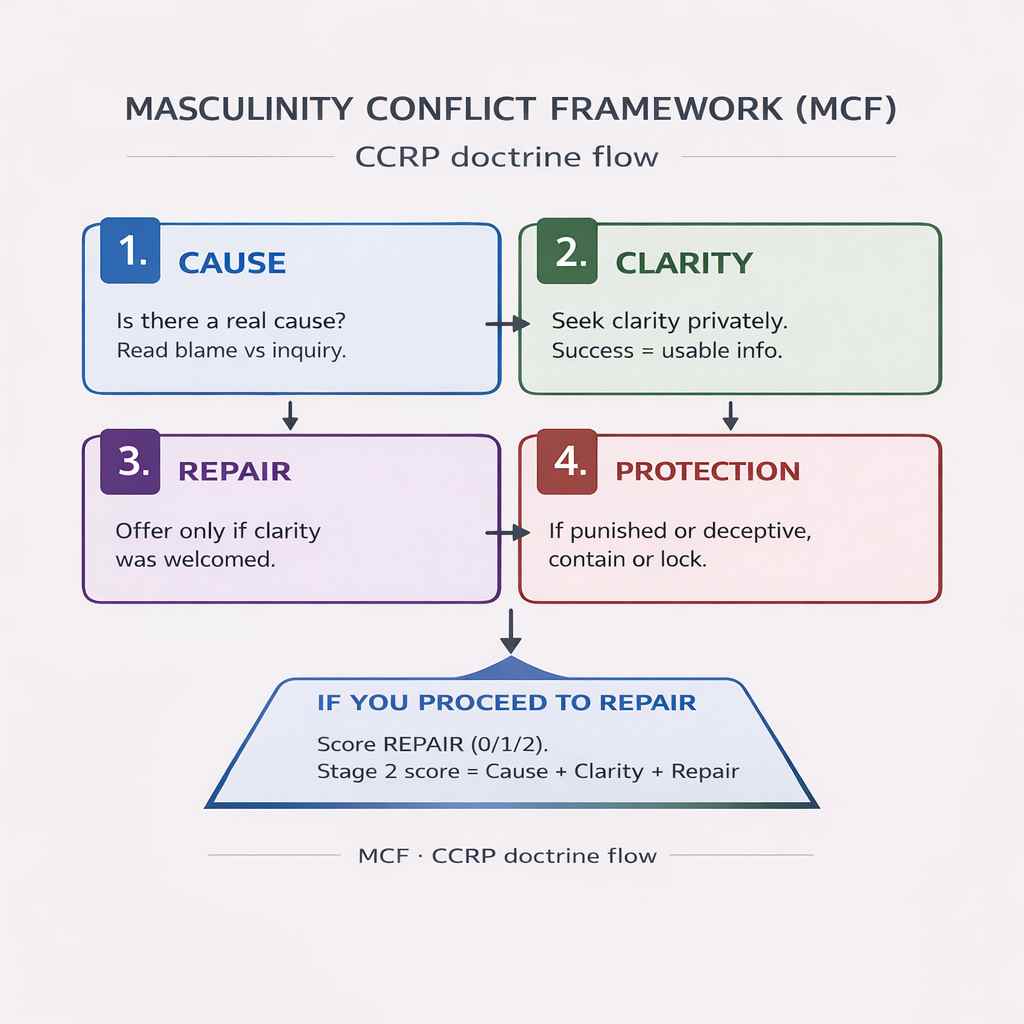
Step 4: Protection
Protection begins when clarity fails, and punishment, deception, or risk appears. This is where MCF draws its sharpest boundaries:
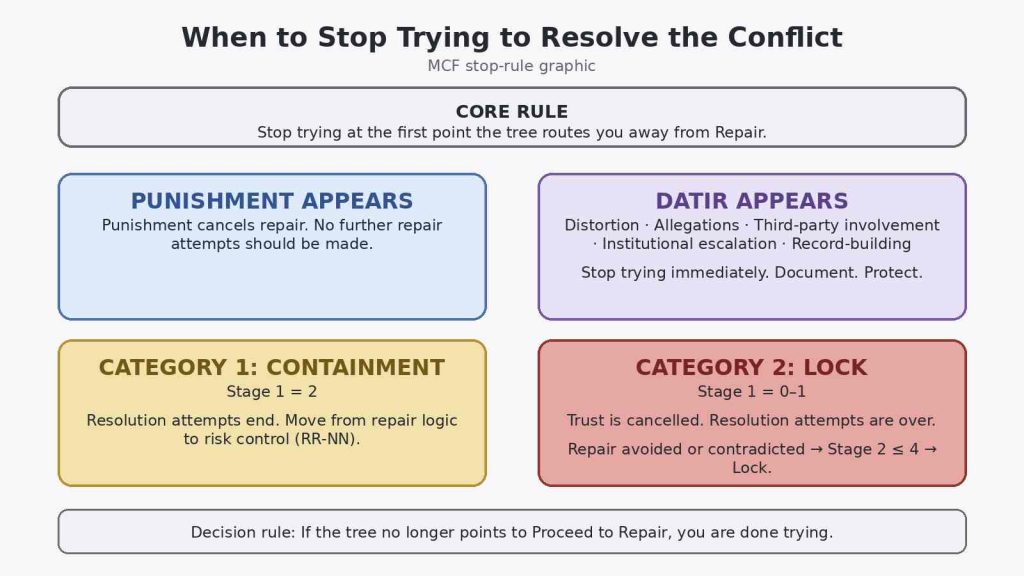
Punishment cancels repair.
Hidden punishment cancels trust.
Once trust is cancelled, the person becomes unsafe for unguarded access, engagement or proximity.
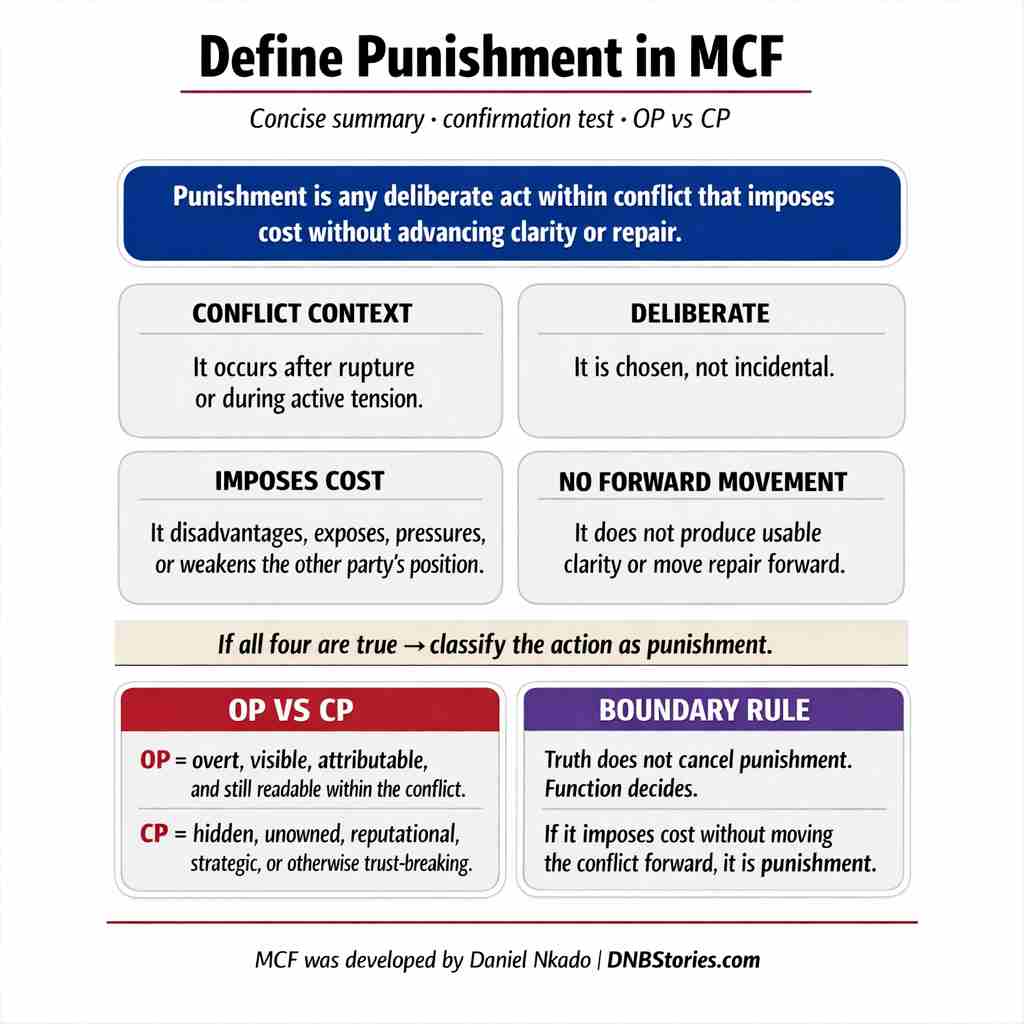
The MCF Punishment Doctrine
Punishment at any stage warrants a score of zero and activates a move to Protection.
a. Overt Punishment (OP)
Punishment that is direct, visible, and attributable. It openly imposes cost during the conflict, leaving no confusion about who is responsible. In some cases, overt punishment may carry a harm-reduction logic.
- Overt Punishment (OP) Example:
You ask privately for clarity, and the other person replies, “You are now embarrassing yourself. Keep pushing this and see what happens.”
This is still punishment, but it remains overt because it is direct, visible, and attributable.
b. Covert Punishment (CP)
Punishment that is hidden, unowned, humiliating, dominating, retributive, or carried out behind someone’s back, often under an innocent front. This form of punishment cancels trust.
- Covert Punishment (CP) Example:
Instead of speaking directly, someone tells others, “He is acting that way because I rejected him.”
They never say this to the target’s face, but quietly damage their standing behind the scenes.
MCF Protection Categories
Category 1 — Yellow Containment
Use when clarity yields no usable clarity through evasion, avoidance, or withdrawal, and the risk level remains unclear. It also applies when punishment is direct and open, but truth-revealing and harm-reducing rather than covert or harm-escalating.
Containment follows the RR-NN rule:
- R – Reduce contact
- R – Reduce exposure
- N – No chasing
- N – No stage
Exit from containment requires them to reopen clarity themselves and actively pursue repair. Containment cancels any prior trust mark, so trust must be rebuilt from scratch after the repair is complete.

Category 2 — Red Lock and Key
Use when hidden punishment appears, trust is cancelled, deception is active at a trust-breaking level, humiliation logic is confirmed, allegation or sabotage risk appears, or snaking is detected.
In MCF, snaking, or “moving like a snake,” refers to covert planning against you: backstage moves, quiet positioning, concealed coordination, underground narrative control, or other hidden preparation.
Red Response
Once Red is triggered, run MANDL:
M — Mark the person unsafe
A — Avoid engagement except for risk management
N — No assumption of goodwill
D — Do not trust words alone
L — Lock access
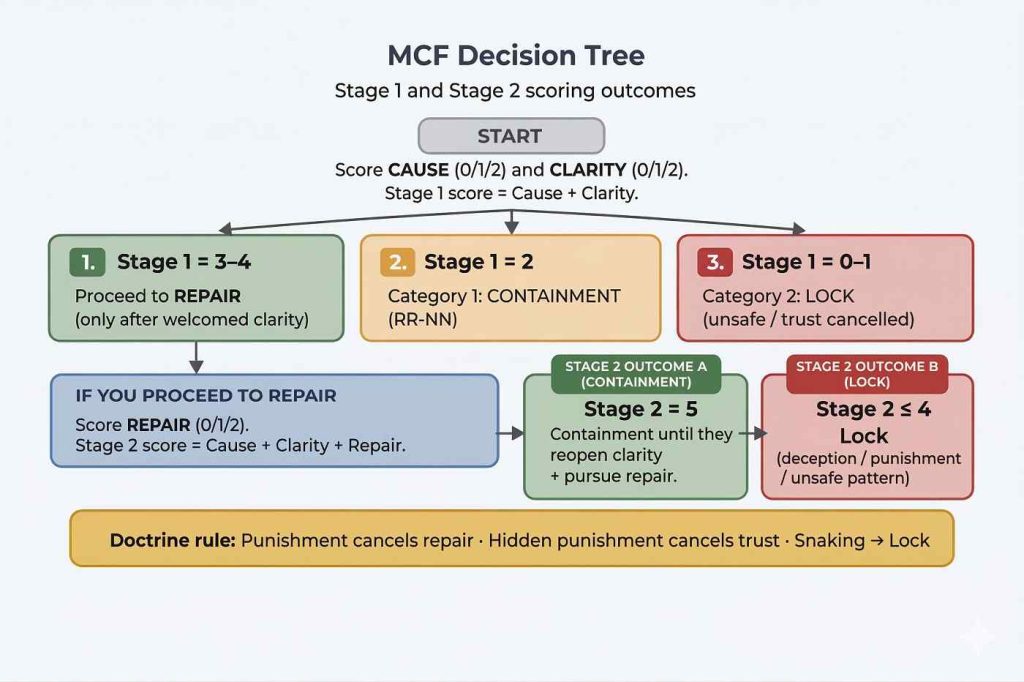
MCF: Quick Scoring Summary
Stage 1: Cause + Clarity
- 3 or 4 → Proceed to Repair
- 2 → Containment
- 1 → Lock and Key
- 0 → Ignore
Stage 2: Cause + Clarity + Repair
- 6 → Possible Trust Asset (PTA)
- 5 → Containment
- 4 or below → Lock and Key
Why MCF Works
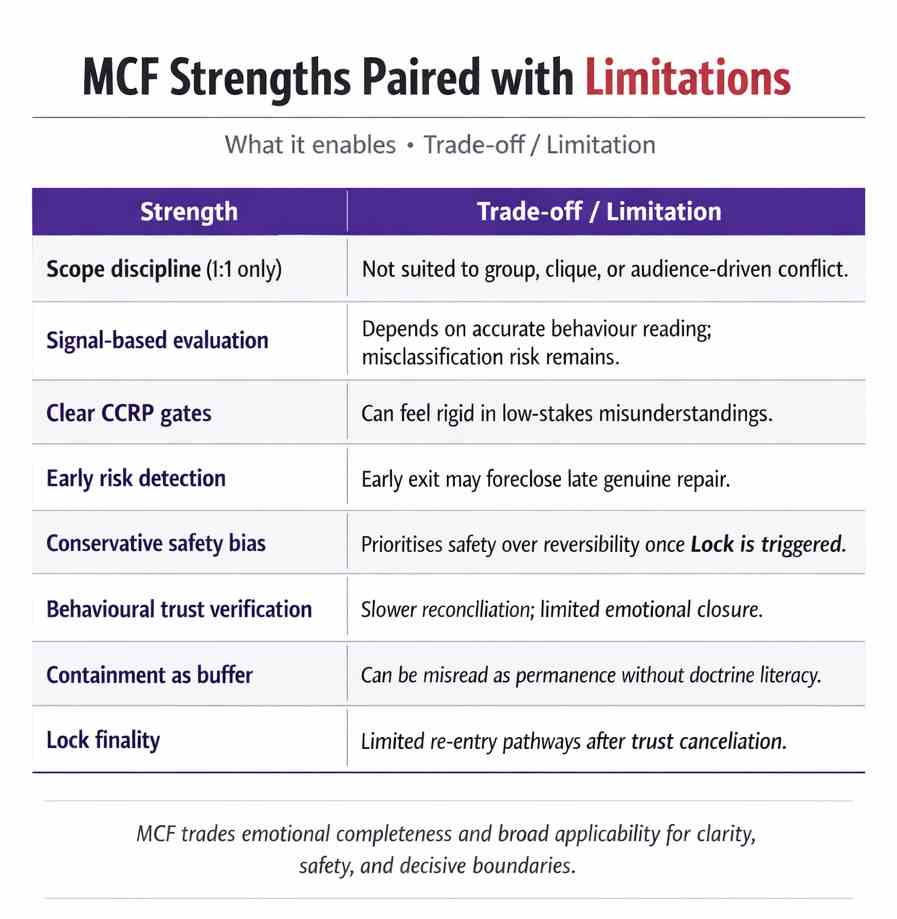
The Masculinity Conflict Framework (MCF) works because it relies on observable signals and behaviour rather than stories, apologies, or emotional performance. It is not built to redeem every conflict. Instead, it focuses on interpersonal conflict and helps users distinguish between repairable conflict and conflict that has become unsafe, deceptive, or harmful. When punishment, deception, or escalation emerges, MCF exits early to protect the user and reduce the risk of further damage. As a harm-minimisation framework, MCF is deliberately safety- and clarity-focused, prioritising firm boundaries over optimism, tolerance, or endurance.
Frequently Asked Questions—1
No. MCF was developed from conflict in Black queer and other male-coded, status-sensitive environments, but it is not biologically restricted to men. It is most useful wherever hierarchy, restraint, image control, and indirect dominance shape interpersonal conflict.
Cause is an early read, not a final verdict. In MCF, clarity is the true test.
Stop trying to resolve conflict when clarity fails, repair does not complete, or punishment or DATIR appears. If you see any sign of DATIR, start documentation and move to protection.
In MCF, punishment is any deliberate act within the conflict that imposes cost and does not advance Clarity or Repair. Examples include humiliation, retaliation, threats, reputation damage, or snaking.
Frequently Asked Questions—2
Rarely. Red is a protective state, not a feeling. It does not reverse through words or reassurance alone, but only through consistent, observable behaviour rebuilt from zero.
Causing harm does not entitle you to repair, but it does not prevent you from seeking clarity with the intention to amend the relationship. If punishment or deception appears in the process, protection rules still apply.
At Clarity, avoidance withholds the signal, while deception corrupts it. At Repair, avoidance withholds action, while deception falsifies it. In both stages of MCF, avoidance points to containment, while deception activates Lock and Key.
Public settings introduce audience and performance incentives that distort the signal. Private clarity offers the cleanest read.
References
- Giacobbi, M., & Lalot, F. (2025). Unpacking trust repair in couples: A systematic literature review. Journal of Family Therapy, 47(1). https://doi.org/10.1111/1467-6427.12483
- Owen, G., & Currie, G. (2021). Beyond the Crisis: Trust repair in an interorganizational network. Organisation Studies, 017084062110317. https://doi.org/10.1177/01708406211031732
- Pettit, C., Hellwig, A. F., Costello, M. A., Hunt, G. L., & Allen, J. P. (2024). You-talk in young adult couples’ conflict: Family-of-origin roots and sequelae of adult relational aggression. Journal of Social and Personal Relationships. https://doi.org/10.1177/02654075241270998
- Rogers, S. L., Howieson, J., & Neame, C. (2018). I understand you feel that way, but I feel this way: the benefits of I-language and communicating perspective during conflict. PeerJ, 6(1). https://doi.org/10.7717/peerj.4831
- Sharma, K., Schoorman, F. D., & Ballinger, G. A. (2022). How Can It Be Made Right Again? A Review of Trust Repair Research. Journal of Management, 49(1), 014920632210898. https://doi.org/10.1177/01492063221089897