Content note: This article discusses social exclusion, reputational harm, gossip, public shaming, minority stress[5], and some references to group sex and chemsex-adjacent social spaces.
Introduction: When Harm Does Not Need a Leader
In UK Black queer communities, harm does not always arrive through open confrontation. More often, it travels quietly — through humiliation disguised as jokes, gossip, screenshots, voice notes, group chats[6], cold greetings, and the carefully managed exclusion of one person from “the room.”
One of the most effective vehicles for this harm is an unofficial but highly destructive role I describe as the “runner” or “errand boy.” The term does not refer to literal drug running or party errands, although practical errands may sometimes overlap with the role.
In this context, a runner is a low-status, insecure, or peripheral participant who carries cruelty on behalf of a more powerful clique.
This article explains how the runner dynamic works, why people participate in it, and how healthier communities can interrupt the machinery of harm.
- Introduction: When Harm Does Not Need a Leader
- Why This Role is Very Dangerous
- What Are 'Runners' and 'Errand Boys'?
- Job Description of Runners in UK Black Queer Social Cruelty
- Why the Runner Role Matters
- Why People Become Runners
- Runners vs the Puppet-Patron Dynamic
- The Patron: Power From a Distance
- Spotting the Errand Boy: Warning Signs That Someone Is Acting as a Runner
- Envy, Past Grievance, and the Ease of Running Cruelty
- How to Neutralise Runner Behaviour
- Conclusion: The Runner Is a Warning Sign
- Frequently Asked Questions
- References
Why This Role is Very Dangerous
In most cases, the runner does not initiate the harm. He may not write the script, or even fully understand the real motive behind it. Yet he delivers it. He spreads the gossip, amplifies the joke, forwards the screenshot, repeats the accusation, and performs loyalty to the group by helping to damage the person the clique has marked for social punishment. His interest is not to understand the cruelty, but to prove his loyalty to the group he admires.
In my previous articles, I have used phrases such as “the petrol of group harm” and “parcel-deliverers of harm” to describe this front-facing role. Both phrases point to the same function: runners amplify harm and carry it from the point of group instruction directly to the target.
Because they often lack the internal foundation to say no, pause, or refuse, their insecurity makes them useful to a powerful clique. They do not need personal conviction to harm someone. Their motive is not truth, justice, or even full understanding. Their motive is approval. In their desperation to be liked, included, or protected by the clique, they may go to great lengths to cause harm — even if it means ruining genuine friendships, betraying people who cared for them, or exposing themselves to risks the clique cannot save them from.
Scope of the Article
This article examines how the runner role operates in some UK Black queer spaces, especially group chills, house parties, WhatsApp circles, chemsex-adjacent environments[3], semi-closed social-sexual networks, and orgies. The point is not to demonise Black queer gatherings. Pleasure and social organising are vital to Black queer life. The issue begins when a space rewards cruelty more reliably than conscience.
Stonewall’s 2018 LGBT in Britain: Home and Communities report found that 51% of Black, Asian and minority ethnic LGBT people had experienced ethnicity-based discrimination or poor treatment within their local LGBT community, showing that “community” is not automatically free from hierarchical sorting, exclusion, or harm[7].
What Are ‘Runners’ and ‘Errand Boys’?
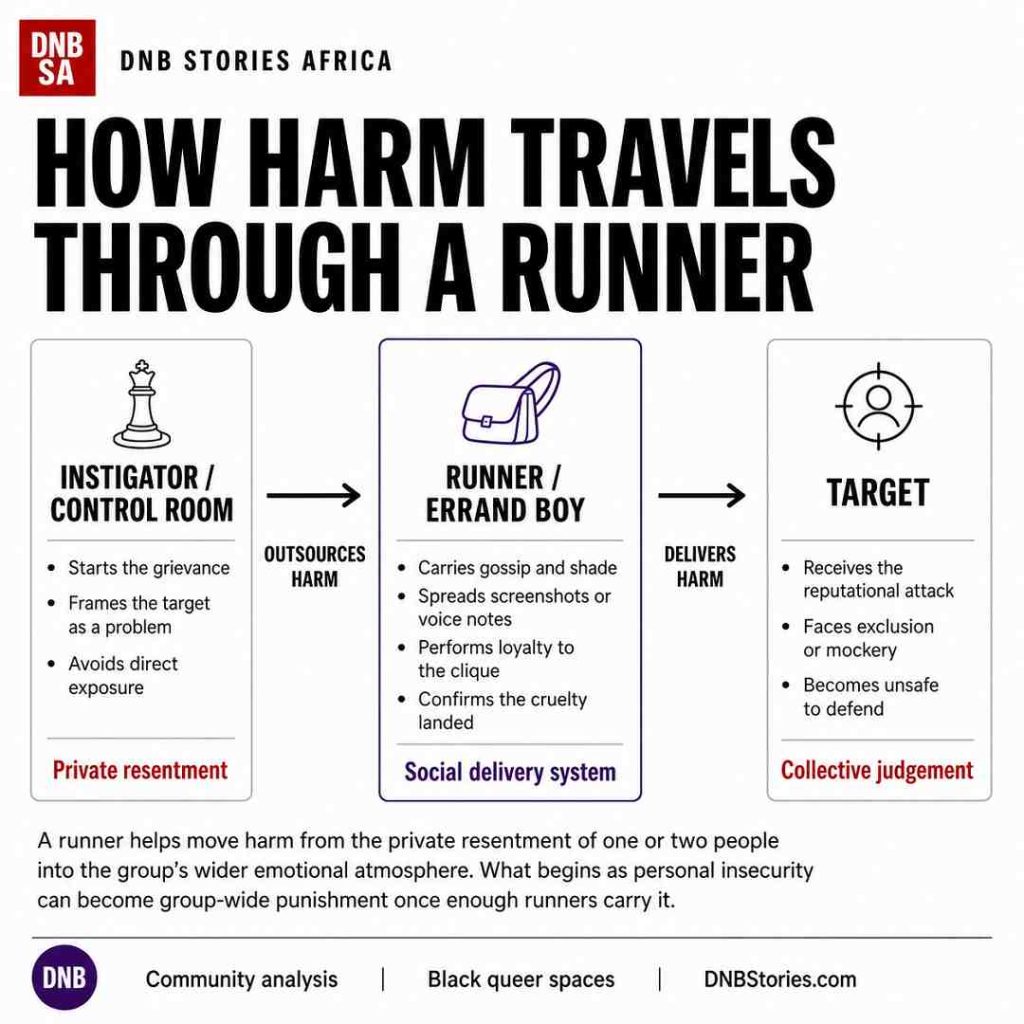
In the context of this article, a runner or errand boy is someone who helps distribute harm from a group, clique, or informal “control room” to a designated target. They are not necessarily the most powerful person in the room. In fact, their usefulness often comes from their insecurity and low social status. They may be tolerated rather than respected, invited but not fully embraced, kept near the circle but never at its centre — what I have previously described as being kept “on the balcony” at group chills, but never allowed into the main room.
Their reward is proximity, not genuine access. Their payment for this crumb of belonging is obedience and blind loyalty, carrying harm, and making sure it reaches the designated target. Like actual delivery workers, runners are often expected to confirm delivery — to prove to the group that the cruelty has landed.
Job Description of Runners in UK Black Queer Social Cruelty
A runner may:
- repeat damaging gossip to new listeners;
- laugh loudly at jokes designed to humiliate a target;
- forward screenshots and voice notes;
- exaggerate or reframe a target’s behaviour;
- bait the target into reacting, then present the reaction as “evidence”;
- organise or participate in group manipulation, gaslighting, and Truman Show-inspired social set-ups designed to confuse, destabilise, or provoke the target;
- help isolate someone by signalling that the room has turned against him;
- perform loyalty to the clique by showing he is willing to harm whoever the clique names.
In my previous article, I explained how a runner may destroy a genuine friendship where he was treated with care, simply to appease a clique that barely respects him. This detail matters. The runner often abandons real care for symbolic access. He trades a relationship that nourished him for a room that merely permits him. In Black queer contexts, this may be one of the deepest forms of self-betrayal: sacrificing genuine connection for conditional proximity to people who see him as useful, but not valued.
Why the Runner Role Matters
The runner helps solve a problem for the instigator. Most instigators do not want to look openly cruel. They may also have a stronger internal mechanism — though one organised around cruelty rather than care — and a better understanding of risk. For that reason, they need distance from the damage. They want to minimise direct association, reduce personal exposure, and avoid the moral burden of doing the dirty work themselves[1].
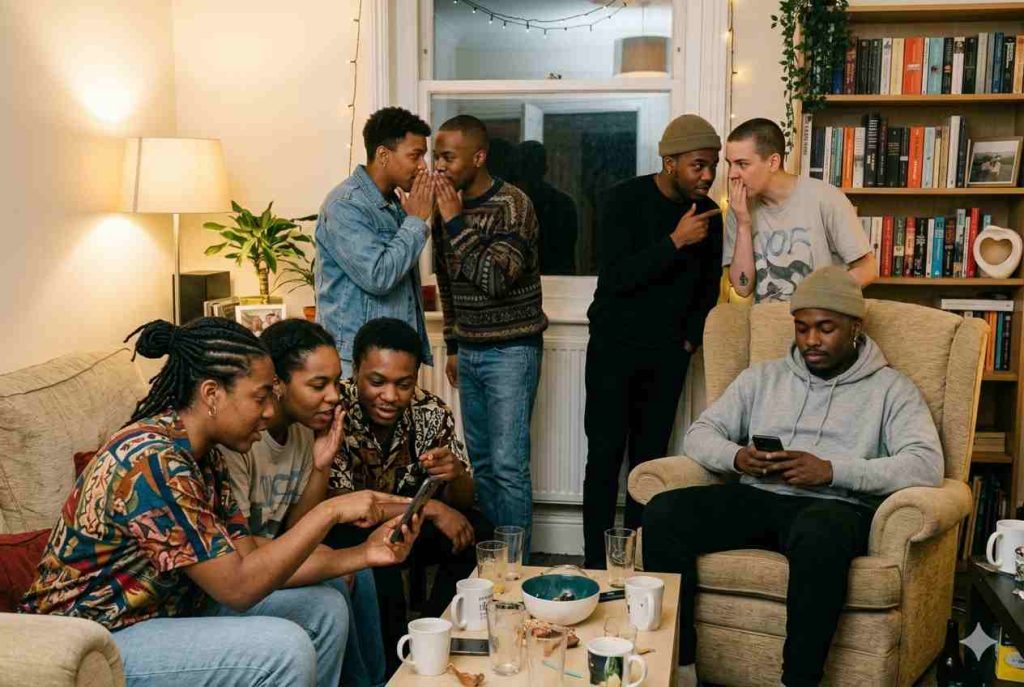
The runner becomes useful because he carries the harm on their behalf. He spreads the rumour, delivers the message, laughs first, asks the baiting question, or “accidentally” brings up the target in the group chat[6]. In this way, the instigator keeps their hands clean while the runner becomes the visible vehicle of the cruelty.
The runner provides this distance. He makes it possible for the clique to say:
“We didn’t do anything. People just started noticing.”
How Instigators Outsource Personal Vendettas to Runners
In tight-knit group chills and chemsex-adjacent gatherings, personal grudges rarely erupt into open confrontation[3]. More often, high-status instigators outsource harm to lower-status runners. The result is a calculated system of plausible deniability: the attack is amplified, circulated, and socially enforced, while the instigator remains safely above the fray.
This usually unfolds through a five-step process.
The 5 Steps of Outsourcing Harm in Black Queer Social Spaces
1. Identification of a Threat
The instigator perceives a challenge to their status, desirability ranking, influence, or social control. Jealousy, resentment, or the memory of a perceived slight begins to take root.
2. Collective Framing
The private grudge is then disguised as a matter of public concern. The instigator reframes the target as a community problem: “He is problematic,” “He disrespects the room,” or “People are starting to notice him.” In this way, a personal grievance is converted into a collective moral frame.
3. Subtle Signalling
Direct orders are usually avoided. Instead, the instigator relies on coded language, private whispers, suggestive comments, sighs, side-eyes, or carefully timed observations to activate selected runners. The message is clear without ever being stated plainly.
4. Delegation and Execution
Desperate for inclusion, runners become what I have elsewhere called the “petrol of group harm.” Like worker termites starving for wood, they gather at the feet of the instigator, who often uses coded language, suggestion, and emotional blackmail or manipulation to assign them specific parts of his plan to carry out.
Their roles might include:
- spreading targeted gossip and voice notes;
- amplifying shade in group chats;
- coordinating exclusion, mockery, public shaming, or social humiliation;
- participating in group manipulation and gaslighting of the target;
- gaining access to the target and spreading harm from within;
- baiting the target into reactions that can later be used as “evidence.”
5. Diffusion and Reward
Once the harm spreads, accountability dissolves into the crowd: “Everyone was saying it.” The instigator claims neutrality or innocence, while the runner is rewarded with an invite, timed proximity, or temporary protection. In reality, the runner has been used to solve a personal problem that never truly involved him.
By the end of it, he may have ruined friendships or partnerships that once nourished him. And when people later describe the cruelty they suffered, they may remember the runner’s face, voice, screenshots, jokes, or direct actions — while the instigator remains unnamed, untouched, and socially protected.
This is the final trap of the role: the runner’s reputation does not climb. He remains low-status, useful, and disposable, while the instigator preserves his position and ensures that runners stay exactly where he needs them — beneath him, available, and ready to serve again.
This is how you get 40-year-old Black queer men still performing runner duties — still carrying other people’s vendettas, still mistaking usefulness for status, still confusing proximity to power with actual belonging.
Why People Become Runners
Most runners are not born cruel. Many become cruel because they are afraid.
1. Fear of Exclusion or Ostracism Anxiety
Ostracism research shows that being ignored, excluded, or rejected can create pain, distress, sadness, anger, and threats to fundamental human needs, including belonging and self-esteem (Williams, 2007).
In minority communities where affirming spaces are scarce, exclusion can feel bigger than ordinary rejection[9]. It can feel like social death. Minority stress[5] can intensify this impact.
For some Black queer men, losing access to a group may also mean losing sexual access, friendship access, party access, or the ability to boast of association with high-status community members — what some community spaces describe as “current tapping.”
That fear can make cruelty feel like the price of survival.
The runner begins to think:
“If I do what they want, they will keep inviting me.”
This is the quiet bargain, almost like a blood-money dynamic: wound someone for the group, and the injury becomes your membership fee[8].
2. The Need for Proximity to Status
Some runners feel socially insecure within the group. They are not fully inside, but they are close enough to crave deeper entry. They may be allowed into the party but not into the main room; may be invited to the group chill but kept on the balcony — used for errands, gossip, validation, or entertainment — but never treated as equals.
The runner mistakes proximity for belonging. Desperate to stay close, he surrenders himself to the group, allowing the clique to use him as it pleases. So when the clique gives him a task, he experiences it as recognition. Being asked to carry harm makes him feel useful, even needed; being useful makes him feel included and being included makes him feel temporarily safe.
With enough manipulation from a clever instigator, the runner may even perform the task with excitement, believing he has finally been chosen. But that safety is false. For someone starving for belonging, crumbs can feel like a feast.
Runners vs the Puppet-Patron Dynamic
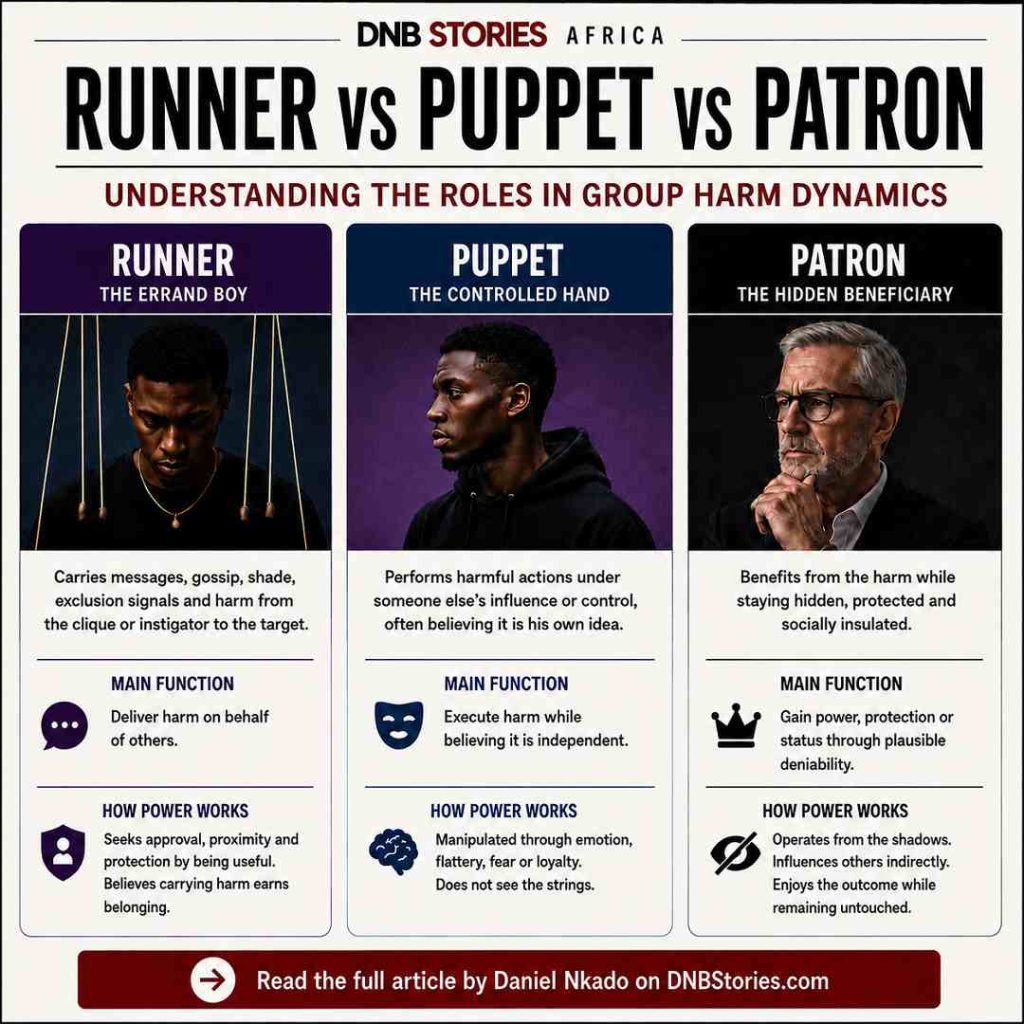
1. A runner or errand boy carries harm from the clique to the target. He is usually low-status, insecure, and seeking access, which makes him useful to people with more social power. His role reveals how harm is distributed across the social field: gossip, mockery, screenshots, exclusion signals, and reputational attacks do not spread on their own. Someone carries them.
2. A puppet organises or performs harm under another person’s influence or control, often without recognising the hidden hand shaping his behaviour. He may believe he is acting independently, but his actions are being directed, encouraged, or rewarded by someone else — often a higher authority he cannot clearly see. The puppet reveals how hidden power acts through another body, making one person the public face of social cruelty while another quietly shapes, benefits from, or protects the action.
The Patron: Power From a Distance
A patron is a privileged beneficiary who enjoys the puppet’s actions while remaining hidden, protected, and socially insulated. The patron is usually higher-status, strategic, or positioned far enough from the visible cruelty to avoid direct accountability.
The patron does not even need to meet the puppet face-to-face. This moves the dynamic beyond simple interpersonal manipulation and into the realm of structural influence. In highly stratified social spaces, a high-status person does not always need to give direct orders. They only need to signal a preference, a dislike, a boundary, or a withdrawal of approval.
Because the patron holds the keys to access, desirability, protection, or status, the social ecosystem does the rest. The patron sits at the top of the machinery of harm, keeping their hands clean while absorbing the social benefits of the target’s removal, humiliation, or reputational weakening.
Power does not always need to touch the weapon. Sometimes it only needs to make the weapon feel useful.
The Instigator May Be A Puppet To White Authority
In Black queer dynamics, the instigator may himself be a puppet to a wider white authority patron, often without realising it. He may believe he is acting independently, defending the group, enforcing standards, or protecting his status, when in reality his behaviour is reproducing a hierarchy designed elsewhere.
In this sense, the patron need not always appear in the room. White authority can operate as an inherited script, a status system, a desirability hierarchy, or an institutional logic that the instigator has absorbed and now enforces through other Black queer people.
A Real-World-Style Example of How Runners, Puppets, and Patrons Operate
Imagine a wealthy white man — let’s call him Mr P — who invites several Black men to a private party. He carefully signals that he is interested only in “very masculine” and “well-endowed” Black men. On the surface, this may seem like nothing more than a personal preference. But the preference is not neutral. It creates a ranking system before anyone has even entered the room.
At the event, the Black men find themselves drawn into a subtle competition over masculinity, sexual performance, straight-passing brand work, desirability, and dominance posturing. Soon, performances of hypermasculinity and straightness intensify. The white patron watches without appearing to intervene, presenting himself as a neutral observer. But his neutrality is deceptive. He has already set the conditions of value.
The Black men competing in the room may not realise they have been pulled into a racial script that ties Black desirability to masculinity, sexual prowess, physical dominance, and emotional hardness. As more Black men internalise this construct, they may turn away from other routes to value, respect, tenderness, creativity, and social power. The space remains organised around the white patron’s gaze, even when he says very little or presents himself as carefree.
During the same event, one Black man — let’s call him Mr M — sees himself as the highest-ranking figure in masculinity. But when another Black man — let’s call him Mr D — appears to threaten that status, Mr M experiences a masculinity threat. He identifies Mr D as a target.
Masculinity Competition and Threat Elimination
Later, back within his Black queer clique, Mr M begins to instigate harm. He mobilises lower-status members of the group — let’s call them Mr K and Mr S — who are desperate for his approval. These runners then carry out reputational harm against the man who threatened Mr M’s masculinity and social standing. They may spread gossip, mock him, question his desirability, circulate private information, or frame him as a problem within the group.
At one level, Mr M appears to be the instigator. He is directing the runners, protecting his status, and using them to punish a perceived rival. But at a deeper level, Mr M may also be functioning as a puppet within a larger patron structure. He may believe he is acting independently, when in fact he is enforcing the very racial script introduced by Mr P. By turning his insecurity into a campaign against another Black man, he further splits his own community, making the racial script harder to recognise and resist.
How the Patron Masterminds the Conflict Without Entering It
This is how the puppet-and-patron dynamic can operate across layers. Mr P does not need to order Mr M to attack anyone. He does not need to meet Mr K or Mr S. He only needs to establish the ranking system: masculinity, endowment, dominance, sexual access, and proximity to whiteness. Once that hierarchy is installed, the social ecosystem begins to police itself.
Mr M becomes both instigator and puppet while Mr K and Mr S become runners. Mr P remains the patron — distant, insulated, and protected — while Black queer men compete, discipline, and wound one another inside a value system they did not create.
The final harm, then, is not only interpersonal. It is structural. A white patron’s racialised desire sets the stage; a Black instigator internalises the ranking; low-status runners carry the punishment; and the target absorbs the damage. Everyone below the patron appears to be acting freely, but the room has already been organised by a hierarchy that benefits the person standing furthest from the visible cruelty.
Research Supports That Masculinity Threat Can Lead To Aggression and Covert Planning
There is a strong research base showing that masculinity threat can trigger aggression, especially when a man experiences his masculinity as unstable, publicly challenged, or in need of proof[4].
Research on precarious manhood shows that masculinity is often experienced as a fragile social status that must be repeatedly proven. When that status is threatened, some men respond with compensatory aggression, dominance displays, or attempts to reassert control[2].
In Black queer social contexts, this can help explain why a perceived challenge to masculinity, desirability, or sexual rank may trigger not only direct hostility, but also reputational aggression carried out through runners.
Spotting the Errand Boy: Warning Signs That Someone Is Acting as a Runner
Because a runner’s primary function is delivery rather than strategy, the behaviour often becomes visible once you know what to look for. Runners are usually driven by a desperate need for inclusion and a fear of ostracism, which can make them reactive, inconsistent, and highly dependent on the group’s emotional temperature.
Someone may not be a runner permanently, but they may act as one when they begin carrying harm, gossip, exclusion signals, or group punishment on behalf of a higher-status clique, instigator, or patron.
Below are some common behavioural warning signs.
1. The Borrowed Grudge
One of the clearest signs of runner behaviour is hostility without a clear origin story. If you ask them directly why they have an issue with the target, they struggle to name a specific personal injury. Instead, they rely on vague, borrowed, or parroted talking points supplied by the instigator.
What it sounds like:
“He just has bad vibes.”
“He doesn’t know his place.”
“We just don’t trust him.”
The tell:
Their anger is disproportionate to their actual lived experience with the target. The grudge does not truly belong to them; they are simply holding it for someone else.
2. Conditional Hostility
A runner’s courage is often situational. Because the hostility is not rooted in a strong personal conviction, their treatment of the target changes depending on who is watching.
In a group, they may become loud, dismissive, mocking, or quick to throw shade, performing loyalty for the “control room.” But one-to-one, they may become avoidant, unusually quiet, overly cordial, or suddenly unsure of themselves. This inconsistency reveals the performance. Their hostility depends less on truth than on the audience.
3. Weaponised Information Gathering
Runners often act as the eyes and ears of the clique. They may engage in fishing expeditions to extract information, provoke reactions, or collect material to bring back to the group.
They may ask leading questions, pretend to be sympathetic, provoke the target into frustration, or create situations that make the target more likely to respond emotionally. The harvested material is then repackaged as proof: screenshots, voice notes, selective quotes, exaggerated gossip, falsifications, or distorted interpretations.
The goal is not understanding. The goal is material.
4. The Messenger of Manufactured Consensus
To avoid individual accountability, runners often frame their cruelty as the group’s objective will. They hide behind plural language to make the target feel isolated.
What it sounds like:
“Everyone is saying it.”
“What did you do that made everyone hate you?”
“He says you’re always doing too much — but don’t mind him.”
The reality:
There may be no real consensus. There may only be an instigator’s frame, repeated enough times by runners until it begins to feel like a collective truth.
5. Proximal Arrogance
When a low-status or previously insecure person suddenly becomes smug, overconfident, or socially bold in ways that do not match their actual standing, they may have secured temporary protection from a clique or patron.
This is proximal arrogance: the borrowed confidence of someone who feels shielded by those more powerful than he is. It may show up through name-dropping, exaggerated claims of closeness, superficial inclusion in exclusive plans, or a sudden willingness to disrespect people he would not confront without backup.
The arrogance is not rooted in self-worth. It is borrowed from proximity.
6. The Bait-and-Retreat Tactic
A runner may deliver a snide joke, sharp insult, passive-aggressive comment, or public provocation, then immediately retreat if confronted directly. He may deny intent, act confused, play the victim, or accuse the target of overreacting.
This is because the runner is built for delivery, not sustained confrontation. His job is to inflict harm, provoke a reaction, and return to the group with evidence that the target is “unstable,” “aggressive,” or “doing too much.”
He throws the stone, then hides inside the crowd.
Envy, Past Grievance, and the Ease of Running Cruelty
Runner behaviour becomes easier when the runner already carries envy, resentment, or an unresolved grievance toward the target. In these cases, the clique does not need to create hostility from nothing. It only needs to activate what was already there.
The runner may have felt overlooked by the target, rejected by him, corrected by him, outshone by him, or quietly threatened by his confidence, desirability, independence, or social ease. Even if the past grievance was minor, exaggerated, or never directly addressed, it can sit beneath the surface as emotional material waiting to be used. When the instigator then marks the target as a problem, the runner experiences the group’s cruelty as permission. What he previously could not justify alone now feels authorised by the room.
Envy as a Catalyst of Group Harm
This is why envy is such a powerful accelerant in group harm. It allows the runner to disguise personal resentment as moral concern. He is no longer simply angry that the target did not validate him, include him, desire him, defer to him, or treat him as important. He can now say the target is “problematic,” “arrogant,” “fake,” “too much,” or “bad for the group.” The language changes, but the emotional root remains.
Past grievance also reduces hesitation. A runner with no personal feeling toward the target may need more persuasion before carrying harm. But a runner who already feels wounded, inferior, rejected, or resentful is easier to mobilise. The instigator only has to give shape to the resentment and provide social cover for it. Once the runner believes the group is on his side, he may pursue the target with unusual intensity, not because the harm is justified, but because it finally gives him a socially acceptable outlet for his private bitterness.
This is where the danger deepens. The runner begins to believe he is serving accountability when he is actually laundering envy through the group. He calls it protection, loyalty or simply “saying what everyone is thinking.” But underneath the performance, old resentment is being given fresh permission to act.
In this sense, runners do not always carry harm only because they are obedient. Sometimes they carry it because the group has finally handed them a weapon they had long been looking for.
How to Neutralise Runner Behaviour
When a runner approaches you with delivered harm — whether gossip about someone else or a manufactured attack against you — the most effective defence is friction.
Runners rely on smooth, unchallenged delivery. If you interrupt the movement, you weaken the machine.
Ask for specifics:
“What exactly do you mean by that?”
“Why are you telling me this?”
Force individual ownership:
“I am not asking what ‘everyone’ thinks. I am asking why you are saying this to me right now.”
Refuse emotional harvest:
“I hear you.”
“That is noted.”
“I am not discussing this in a crowd.”
The goal is not to win a performance. The goal is to deny the runner the reaction, confusion, or emotional material he was sent to collect.
A runner’s power depends on movement. Slow him down, ask for clarity, make him own his words, and the delivery system begins to fail.
Conclusion: The Runner Is a Warning Sign
The runner’s role is not simply an individual moral failure. It is a warning sign that a community’s reward system has become distorted.
When insecure people gain belonging by carrying cruelty, the group has created a market for harm. When gossip earns invitations, gossip will grow; likewise, when humiliation earns laughter, humiliation will spread; and when silence earns safety, conscience will become expensive.
Naming the runner matters because it makes the machinery of harm visible. Once visible, it can be interrupted.

Frequently Asked Questions
A runner is someone who carries harm from a clique, instigator, or informal “control room” to a designated target. In Black queer social dynamics, runners may spread gossip, amplify shade, circulate screenshots, provoke reactions, or help enforce exclusion in exchange for proximity, approval, or temporary belonging.
People may become runners because they fear exclusion, crave approval, or desperately want access to higher-status people in the community. In spaces where belonging feels scarce, some people may carry cruelty as a membership fee, mistaking temporary usefulness for genuine acceptance.
A runner carries harm from the group to the target. A puppet performs harm under another person’s influence or control, often believing he is acting independently. A runner explains how harm travels; a puppet explains how hidden power acts through another body.
Warning signs include borrowed grudges, sudden hostility without personal cause, repeating vague group claims, fishing for private information, delivering insults in public, hiding behind “everyone is saying it,” and becoming arrogant after gaining temporary protection from a clique.
The puppet-and-patron dynamic describes a system in which one person publicly inflicts harm while another quietly benefits from it. The puppet becomes the visible actor — spreading gossip, organising exclusion, provoking the target, or carrying out social cruelty — while the patron remains hidden, protected, and socially insulated.
References
- Bandura, A. (1999). Moral Disengagement in the Perpetration of Inhumanities. Personality and Social Psychology Review, 3(3), 193–209. https://doi.org/10.1207/s15327957pspr0303_3
- Bosson, J. K., Vandello, J. A., Burnaford, R. M., Weaver, J. R., & Arzu Wasti, S. (2009). Precarious Manhood and Displays of Physical Aggression. Personality and Social Psychology Bulletin, 35(5), 623–634. https://doi.org/10.1177/0146167208331161
- Jaspal, R. (2022). Chemsex, Identity and Sexual Health among Gay and Bisexual Men. International Journal of Environmental Research and Public Health, 19(19), 12124. https://doi.org/10.3390/ijerph191912124
- Lorenz, L. L., Hüther, L., Steffens, M. C., Niedlich, C., Wesnitzer, H., & Kachel, S. (2026). Masculinity Threat in Heterosexual Men: A Comprehensive Meta-Analysis of Experimental Research with Recommendations for Future Theory Building and Research Practice. Personality and Social Psychology Review. https://doi.org/10.1177/10888683261433109
- Meyer, I. H. (2003). Prejudice, social stress, and mental health in lesbian, gay, and bisexual populations: Conceptual issues and research evidence. Psychological Bulletin, 129(5), 674–697. https://doi.org/10.1037/0033-2909.129.5.674
- Muir, S. R., Roberts, L. D., Sheridan, L., & Coleman, A. R. (2023). Examining the role of moral, emotional, behavioural, and personality factors in predicting online shaming. PLOS ONE, 18(3), e0279750–e0279750. https://doi.org/10.1371/journal.pone.0279750
- Stonewall. (2018, June 27). LGBT in Britain – Home and Communities (2018). Stonewall. https://www.stonewall.org.uk/resources/lgbt-britain-home-and-communities-2018
- Tate, M. C., Thrasher, S. S., Watts, K. J., Otachi, J. K., Griffin, D., & Moore, J. X. (2025). The Paradox of Belonging: Minority Stress, Community Belongingness, and Subjective Well-Being Among Black LGBTQ+ Adults. Behavioral Sciences, 15(12), 1604. https://doi.org/10.3390/bs15121604
- Williams, K. D. (2007). Ostracism. Annual Review of Psychology, 58(1), 425–452. https://doi.org/10.1146/annurev.psych.58.110405.085641
- Wright, J. (2025). Lateral Gender-Based Violence in 2SLGBTQ+ Communities: The Stifling of Queer Joy Through Intersectional Oppression, “Pitiful” Sexuality Education, and Media (Mis)Representation. Journal of Homosexuality, 1–25. https://doi.org/10.1080/00918369.2025.2489454