
In close-knit Black queer communities, triangulation refers to a manipulative strategy where a person avoids resolving an issue directly with someone and instead pulls a third party—or several third parties—into the dynamic to create division, isolate the target, or damage the target’s relationships with others.
In Black queer spaces, where belonging can already be hard-won and many queer individuals rely heavily on chosen family and tight social circles for emotional support, triangulation can become a tool of control.
Manipulative queer men use different triangulation tactics, including gossiping to third parties and distributing cropped screenshots, edited videos, or voice notes to push a narrative designed to divide the target from his friends.
But one triangulation strategy deserves particular attention because of how deeply and immediately effective it can feel once deployed. This is what I call staged-affection triangulation — or, informally, the Macos Threesome.
This article explains how manipulative queer men may use staged-affection triangulation to provoke jealousy, isolate a target, fracture friendships, and control social power within Black queer spaces.
- What Is the Macos Threesome?
- 9 Core Functions of Staged-Affection Triangulation
- Staged Affection as a Form of Relational Aggression
- Real-World Example of a Macos Threesome
- How to Respond If You Find Yourself in a Macos Threesome
- What the Displayed Favourite Should Do
- Ethical Caution and How to Spot a Staged Affection Triangulation
- References
What Is the Macos Threesome?
The Macos Threesome, or staged-affection triangulation, is a calculated dynamic involving three or more people, set up by a manipulative queer man who deliberately showers one person with visible attention, warmth, intimacy, or exaggerated care in order to provoke jealousy, rivalry, and emotional distress in another.
In many cases, power and the need for control — not genuine desire — drive the display. The manipulative person uses staged affection to control the emotional atmosphere and punish the target by making them feel displaced or replaceable. Where the third person and the target already share a relationship, the manipulator uses the strategy to plant a rift between the target and their friend.
Scope of Article
To be clear, this article does not suggest that every triad or threesome situation, flirtation, shifting friendship, or new connection is manipulative. Consenting adults are free to pursue their desires, and new bonds can form naturally. The concern begins when intimacy is deliberately staged and weaponised — not as a genuine connection, but as a way to destabilise, punish, or isolate a person from their friends.
How the Macos Threesome or Staged Affection Dynamic Works
This manipulative strategy usually involves three or more people:
- The Director: This is the manipulative person who controls the emotional performance. They orchestrate the dynamic, distribute attention unevenly, and use visible warmth toward one person to destabilise another.
- The Displayed Favourite: The recruited third party who receives exaggerated warmth, attention, praise, intimacy, or visible special treatment within the staged dynamic.
- The Disoriented Target: This is the person made to watch, compare, doubt themselves, or feel replaced by the uneven performance of attention, warmth, and care.
The displayed favourite may not always know they are being used. In some cases, they may simply enjoy the attention. In other cases, they may slowly become a pawn in someone else’s private conflict.
The target, meanwhile, is pushed into a painful double bind. If they react, they may be labelled jealous, insecure, dramatic, or controlling. If they stay silent, the staged hierarchy continues. This is why the tactic is effective: it creates injury while making the injured person look unreasonable for naming it.
9 Core Functions of Staged-Affection Triangulation
The Macos Threesome, or staged-affection triangulation, may look casual on the surface — a flirtatious joke, a sudden display of warmth, a public compliment, a visible preference — but within the triangulation dynamic, these gestures serve a deeper function.
The aim is to unsettle the target, manipulate the emotional atmosphere, and place the manipulative person at the centre of control. By understanding these functions, the tactic becomes easier to recognise and harder to internalise.
1. Staged Affection Triangulation Is Used To Provoke Jealousy
One of the primary functions of staged affection is to provoke jealousy. The manipulative person gives visible attention, praise, flirtation, or warmth to one person while ensuring the target notices the contrast.
This creates a painful emotional comparison: one person is publicly favoured, while the other is made to feel displaced, unwanted, or replaceable.
2. To Create Emotional Confusion
Staged affection works because it often operates through ambiguity. Unlike a direct insult or open confrontation, the harm is indirect and difficult to prove. The target may sense that something is being performed against them, but when they try to name it, they risk being accused of jealousy, insecurity, or overreaction.
This creates emotional confusion. They begin to question their own perception, moving between hurt, anger, embarrassment, and self-doubt. When the target is not equipped to read the manipulative person’s mechanics, they may feel pressured to win back the manipulator’s attention through compliance, or they may spiral into anger, shame, and self-blame.
3. To Punish the Target
Staged affection can function as punishment. Instead of addressing a grievance directly, the manipulative person performs closeness with someone else as a form of retaliation.
This may happen after the target asserts a boundary, refuses control, challenges the manipulator, or fails to behave as expected. The unspoken message becomes: You displeased me, so I will show you how replaceable you are.
The punishment is rarely announced. It is staged.
4. To Create Rivalry
Another function of staged affection triangulation is to manufacture rivalry between people who may otherwise have had no previous conflict.
The manipulative person creates a triangular dynamic that pushes two people into competing for his attention, status, intimacy, or approval. This becomes especially damaging when the third person is a friend, partner, or associate of the target, because the tactic can turn friends, peers, or community members into perceived rivals.
The manipulator benefits from the tension because the rivalry positions him as the central prize — the figure who chooses or decides who is special and who is not.
5. To Isolate the Target From Friends
In close-knit Black queer communities, damaging one trusted bond can have wider social consequences. If the third person is part of the target’s friendship circle, staged affection can be used to plant mistrust, resentment, or emotional distance between them.
This is arguably the most destructive function of staged-affection triangulation. It does far more than wound the target’s feelings; it fractures their social network.
By planting distrust within the target’s friendship circles — often reinforced through calculated gossip, falsifications, and selective storytelling — the manipulator aims to leave the target isolated, unsupported, and easier to control.

6. To Control the Emotional Atmosphere
The manipulative person also uses staged affection to control the emotional temperature of the room.
By deciding who receives warmth and who is frozen out, they turn their attention into social currency. People begin to watch their cues, adjust their behaviour, and try to remain in their favour. The manipulative person becomes the emotional centre of the space: their approval becomes desirable, and their withdrawal becomes threatening.
This gives them power not only over the target but over the wider group dynamic.
7. To Make the Target Appear Unstable
Another deeply insidious function of staged affection is its ability to turn the target’s legitimate reaction into evidence against them.
If the target reacts, confronts the behaviour, or expresses visible pain, the manipulator can quickly flip the narrative — reframing the target as jealous, dramatic, possessive, or fundamentally unstable. To outsiders who did not witness the slow, calculated build-up, the target’s justified response may be misread as a sudden, irrational outburst.
8. To Gain Social Power
With a carefully engineered staged-affection dynamic, a manipulative person can establish a temporary social hierarchy that places him at the centre of social judgment. He becomes the ranker — the figure who grants desirability approval, controls who receives social attention, and trains the group on who to dismiss.
The favoured person may feel special. The target may feel pressured to fight for the manipulator’s approval. The wider group may begin to organise itself around the manipulator’s preferences. Over time, this can give him influence over social narratives, invitations, alliances, and reputations. Through staged affection triangulation, a manipulative queer man can turn affection into a ranking system.
9. To Create Dependency
The final function of the Macos Threesome, or staged-affection triangulation, is to create dependency.
After destabilising the target through jealousy, confusion, exclusion, or humiliation, the manipulative person may offer small moments of warmth, reassurance, or attention. For a target who already feels emotionally unsettled, these brief gestures can feel soothing.
The target may begin seeking relief from the same person who caused the distress. This creates a harmful cycle: the manipulator manufactures insecurity, rations comfort, and keeps the target increasingly invested in winning back his attention.
That is the greater danger of staged affection triangulation: it can make a person seek reassurance from the very source of their own destabilisation.
Staged Affection as a Form of Relational Aggression
Relational aggression is a non-physical form of bullying designed to harm an individual by deliberately manipulating, damaging, or threatening their social standing and interpersonal bonds.
Rather than relying on direct confrontation, perpetrators use covert tactics such as exclusion, gossip, rumour-spreading, and social manipulation to inflict emotional distress and assert control within group hierarchies. As psychological research shows, these behaviours are intended to fracture a person’s sense of belonging, damage their reputation, and engineer social insecurity.
The Macos Threesome belongs in this family of behaviours because its damage is relational. It does not need shouting, threats, or direct insults to work. Its message is often communicated through contrast:
“You are not the chosen one.”
“You are replaceable.”
“Watch how warmly I can treat someone else.”
“React, and I will call you insecure.”
This is why staged affection can destabilise the target so deeply. The manipulator does not simply give one person attention; he stages that attention to publicly demote another person. He uses affection to create humiliation, insecurity, or emotional displacement, turning warmth into a social weapon.
Real-World Example of a Macos Threesome
To illustrate how this manipulative dynamic operates in real life, let’s consider a practical scenario within a Black queer collective.
CJ and Daniel are close friends who naturally occupy a respected position within the group’s masculinity hierarchy. Their bond is visible, trusted, and socially influential. Then Marcus enters the space — an outsider who performs hypermasculinity and quickly recognises that their unified friendship poses a threat to his desired dominance within the group.
Rather than confronting either man directly, Marcus begins orchestrating a calculated triangulation.
He initiates the Macos Threesome by strategically directing conspicuous attention, warmth, and exaggerated care towards CJ, while subtly sidelining Daniel. He laughs loudly at CJ’s jokes, praises his masculinity, invites him to his chills and private parties, seeks him out in group settings, and performs a sudden closeness that appears affectionate on the surface. But, in reality, he carefully designs these displays so they become impossible for Daniel not to notice.
Even when Daniel is not present to witness the staged affection directly, Marcus finds ways to make sure he knows about it. He calls Daniel afterwards, casually revealing that he was with CJ. Behind the scenes, Marcus reinforces the divide through selective whispers and gossip. To onlookers, he casually suggests, “Daniel has become rather arrogant lately, hasn’t he?” while privately warning CJ, “Daniel seems jealous of our connection, you know?” In doing so, Marcus plants distrust in CJ’s mind while ensuring Daniel feels increasingly displaced.
The Aftermath: The Friendship is Destroyed
Predictably, tension begins to build between CJ and Daniel. Daniel senses the displacement but risks appearing insecure if he names it. CJ, influenced by Marcus’s framing, begins to feel chosen and superior and starts to interpret Daniel’s discomfort as jealousy rather than as a rational response to a harmful pattern.
By driving a wedge between the two friends, Marcus fractures their unified front and elevates himself to the apex of the triangle. He becomes the central figure who controls closeness, distance, validation, and exclusion. What appears to be affection is, in reality, a calculated status manoeuvre: Marcus uses staged warmth to dismantle a perceived threat, secure his own position, and reorganise the group’s emotional hierarchy around himself.

Why the Macos Threesome Works Very Well in Black Queer Contexts
The Macos Threesome is super effective in Black queer spaces for two major reasons: belonging strain and status ranking.
1. Belonging Strain
Human beings are fundamentally wired for belonging. For Black queer men in particular, experiences of exclusion, marginalisation, and conditional acceptance can create a heightened sensitivity to inclusion and rejection. Within communities already shaped by minority stress, this unmet need for genuine belonging becomes intensified. As a result, even subtle shifts in attention, favour, or emotional access can carry disproportionate weight, making staged affection a powerful tool for destabilisation.
This is why staged affection can feel so destabilising. It manipulates not just desire, but the target’s need for social safety.
2. Status Ranking
The second reason staged-affection triangulation works is that many Black queer groups, especially small and close-knit ones, are vulnerable to status ranking.
Social identity theory explains how individuals organise themselves into in-groups and out-groups, often favouring those perceived as more desirable or socially valuable. In smaller queer social circles, these hierarchies can become particularly pronounced.
Individuals who rank highly within desirability or social capital hierarchies can convert attention into a form of currency—something to distribute, withhold, or perform. In this context, staged affection becomes a strategic tool which manipulative individuals use to reinforce a hierarchy, eliminate perceived competition, or punish those seen as status threats.
How to Respond If You Find Yourself in a Macos Threesome
The first rule is: do not compete for staged affection.
That is what the manipulator wants. Competition confirms their centrality. It turns them into the prize and converts your pain into entertainment.
A stronger response is to step out of the triangle.
You can say:
- “I am not competing for anyone’s attention.”
- “I noticed the dynamic, and I am naming it calmly.”
- “If there is an issue, speak to me directly.”
- “I am not joining a rivalry someone else created.”
- “I will not stay in a situation designed to make me feel small.”
If your trusted friend is being used as the displayed favourite, speak to them directly if it is safe to do so. Do not let the manipulator control all communication. Triangulation survives when people stop comparing notes. If the person dismisses you, mocks you, or joins the performance, that becomes information too.
What the Displayed Favourite Should Do
If you are the person receiving the staged attention, you also have responsibility.
Enjoying attention is human. But if you can see that your elevation is being used to hurt another person, you are no longer neutral.
A simple interruption can break the spell:
- “Don’t use me to make him uncomfortable.”
- “I’m not interested in being placed above anyone.”
- “You can compliment me without putting someone else down.”
- “If there is tension between you two, please address it directly.”
This matters because triangulation often depends on the displayed favourite enjoying the temporary status too much to question the harm behind it.
Ethical Caution and How to Spot a Staged Affection Triangulation
The term Macos Threesome should not be used carelessly. Not every sexual encounter, flirtation, friendship shift, or romantic disappointment is triangulation. People are allowed to change their minds. People are allowed to desire someone else. They are allowed to form new connections without being accused of manipulation.
The difference lies in the structure.
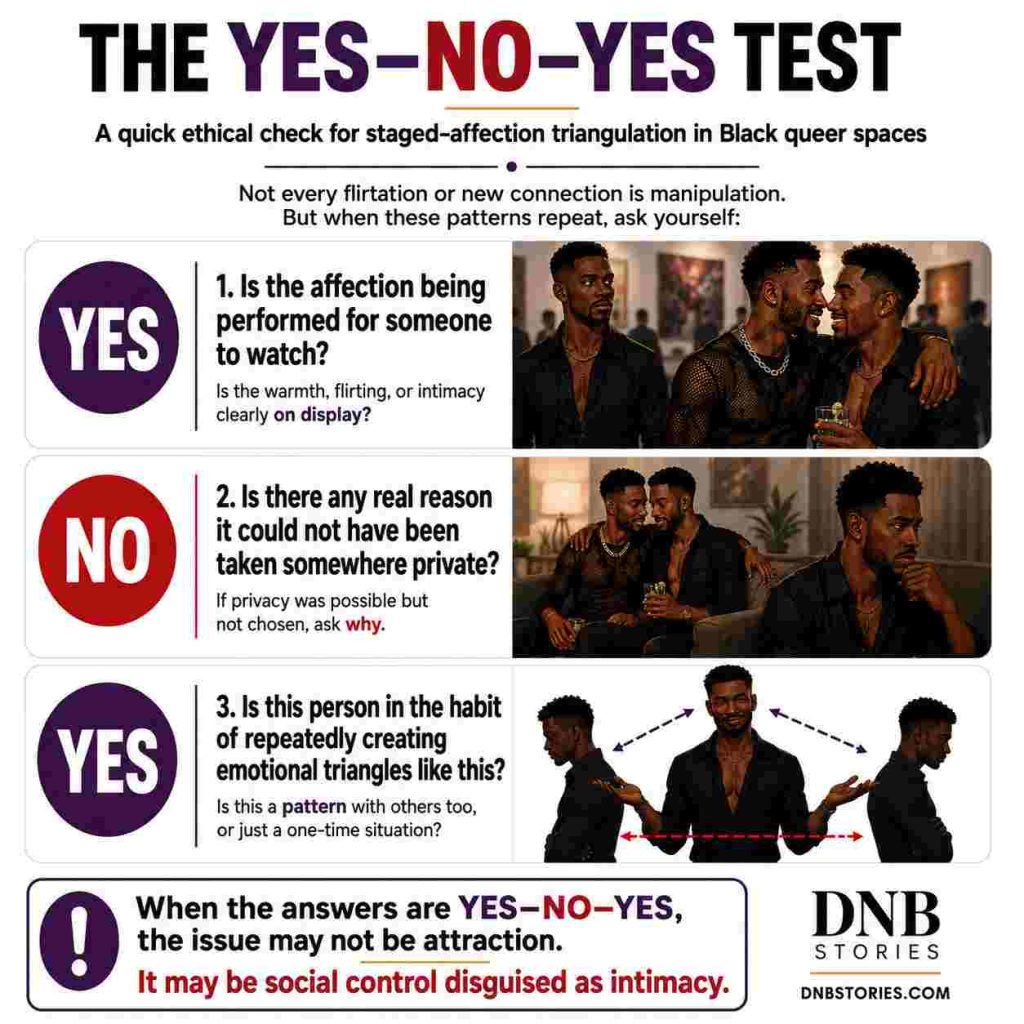
A Yes–No–Yes pattern may suggest that intimacy is being orchestrated for social control:
- Yes: Is the affection being performed for someone to watch?
- No: Is there any real reason their “sweet darling love” could not be taken somewhere private?
- Yes: Is the same person in the habit of repeatedly creating emotional triangles like this?
When the answer keeps pointing in this direction, the issue may no longer be ordinary attraction, flirtation, or shifting desire. It may be social control disguised as intimacy.
References
- Bowen Center for the Study of the Family. (n.d.). Triangles. https://www.thebowencenter.org/triangles
- Crenshaw, K. (1989). Demarginalizing the intersection of race and sex: A Black feminist critique of antidiscrimination doctrine, feminist theory and antiracist politics. University of Chicago Legal Forum, 1989(1), 139–167. https://scholarship.law.columbia.edu/faculty_scholarship/3007
- Crick, N. R., & Grotpeter, J. K. (1995). Relational aggression, gender, and social-psychological adjustment. Child Development, 66(3), 710–722. https://www.jstor.org/stable/1131945
- Hailey, J., Burton, W., & Arscott, J. (2020). We are family: Chosen and created families as a protective factor against racialized trauma and anti-LGBTQ oppression among African American sexual and gender minority youth. Journal of GLBT Family Studies, 16(2), 176–191. https://doi.org/10.1080/1550428X.2020.1724133
- Meyer, I. H. (2003). Prejudice, social stress, and mental health in lesbian, gay, and bisexual populations: Conceptual issues and research evidence. Psychological Bulletin, 129(5), 674–697. https://doi.org/10.1037/0033-2909.129.5.674
- Nkado, D. (2026). Triangulation: A Black queer manipulator’s ultimate tool for destroying friendships. DNB Stories Africa. https://dnbstories.com/2026/05/triangulation-destroy-black-queer-friendships.html
- Williams, K. D. (2007). Ostracism. Annual Review of Psychology, 58, 425–452. https://doi.org/10.1146/annurev.psych.58.110405.085641