In some UK Black queer social spaces, social cruelty can move downward through a chain of power, desire, access and desperation, while those with the greatest influence remain hidden from view.
The way I explain it is this: harm moves through an inverted pyramid. Power protects itself at the top, desire becomes social currency in the middle, and access-starved people at the bottom are left to carry out the visible work of cruelty.
This article introduces the Inverted Pyramid of Harm, a framework for understanding how social cruelty can move through UK Black queer communities. It argues that harm does not always begin with the person who performs it most visibly. Instead, it can travel through layers of power, desire, access and desperation, with the most powerful actors often remaining hidden from view.
The framework is based on lived experience, informal observation, and synthesis of existing ideas on social harm.
Scope of the Article
This framework names roles within a harm dynamic, not fixed identities. “Patron,” “puppet” and “runner” should be read as positions people may occupy in a particular social economy of power, desire and access. The purpose is not to condemn an entire community, but to make visible how power can hide behind those with less protection.
The article explains that this structure is inverted because those doing the most visible harm often hold the least real power, while those who benefit most from the cruelty remain hidden. It also examines how social spaces such as group chills, sexual gatherings, nightlife networks and online interactions can become sites where targets are identified, runners are recruited, and reputational harm is distributed.
The central argument is simple: the least powerful Black queer man in the room is often the most visible performer of harm. To understand community harm properly, we must look beyond the person openly shaming others, spreading gossip or forwarding cropped screenshots. We must ask who benefits from the harm, who rewards it, who remains hidden, and who is being used to advance a cruel agenda.
This framework reflects observed patterns in certain social contexts and should not be taken as representative of all UK Black queer experiences.
How the Inverted Pyramid of Harm Works
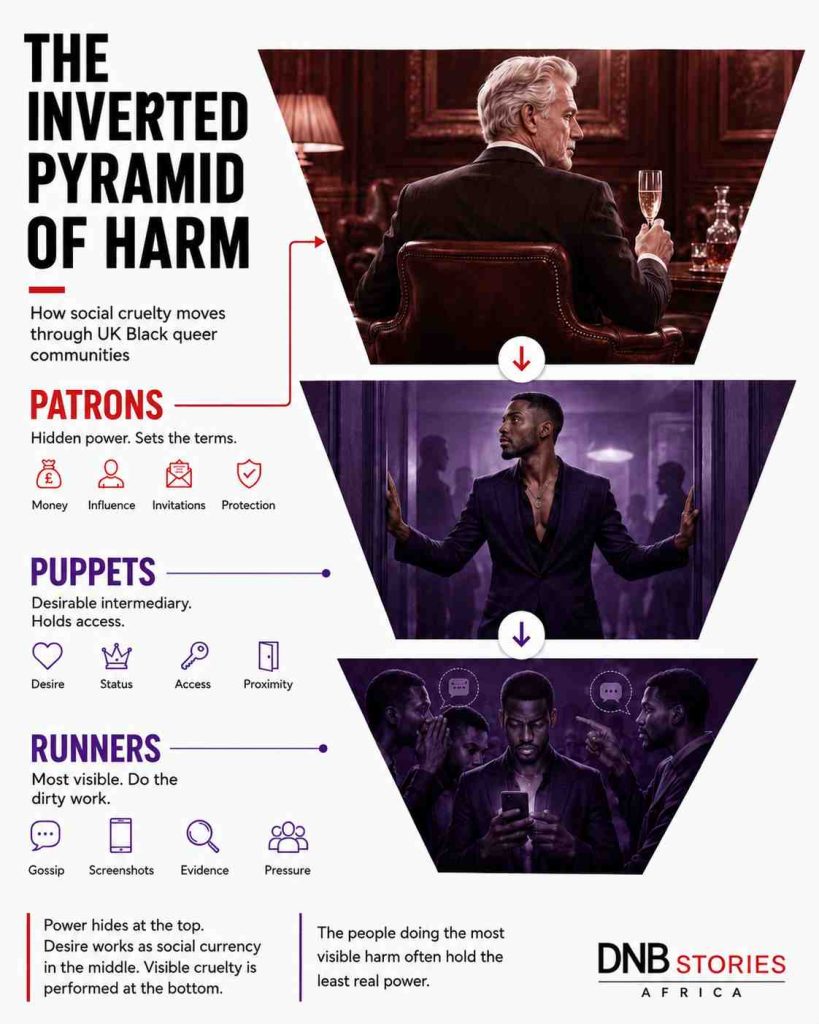
This framework describes a pattern in which social harm is outsourced through layers of power. At the top are those with money, influence and protection. In the middle are desirable social intermediaries who translate that hidden power into community pressure. At the bottom are access-starved participants who carry out the visible work of gossip, screenshot circulation, evidence-mining and reputational damage.
It is an inverted pyramid because those doing the most visible harm often hold the least real power, while those who benefit most remain hidden from view.
1. Patrons—Rich, Powerful White Queer Men
Patrons represent rich, powerful and well-connected white queer men, often older.
Patrons use money, influence, accommodation, invitations, sexual access, nightlife proximity, professional links and social protection to mobilise Black queer people against one another.
Their target is often someone who refused them, rejected extractive intimacy, challenged racism, spoke about objectification culture, or disrupted a structure that benefited them.
Because open hostility toward a Black person may expose them to reputational risk, they rarely act directly. Instead, they sponsor, encourage or quietly reward other Black queer men to carry out the punishment on their behalf.
Their power lies in distance. They do not need to shout. They only need to signal who should be isolated.
2. Puppets—Masculine, High-Status Black queer men
Puppets represent hot, masculine, highly desired Black queer men who receive social and material rewards — such as access, protection, money, invitations or status — from patrons in exchange for carrying out their demands.
The puppet is not powerless. He is rewarded with proximity, attention, housing support, money, invitations, sexual validation, social elevation or protection from consequences.
His desirability becomes a tool. Because many men want access to him, his approval carries social weight. He can mobilise others without appearing to command them directly.
He does not always need to spread the gossip himself. He only needs to make the target look undesirable, unstable, arrogant, difficult or unsafe. Once he frames the target this way, others begin doing the work for him.
The puppet translates the patron’s hidden power into Black queer social pressure.
Some Black Queer Men Have Turned Social Cruelty as Livelihood
In this dynamic, puppets function as desirable intermediaries. Their attractiveness, masculinity and social appeal give them influence, which they use to gain access to different rooms, networks and opportunities.
He often seeks out group chills, sexual gatherings and orgies where he can identify new targets and prospective runners. In some cases, he may notice a potential target before a patron does and then present the person as someone who deserves isolation, social punishment, exclusion or reputational destruction.
In this sense, he does not only carry out harm; he can also scout for it, package it and pitch it upward as a contract.
3. Runners—Low-status, access-starved Black queer men
Runners represent lower-status Black queer men rewarded with crumbs of access or empty promises.
The runner receives the least but often works the hardest.
He may not get money, protection, real friendship or meaningful intimacy. What he receives is the possibility of closeness: a reply, an invitation, a flirtatious message, a sense of being “in,” or the fantasy that loyalty will one day be rewarded.
This hunger for access makes him useful.
He becomes the one who shares screenshots, distributes gossip, stages conversations with the target, mines for evidence, exaggerates stories, monitors the target’s movements, and repeats the puppet’s framing as if it were his own independent judgement.
The runner is often the most exposed person in the chain. He carries the visible cruelty while receiving the smallest benefit.
The Runner’s Job Description
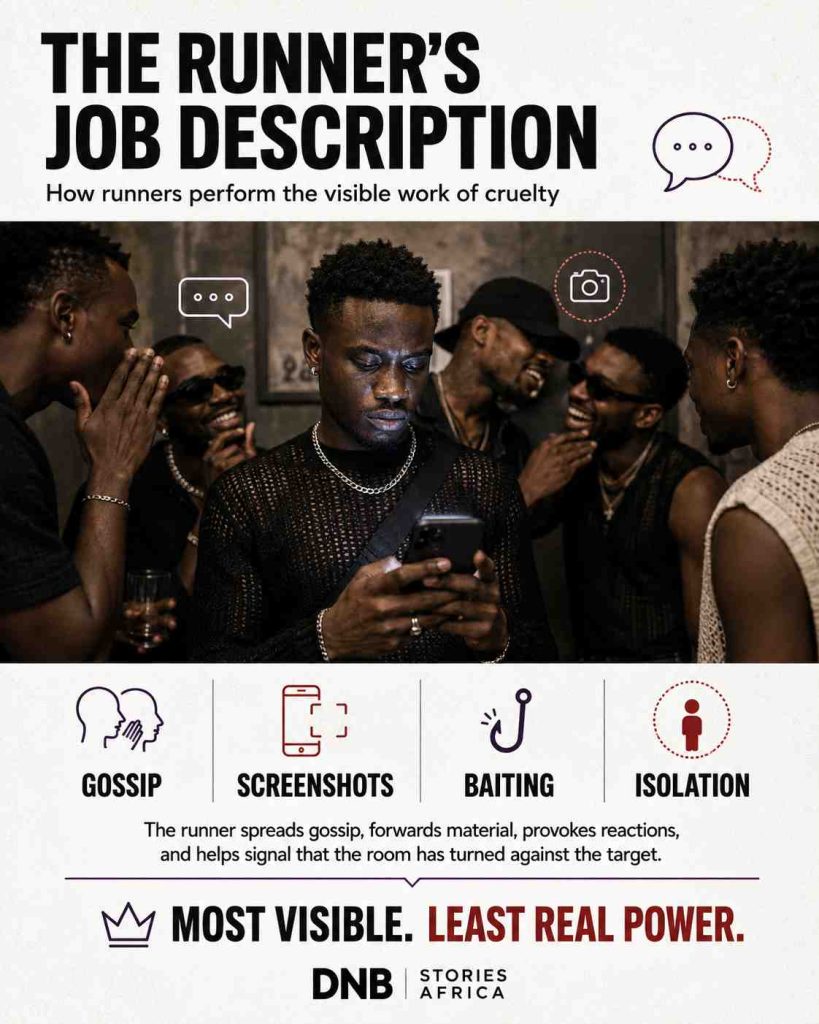
Within this dynamic, the runner performs the most visible labour of social cruelty. He may repeat damaging gossip to new listeners, laugh loudly at jokes designed to humiliate a target, forward screenshots and voice notes, or exaggerate and reframe a target’s behaviour until ordinary actions begin to look suspicious.
The runner may also bait the target into reacting, then present that reaction as “evidence.” In more organised cases, he may participate in group manipulation, gaslighting and staged Truman-inspired social set-ups designed to confuse, destabilise or provoke the target.
His role is not only to spread information, but to help create the feeling that the room has turned against someone. By doing this, he performs loyalty to the clique and shows that he is willing to harm whoever the group names.
The Core Mechanism
The patron supplies power.
The puppet supplies desire.
The runner supplies labour.
The target receives punishment.
This is how harm moves without the most powerful person appearing to touch it.
The system works because each level is driven by a different hunger: the patron wants control, the puppet wants reward, and the runner wants access.
In this dynamic, harm does not simply come from hatred. It comes from a managed economy of power, desire and access, where the most protected people outsource cruelty to those still fighting to be chosen.
Temporary or Transactional Recruits
In some cases, people may be brought into the dynamic temporarily through travel, accommodation, money, sexual access, social status or promises of opportunity. Where the person is new to the social network, unfamiliar with the deeper conflict history, or dependent on the person offering access, they may be easier to direct.
This may include people travelling from African countries or other diaspora networks, especially where migration pressure, financial need or the desire for social entry makes refusal more difficult.
These roles may be brief, but their impact can be serious. The recruited person may be brought into a community space, relationship network or nightlife setting for a short period, not necessarily to build genuine belonging, but to perform a function: gather information, provoke interaction, validate a rumour, increase social pressure, or help isolate a target.
How to Protect Yourself from This Dynamic
In an inverted pyramid of harm, the loudest person may not be the source of the power. They may only be the messenger, performer or runner.
1. Read the Movement of Harm
The first protection is to understand that not every attack is coming from the person visibly carrying it out. Do not spend all your energy fighting the most visible participant. Study the movement of the harm instead.
Ask:
Who benefits from this story spreading?
Who has the power to reward the people involved?
Which person is being protected from visibility?
Who keeps appearing around the conflict without looking directly responsible?
2. Control Access
The second protection is access control. Do not give emotionally loaded messages, voice notes, screenshots, private confessions or reactive replies to people whose loyalty is unclear.
Many harm campaigns depend on making the target speak in anger, pain or confusion, then cutting that material into “evidence.”
If the person has not earned trust, do not give them content they can weaponise. My Trust Onion Model can help you regulate how much access you give.
3. Slow the Interaction Down
The third protection is slowness. When someone stages a suspicious interaction, refuses context, asks leading questions, suddenly becomes overly friendly, or tries to provoke an emotional answer, slow the conversation down.
Do not rush to defend yourself. Do not perform innocence for people who may already be building a case against you.
Say less. Ask for clarity. Keep records. Move important conversations into writing.
4. Avoid Isolated Conflict Spaces
The fourth protection is witnessed accountability. Do not handle serious conflict entirely in private with people who have already shown manipulative behaviour.
Private spaces are where stories can be twisted. Where possible, involve trusted witnesses, written summaries, clear boundaries and dated records.
Use my Masculinity Conflict Framework to read conflict better.
5. Practise Containment
The fifth protection is containment. Do not immediately restore full access to people who suddenly return with friendliness after participating in cruelty.
Sudden warmth is not the same as repair. Real repair requires acknowledgement, consistency, changed behaviour and time.
A simple boundary line could be:
“I am not available for private conversations about this unless there is clarity, accountability and respect.”
6. Stop Chasing Reputation
The final protection is to stop chasing reputation among people committed to misunderstanding you.
Some circles are not confused; they are organised around keeping the target explainable as the problem. In that kind of environment, your safety may come less from persuading them and more from withdrawing access, preserving evidence, strengthening your real support system, and refusing to feed the performance.
Protection begins when you stop treating every puppet as the source, every runner as a friend, and every invitation as harmless.
Frequently Asked Questions
The Inverted Pyramid of Harm is a framework for understanding how social cruelty can move through layers of power, desirability and access scarcity. It argues that the people doing the most visible harm may not always be the people with the greatest power.
Patrons are powerful or well-connected individuals who may use money, protection, access, invitations or influence to shape community behaviour while remaining less visible.
Puppets are desirable intermediaries whose attractiveness, masculinity, status or social appeal gives them influence. They can translate hidden power into community pressure.
Runners are access-seeking participants who perform the visible work of cruelty, including gossip, screenshot circulation, baiting, isolation and reputational damage.
Protection begins with reading the movement of harm, controlling access, slowing suspicious interactions, preserving records, avoiding isolated conflict spaces and refusing to chase reputation among people committed to misunderstanding you.
References
- Balsam, K. F., Molina, Y., Beadnell, B., Simoni, J., & Walters, K. (2011). Measuring multiple minority stress: The LGBT People of Color Microaggressions Scale. Cultural Diversity and Ethnic Minority Psychology, 17(2), 163–174. doi:10.1037/a0023244
- Crenshaw, K. (1991). Mapping the margins: Intersectionality, identity politics, and violence against women of color. Stanford Law Review, 43(6), 1241–1299. https://doi.org/10.2307/1229039
- Hammack, P. L., Grecco, B., Wilson, B. D. M., & Meyer, I. H. (2022). “White, tall, top, masculine, muscular”: Narratives of intracommunity stigma in young sexual minority men’s experience on mobile apps. Archives of Sexual Behavior, 51, 2413–2428. https://doi.org/10.1007/s10508-021-02144-z
- Han, C.-S., & Choi, K.-H. (2018). Very few people say “no whites”: Gay men of color and the racial politics of desire. Sociological Spectrum, 38(3), 145–161. https://doi.org/10.1080/02732173.2018.1469444
- Jacobson López, D., Chandler, C., Whitfield, D. L., Adams, B., Burdick, J., & Friedman, M. R. (2023). “Take it out on the floor”: Experiences of violence among Black LGBT House and Ball community youth in a Rust Belt city. Journal of Interpersonal Violence, 38(3–4), 3950–3978. https://doi.org/10.1177/08862605221113025
- Pachankis, J. E., Clark, K. A., Burton, C. L., Hughto, J. M. W., Bränström, R., & Keene, D. E. (2020). Sex, status, competition, and exclusion: Intraminority stress from within the gay community and gay and bisexual men’s mental health. Journal of Personality and Social Psychology, 119(3), 713–740. doi:10.1037/pspp0000282