
Mandem simply means “my friends” or “the boys” and carries a positive communal meaning. This article talks about “Mandem Performance”: the strategic adoption or exaggeration of urban masculine aesthetics, mannerisms and social codes by some Black gay men as a means of controlling, intimidating or manipulating others.
1. What Masculinity Can’t Confront, It Tries to Control
In parts of the UK Black gay scene—especially where “mandem” performance overlaps with down-low (DL) secrecy—conflict often shifts from open disagreement into covert power tactics. These tactics include narrative control, secret plotting, emotional manipulation, gossip and triangulation, strategic social sabotage and isolation.
This analysis examines how masculinity threat, stigma, and informal surveillance can transform intimate relationships into reputational battlegrounds, where maintaining “masculinity” takes precedence over human connection.
By contrasting this with Nigerian masculinity scripts—where cultural norms largely encourage men to address conflict through direct confrontation—this analysis clarifies how different social environments shape both the expression and management of conflict.
- 1. What Masculinity Can’t Confront, It Tries to Control
- 2. Covert Conflict Management in UK Black Gay Spaces
- 3. Hypermasculinity and the “Mandem” Persona in the UK Gay Scene
- 4. Masculinity Threats and Covert Control Tactics
- 5. Nigerian Masculinity and the Politics of Public Justice
- 6. Queer-to-Queer Conflict Resolution in Nigeria
- 7. Neutralising Manipulative Control: Four Practical Communication Strategies
- FAQs
Article Scope: What This Article Is and What It Isn’t
This article offers a focused, community-anchored analysis of how performances of masculinity can function as a form of social technology—used to regulate behaviour, manage reputation, and exert control within specific networks. It adopts a harm‑minimisation lens, aiming to help readers recognise coercive dynamics and support the rebuilding of safer, more accountable community norms. This analysis is not a diagnostic guide, nor does it suggest that all down‑low men are inherently abusive. It does not endorse harassment, vigilantism, or forced “outing,” and it makes no claim to define or speak for the entire UK Black gay community.
Key Terms and Social Context
a. “Mandem” and the London Roadman Masculinity Register
The term “mandem” originates in Multicultural London English (MLE) as a largely neutral reference to a person’s male friends. However, its meaning can shift in practice depending on context. In certain environments, it has come to signify a style of hyper-performative, roadman-influenced Black British masculinity characterised by emotional restraint, dominance cues, and rigid respect–disrespect hierarchies[8].
Where this register carries social status—for example, within some UK Black gay scenes—these norms can shape how Black men understand and manage power, vulnerability, and conflict.
b. Down-low (DL) Culture and “Straight-Passing” Labour
“DL” (down‑low) describes men who engage in same‑sex intimacy while maintaining a heterosexual public identity. While this often represents a necessary survival strategy under conditions of high risk, in comparatively safer contexts such as the UK, it can create a significant imbalance in intimate relationships where one partner holds disproportionate control over a relationship’s visibility and direction, allowing them to exploit secrecy as a form of power and, in some cases, weaponise it to maintain dominance.
Reproducing DL lifestyles in relatively safer conditions—where a shared need for secrecy no longer applies—can shift the DL mask from personal protection to social leverage, used to manage status and exert control within a relationship.
DL-to-DL Relationships Can Balance Power
One proposed way to mitigate this dynamic is for DL men to engage exclusively with others who also perform DL identities, thereby restoring symmetry around secrecy and risk. When both partners share similar visibility constraints, they reduce the need for constant explanation, policing, or one‑sided control over the relationship’s narrative.

2. Covert Conflict Management in UK Black Gay Spaces
In many UK Black gay male spaces, conflict often goes underground—not because confrontation disappears, but because visibility itself carries risk. Four forces help explain why.
First, the concept of precarious manhood frames masculinity as a fragile status that men must continually prove and protect[9]. Public confrontation, therefore, becomes risky, particularly when an opponent’s unpredictability heightens the chance of visible loss or embarrassment.
Second, hegemonic masculinity explains how social hierarchies reward those who embody the dominant masculine ideal within a given context [2]. In some UK Black communities, this ideal often privileges calm, emotionally restrained, and non‑reactive dominance. Men who control situations rather than openly confront them.
Third, the theory of minority stress explains why visibility itself can feel dangerous. Stigma produces chronic vigilance, expectations of rejection, and pressure to conceal[5]. All of these increase the emotional risk of direct confrontation.
A fourth force is the law and legal consequences. The UK recognises coercive control and harassment as prosecutable offences, meaning overt intimidation carries a higher institutional risk.
Together, these forces create a culture in which covert conflict management becomes the smart, masculine, and self-preserving choice. Power operates not through shouting matches, but through silence, implication, and control over who is seen, heard, believed, or quietly erased. These covert tactics allow the aggressor to appear harmless, maintain access to the target, and exercise control while keeping offences easily deniable.
To understand how deeply the environment shapes these behaviours, it is helpful to contrast the UK Black gay scene with Nigerian queer networks, where the rules of masculinity and conflict look very different.
Covert Aggression in the UK vs. Open Confrontation in Nigeria
In some UK Black male contexts, relational and social aggression—such as damaging someone’s reputation, spreading rumours, gossiping, or quietly excluding them from social networks—has become a recognised mode of masculine power. These indirect strategies allow men to assert dominance, as defined within this context, while maintaining the appearance of emotional control and social composure.
By contrast, many Nigerian masculinity frameworks stigmatise these indirect behaviours in men, often labelling them as petty or distinctly unmanly. In this context, masculine credibility relies more on direct confrontation—through verbal assertion and physical presence—where men articulate grievances and defend honour face‑to‑face.
A common Nigerian saying captures this ethos succinctly. “If you want to talk to me, talk to me directly, like a fellow man—stop going round the corners.”
This divergence reflects a key insight across multiple scholarly works that frames masculinity not as a fixed identity but as a locally constructed performance shaped by differing norms of visibility, silence, and respect.
3. Hypermasculinity and the “Mandem” Persona in the UK Gay Scene
In London’s Black urban masculinity ecosystem, the “mandem” performance operates simultaneously as a stigma shield—protecting inclusion within straight Black circles—a dominance signal that discourages challenges before they take shape, and a passport to belonging, granting access to male‑coded networks and closer proximity to other high‑status mandems.
While this posture may offer protection on the street, in queer intimate contexts, it can become a relational weapon. It discourages open negotiation and repair during conflict, punishes authenticity, and frames basic emotional needs as “femininity.” The mask ceases to be a form of self-presentation and becomes a tool of control within relationships.
DL Power Dynamics and the Social Weight of Secrecy
DL life is heavily shaped by the politics of “passing.” However, intense secrecy—especially in contexts where fear cannot be openly explained or accounted for—reshapes relationship dynamics by restricting partners’ autonomy and framing “exposure” as the ultimate threat. Because preserving a heterosexual public image and continued association with straight male peers functions as a high‑value social asset, it becomes a site of power struggle, rewarding those who can successfully control the narrative and manage visibility (McCune, 2014).
Black Gay Men in the UK: Passing as a Career Strategy
The DL/Mandem power dynamic often intensifies in entertainment economies—music, nightlife, Black film, and informal social ventures—where social mobility bypasses traditional educational routes and credentials, relying instead on reputation, masculine credibility, and proximity to visibly straight male peers. In these spaces, straight association and performance of straightness signal marketability, industry toughness, and cultural legitimacy, while deviation from heteronormativity gets treated as an exclusion risk—often more imagined than real. As a result, heterosexual presentation and straight connections shift from personal identity choices to strategic assets that are carefully managed and firmly protected.

Queerness, Visibility, and the Myth of Professional Risk
This perspective often rests on outdated assumptions about what queerness “costs” a Black man. In contemporary UK cultural industries, being queer is not automatically a career liability. While discrimination persists and risks vary by sector, authenticity can also expand opportunity: commissioners and audiences increasingly value distinctive voices and representation—particularly for Black stories that have long been under‑resourced and under‑amplified.
If a certain performance has been treated as the only safe route for so long, it is worth asking what it has actually delivered—and what it has quietly taken. For many queer Black men, embracing queerness can shift power: from managing suspicion and reproducing harm to building presence, from hiding to speaking in a voice that is genuinely ours.
4. Masculinity Threats and Covert Control Tactics
In the Black gay male contexts described above, Mandem and DL personas often overlap, such that a threat to one is experienced as a threat to the other. Perceived risks of outing, increased queer visibility, emotional vulnerability, or being read as “feminised” are not merely personal anxieties but structural dangers. To avoid compounding these risks, conflict in such relationships frequently bypasses open disagreement and instead shifts toward covert forms of control. These strategies allow power to be exercised without triggering exposure or destabilising masculine credibility.
What Covert Control Can Look Like In Real Life
When dominant masculinity norms discourage open conflict, power often shifts into indirect forms of control. Rather than addressing disagreements face‑to‑face, dominance is exercised through everyday emotional and relational dynamics—gossip, spreading rumours, damaging reputations, and social exclusion.
In relationship contexts, covert control can manifest in several interrelated forms:
a. Information Control
When direct conversation feels too risky, information becomes a proxy for power.
- Selective truths and strategic omissions.
- “You can’t say that”—rules that limit expression.
- Narrative editing: “You’re imagining it” / “You’re too sensitive”
b. Emotional Manipulation
When feelings can’t be named openly, they get managed indirectly.
- Guilt loops and intermittent validation.
- Humiliation disguised as “banter” or concern; “negging”.
- Love‑bombing followed by withdrawal.
- Gaslighting: repeated distortion of reality that weakens trust in your own perception.
c. Coercion and Intimidation
When confrontation is avoided, masked threat replaces dialogue.
- Explicit or implied threats to reputation, safety, or social standing.
- Withholding affection, access, or information as punishment.
- Planning deniable acts of intimidation with “his boys” to reassert dominance.
- In UK law, controlling or coercive behaviour is recognised as a serious form of abuse in intimate and family relationships (see: UK Government factsheet—statutory guidance framework).
d. Dependency Engineering
When autonomy feels threatening, dependence becomes the fallback.
- Creating emotional, financial, or housing reliance.
- Isolating you from people who “ask too many questions”.
- Making stability contingent on compliance or silence.
Closeting Is Not Abuse. Control Is.
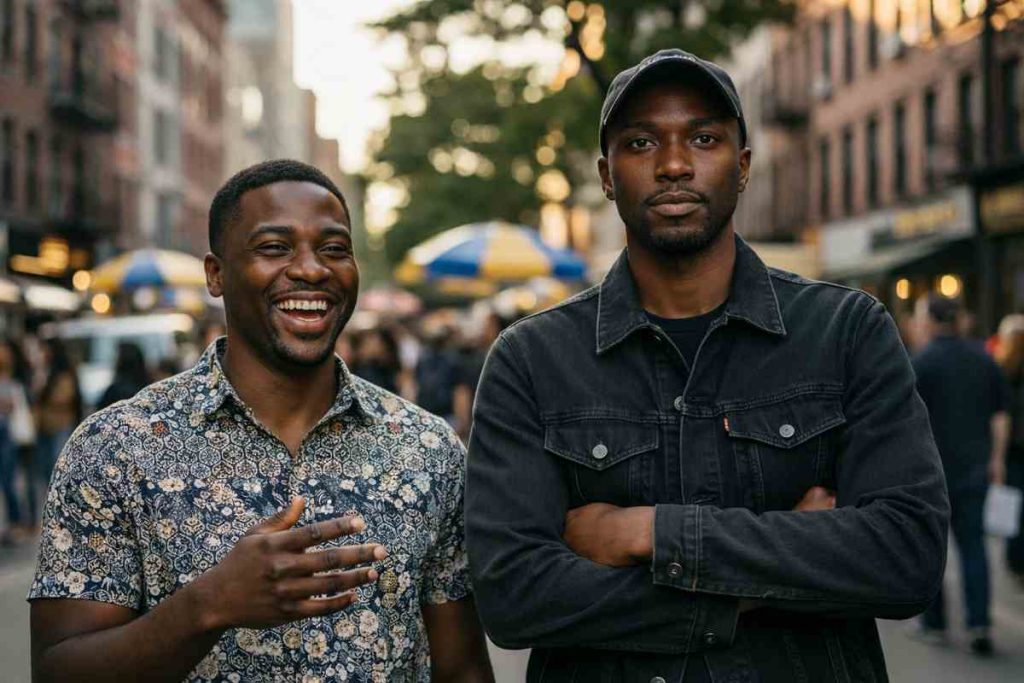
This distinction is critical. Harm emerges not from secrecy itself, but from the unilateral use of secrecy to regulate, restrict, or dominate another. Many individuals choose—or feel compelled—to remain closeted to ensure safety, livelihood, or social survival. My Dynamic Disclosure Model outlines five practical modes of disclosure that Black gay men may adopt across different contexts and spaces, reflecting the complexity of negotiating visibility. However, closeting becomes coercive when one person imposes it unilaterally within a relationship and uses it to regulate a partner’s behaviour, restrict their autonomy, or extract compliance through the threat of exposure or the exploitation of this fear.
In such cases, what may have begun as a protective strategy shifts into a mechanism of control—no longer a neutral condition, but a form of relational domination.
5. Nigerian Masculinity and the Politics of Public Justice
In dominant Nigerian heterosexual scripts, men typically defend their masculine status through public assertion—via verbal dominance, community-sanctioned discipline, and visible acts of reputation defence (Benebo et al., 2018)[1].
However, in the context of queerness, the dynamics shift dramatically. Nigeria’s criminalisation of same-sex intimacy—rooted in colonial-era laws and reinforced by contemporary legislation—combined with pervasive societal stigma, means that queer men often prefer to handle threats of exposure without attracting attention. Yet even within this climate, homophobic violence rarely occurs in public view. Gangs that target queer individuals often lure victims into secluded areas before attacking. This is not merely a tactic of evasion; it reflects a cultural logic in which public confrontation is not just about physical dominance but about justice.
In Nigerian public life, fighting in the open invites witnesses. Elders and bystanders often intervene, asking, “What is the matter?” In such moments, the outcome of a confrontation typically shifts from physical strength to the crowd’s judgment. Intimidating someone weaker or younger brings shame, not honour. An innocent man can cry in public to affirm his truth without compromising his masculinity. In fact, so long as people judge his emotion as sincere, it can enhance his honour. They’d view his vulnerability not as weakness but as a testament to his integrity.
Homophobic Violence in Public Places in Nigeria
Even in cases of homophobic violence in the open in Nigeria, the question often arises: “Did you catch him in the act?” Without proof, the aggressor often earns blame. Public parading and shaming largely occur only when someone catches the two men in the act of same-sex intimacy.
The demand for “proof” does not protect anyone. It merely sets the threshold for what bystanders treat as punishable, believable, or worthy of public disturbance. The “caught in the act” logic can also fuel a culture of active surveillance. As documented in a 2016 Human Rights Watch report, one activist described how neighbours became “hunters,” entering homes at night in search of individuals in “compromising positions.” In such cases, the objective is not simply to respond to an act, but to produce evidence—or the appearance of it—that can legitimise violence, public shaming, and coercive control. The insistence on proof becomes less about justice and more about justification. A way to rationalise harm under the guise of moral or legal authority.
6. Queer-to-Queer Conflict Resolution in Nigeria
In Nigerian queer communities, where external threats such as criminalisation, raids, and public exposure make discretion essential for survival, trust‑based circles often form around mutual protection and clearly defined boundaries. Within these circles, people mostly prefer direct communication—naming harm, clarifying misunderstandings, and negotiating limits—as a harm-reduction strategy.
Many queer Nigerian men view indirect conflict—when not softened by humour—as sneaky and threatening. This is especially true when claims seem vague or unsubstantiated, and actions undermine masculine norms of directness and open confrontation.
Structural barriers to public confrontation mean that direct assertion occurs only where safety allows. But most conflicts do not require spectacle to be resolved. What matters is communicating a grievance directly to the person responsible, ensuring they understand that harm has occurred. Their response often determines the outcome. Naming offence is commonly received as a sign of respect rather than aggression. Where a relationship is not valued, disengagement—quietly moving on without retaliation—is typically preferred over escalation.
Harmful Power Tactics in Some UK Black Gay Circles vs. Nigerian Contexts
These are not fixed individual traits or cultural absolutes, but recurring patterns of power shaped by specific social conditions.
In UK Black gay networks where “mandem” hypermasculinity intersects with DL (down-low) secrecy, power is often exercised through covert control.
Dominance strategy of UK “mandem”/DL-coded networks:
- Covert control: strategic secrecy, covert planning, and sometimes “enemy-friend” positioning to manage access and outcomes.
- Intimidation-by-implication: veiled threats, silent punishment, emotional withdrawal.
- Narrative management: controlling who knows what, when they know it, and how events are framed.
- Emotional manipulation: “mind games” that wear down clarity, confidence, and agency.
In Nigerian gay men’s circles, particularly within trust-based queer networks, power struggles tend to be more overt.
Patterns of Power Tactics in Nigerian queer networks:
- Audience-based success signalling: fashion, connections, visibility, media influence.
- Open rivalry “gay power-tussles”: contests over influence, desirability, and access.
- Visible dominance: direct confrontation or public social performance; power is asserted visibly rather than through hidden manoeuvring.
Secret Sabotage As The Way of ‘Snakes’
Within many Nigerian queer social circles, the most serious breach of communal ethics is not open rivalry but covert planning. Someone suspected of moving in secrecy—gathering information, setting traps, quietly undermining others—is often branded a snake. The metaphor does real work. Snakes do not announce themselves, do not move in groups, and cannot be trusted to behave predictably.
To be labelled a snake is therefore not simply to be called dangerous. It leaves a mark of moral unreliability, rendering someone socially unfit for friendship. Unlike open power tussles, which depend on readability and shared audiences to function, secret manoeuvring introduces asymmetry and uncertainty. Once intentions become opaque, trust collapses—not only between rivals, but across entire networks.
In such conditions, even close associates may withdraw, recognising that proximity to hidden moves carries risks they cannot see, measure, or control.

7. Neutralising Manipulative Control: Four Practical Communication Strategies
These approaches can reduce escalation, but if there’s intimidation, stalking, threats, or coercive control, prioritise safety and specialist support. The UK government recognises coercive control in law and professional guidance as a serious and cumulative form of abuse, not a minor interpersonal dispute.
Bridge Builders and the Repair of Masculinity‑Driven Harm
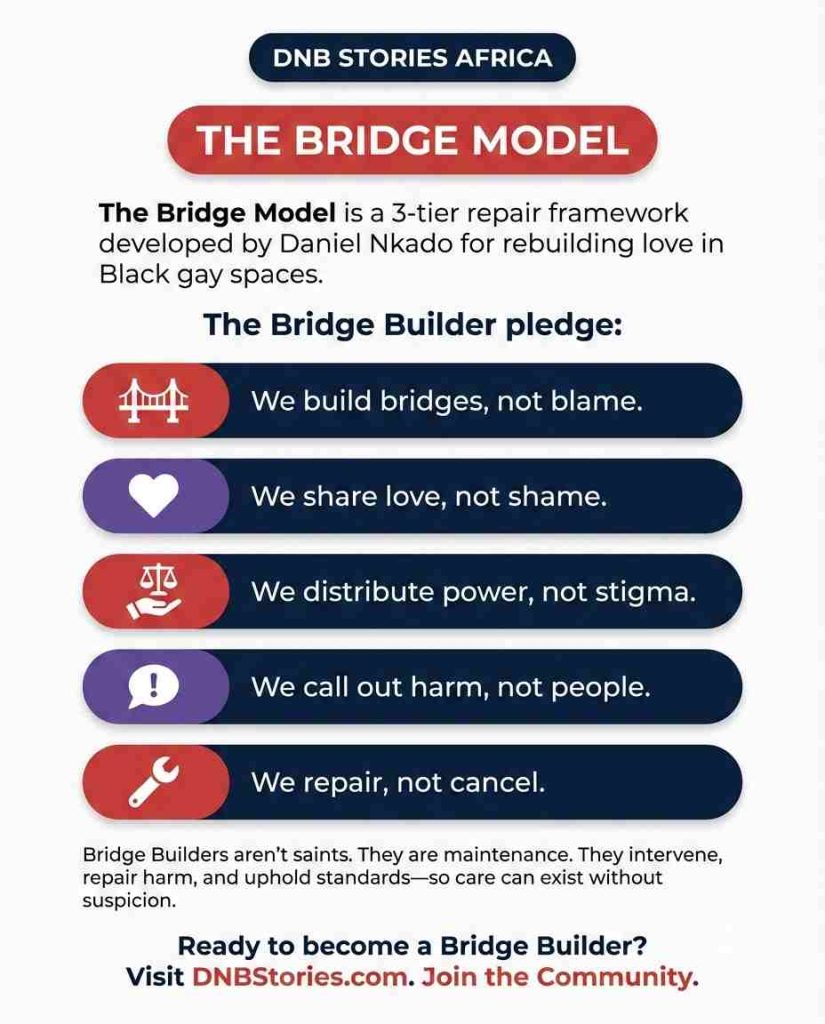
Bridge builders play a vital role in repairing trust within Black gay spaces, particularly where masculine norms around silence, reputation, and indirect conflict have allowed harm, exclusion, or power imbalances to fracture community bonds.
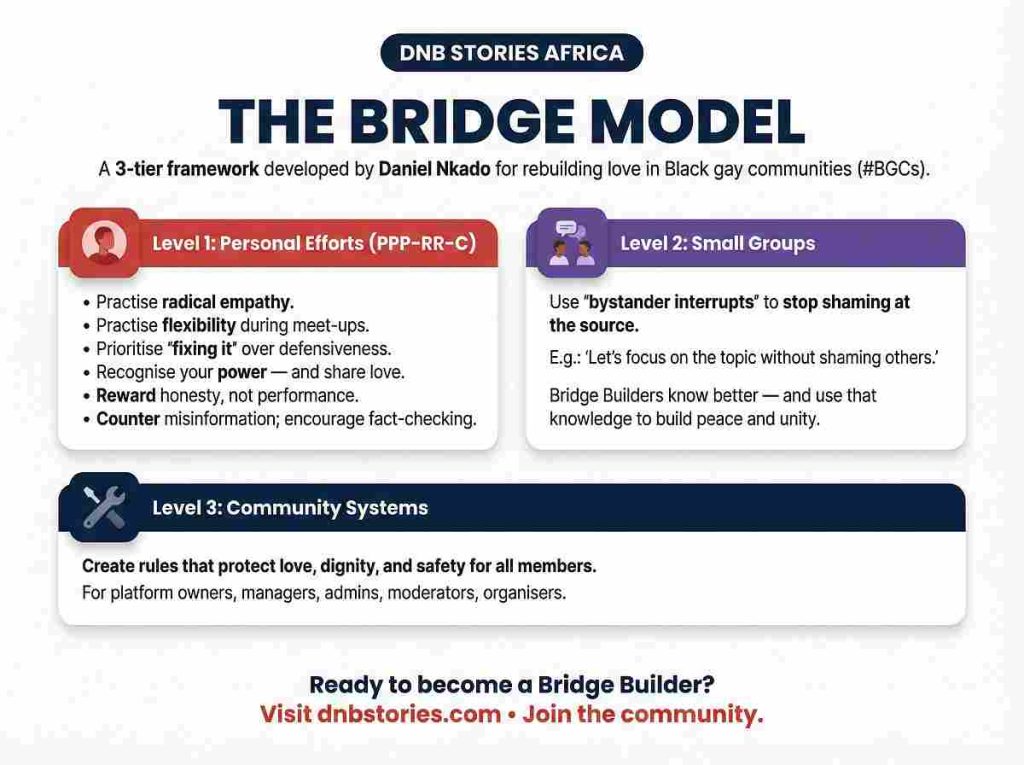
According to the repair framework developed by Daniel Nkado, Bridge Builders are not neutral bystanders. They are people with lived experience of both harm and care, who understand how quickly conflict can escalate when direct confrontation feels unsafe or socially costly. They use their credibility to hold space for difficult conversations without turning disagreement into spectacle or exile.
Their role in this particular context includes:
- Facilitating dialogue between parties who may not feel safe speaking directly, especially in contexts where visibility carries risk.
- Naming harm without resorting to public shaming, which can trigger defensive masculinity rather than accountability.
- Modelling accountability and repair in environments where formal systems are absent, distrusted, or perceived as punitive.
- Helping communities distinguish between harm and conflict, and between accountability and punishment—clarifying what repair actually requires.
- Offering low‑stakes entry points for reflection, rather than demanding immediate public confessions or performative remorse.
Bridge builders are especially important in spaces where indirect conflict can spiral into social exile and where masculine avoidance of confrontation leaves few pathways for repair. By re‑centring care, clarity, and mutual protection, they offer alternatives to both silence and spectacle—making it possible to address harm without reproducing the very dynamics that caused it.
Coercive Control: Harm Minimisation Strategies for Black Gay Men
For Individuals
- Name the Harm, Not the Person: Learn to identify harmful behaviours—such as secrecy used for control, emotional withdrawal as punishment, or social exclusion as manipulation—without immediately labelling someone as “toxic.” Pattern recognition allows for clearer responses and reduces reactive escalation.
- Set and Revisit Boundaries: Be explicit about your emotional, social, and disclosure boundaries, and revisit them as relationships evolve. Resistance to boundaries—or punishment for asserting them—is a red flag.
- Document Your Experience Safely: Keep a private record of incidents that feel harmful, confusing, or destabilising. This helps track patterns over time and provides grounding if you later need support or validation.
- Build a Safety Net: Maintain at least one or two trusted connections where you can speak honestly. Isolation increases vulnerability to coercive dynamics; connection is protective.
- Resist the Urge to Perform “Strength” Through Silence: Emotional suppression is not resilience. Allow yourself to name and process harm, even if you choose not to disclose it publicly.
- Know Your Exit Routes: If a relationship or network becomes unsafe, plan how to disengage with minimal fallout. This may include digital boundaries (blocking, muting, changing passwords) and social ones (shifting circles, limiting contact).
- Avoid Retaliatory Outing: It increases physical danger and ethical harm.
For Communities
- Create Low‑Stakes Accountability Spaces. Develop peer‑led spaces where people can discuss harm, missteps, and power without fear of public shaming or exile. This can include check‑in circles, moderated group chats, or anonymous feedback channels.
- Normalise Conflict Literacy. Share tools—workshops, zines, or dialogues—that help people recognise and respond to relational harm, especially covert control, emotional manipulation, and coercive secrecy.
- Challenge the Glamour of Control. Use storytelling, art, and public conversation to disrupt the idea that secrecy, emotional detachment, or dominance cues represent strength or Black masculinity. Reframe care, clarity, and accountability as forms of power.
- Support Emotional Expression Among Black Men. Create spaces—particularly for Black queer men—where emotional honesty is affirmed rather than penalised. This reduces reliance on indirect or controlling behaviours as default responses to conflict or insecurity.
- Develop Shared Language Around Power: Equip communities with accessible, culturally grounded language to discuss power, harm, and consent, without resorting to clinical terms or therapy-speak.
- Protect Boundary‑Setters and Whistleblowers: Make it clear that those who name harm or set limits will be supported rather than punished. Silence often persists because social exile feels more dangerous than the harm itself.
- Design for Exit, Not Just Inclusion: Healthy communities allow people to step back, disengage, or leave without retaliation. Build norms that support graceful exits and returns, rather than treating distance as betrayal.
Getting Help in the UK
If you are experiencing coercive control, support is available:
- Galop: The UK’s LGBT+ anti-abuse charity.
- Switchboard LGBT+: A safe space to talk about anything.
- Men’s Advice Line: Support for men experiencing domestic abuse.
- NHS Domestic Abuse Guidance: Medical and psychological support pathways.
- Emergency: Call 999 (Emergency) or 101 (Non-emergency).
FAQs
“DL” (short for “Down-Low”) is a term commonly used in Black gay communities to describe men who engage in same-sex intimacy while publicly presenting as heterosexual. While this form of concealment can serve as a necessary survival strategy in high-risk environments, its continued use in relatively safer contexts—where secrecy no longer serves a mutual purpose—can create power imbalances in relationships. In such cases, secrecy may be weaponised to maintain control, avoid accountability, or limit a partner’s autonomy.
No. The term itself is not automatically harmful, and for many, it represents brotherhood and loyalty. The concern arises only when this performance of masculinity becomes a tool for control—where “composure” is used to dismiss feelings, and “respect” becomes a pretext for covert intimidation or emotional punishment.
Coercive control refers to a pattern of behaviours—rather than a single incident—used to dominate, isolate, or destabilise another person. It can involve intimidation, threats, humiliation, monitoring, or other forms of psychological and emotional pressure. The aim is to make someone increasingly dependent by cutting them off from support, limiting their autonomy, exploiting their resources, and regulating their daily life.
Yes. In England and Wales, controlling or coercive behaviour in an intimate or family relationship is a criminal offence under Section 76 of the Serious Crime Act 2015.
References
- Benebo, F. O., Schumann, B., & Vaezghasemi, M. (2018). Intimate partner violence against women in Nigeria: a multilevel study investigating the effect of women’s status and community norms. BMC Women’s Health, 18(1). https://doi.org/10.1186/s12905-018-0628-7
- Connell, R. W., & Messerschmidt, J. W. (2005). Hegemonic Masculinity: Rethinking the Concept. Gender & Society, 19(6), 829–859. https://doi.org/10.1177/0891243205278639
- Human Dignity Trust (HDT). (2013). Nigeria: Country Profile | Human Dignity Trust. Humandignitytrust.org. https://www.humandignitytrust.org/country-profile/nigeria/
- McCune, J. Q. (2014). Sexual Discretion: Black Masculinity and the Politics of Passing. The University Of Chicago Press. https://press.uchicago.edu/ucp/books/book/chicago/S/bo17092702.html
- Meyer, I. H. (2003). Prejudice, social stress, and mental health in lesbian, gay, and bisexual populations: Conceptual issues and research evidence. Psychological Bulletin, 129(5), 674–697. https://doi.org/10.1037/0033-2909.129.5.674
- Pachankis, J. E., Mahon, C. P., Jackson, S. D., Fetzner, B. K., & Bränström, R. (2020). Sexual orientation concealment and mental health: A conceptual and meta-analytic review. Psychological Bulletin, 146(10), 831–871. https://doi.org/10.1037/bul0000271
- Serious Crime Act. (2015). Serious Crime Act 2015. Legislation.gov.uk. https://www.legislation.gov.uk/ukpga/2015/9/section/76
- University of York. (2025). What is MLE? – Department of Language and Linguistic Science, University of York. York.ac.uk. https://www.york.ac.uk/language-linguistic-science/research/projects/mle/what-is-mle/
- Vandello, J. A., Bosson, J. K., Cohen, D., Burnaford, R. M., & Weaver, J. R. (2008). Precarious Manhood. Journal of Personality and Social Psychology, 95(6), 1325–1339. https://psycnet.apa.org/doi/10.1037/a0012453