
Introduction: You Can Have 100 Friends and Still Be Alone
You can have 100 friends—and still feel completely alone.
You can have 100 friends and still have nobody to call when life starts to press on your neck.
That’s the truth a lot of people don’t say out loud. We’ve been taught to measure community by numbers: how many people follow you, how many people you can call, how many people you see on weekends. But in real life, support isn’t about how many people you know—it’s about who shows up, how they show up, and what they’re able to provide when it matters.
A large circle does not always mean real support. You may know many people, be hot and widely desired, get invited to every gathering, appear in every group chat, and still discover, in a crisis, that your life is not actually held by anyone.
Why This Topic Carries More Weight for Black Queer Men in Their 30s
In your thirties, the stakes get higher. Life becomes more complex—financial pressures, relationships, health, identity, and safety all start demanding more from you. And for many Black queer men, the margin for error is even smaller.
At this age, many Black queer men are navigating adulthood while carrying pressures around identity, family, money, safety, intimacy, work, migration, community politics, racism, homophobia, and loneliness. In that kind of life, “community” cannot remain a vague word. It has to become something functional[1].
The truth is: Not all support is the same. And not everybody can support you in every way.
Instead of chasing a wide circle, what you actually need is a structured support system—a small, intentional network where each person plays a clear, necessary role.
This article breaks down the four types of support every Black queer man needs—so you can stop collecting people and start building something that actually holds you.
- Introduction: You Can Have 100 Friends and Still Be Alone
- The 4 Types of Support Every Black Queer Man Needs in His 30s
- 1. The Clarity Friend
- 2. The Financial Support Friend
- 3. The Domestic Support Friend
- 4. The Mentor / Guarantor
- Support Must Be Mutual, Not Parasitic
- Why Support Needs Structure
- What If You Do Not Have All Four?
- Do Not Let Clique Loyalty Isolate You From Genuine Support
- Community Is Not Everybody
- Key Takeaways
- References
The 4 Types of Support Every Black Queer Man Needs in His 30s
For Black queer men, Support is not about how many people know your name. It is about who can show up, how they show up, and whether the help they offer is safe, reliable, and appropriate.
Social support research often describes support in various forms, including emotional, practical, material, informational, and appraisal support[2]. In ordinary language, this means we do not need one magical person who can do everything. We need the right people in the right roles.
Here are four types of support every grown Black queer man should think about building.
1. The Clarity Friend
The clarity friend is the person you go to when your mind is crowded, and you need help separating truth from fear.
This is the friend you call when you need a suspicion, thought, or emotional reading confirmed — or challenged. You may be spiralling after a mistake. You may be unsure whether you are overreacting. Or you may have misread the situation. You may need someone to tell you, with care, “No, you are not mad,” or “Actually, you may need to calm down and look again.”
This friend is not useful because they always agree with you. They are useful because they have integrity.
A good clarity friend is:
- grounded
- emotionally mature
- honest without being cruel
- intelligent enough to understand complexity
- calm enough not to intensify your panic
- loving enough to challenge you when necessary
This is the friend who helps reset your head.
But there is a warning here too. If you need five different people to confirm every thought, every suspicion, and every emotional reaction, the issue may no longer be your lack of support. It may be that your inner compass needs strengthening.
A “clarity friend” should help you think. They should not replace your ability to think.
2. The Financial Support Friend
Money is one of the most revealing areas of friendship.
A financial support friend is not someone you randomly beg whenever your account balance insults you. At this level, I am not talking about casual borrowing; this is a friendship where trust has already been built, tested, and respected.
This is the friend you can call and say:
“This is how much I need and this is why I need it. I will pay it back on this date.”
And because trust already exists, they do not need a long performance of suffering before they respond. Sometimes, they ask only one direct question:
“Same account?”
That kind of friendship is not built in one emergency. It is built through accountability. You borrowed a small amount before and paid it back. You communicated clearly, did not disappear, did not turn help into entitlement. And you respected the person’s boundaries.
Financial support is a real part of adult life. People need help with rent, transport, food, bills, medical costs, emergencies, relocation, and unexpected gaps. There is no shame in needing help.
But there must be honesty.
A financial support friend is not:
- an emergency ATM
- a substitute for planning
- someone you manipulate with guilt
- someone whose kindness you keep exploiting
- someone you punish when they cannot help
If you have more than three financial support friends, please check yourself. You may not be building community. You may be developing a borrowing pattern.
The goal is not to collect people you can run to for money. The goal is to build enough trust that, when genuine need appears, help can move without drama.

Financial Support Should Be Built on Trust, Not Panic
As a Black queer man in your thirties or older, you should not be calling random people to borrow money whenever an emergency financial need arises.
Financial support should come from trust, not panic.
You should have one or two trusted people — not more than three, unless your aspiration is to become a chronic borrower — with whom financial help can move both ways. These are people you can go to when there is a genuine need, and people who can also come to you when they need help, because trust has already been established.
This kind of support is not begging. It is not entitlement, or emotional manipulation. It is an accountable friendship.
You say what you need, why you need it, and when you intend to pay it back. And because the relationship has already been tested, help does not have to become humiliation.
3. The Domestic Support Friend
Not all support is deep conversation. Sometimes life becomes very practical, very quickly.
The domestic support friend is the person you call when real-life wahala enters your house.
You fall in the bathroom.
You are ill and cannot stand properly.
Or you are stranded.
You feel unsafe.
Your DL or macho partner — the one your clarity friend already told you to avoid, but you did not listen — is now threatening you.
Something has gone wrong at home.
You need somebody who can show up, not just send “OMG” and disappear.
This friend may not be your deepest philosopher. They may not be the person you call for a ten-part emotional analysis of your childhood. But they are reachable, practical, and reliable.
They know how to act.
They can call a taxi, or come over to you.
When they come, they sit with you and support you, not mock, humiliate or join your abuser in making you feel unsafe.
They can help you leave.
They can take you to the hospital.
Or they can help contact someone else who can come.
They can remain calm when your own body is shaking, and hold you through the tension.
This kind of friend matters because a crisis does not always give you time to explain your whole life. Sometimes you simply need a person who can respond.
And again, there is a warning. If your life is constantly requiring domestic emergency intervention, it may be time to look beyond friendship and ask deeper questions about your environment, relationships, housing, habits, and safety.
A domestic support friend helps you survive a crisis. They should not become the permanent manager of your chaos.
When Friendship Is Not Enough for Safety
If you are in immediate danger, especially from a violent partner or someone in your home, your safety should not depend on friendship alone. Contact emergency services or a trusted local support service where possible.
A friend can be part of your safety plan, but they should not be your only protection from harm. Know the emergency numbers where you live. Memorise them before you need them.
4. The Mentor / Guarantor
This role is different from ordinary friendship.
The mentor or guarantor is usually an older, more experienced, or more established person who can guide you, recommend you, correct you, sign for you, connect you, or open a door without making you feel owned[4].
This person may help with career direction, references, housing forms, professional introductions, education, business decisions, or life strategy. They may have knowledge you do not yet have. They may understand systems you are still trying to enter.
But mentorship must be ethical.
A healthy mentor does not turn guidance into control.
He does not turn access into sexual debt.
He does not use your vulnerability as food for his ego.
This person must not make you feel that your future depends on pleasing him.
He does not confuse support with ownership.
Ethical Mentorship in Black Queer Spaces
A good mentor or guarantor is:
- experienced
- principled
- boundaried
- honest
- generous without being possessive
- willing to correct you without humiliating you
- able to help without making himself the centre of your life
This matters because some people do not mentor; they recruit dependents. They identify someone younger, lonelier, poorer, newer to the city, newer to the scene, or desperate for direction, and then they turn “help” into a system of control.
That is not mentorship. That is extraction. Read my previous article on extractive intimacy.
A mentor should expand your freedom. He should not shrink your world until he becomes the only door you can see.
If you have more than three mentor-guarantors, be careful. You may no longer be building a support system. You may be collecting patrons[5].
And patronage always has a price.

Support Must Be Mutual, Not Parasitic
Meaningful supportive friendships thrive on mutuality, not one-sidedness or parasitism. Support does not always have to be equal in the same moment or expressed in the same form, but it should never become a permanent arrangement where one person gives, rescues, carries, and absorbs while the other only takes.
Support should move both ways. A friend may help you financially today, while you support them emotionally, practically, or strategically tomorrow. The point is not a perfect exchange in every moment. The point is care, trust, accountability, and respect flowing in both directions.
Why Support Needs Structure
The point is not that one person must fit one role forever. Human beings are more complex than that. One trusted friend may offer clarity and domestic support. A mentor may also become emotionally supportive. A financially reliable friend may also be deeply wise.
But the roles still matter.
When your support system has no structure, you may start expecting the wrong things from the wrong people. You may go to a gossip friend for clarity, or go to an unreliable friend for emergency help. You may go to a controlling older man for mentorship, or go to a broke friend for financial rescue and then resent him for having boundaries.
Structure protects both you and the people who care about you.
It helps you ask:
Who helps me think clearly?
Who can support me materially when there is a genuine need?
And who can show up when something goes wrong?
Who can guide me without trying to own me?
If you can answer these questions honestly, your life is already more supported than you think.
What If You Do Not Have All Four?
Do not panic.
Many people do not yet have all four forms of support. Some people are rebuilding after betrayal. Some have relocated. Others have outgrown old friendship circles. Others are recovering from family rejection, religious trauma, toxic relationships, economic instability, or community harm.
Support systems are not built overnight.
Start with one role. Strengthen one reliable connection. Become clearer about your own boundaries. Be the kind of friend who can also be trusted. Stop calling everybody “community” before they have earned a role in your life.
You can also build support beyond friendship. Therapy, peer groups, professional networks, community organisations, mutual-aid spaces, faith spaces, creative circles, and workplace allies can all form part of a wider support system when they are safe and appropriate.
The goal is not to force intimacy. The goal is to build reliability.
Do Not Let Clique Loyalty Isolate You From Genuine Support
If you are a Black queer man who belongs to a clique or queer coven, you need to understand something clearly: the four types of support listed above are not always compatible with clique politics.
A clarity friend may challenge the fantasy that the clique is feeding you.
The friend who provides financial support may give you stability that the clique cannot control.
A domestic support friend may show up in ways the clique only talks about.
A healthy mentor or guarantor may open doors without demanding your submission.
This is why unhealthy cliques often become suspicious of grounded people around you. They may want you separated from anyone who helps you think clearly, live safely, act independently, or grow beyond the group’s control.
Many Black queer people are not taught to recognise these dynamics early enough. They may confuse numbers for safety, desirability for recognition, masculinity for power, and sex for proof of relevance. But none of these things can replace genuine support.
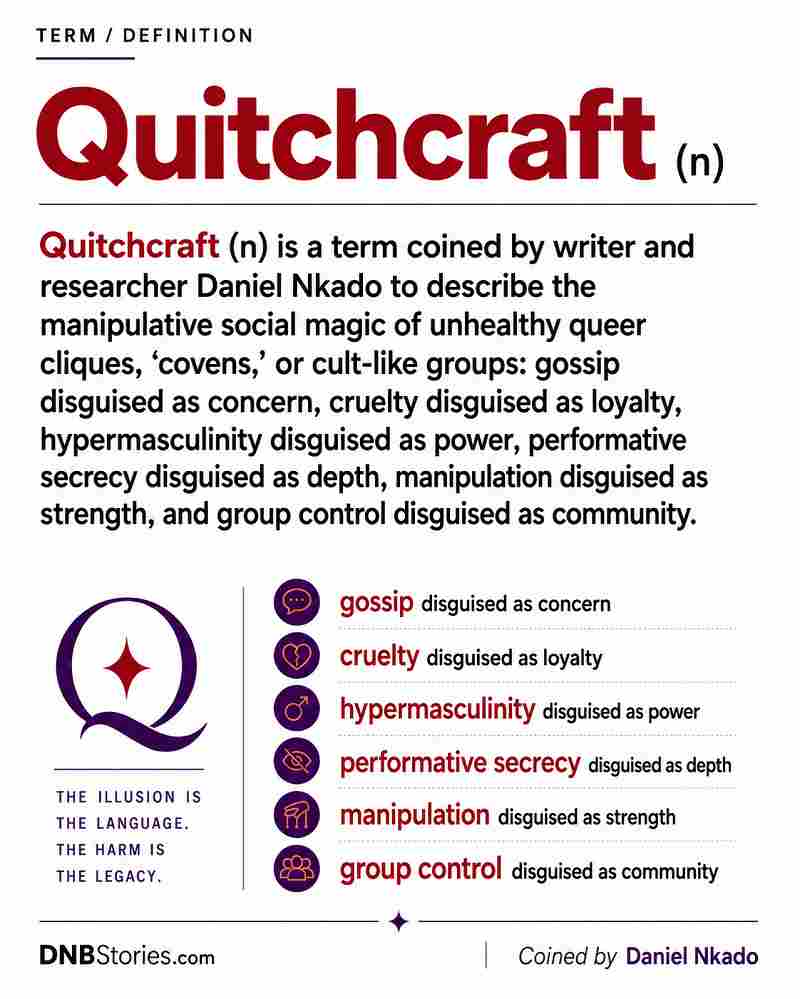
If you allow a clique to separate you from the grounded people who could have formed the backbone of your life, you may be trading your safety, stability, security, and growth for the temporary thrill of quitchcraft — queer witchcraft dressed up as belonging.
Be careful. Any group that requires you to be isolated from others to prove loyalty is not building community. It is building a cult.
Community Is Not Everybody
A strong support system is not about popularity.
It is not about having the most followers, the busiest phone, the loudest weekend plans, or the largest group chat presence. Many people are socially visible but privately unsupported.
Real support is quieter than performance.
It is the friend who tells you the truth.
The friend who sends help without humiliating you.
That one friend who shows up when your body, house, or life is in crisis.
The mentor who opens a door without placing a chain around your neck.
You do not need 100 friends to feel supported.
You need the right people, in the right roles, with the right boundaries.
Community is not everybody.
Community is structure.
Key Takeaways
- A large social circle does not always mean real support.
- Being desired, visible, invited, or socially known does not mean your life is properly held.
- Support works better when different people serve different roles.
- Every adult needs some form of emotional, practical, crisis, and guidance-based support.
- Financial help in friendship requires trust, clarity, accountability, and respect for boundaries.
- Mentorship should never become control, sexual debt, emotional ownership, or dependency.
- Support systems should reduce chaos, not enable it.
- Clique loyalty should never separate you from grounded people who genuinely support your safety, stability, and growth.
- One reliable person in each role is often more valuable than 100 shallow connections.
References
- Choi, S. K., Wilson, B. D. M., & Mallory, C. (2021). Black LGBT adults in the US. The Williams Institute, UCLA School of Law. https://williamsinstitute.law.ucla.edu/publications/black-lgbt-adults-in-the-us/
- Drageset, J. (2021). Social support. In G. Haugan & M. Eriksson (Eds.), Health promotion in health care: Vital theories and research (Chapter 11). Springer. https://doi.org/10.1007/978-3-030-63135-2_11
- Montero, A., Hamel, L., Artiga, S., & Dawson, L. (2024, April 2). LGBT adults’ experiences with discrimination and health care disparities: Findings from the KFF Survey of Racism, Discrimination, and Health. KFF. https://www.kff.org/racial-equity-and-health-policy/lgbt-adults-experiences-with-discrimination-and-health-care-disparities-findings-from-the-kff-survey-of-racism-discrimination-and-health/
- Palmer, C. (2019, April 1). How to mentor ethically. Monitor on Psychology, 50(4), 70. American Psychological Association. https://www.apa.org/monitor/2019/04/mentor-ethically
- University of Pennsylvania. (n.d.). Part three, chapter nine: Key constructs—Social support. Health Behavior and Health Education. https://www.med.upenn.edu/hbhe4/part3-ch9-key-constructs-social-support.shtml