
1. ✅ What is the Absurdity Reps Method (ARM)?
In many gay spaces—including Black queer contexts—shaming and humiliation can quietly become entertainment: a room laughs while someone’s dignity gets turned into a joke. I developed ARM for this reality.
The Absurdity Reps Method (ARM) is a cultural, shame‑regulation practice designed to help people withstand identity‑targeting social attacks—such as shaming, humiliation, ridicule, or verbal bullying—without arguing, defending worth, or shrinking themselves. ARM works by deliberately exaggerating feared identity scripts into absurdity and pairing that exaggeration with small, real‑world actions that restore behavioural choice.
Important Note:❗ARM is a cultural practice, not a medical substitute. Use it privately, one-on-one, or in small groups where safety is confirmed. Do not replace professional care with ARM. For adults only.
ARM = Reps + Truth Action
The Absurdity Reps Method (ARM) interrupts shame in real time by pushing shame scripts past coherence and reclaiming control through small, concrete actions—called Truth Actions. Repeated over time, this practice trains down the threat responses that drive distress and anxiety during public shaming and humiliation—much like training a muscle.
Instead of correcting the shamer or defending your worth, ARM asks you to accept the trigger script or label and push it to an impossible extreme—teaching the nervous system that even the worst‑case version of the ridicule carries no real danger. Over time, the body learns that shame only wields the authority we give it.
- 1. ✅ What is the Absurdity Reps Method (ARM)?
- 2. 😀 Absurdity Reps As A Potent 'Shamicide'
- 3. 🧠 Science Behind the Absurdity Reps Method (ARM)
- 4. 🛠️ The ARM Protocol: A Harm-Minimising Approach
- Gay Culture and the Power of Absurdity
- Absurdity Reps Method (ARM): Quick Guide and Rules
- Step 0: Alignment
- Step 1: Name the Shame Script
- Step 2: Design Your Absurd Rep (AR)
- Step 3: Deliver Absurdity Rep in a Safe Container
- The A-L-D-A Follow-Through
- Delivering an Absurd Rep (AR): How to Do It Right
- Struggling To Deliver The Rep?
- Step 4: Truth Action
- Using ARM to Survive Public Shaming/Humiliation
- 5.🧱 How ARM Relates to the Bridge Model
- 6. 🖊️ ARM Applications Beyond Sexual Roles
- 7. 🦺 ARM Limitations, Risks, and Ethical Lines
- Conclusion
- Frequently Asked Questions
- References
- Absurdity Reps Method: Key Terms
2. 😀 Absurdity Reps As A Potent ‘Shamicide’
I built the Absurdity Reps Method (ARM) on a simple philosophy: toxic shame—the internal pillar we develop from constantly absorbing society’s negative messages about our existence—survives on two foods: silence and seriousness. Silence keeps the script unspoken; seriousness grants it authority. We feed shame whenever we obey it—by hiding, defending ourselves, lying, performing, avoiding exposure, and passing the shame on. That is how shame secures our complicity. The masks we wear, the lies we tell, and the stigma we redistribute keep shame’s power intact.
ARM breaks the cycle of public shaming by refusing obedience: we say it loud, laugh at it, and take one small action that aligns with our truth. I describe ARM as a form of shamicide: a method of “killing” shame by cutting off its food supply—one absurd rep and one Truth Action at a time.
Absurdity Reps and Black Queer Culture
ARM emerged from my cultural exploration of sexual role anxiety and role-related shame among Black gay men. It is a method I practise personally and have seen work in real rooms.
ARM draws on Black queer traditions of resistance, where humour and performance have long served as tools of survival, deflection, and self‑protection. Drag culture offers a clear example: performers often use self‑directed humour to absorb criticism before it can fully land.
A similar logic appears in the Igbo practice of ịkọ‑ọnụ, where a person facing a verbal attack may neutralise an insult by over‑accepting and amplifying it until the attacker’s logic collapses under its own weight.

Shaming as the “Last Resort of a Losing Man”
Many African sociological contexts treat personal shaming as a sign of defeat. In social or intellectual power struggles, attacking a personal trait usually shows that the shamer has run out of real leverage, revealing desperation rather than truth. For shame to cause real psychological harm, it typically requires two things: truth and stakes. If a trait harms the public, shame can land; if it is personal and harmless, the attack often makes the shamer look intrusive or wounded. Shame also depends on the target’s complicity: labels like “bottom” or “fem” do the most damage when they expose a gap between lived reality and public image. Where that gap no longer exists, shaming often fails.
3. 🧠 Science Behind the Absurdity Reps Method (ARM)
The Absurdity Reps Method (ARM) challenges internalised shame in Black gay men by disrupting inherited identity scripts—such as the demand to perform “alpha top,” DL (down low), or “hood” archetypes, or the idea that masculinity requires dominance, control, or straight-passing labour. These scripts often become trigger points for shame when a man senses that others can see his mismatch with them. Instead of defending against that deviation when it is used to shame him, ARM accepts the trigger and pushes it to excess until the script’s instability becomes visible and its authority begins to crumble.
Psychological Theories Behind the Absurdity Reps
ARM sits on seven established psychological and therapeutic frameworks:
- Cognitive Dissonance: Exaggerated over‑acceptance creates a mismatch between the shaming message and lived reality, weakening its credibility[3].
- Exposure Learning: Repeated, playful engagement with shame cues reduces their emotional charge over time[2].
- Paradoxical Intention: Leaning into the feared label undermines its power to regulate behaviour[4].
- Affect Labelling: Naming and performing shame aloud disrupts its silent, internal hold[6].
- Narrative Externalisation: Treats shame as a script or role rather than as an essential truth of the self[8].
- Performativity Theory: Frames identity as something enacted, not fixed, and therefore open to subversion[1].
- Humour‑Based Cognitive Reappraisal: Comedy reframes the meaning of the shaming signal, replacing threat with play[9].
ARM and the Igbo Culture of ịkọ-ọnụ
Beyond psychological theory, ARM draws on Igbo expressive culture, where conflicts often escalate into open verbal confrontation (ịkọ‑ọnụ). In these contexts, people sometimes neutralise insults that could damage their reputation or trigger prolonged rumination not by defending themselves, but by strategically accepting the insult and exaggerating it beyond what is realistic. By “over‑accepting” the attack, the target reduces its potency both internally and externally: the mind stops registering the insult as a serious threat that could harden into shame, and onlookers lose interest in carrying the accusation forward as credible gossip.
For example, when an aggressor tries to wound a woman’s reputation by calling her a sex worker, she may respond by over-accepting the insult: “Why are you saying it quietly? I’m a sex worker—actually, the biggest this town has ever known.” In many cases, the confrontation loses force and ends there.
This refusal to take offence deprives the insult of the seriousness it needs to function, both as fuel for shame and as socially credible material.
4. 🛠️ The ARM Protocol: A Harm-Minimising Approach
ARM borrows the idea of “reps” from physical training, using repetition to prompt the mind to re-examine rigid internal scripts. When someone who has spent years hiding his deviation from a rigid role or identity replaces fear with bold ownership, shame begins to loosen.
Gay Culture and the Power of Absurdity
Consider a Black gay man who presents himself on Grindr as a “DL Alpha Top” but bottoms on occasion. He experiences the possibility of being found out as social death. During a shaming moment, instead of arguing or defending himself, he declares, “I’m a power bottom lesbian.” The brain does not adopt a new literal identity. Instead, the absurdity punctures the hierarchy, recoding it as something to joke about rather than fear. He then follows up with a small Truth Action to complete the ARM loop—for example, by changing his Grindr bio to “Vers Top.”
The Absurdity Reps Method (ARM) is most effective at managing the threat responses that cause distress during public shaming, humiliation, and verbal bullying. When applied correctly, it also interrupts the silence-and-withdrawal cycle that intensifies rumination and deepens shame. This makes ARM especially valuable in unexpected social attacks, where it can help stabilise internal regulation while also reducing external reinforcement that sustains shaming.
Below is a structured guide to practising ARM safely and effectively:
Absurdity Reps Method (ARM): Quick Guide and Rules
The mechanism of the Absurdity Reps Method (ARM) is simple: through repeated absurd reps, individuals build tolerance to shame triggers that once caused distress and anxiety, prompting the mind to recategorise labels and stereotypes as less threatening.
Step 0: Alignment
ARM begins with internal honesty, not public disclosure. Before using the method, ask whether you are still hiding the truth from yourself. What matters is not the persona you perform for safety or status, but the story you tell your own mind. You may present as “Bisexual Total Top” to the world—but does that reflect your internal truth? If not, align.
Step 1: Name the Shame Script
Identify a specific identity script that triggers shame. Focus on a concrete social fear, not a vague insecurity: how you believe others see you, and what you think deviation will cost you—respect, safety, belonging, or status. Use clear, specific language. ARM targets precise scripts, not general self-doubt.
Examples:
- “If they think I’m a bottom, I’ll lose all respect.”
- “If I’m read as fem or a ‘soft man,’ I’ll drop in status.”
- “If they know I wear a wig to cover my bald patch, I’ll lose desirability.”
- “If I don’t perform dominance, I’ll be treated as a lesser man.”
- “If they see how sensitive I am, I won’t be taken seriously.”
Step 2: Design Your Absurd Rep (AR)
Create a short, self‑referential phrase that accepts the feared label and exaggerates it into utter absurdity. Treat this as deliberately writing the worst‑case version of the shame point—pushed so far it breaks realism. The goal is not wit or irony, but language that reveals the script’s weak foundation.
Rule: Each rep must accept the feared identity and exaggerate it into the realm of absurdity. If the rep still sounds believable, it isn’t absurd enough. The goal is to collapse the script into ridicule—not to defend the self.
Example A — Fear: being called a bottom
- “I’m a power bottom lesbian.”
- “I’m the Minister of Receptivity.”
- “I’m the size-queen power bottom that invented fisting.”
Example B — Fear: being called a soft or feminine man
- “I’m a muscle pillow princess.”
- “I’m the national anthem of tenderness.”
- “I’m so feminine I ovulate compliments.”
- “I’m the Queen Mother of sweetness.”
- “I’m the national budget for femininity.”
- “I’m a Ballroom Barbie trapped in human form.”
- “I’m so feminine my pronouns are slay and soft.”
- “I’m a walking handbag with opinions.”
Step 3: Deliver Absurdity Rep in a Safe Container
Treat this as non-negotiable. Absurdity is a tool, not a public dare. A safe container has two core conditions: low power imbalance—no one present can materially punish you through your job, housing, immigration status, or physical safety—and a clean exit, meaning you can disengage, change the subject, or leave the room without consequence. When a Bridge Builder is present, the space can become a sanctuary.
Start low‑risk:
- private practice: voice note, mirror rep, journaling, notes app (zero audience).
- trusted friend/partner or close friends.
- queer support circles or group chats with shared norms.
- creative spaces—writing, comedy, drag, spoken word, rehearsal.
- environments where humour/camp/irony already function as social language.
The A-L-D-A Follow-Through
After a successful absurd rep delivery, you can run A-L-D-A.
It means:
- A — Allow the moment to land.
- L — Let the silence sit.
- D — Disengage by shifting attention to something else or leaving.
- A — Act. Follow rep with a truth action—one small micro‑action that aligns with your truth.
Delivering an Absurd Rep (AR): How to Do It Right
i. Say it once, boldly and clearly:
Deliver the rep in one clean line—audible, steady, and complete. Don’t trail off, whisper, or add qualifiers. The rep needs to land as a full unit. Half‑delivery keeps the script “serious” and leaves shame untouched.
Tip: Aim for plain confidence, not theatrical performance. The goal is not to win the room, but to teach your nervous system that this carries no danger. Use a calm, casual, lightly playful tone. Avoid bitter sarcasm, angry clapback energy, or pleading humour.
ii. Do not try to explain or justify:
No “I’m joking,” no “you know what I mean,” no clarification. Explanation restores seriousness—one of shame’s main fuel sources.
iii. Let the discomfort pass:
Expect a brief spike of awkwardness, heat, or embarrassment after delivering a rep. That sensation is your nervous system recalibrating. Don’t smooth it over or try to “repair” the moment with extra talking, forced laughter, or follow‑up explanations—just let it pass.
iv. Exit cleanly:
Once the line lands, disengage. Pause, turn away, sip your drink, check your phone, turn to a friend, change the subject, or leave. A clean exit stops the room from turning the moment into a scene and taking control back from you.
v. Prioritise repetition over intensity:
Consistent, low‑stakes reps retrain the threat response. Accept affirmation if it comes, but don’t chase it—ARM trains the nervous system, not the audience.
Struggling To Deliver The Rep?
If the rep feels blocked, it’s not a failure but data—often a signal of safety or alignment issues. Check the container for power imbalance and clean exit. If space is safe, self-alignment may have been skipped. This means you may still be protecting a mask or performance for approval or to avoid shame. Take enough time to decide whether to continue obeying the script or break from it.
Step 4: Truth Action
A Truth Action is a small, concrete action that proves you are no longer obeying the shame script. It is intentionally modest—not dramatic or confrontational. It should feel relieving rather than heroic and align with the collapsed shame script.
Examples of truth actions:
- Wearing what you want to an event instead of dressing for status.
- Updating how you present yourself (online or offline) to reflect your real preferences rather than a rewarded persona.
- Playing or sharing music you genuinely enjoy instead of curating taste for credibility.
- Interrupting a shaming or humiliating comment aimed at someone else rather than staying silent.
- Sharing a piece of creative work you previously kept hidden out of fear of judgment.
- Staying present in a room instead of leaving early to avoid scrutiny.
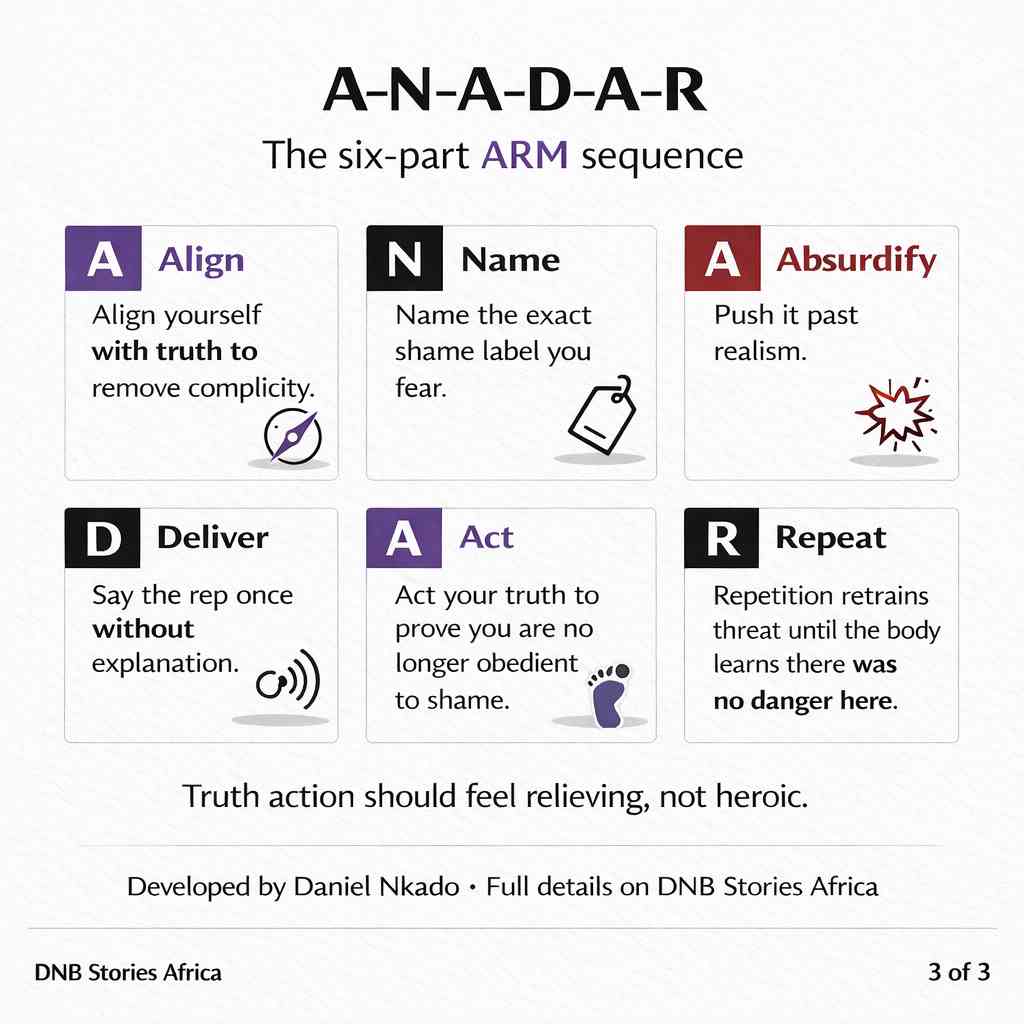
Using ARM to Survive Public Shaming/Humiliation
Public shaming works by creating a sudden sense of exposure—the fear that others are watching, judging, and recalculating your status in real time. ARM is designed for precisely these moments, not to “win” the exchange, but to interrupt shame before it hardens into obedience, rumination, or self‑erasure. If someone targets you with shaming, humiliation, or bullying in public and no Bridge Builder is present, ARM can be used defensively—but remember that safety comes first. Always assess power dynamics and exit options before deploying it.
5.🧱 How ARM Relates to the Bridge Model
Both developed by Daniel Nkado, the Absurdity Reps Method (ARM) and Bridge Model work as companion frameworks that interrupt shame at two levels—internal and external. ARM does the inner work by helping individuals regulate threat responses during shaming episodes and loosen rigid shame scripts through repeated absurd reps and Truth Actions.
The Bridge Model does the outer work by targeting the social conditions that reward shame—bystander silence, ridicule‑as‑entertainment, and unchallenged hierarchies—using a three‑tier strategy of personal effort, small‑group norms, and community systems. ARM retrains the person; the Bridge Model retrains the space—together they make dignity a livable reality for all gay men.
Role of Bridge Builders in ARM
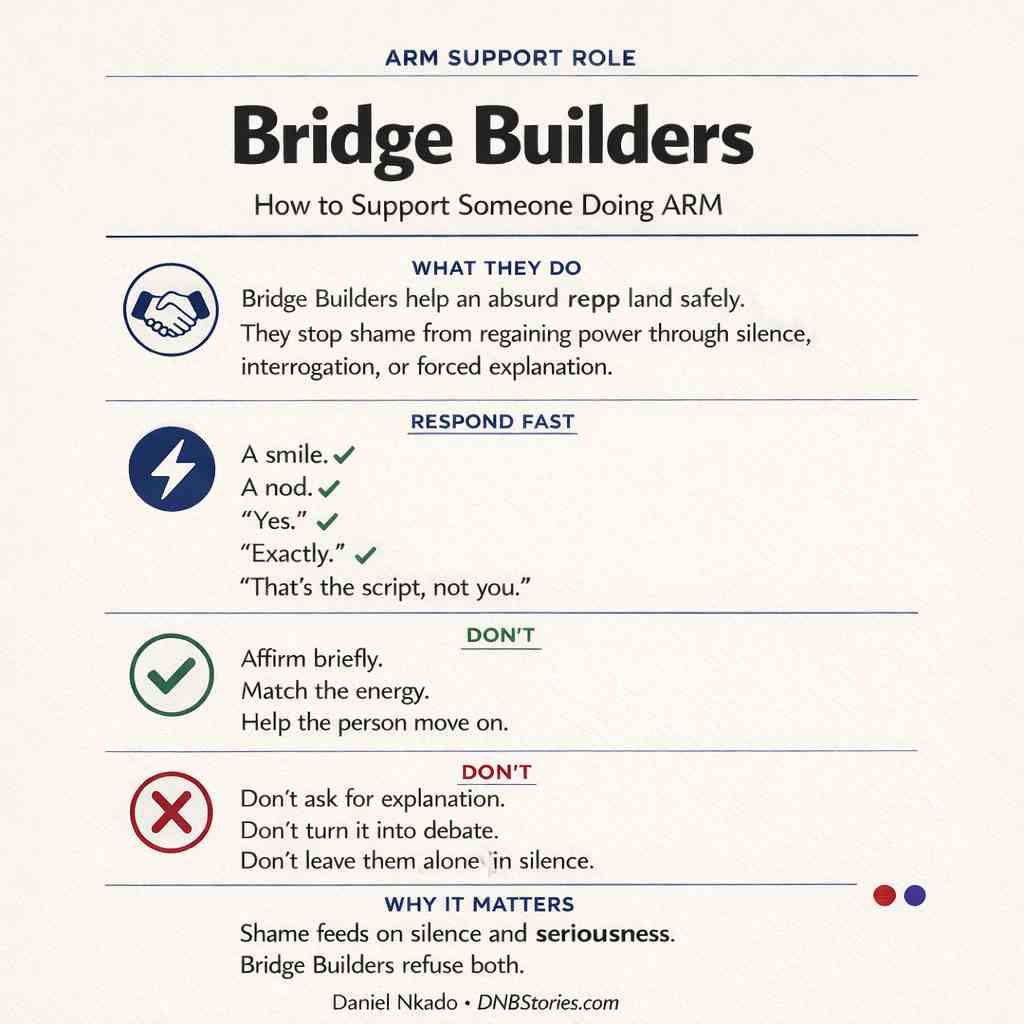
Bridge Builders are the connective tissue between the two frameworks. They are not saviours, but forms of community maintenance that step in where harm would otherwise grow under silence. By interrupting shaming, briefly affirming dignity, and helping the room move on, they protect the social conditions ARM needs to work with. When someone delivers an absurd rep, Bridge Builders provide quick reinforcement so that silence does not return and shame is not fed again.
How to Support Someone Doing ARM as a Bridge Builder
Bridge Builders help an absurd rep land safely. Respond fast and lightly: a smile, a nod, a brief laugh, or a simple line like “Exactly,” “That’s the script, not you,” or “Good rep—moving on.” The goal is not to analyse the rep or make the person explain it. The goal is to affirm, protect dignity, and help the moment pass cleanly.
Ready-to-use Bridge Builder lines
- “Perfect. That’s the script.”
- “You did it.”
- “Shame aint cashing that cheque.”
- “We’re not doing seriousness today.”
- “Good rep, baby—moving on.”
🦹🏾♂️ The Bridge Builders’ Pledge:
“We build bridges, not blame. We share love, not shame. We distribute power, not stigma. We call out harm, not people. We repair, not cancel.”
ARM Use and Safety Note
ARM is a cultural, self-directed practice, not a clinical or therapeutic intervention. It does not offer or substitute medical diagnosis, treatment, or professional care. ARM uses repeated absurd reps to reduce shame-based threat perception and loosen rigid identity scripts. It does not create new identity categories or encourage risk in unsafe environments. ARM is for adult use only and should be practised voluntarily in safe contexts.
6. 🖊️ ARM Applications Beyond Sexual Roles
While ARM is often first understood through sexual‑role anxiety, its mechanism applies far more broadly to the identity scripts that quietly regulate behaviour in many Black gay spaces. Scripts around femininity, softness, desirability, and class presentation often function as informal status hierarchies, where deviation reads as weakness, failure, or social risk. Shame emerges not from the trait itself, but from the fear of being seen as mismatched with what the environment rewards.

7. 🦺 ARM Limitations, Risks, and Ethical Lines
ARM is effective, but it is not universal and must be used with judgment. While the method is a powerful tool for dismantling internalised scripts, it requires strict ethical boundaries to ensure it does not cause unintended harm.
- Safety comes first. Do not use ARM in settings where someone can punish you materially (job, housing, immigration status, physical safety, or serious community retaliation). When safety is uncertain, prioritise exit and practise privately later.
- ARM is not an escalation. The method is not for humiliating others, winning exchanges, or provoking conflict. Use ARM as a personal safety tool, not as a strategy to intimidate others; otherwise, this can reinforce the very hierarchies it aims to dismantle.
- ARM is not therapy. It is a cultural, self‑directed practice—not a replacement for professional mental‑health care. It supports regulation but does not treat trauma or clinical distress on its own.
- Misuse can reinforce shame. Believable reps, post‑rep explanations, skipping the Truth Action, or using ARM without alignment can restore seriousness rather than break it.
- Context and consent matter. ARM belongs in safe containers—low power imbalance, clean exit, and shared norms around humour. Spaces that reward ridicule or spectator cruelty are not appropriate.
- ARM targets scripts, not people. It is inward‑facing. It should never pressure others into disclosure, mock their identities, or force vulnerability.
Bottom line: ARM withdraws obedience from shame, but restraint is part of its ethics. When safety, alignment, and context are respected, it can be liberating. When they aren’t, choosing not to use it is the ethical move.
ARM Future Directions
For ARM to mature into a teachable practice, it requires ethical, community-controlled documentation. Future qualitative studies could track how Black gay men describe shifts in shame after using ARM. Diary-based research designs could measure within-person changes across several weeks. Practically, creating a short ARM workbook or a community facilitator guide would help standardise safe practice and expand its reach.
Conclusion
The Absurdity Reps Method rests on a simple but profound insight: shame isn’t just a belief—it’s a conditioned response to a social script. When labels harden into hierarchies, deliberate absurdity reopens space for flexibility and choice. ARM doesn’t ask you to deny reality; it asks you to stop treating the script as sacred—and to repeat that refusal until the body believes it.
Frequently Asked Questions
ARM is a cultural tool for breaking shame by pushing feared identity labels into absurdity and reclaiming behavioural choice through repetition and small, defiant actions.
ARM can be used wherever shame depends on rigid social scripts. For gay men, this often includes shame tied to sexual role labels, femininity, softness, desirability, masculinity, visibility, and other identity-based pressures.
Yes—but only where safety allows. In the right context, ARM can help a target reclaim control by reducing the internal threat response while also cutting off the external reward that sustains shaming.
ARM works internally by retraining the nervous system and loosening the grip of shame on a person. The Bridge Model works externally by changing the group and community norms that allow shame to thrive. Together, they make dignity sustainable rather than situational.
ARM does not depend on argument, reassurance, or insight alone. It works through repetition and behaviour, gradually teaching the body that the shame script carries no real danger.
ARM was developed in the context of Black gay social spaces, but its mechanism applies wherever rigid scripts turn difference into danger. It is for people who want a practical way to stop obeying shame without escalating conflict.
ARM is an internal safety tool. Do not use where safety looks uncertain—such as hostile contexts with real risk of homophobia or violence, or formal professional settings with material consequences.
References
- Butler, J. (1988). Performative Acts and Gender Constitution: an Essay in Phenomenology and Feminist Theory. Theatre Journal, 40(4), 519–531. https://doi.org/10.2307/3207893
- Craske, M. G., Treanor, M., Conway, C. C., Zbozinek, T., & Vervliet, B. (2014). Maximising exposure therapy: An inhibitory learning approach. Behaviour Research and Therapy, 58(1), 10–23. https://doi.org/10.1016/j.brat.2014.04.006
- Festinger, L. (1962). Cognitive Dissonance. Scientific American, 207(4), 93–106. https://doi.org/10.1038/scientificamerican1062-93
- Jansson‐Fröjmark, M., Alfonsson, S., Bohman, B., Rozental, A., & Norell‐Clarke, A. (2021). Paradoxical intention for insomnia: A systematic review and meta‐analysis. Journal of Sleep Research. https://doi.org/10.1111/jsr.13464
- Kugler, L., & Kuhbandner, C. (2015). That’s not funny! – But it should be: effects of humorous emotion regulation on emotional experience and memory. Frontiers in Psychology, 6. https://doi.org/10.3389/fpsyg.2015.01296
- Lieberman, M. D., Eisenberger, N. I., Crockett, M. J., Tom, S. M., Pfeifer, J. H., & Way, B. M. (2007). Putting feelings into words: affect labelling disrupts amygdala activity in response to affective stimuli. Psychological Science, 18(5), 421–428. https://doi.org/10.1111/j.1467-9280.2007.01916.x
- Nkado, D. (2025, December 14). The Power of Screaming “I’m a Power Bottom Lesbian” as a Black Gay Man – DNB Stories Africa. DNB Stories Africa. https://dnbstories.com/2025/12/black-gay-men-top-bottom-role-anxiety.html
- White, M., & Epston, D. (1990). Narrative Means to Therapeutic Ends. Norton. https://wwnorton.com/books/Narrative-Means-to-Therapeutic-Ends/
- Wu, X., Guo, T., Zhang, C., Hong, T.-Y., Cheng, C.-M., Wei, P., Hsieh, J.-C., & Luo, J. (2020). From “Aha!” to “Haha!” Using Humour to Cope with Negative Stimuli. Cerebral Cortex, 31(4), 2238–2250. https://doi.org/10.1093/cercor/bhaa357
Absurdity Reps Method: Key Terms
ARM (Absurdity Reps Method)
A self‑directed practice for weakening shame by exaggerating its scripts into absurdity and restoring behavioural choice through repetition and small, defiant actions.
Absurd Reps (AR)
Short, intentional and wildly unreasonable statements or mini‑performances that turn shame‑triggering labels into obvious absurdity. ARs disrupt shame by denying it the silence and seriousness it feeds on. They are delivered clearly, without explanation, and allowed to stand on their own.
Shame Script
An internalised rule linking an identity or trait to social loss (e.g., dignity, status, desirability, belonging). ARM targets the script—not the person.
Self‑Alignment (Authenticity)
A state of internal coherence with one’s truth that does not require public disclosure.
Safe Container
A space with low power imbalance and an easy exit—allowing ARs to land without escalating into harm or surveillance.
Silence (Shame Sustainer)
Non‑response that allows shame to intensify via withdrawal and rumination. ARs interrupt silence by making the script sayable.
Seriousness (Shame Sustainer)
Credibility, explanation, or defence that grants shame authority. Explaining a rep restores seriousness and re‑legitimises the script.
Obedience (Shame Sustainer)
Any behaviour that treats the shame script as law—silence, defence, hiding, performance, or shame redistribution—thereby giving shame fuel and authority.
Truth Action
One small, concrete action taken after an AR that contradicts the script’s “cost.” In ARM, the rep collapses shame’s story; the truth action collapses its control.
Bridge Builder
An active bystander who applies the Bridge Model to interrupt shame and other forms of cruelty and uphold the dignity of community members.
Shame Threat Response
The nervous system’s reaction to perceived social danger (e.g., anxiety, freeze, rumination, over‑performance). ARM retrains this through repetition.