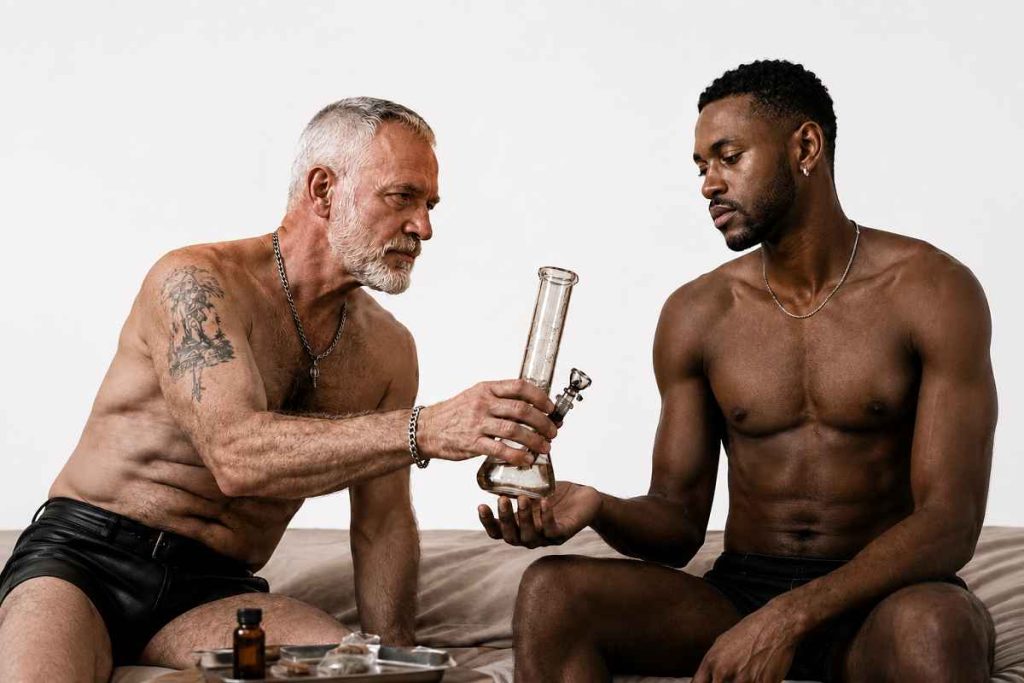
Chemsex is often discussed as though it begins with an isolated personal decision: a queer man encounters a drug, enjoys the sexual effects and chooses to continue using it.
That explanation is incomplete.
For some Black queer men, entry into chemsex may occur within a wider racialised sexual economy in which:
A. Black bodies are intensely desired without meaningful recognition of the people inhabiting them;
B. specific racialised sexual performances are expected; and
C. older or better-positioned white queer men control access to the drugs, venues and networks through which those performances take place.
The Economics of Black Queer Desire and Racial Fetishisation
The Economics of Black Queer Desire—or EBQD—is a framework developed by Daniel Nkado to explain how this process unfolds. EBQD argues that desire is shaped not only by private attraction but also by a social market in which attention functions as currency, desirability becomes a measure of value, and bodies may be rewarded more readily than emotional depth or personhood.
Its DEPS structure identifies four forces that organise Black queer sexual experience: desirability hierarchies, economic inequality, platform dynamics, and stigma or safety conditions.
Through this lens, racial fetishisation and chemsex are not necessarily separate issues.
Repeated Fetishisation Trains Black Queer Men into Performance-Led Sex
Repeated fetishisation can establish the racialised sexual role a Black queer man is expected to perform. Performance-led sex then converts that role into a continuing obligation: to remain desirable, he must repeatedly deliver the body, behaviour and sexual intensity the market expects from him.
Chemsex substances may enter this process through two routes. They may be introduced directly by someone seeking access to the fetishised body, or adopted indirectly by the Black queer man because chemically enhanced sex makes the required performance easier to sustain.
The first route supplies the drug.
The second supplies the perceived need for it.
When Performance-Led Sex Replaces Connection-Led Sex: How Chemsex Enters the Picture
Chemsex is not automatically compulsive, coercive or harmful. Some people describe sexualised drug use in terms of pleasure, exploration, confidence, belonging and intimacy. It would therefore be inaccurate and stigmatising to treat everyone who participates in chemsex as addicted, exploited or incapable of making informed choices.
The concern of this article is more specific: the conditions under which racial fetishisation, unequal access to resources and pressure to sustain demanding sexual performances may increase the likelihood of:
- initiation into chemsex;
- repeated or escalating participation;
- psychological reliance on drugs to have sex;
- dependence on a particular substance;
- dependence on the person or network controlling access to drugs, venues or sexual opportunities; and
- difficulty imagining satisfying sex without chemical assistance.
How EBQD Explains the Connection Between Repeated Fetishisation and Chemsex
Daniel Nkado’s Economics of Black Queer Desire—or EBQD—framework describes a Black Queer Desire Market in which attention functions as currency and visible desirability may be rewarded more readily than emotional depth or personhood.
Under these conditions, a Black queer man may receive intense interest in his body and perceived sexual attributes while attracting little curiosity about his character, values, vulnerabilities or inner life.
He is immediately recognised as a sexual body, yet remains largely unseen as a person.
Repeated Fetishisation Can Teach a Black Queer Man to Hide His Interior Self
Repeated exposure to the same rewards and exclusions can teach queer men what to pursue, which bodies to notice and which forms of intimacy appear unrealistic, unrewarding or unsafe.
What begins as an external desirability hierarchy can gradually become an internal sexual expectation. A Black queer man who is repeatedly rewarded for his body, masculinity or sexual performance—but overlooked when he expresses vulnerability, emotional need or relational depth—may begin to conceal the parts of himself the sexual market does not appear to value.
The mother framework, Queer Desirability Economics—or QDE—explains how desire can be socially trained through repeated patterns of reward, exclusion and recognition.
How It Plays Out
A Black queer man may initially want sex that includes affection, reciprocity, curiosity and recognition. Yet the attention available to him may repeatedly arrive through a narrow racial script:
- unusually large or permanently erect;
- naturally dominant;
- physically aggressive;
- emotionally detached;
- endlessly confident;
- sexually experienced;
- always the penetrative partner;
- capable of prolonged activity;
- willing to fulfil someone else’s fantasy of Black masculinity.
When fuller forms of recognition remain scarce, the individual may begin to accept the form of desire the market repeatedly makes available.
The lesson becomes:
My body is welcome when it performs the racial fantasy correctly.
Research involving men of colour in gay dating environments found that racial fetishisation could leave them feeling objectified, confined to stereotypes and prevented from establishing intimate or even platonic connections. Other research has associated sexual racism with poorer psychological wellbeing among men of colour who have sex with men.
The Fetishisation-to-Disconnection Pathway
Repeated fetishisation does more than shape how other people view a Black queer man. It may also influence what he learns to expect from sexual encounters.
Repeated racial fetishisation does not necessarily train him out of wanting connection. It often instead trains him out of expecting connection to be available through sex.
This distinction between connection-led sex and performance-led sex emerged as a central part of the analysis developed in this article.
Connection-Led Sex and Performance-Led Sex
Meaning of connection-led sex
Connection-led sex is organised around mutual recognition.
Each participant remains aware that the other is a person with feelings, limits, desires, uncertainty and an interior life. The encounter allows space for communication, responsiveness, changing preferences, emotional presence and care.
Its central question is:
Who are you, and how can we meet each other here?
Connection-led sex does not have to be romantic, exclusive or long-term. Casual sex can still be connection-led when the people involved remain attentive to one another’s humanity.
Performance-led sex
Performance-led sex is organised around the successful delivery of an expected role.
The encounter is less concerned with discovering what the individual wants and more concerned with whether he can convincingly perform dominance, submission, masculinity, aggression, receptivity, discretion or some racialised sexual identity.
Its central question is:
Can you perform what I expect you to be?
Performance-led sex may still be consensual and pleasurable. Sexual play itself often includes role-play, fantasy and performance.
The problem arises when performance becomes the condition of recognition—when the person feels that he will lose attention, access, praise, or belonging if he stops performing the assigned role.
The essential contrast is not casual sex versus relationship sex.
It is mutual recognition versus compulsory role compliance.
Connection-led sex recognises the person carrying the body. Performance-led sex recognises only the body and what it can deliver; the person behind the performance is ignored.
Why Performance-Led Sex Creates a Demand for Enhancement
A human body is variable. Erections fluctuate. Energy declines. Anxiety interrupts arousal. Desire changes during an encounter. People sometimes need to slow down, stop, talk or change what they are doing.
Connection-led sex can accommodate this variability because the encounter is responsive to the people involved.
Performance-led sex is less forgiving. If a Black queer man’s sexual value appears to depend on being permanently dominant, exceptionally erect, tireless, uninhibited and capable of prolonged penetration, ordinary bodily variation may begin to feel like failure.
The individual is no longer simply having sex. He is being evaluated against a racialised product specification.
Chemsex substances can then function as performance infrastructure.
Qualitative chemsex research has found that participants may use drugs to increase libido, confidence, energy and stamina; reduce inhibition and sexual anxiety; intensify sensation; prolong encounters; delay orgasm; maintain arousal; and participate with more partners. Some participants described improved sexual performance as an important reason for using substances rather than an incidental effect.
Drugs As Fuel For Performance
Within a racialised access economy:
- the Black queer man’s body becomes the labour machine;
- the expected sexual role becomes the product, and
- drugs become the fuel that keeps production going.
The drug helps close the gap between the real, variable human body and the exaggerated sexual performance demanded by fetishisation.
The Two Routes Through Which Racial Fetishisation Draws Black Queer Men into Chemsex
EBQD identifies two connected pathways through which some older, better-resourced white queer men can increase Black queer men’s vulnerability to chemsex.
Route One: Direct Drug Provision
The first route is direct.
An older or more established participant may provide:
- drugs;
- private accommodation;
- transport;
- food or alcohol;
- access to parties;
- introductions to sexual networks;
- knowledge about substances and dosages;
- social protection within the chemsex environment.
The Black queer participant may be desired for youth, physique, perceived endowment, dominance, racialised masculinity or sexual availability.
The resulting exchange may appear informal:
I supply the drugs, venue and access. You supply your body and the sexual performance that fulfils my fantasies.
A study of young gay and bisexual men found that most first used methamphetamine in a social setting rather than alone. A wider systematic review of qualitative chemsex studies also identified environments in which hosts supplied drugs, as well as hierarchies involving status, age and relational power. These findings do not establish a specifically older-white-to-Black pattern, but they demonstrate that drug initiation and access can be socially organised rather than purely individual.
The same review identified an “economy of drug use” in which some participants engaged in particular sexual acts in exchange for substances. Researchers also found accounts of subtle power being used to encourage people to take drugs or agree to sexual practices.
Direct provision can increase vulnerability by:
- removing the financial barrier to first use;
- placing drugs inside a desired sexual or social opportunity;
- making chemical use appear normal within queer sex;
- connecting drugs with racial validation and belonging;
- making continued access dependent on returning to the same person or network;
- allowing the supplier to control the venue, supply, timing and social rules;
- complicating the participant’s ability to refuse sex after accepting drugs or hospitality.
Drug provision is not automatically coercive. Adults may knowingly share substances within consensual encounters.
The power problem begins when access to drugs, accommodation, affection or community becomes conditional on sexual compliance—or when intoxication is used to weaken boundaries and make them easier to cross.
Route Two: Indirect Performance-Demand Conditioning
The second route does not require the older white participant to supply any drugs. Repeated fetishisation may itself create the performance standard that makes chemsex seem necessary.
The pathway is:
Racial fetishisation assigns the role:
- sexual attention becomes conditional on performing it
- the Black queer man fears failing the expectation
- ordinary bodily variation produces performance anxiety
- drugs or enhancers increase confidence, erection, stamina and disinhibition
- the enhanced performance receives attention and approval
- chemically assisted sex becomes the new reference point
- sober sex begins to feel inadequate, vulnerable or difficult
- the individual returns to chemical enhancement.
This is the Performance–Enhancement Loop.
Its central proposition is:
When sexual value depends on delivering an exaggerated racial role, substances can become tools for maintaining the performance on which that value appears to depend.
The fetishising partner may not consciously intend to produce drug use. He may never personally offer a substance. Yet repeated demands for exceptional endurance, aggression, erection or emotional detachment can help create a sexual environment in which chemical assistance appears practical or very necessary.
The first pathway supplies the drug. The second supplies the perceived need for the drug. Both pathways end up increasing a Black queer man’s vulnerability to drug use.
Fetishisation Creates the Role; Chemsex Helps Sustain It
Racial fetishisation often presents itself as admiration. A Black queer man may be praised as powerful, masculine, dominant, well-endowed or sexually gifted. He may receive far more immediate sexual interest than relational interest, creating the appearance of genuine desire.
He receives messages. The Black man is invited to parties. He is offered drugs, accommodation or access to social networks. His body is praised. Sexual opportunities may appear abundant.
Yet this apparent abundance can conceal a deeper scarcity: he is wanted for the experience his body can provide, not necessarily for the person he is.
High sexual demand does not necessarily produce human recognition. A person may be erotically overvalued and relationally undervalued at the same time.
EBQD describes this as scarcity concealed beneath apparent abundance: the person may have extensive access to people who want a performance from his body, yet limited access to people who want to know, support and recognise him as a whole human being.
The substances may intensify the apparent abundance by enabling longer sessions, more partners and more dramatic validation. Yet the underlying need remains unresolved because the recognition is still attached to performance rather than personhood.
This is why reassurance may fade so quickly. The individual is praised, but only for what the enhanced body delivers—not for who he actually is.
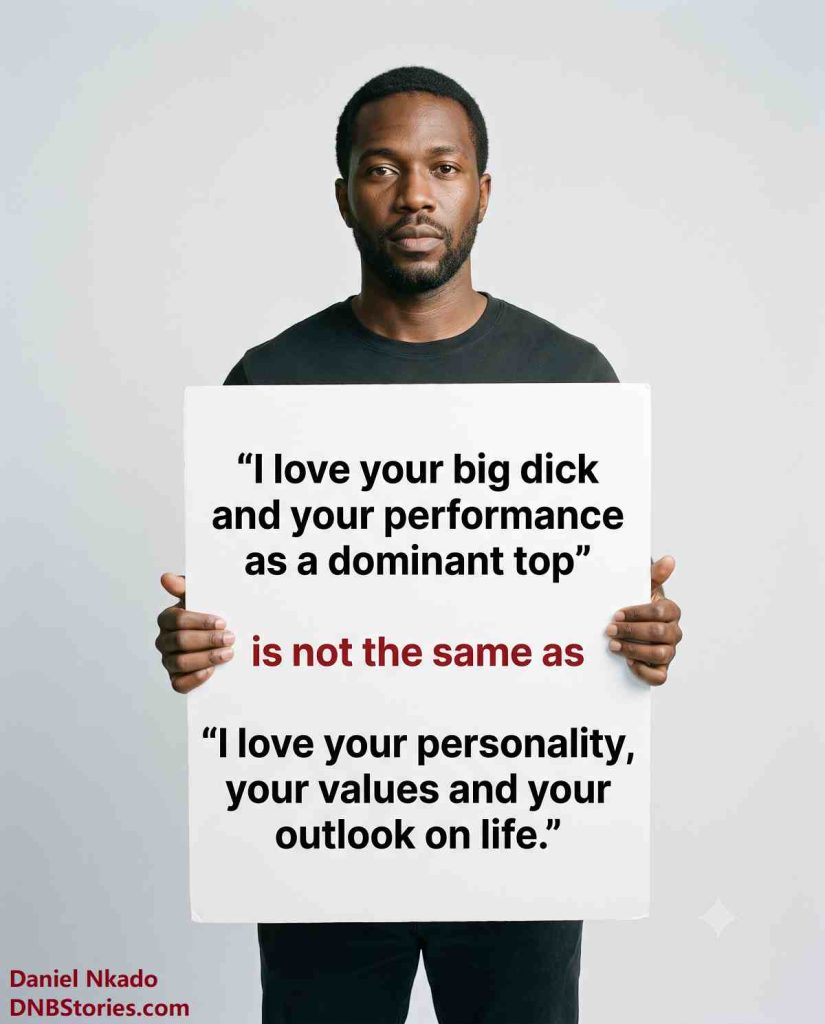
“I love your big dick and your performance as a dominant top” is not the same as “I love your personality, your values and your outlook on life.”
The Fetishiser Creates the Problem and Supplies the Solution
The direct and indirect routes can operate together.
A fetishising participant may expect a Black queer man to be dominant, tireless, endlessly erect and uninhibited. He then supplies substances that help the younger or more vulnerable man meet those expectations.
The offer can appear generous:
Take this. It will help you relax, enjoy yourself and keep going.
But within an unequal racialised exchange, the drug may primarily help the Black participant become more useful to the person providing it.
The structure becomes:
- the fetishiser establishes an exaggerated standard of Black sexual performance;
- the Black queer man experiences pressure to meet that standard;
- the fetishiser supplies the chemical means of meeting it;
- the enhanced performance receives attention and reward;
- the Black queer man learns that chemically assisted performance produces greater access;
- ordinary sober sexuality feels less competitive or less desirable;
- participation repeats.
The fetishiser has helped manufacture the sense of inadequacy and then provided the technology through which the fetishised person temporarily overcomes it.
Fetishisation creates the role. Performance-led sex enforces it. Chemsex helps the body continue delivering it. Together, they form a racialised access economy.
The sexual exchange becomes difficult to analyse when attention is focused only on the drug. The person may not simply be consuming a chemical; he may also be paying the price of admission into a social world in which his recognition has otherwise become very scarce.
Why “Just Quit” Is an Inadequate Chemsex Intervention
This helps explain why “just stop taking drugs” can be an inadequate intervention.
Leaving chemsex may also mean leaving:
- a friendship group;
- a sexual identity;
- a source of confidence;
- a route to racial validation;
- a place to sleep or spend the night;
- a network of desired partners;
- one of the few available experiences of queer belonging.
This does not mean that unequal encounters are automatically non-consensual. It means that consent must be understood as more than the absence of a verbal “no”.
A meaningful assessment should ask:
- Who controls the drugs?
- Who controls the venue?
- Who determines the sexual script?
- Can either person stop without punishment?
- Is access to affection or shelter conditional on sexual participation?
- Does the Black participant know what he is taking and how much he is taking?
- Can he leave safely?
- Is he desired as a person or primarily as a racial performance?
Why This Is Not an Argument Against Interracial or Age-Different Relationships
There are loving, ethical and mutually respectful relationships between Black queer men and older white queer men. An age difference does not automatically indicate exploitation, and white identity does not make someone inherently abusive. Likewise, drug use does not automatically erase agency.
A Black queer man may knowingly choose and enjoy racial fantasy, chemsex, dominant sexual performance or a relationship with an older white partner. The concern is not the existence of these desires or relationships, but the conditions under which power, dependency, coercion or conditional access begin to shape them.
The purpose of EBQD is not to police whom Black queer men desire. Its purpose is to make visible the structures that shape, reward and constrain desire.
The relevant distinction is between:
- attraction and reduction;
- generosity and conditional patronage;
- fantasy and compulsory identity;
- shared pleasure and extracted performance;
- mutual experimentation and chemically enabled access;
- connection-led sex and performance-led sex.
An ethical partner remains interested in the Black person when the racial performance ends.
An EBQD Response: Building Alternative Value Routes
EBQD proposes Alternative Value Routes (AVR) as ways to build worth, emotional regulation, safety, and connection outside the unstable rewards of the sexual marketplace.
AVR does not ask individuals to dismantle racism, economic inequality or platform culture on their own. Instead, it seeks to interrupt the point at which these structural pressures become internalised and reproduced as repeated personal behaviour.
In relation to fetishisation and chemsex, AVR could include:
Race-conscious peer support
Black queer men need spaces where racial fetishisation, drug provision and sexual power can be discussed without judgement or pressure to protect the reputation of dominant queer institutions.
Connection-led sexual literacy
Sexual-health work should teach that good sex does not require endless erection, extreme endurance, permanent dominance or emotional disappearance.
Performance refusal
Black queer men should be supported to identify and reject sexual roles that exist primarily for someone else’s racial fantasy.
Relearning sober sex
People reducing or leaving chemsex may need psychosexual support to tolerate slower sensation, ordinary bodily variation, emotional presence and the vulnerability of being fully conscious during intimacy.
Network diversification
Leaving a chemsex environment is more sustainable when a person has access to friendship, housing support, cultural belonging, creative activity and queer community beyond the supplier network.
Material support
Housing instability, poverty, immigration pressure and lack of privacy can make resource-rich partners more powerful. Prevention must therefore include the material conditions that determine who controls sexual space.
Trauma-informed and culturally competent services
Services should recognise that race, migration, masculinity, fetishisation, shame and sexual role pressure may be part of the chemsex story. Treating the substance while ignoring the racialised environment may leave the original pathway intact.
A Research Agenda for Black Queer Chemsex
The current evidence gap should not be used to dismiss community observations. It should guide better research.
Future studies should examine:
- who first supplied Black queer participants with chemsex drugs;
- the age, race and socioeconomic position of suppliers and hosts;
- whether drugs were introduced inside interracial or age-disparate encounters;
- what racialised sexual expectations were expressed before use;
- whether participants felt pressure to perform dominance, penetration or exceptional stamina;
- whether drug access was connected to accommodation, money or social entry;
- how migration status and housing insecurity affected consent;
- whether chemsex made participants feel more desirable or racially validated;
- whether they found sober sex difficult after repeated performance-led chemsex;
- whether leaving the supplier also meant losing community or material support.
This research must be community-led, anonymised and trauma-informed. It should avoid portraying Black queer men only as passive victims or chemsex participants only as public-health risks.
The purpose should be to understand how power moves through desire.
Frequently Asked Questions
Is this article saying that all older white queer men exploit Black queer men?
No. The argument concerns particular encounters in which racial, age-related, economic and social power become concentrated in one participant. Ethical, loving and mutually respectful interracial and age-different relationships are entirely possible.
What is performance-led sex?
Performance-led sex is organised around fulfilling a prescribed sexual role rather than recognising and responding to the individual person. In racialised encounters, that role may involve compulsory dominance, exceptional stamina, perceived endowment, permanent sexual availability or emotional detachment.
What is connection-led sex?
Connection-led sex is organised around mutual recognition, communication, care and responsiveness. It recognises the person carrying the body, not only the body and what it can deliver. Connection-led sex can occur in either casual or committed encounters.
Does using drugs during sex mean someone is being exploited?
No. Chemsex can be consensual, pleasurable and freely chosen. The risk of exploitation increases when one person controls the drug supply, venue, accommodation or social access; when intoxication is used to weaken boundaries; or when continued access to drugs, affection, community or opportunity becomes conditional on sexual compliance.
Why might chemsex make sober sex difficult?
Repeated chemically intensified sex may alter expectations concerning stimulation, confidence, stamina, inhibition and duration. Sober sex may then feel slower, less intense, more emotionally exposed or more vulnerable to performance anxiety. Support may therefore need to address psychosexual adjustment and emotional regulation as well as substance use.
How does this article extend EBQD?
EBQD explains how desirability hierarchies, scarcity and unequal access to recognition can produce repetitive proof-seeking. This extension shows how repeated racial fetishisation may create performance-led sexual roles, while chemsex substances help some Black queer men sustain the exaggerated performances rewarded within the racialised desirability market.
References
- Mundy, E., Carter, A., Nadarzynski, T., Whiteley, C., de Visser, R. O., & Llewellyn, C. D. (2025). The complex social, cultural and psychological drivers of the ‘chemsex’ experiences of men who have sex with men: A systematic review and conceptual thematic synthesis of qualitative studies. Frontiers in Public Health, 13, Article 1422775. https://doi.org/10.3389/fpubh.2025.1422775
- Nkado, D. (2026, March 16). The economics of Black queer desire: Surviving ‘sex scarcity’. DNB Stories Africa. https://dnbstories.com/2026/03/economics-of-black-queer-desire.html
- Nkado, D. (2026, April 17). Queer desirability economics: Why queer men keep chasing the same type. DNB Stories Africa. https://dnbstories.com/2026/04/queer-desirability-economics.html
- Parsons, J. T., Kelly, B. C., & Weiser, J. D. (2007). Initiation into methamphetamine use for young gay and bisexual men. Drug and Alcohol Dependence, 90(2–3), 135–144. https://doi.org/10.1016/j.drugalcdep.2007.02.017
- Public Health England. (2015). Substance misuse services for men who have sex with men involved in chemsex. https://www.gov.uk/government/publications/substance-misuse-services-for-men-involved-in-chemsex
- Stacey, L., & Forbes, T. D. (2022). Feeling like a fetish: Racialized feelings, fetishization, and the contours of sexual racism on gay dating apps. The Journal of Sex Research, 59(3), 372–384. https://doi.org/10.1080/00224499.2021.1979455
- Thai, M. (2020). Sexual racism is associated with lower self-esteem and life satisfaction in men who have sex with men. Archives of Sexual Behavior, 49(1), 347–353. https://doi.org/10.1007/s10508-019-1456-z
- Webber, V., McCready, S., Yurkovich, C., Dietzel, C., Feicht, B., Joy, P., Holmes, D., & Numer, M. (2024). Are queer men queering consent? A scoping review of sexual consent literature among gay, bisexual, trans, and queer men. International Journal of Sexual Health, 36(3), 359–383. https://doi.org/10.1080/19317611.2024.2360727




I really like reading through a post that can make men and women think. Also, thank you for allowing me to comment!