African fantasy literature is filled with extraordinary worlds where witches pursue forbidden power, ancestral spirits influence human destinies, sacred kingdoms conceal ancient secrets, and ordinary people discover magical abilities they never knew they possessed.
Drawing inspiration from different African cultural traditions, histories and mythologies, these stories offer imaginative adventures that go beyond the familiar settings of European medieval fantasy.
Some explore witchcraft and secret magical societies. Others introduce readers to powerful deities, enchanted forests, supernatural creatures, royal conspiracies and the complicated relationship between humans and the spiritual world.
Importantly, African fantasy is not a single tradition. Nigerian, Ghanaian, Sierra Leonean and East African storytelling draw upon different cultural histories and beliefs. Contemporary fantasy authors also invent magical systems that should not be mistaken for literal representations of traditional African religions.
For readers looking for African fantasy novels about witches, magic and folklore, the following seven books offer compelling journeys into supernatural worlds shaped by African and African-inspired storytelling.
The selection includes young adult fantasy, epic adventures, mythological fiction and magical coming-of-age stories.
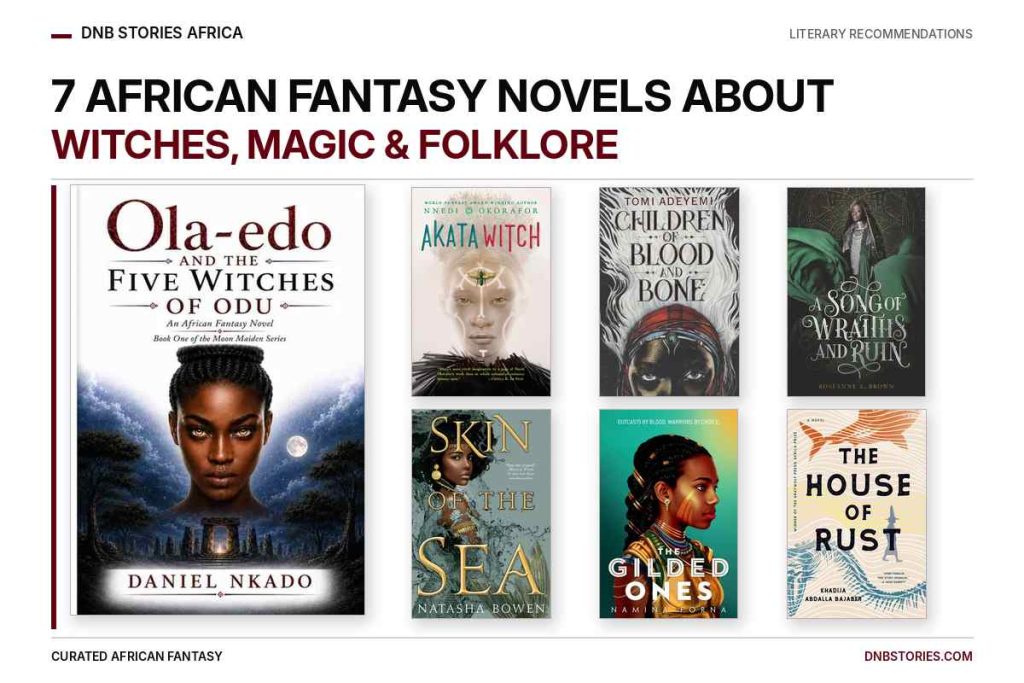
1. Ola-edo and the Five Witches of Odu — Daniel Nkado (2026 edition)
Themes: African witchcraft fantasy, moon magic, sacred kingdoms, prophecy, royal intrigue and hidden power.
Five witches. One Moon Maiden. A kingdom threatened by ancient darkness.
In the mysterious Kingdom of Odu, a powerful coven of witches is preparing to carry out a dangerous plan.
The witches seek to resurrect their dark master, an ancient force whose return could plunge the kingdom into terror.
Their opportunity comes with the approach of the rare Elder Moon, an event associated with extraordinary magical power.
But something stands between the witches and their ambitions: a young woman named Ola-edo.
Ola-edo is a farmer’s daughter whose life has been shaped by the grief of her mother’s wrongful execution. She wants little to do with the kingdom’s powerful families, its cruel social arrangements or the royal palace.
Her desire for a quiet existence becomes increasingly difficult to maintain when a defiant crown prince begins drawing her into palace affairs.
Unknown to Ola-edo, she carries an ancient power connected to the legendary Moon Stone.
She is the chosen Moon Maiden, a vessel of sacred light whose destiny is tied to the survival of Odu.
As the witches begin their schemes, Ola-edo becomes entangled in a dangerous struggle involving betrayal, deception, forbidden magic and the competing interests of powerful figures within the kingdom.
What begins as a personal story of grief and survival gradually becomes a supernatural battle over the future of an entire kingdom.
Why Ola-edo and the Five Witches of Odu belongs on this list
Daniel Nkado’s novel draws upon the atmosphere of African moonlight tales, village storytelling and supernatural folklore to construct an original fantasy world.
Its central conflict revolves around the relationship between magical power and the people who seek to control it.
The witches are not simply mysterious figures living outside ordinary society. They are organised participants in a struggle for power, using secrecy, deception and supernatural abilities to advance their ambitions.
Meanwhile, Ola-edo must confront the difficult consequences of possessing a power she neither requested nor fully understands.
The novel explores questions about inherited destiny, personal courage, betrayal, loyalty and the responsibility that can accompany extraordinary abilities.
Readers who enjoy witches, covens, royal conspiracies, sacred artefacts, mysterious forests and female protagonists discovering hidden powers may find the Kingdom of Odu an intriguing fictional world.
The Moon Maiden series
Ola-edo and the Five Witches of Odu is Book One of Daniel Nkado’s Moon Maiden series.
The adventure continues in Book Two, Ola-edo and the Sacred Sisters of Uwoma, which takes Ola-edo and her companions deeper into the magical world surrounding Uwoma Forest and the search for the Moon Stone.
Book Three, Ola-edo and the Hopping Spirits of Ezumezu, is forthcoming.
The story has roots in Nkado’s earlier fantasy Ola: The Tale of a Young Moon Maiden, first published as an e-book in February 2014.
Recommended for: Readers interested in African witchcraft fantasy, moon magic, supernatural battles, royal politics and folklore-inspired adventures.
Where to read: Buy Ola-edo and the Five Witches of Odu on Amazon.
2. Akata Witch — Nnedi Okorafor (2011)
Themes: Nigerian magic, witchcraft, secret societies, spiritual identity and supernatural adventure.
What if the reason you never quite fitted into the world around you was that you belonged to another world entirely?
That is the discovery awaiting Sunny Nwazue in Nnedi Okorafor’s Akata Witch.
Sunny is a Nigerian girl born in the United States who now lives in Nigeria with her family.
Because she has albinism, she experiences difficulties with everyday activities and is often treated as different by those around her.
Her life begins to change when she discovers that she possesses extraordinary magical abilities.
Through her classmates Orlu and Chichi, Sunny is introduced to a secret society of magical practitioners known as Leopard People.
Within this hidden world, she begins learning about juju, spells, magical history, supernatural abilities and the rules governing the use of power.
But the excitement of discovering her abilities soon becomes complicated by danger.
Sunny and her friends must confront a powerful criminal whose magical abilities threaten innocent lives.
Why Akata Witch belongs on this list
Akata Witch is one of the clearest examples of fantasy that brings supernatural adventure into a recognisably contemporary Nigerian environment.
Rather than transporting readers into a distant European-inspired kingdom, Okorafor creates a magical society existing alongside everyday Nigerian life.
The novel incorporates cultural references, spiritual concepts and imaginative magical systems while exploring identity, friendship, belonging and personal courage.
Its witches and magical practitioners are also more varied than the familiar fantasy image of an isolated, malevolent witch.
Recommended for: Readers who enjoy Nigerian fantasy, magical schools and apprenticeships, witchcraft, secret societies and coming-of-age adventures.
3. Children of Blood and Bone — Tomi Adeyemi (2018)
Themes: West African-inspired mythology, forbidden magic, divine powers, resistance and oppression.
In the kingdom of Orïsha, magic was once an essential part of life.
People known as maji possessed extraordinary abilities, including the power to command natural elements and interact with spirits.
But everything changed when a ruthless monarchy launched a campaign against magical practitioners.
Many maji were killed, and their descendants were left to endure a society shaped by persecution and fear.
Among those affected is Zélie Adebola, a young woman who remembers the violent loss of her mother.
When an unexpected opportunity arises to restore magic, Zélie becomes involved in a dangerous mission that could transform the kingdom.
With help from unlikely allies, including a princess who turns against her father’s oppressive rule, she must confront powerful enemies determined to prevent the return of magic.
As the conflict intensifies, Zélie discovers that restoring power is not simply a matter of defeating a king.
It also means confronting the consequences of violence, prejudice and the struggle for political control.
Why Children of Blood and Bone belongs on this list
Tomi Adeyemi’s novel draws inspiration from West African cultural and mythological traditions to create an original fantasy world.
The story uses magic as a central element in a wider narrative about oppression, resistance, identity and the unequal distribution of power.
Its supernatural abilities are inseparable from the social and political conditions determining who is allowed to possess them.
Readers who enjoy epic adventures involving ancient powers, magical inheritance, dangerous kingdoms and rebellious young protagonists may find Children of Blood and Bone particularly compelling.
Recommended for: Readers interested in African-inspired epic fantasy, mythology, elemental magic, political conflict and powerful female protagonists.
4. A Song of Wraiths and Ruin — Roseanne A. Brown (2020)
Themes: West African folklore, spirits, ancient magic, sacrifice, royal politics and dangerous love.
In Roseanne A. Brown’s A Song of Wraiths and Ruin, two young people are drawn into a supernatural conflict that threatens everything they care about.
Malik is a refugee travelling with his sisters in search of a better life.
Their journey leads them towards the prosperous desert city of Ziran, where the Solstasia festival offers the possibility of a new beginning.
But when a vengeful spirit abducts Malik’s younger sister, Nadia, he finds himself facing an impossible decision.
To secure her freedom, he must kill Karina, the Crown Princess of Ziran.
Karina, meanwhile, is struggling with grief and the political responsibilities left behind after her mother’s assassination.
Desperate to restore her mother to life, she turns towards ancient magic and a dangerous ritual requiring a terrible sacrifice.
As Malik and Karina’s lives become intertwined, their separate plans place them on a collision course involving magic, deception, political intrigue and unexpected emotional attachment.
Why A Song of Wraiths and Ruin belongs on this list
Brown’s novel is inspired by West African folklore and uses spirits, magical bargains and supernatural rituals to construct its central conflict.
The story explores the emotional consequences of grief and desperation, particularly when characters become willing to endanger others to protect someone they love.
It also examines how power operates within royal institutions and the sacrifices demanded of people who inherit authority.
Recommended for: Readers who enjoy African-inspired fantasy romance, dangerous magical bargains, vengeful spirits, royal intrigue and stories about grief and sacrifice.
5. Skin of the Sea — Natasha Bowen (2021)
Themes: West African mythology, Mami Wata, sea spirits, divine authority, sacrifice and forbidden love.
African fantasy does not always take place in sacred forests or enchanted kingdoms.
Sometimes, its most mysterious worlds lie beneath the ocean.
In Natasha Bowen’s Skin of the Sea, readers meet Simi, a young woman who has become a Mami Wata — a mermaid entrusted with collecting the souls of those who die at sea.
Her duty is to guide these souls towards the Supreme Creator.
But when Simi encounters a living boy thrown into the ocean, she makes a decision that threatens the sacred laws governing her existence.
Instead of allowing him to drown, she saves his life.
This act of compassion places her in danger because she has defied a divine command.
To protect herself and the other Mami Wata, Simi must embark on a dangerous journey involving powerful deities, legendary creatures and supernatural threats.
As she travels, she discovers that the consequences of her decision may extend far beyond her own fate.
Why Skin of the Sea belongs on this list
Skin of the Sea draws inspiration from West African mythology, including traditions associated with Mami Wata and other spiritual figures.
Rather than presenting magic primarily through witchcraft, Bowen explores divine authority, spiritual obligations and the relationship between human life and supernatural power.
The novel also examines compassion and moral responsibility.
Simi’s central conflict arises because an act she considers humane violates the rules she is expected to obey.
For readers interested in African mermaid mythology, water spirits and fantasy adventures involving deities, Skin of the Sea provides a distinctive alternative to land-based magical kingdoms.
Recommended for: Readers interested in African mythology, Mami Wata, mermaid fantasy, supernatural adventure and romantic stories involving difficult sacrifices.
6. The Gilded Ones — Namina Forna (2021)
Themes: West African-inspired fantasy, ancient deities, supernatural warriors, gender expectations and hidden power.
In Namina Forna’s The Gilded Ones, sixteen-year-old Deka lives in a society where a young woman’s place is determined by a ritual involving the colour of her blood.
For most girls, the ceremony is supposed to confirm their purity and acceptance within the community.
But when Deka’s blood runs gold rather than red, she is immediately marked as different.
The discovery places her in danger because her society associates golden blood with impurity and demonic origins.
Deka’s circumstances change when a mysterious woman offers her an alternative to the punishment awaiting her.
She can join an army of extraordinary female warriors known as the alaki — girls with supernatural abilities and an almost immortal nature.
As Deka begins training, she discovers a world of ancient powers, dangerous creatures and secrets that challenge everything she has been taught about her identity.
Her journey forces her to reconsider the relationship between the society’s official beliefs and the truth about the powers it fears.
Why The Gilded Ones belongs on this list
Drawing inspiration from West African cultural influences, Forna constructs a fantasy world in which supernatural power becomes closely connected to gender, social exclusion and political authority.
Deka’s abilities are initially treated as evidence of her supposed inferiority.
Yet those same abilities may reveal a different understanding of her identity and the society around her.
The novel explores how fear and collective beliefs can be used to justify discrimination, while placing female friendship and solidarity at the centre of its supernatural adventure.
Recommended for: Readers interested in African-inspired dark fantasy, ancient deities, magical warriors, female empowerment and stories about challenging oppressive traditions.
7. The House of Rust — Khadija Abdalla Bajaber (2021)
Themes: Swahili coastal folklore, supernatural creatures, enchanted journeys, family and coming of age.
In The House of Rust, Khadija Abdalla Bajaber takes readers into a magical world inspired by the coastal cultures of Mombasa, Kenya.
The story follows Aisha, a young girl whose father works as a fisherman.
When her father disappears at sea, Aisha refuses to accept his disappearance without attempting to find him.
Her determination leads her into an extraordinary supernatural adventure.
Travelling aboard a magical boat made from a skeleton, she encounters a world where animals speak, mysterious creatures offer guidance, and dangerous sea beings inhabit the waters.
Among her unlikely companions is a scholarly talking cat.
But not every supernatural encounter is friendly.
Aisha must confront terrifying sea creatures, including the formidable Baba wa Papa, the father of all sharks.
Her journey becomes an exploration of courage, family loyalty and the unfamiliar powers surrounding her.
Why The House of Rust belongs on this list
Unlike the more conventional epic battles and magical hierarchies of some fantasy novels, The House of Rust draws heavily upon the atmosphere of oral storytelling and coastal folklore.
Bajaber’s fictional world is shaped by the cultural environment of Mombasa and its Swahili and Hadhrami influences.
The supernatural is presented through a mixture of everyday life, strange creatures, enchanted objects and extraordinary journeys.
Although this is not primarily a novel about witches, its use of folklore and magic makes it a strong recommendation for readers who want to explore the diversity of African fantasy traditions.
It is also a distinctive example of fabulist fantasy, combining an imaginative supernatural adventure with a culturally grounded coming-of-age narrative.
Recommended for: Readers interested in East African folklore, fabulist fantasy, sea monsters, enchanted animals and imaginative coming-of-age fiction.
What Makes African Fantasy Different?
African fantasy cannot be reduced to a single set of supernatural beliefs or storytelling conventions.
The continent contains many cultural traditions, each with its own histories, spiritual concepts, mythologies and narrative practices.
Contemporary fantasy writers draw upon these influences in different ways.
Some construct entirely fictional kingdoms inspired by African societies. Others place supernatural events within recognisable modern African communities.
Certain writers incorporate ideas associated with spirits, deities, divination or magical practices, while others invent new systems of power inspired by particular cultural settings.
These approaches produce very different reading experiences.
In Akata Witch, supernatural abilities exist alongside contemporary Nigerian life.
Children of Blood and Bone has magical persecution become central to a political struggle.
In Skin of the Sea, the supernatural world is connected to divine authority and the ocean.
Meanwhile, The House of Rust uses magical creatures and an extraordinary sea journey to explore family relationships and cultural storytelling.
And in Ola-edo and the Five Witches of Odu, an original African-inspired fantasy kingdom becomes the setting for witchcraft, political manipulation, ancestral power and a young woman’s struggle with a destiny she did not choose.
What unites these books is not one universal African belief system.
Rather, they demonstrate how African and African-inspired storytelling can generate distinct supernatural worlds, characters and conflicts without relying exclusively on European fantasy conventions.
Which African Fantasy Novel Should You Read First?
Your ideal starting point depends on the kind of magical adventure you enjoy.
| If you enjoy… | Consider reading… |
|---|---|
| Witches, covens, moon magic and sacred kingdoms | Ola-edo and the Five Witches of Odu |
| Secret magical societies and Nigerian witchcraft fantasy | Akata Witch |
| Epic fantasy, magical persecution and rebellion | Children of Blood and Bone |
| Vengeful spirits, dangerous rituals and royal romance | A Song of Wraiths and Ruin |
| Water spirits, mermaids and West African mythology | Skin of the Sea |
| Supernatural warriors, ancient deities and female power | The Gilded Ones |
| Enchanted animals, sea monsters and East African folklore | The House of Rust |
Readers looking specifically for stories featuring witches and covens may want to begin with Ola-edo and the Five Witches of Odu or Akata Witch.
Those drawn to epic magical battles and political conflict may prefer Children of Blood and Bone or The Gilded Ones.
For a more mythology-centred adventure, Skin of the Sea offers an imaginative journey into the world of water spirits, while The House of Rust presents a different tradition of supernatural storytelling through the coastal world of Mombasa.
Frequently Asked Questions
African and African-inspired fantasy novels involving witches or magic include Ola-edo and the Five Witches of Odu by Daniel Nkado, Akata Witch by Nnedi Okorafor, Children of Blood and Bone by Tomi Adeyemi and A Song of Wraiths and Ruin by Roseanne A. Brown. These books explore different forms of magical power, spiritual conflict and supernatural adventure.
Yes. Akata Witch by Nnedi Okorafor follows a Nigerian girl who discovers a hidden society of magical practitioners. Daniel Nkado’s Ola-edo and the Five Witches of Odu is an African-inspired fantasy set in the fictional Kingdom of Odu, where a coven of witches seeks to resurrect an ancient dark power.
Children of Blood and Bone by Tomi Adeyemi and Skin of the Sea by Natasha Bowen draw inspiration from West African mythology. The House of Rust by Khadija Abdalla Bajaber incorporates the storytelling atmosphere and cultural influences of the East African coast.
The Moon Maiden series follows Ola-edo, a young woman from the Kingdom of Odu who discovers that she carries a sacred power connected to the mysterious Moon Stone. Her journey involves witches, prophecy, royal intrigue, sacred forests and a struggle between darkness and light.
Begin with Ola-edo and the Five Witches of Odu, followed by Ola-edo and the Sacred Sisters of Uwoma. Book Three, Ola-edo and the Hopping Spirits of Ezumezu, is forthcoming.
Final Thoughts
African fantasy offers an extraordinary range of supernatural adventures.
Its stories can involve witches, spirits, magical societies, divine powers, legendary creatures, enchanted forests and fictional kingdoms whose histories are shaped by forces beyond ordinary human understanding.
But these stories are often concerned with more than magic.
They also explore identity, grief, friendship, political power, oppression, sacrifice and the difficult choices people make when extraordinary responsibilities are placed upon them.
From the secret magical world of Akata Witch to the supernatural waters of Skin of the Sea, the seven novels featured here demonstrate the breadth of possibilities within African and African-inspired fantasy fiction.
For readers particularly interested in witches, moon magic, royal conspiracies and a young heroine discovering the power hidden within her, Daniel Nkado’s Ola-edo and the Five Witches of Odu offers a direct entry point into the Moon Maiden series.
Further Reading and Book References
For more information about the books discussed in this article, explore the following author and publisher resources.
- Nkado, Daniel. Ola-edo and the Five Witches of Odu (2026 edition). Moon Maiden series guide — DNB Stories Africa.
- Okorafor, Nnedi. Akata Witch (2011). Official author book page.
- Adeyemi, Tomi. Children of Blood and Bone (2018). Macmillan.
- Brown, Roseanne A. A Song of Wraiths and Ruin (2020). Official author book page.
- Bowen, Natasha. Skin of the Sea (2021). Official author book page.
- Forna, Namina. The Gilded Ones (2021). Penguin Random House.
- Bajaber, Khadija Abdalla. The House of Rust (2021).
Further DNB Stories reading: The Moon Maiden Series by Daniel Nkado: African Fantasy Novels Set in Odu.