Who is a “Good Man”?
A “good man” is not a perfect man. No one is. More simply, a good man is a man anchored by integrity and compassion. That may sound like a short list, but it is not. Integrity means he can be trusted to do the right thing when a situation demands that choice. Compassion means he does not turn his fear, shame, or frustration into punishment for other people.
This article explores how masculinity hierarchies, secrecy, stigma, and other structural pressures distort intimacy, trust, and community life in Western Black gay scenes.
What Makes a Good Black Gay Man?
By a good Black gay man, I do not mean perfection, a gym body, or masculinity. I mean a man whose integrity does not collapse under the pressure of desire, fear, or social reward. A man who will not harm another person to defend a sex role, nor hide behind masculine performance or DL secrecy to police or shame others. He handles conflict without resorting to gossip, humiliation, or covert punishment. A man whose word can be trusted even when no one is watching.
I mean a man who can speak openly about difficult things without turning vulnerability into theatre or weakness into spectacle. A man whose masculinity does not require harm in order to stand. The kind of man we often called a gentleman in Nigeria—who wears both his hard and soft sides with ease, like a well-fitted two-piece. A man who respects others, stands up for what is right even when it costs him, and contributes positively to the people around him.
A man who can think for himself, whose word is his bond, and who understands adulthood as a commitment to emotional and moral growth. He seeks knowledge rather than refuge in ignorance or conspiracies, and refuses to sacrifice truth or integrity to the performance of hardness.
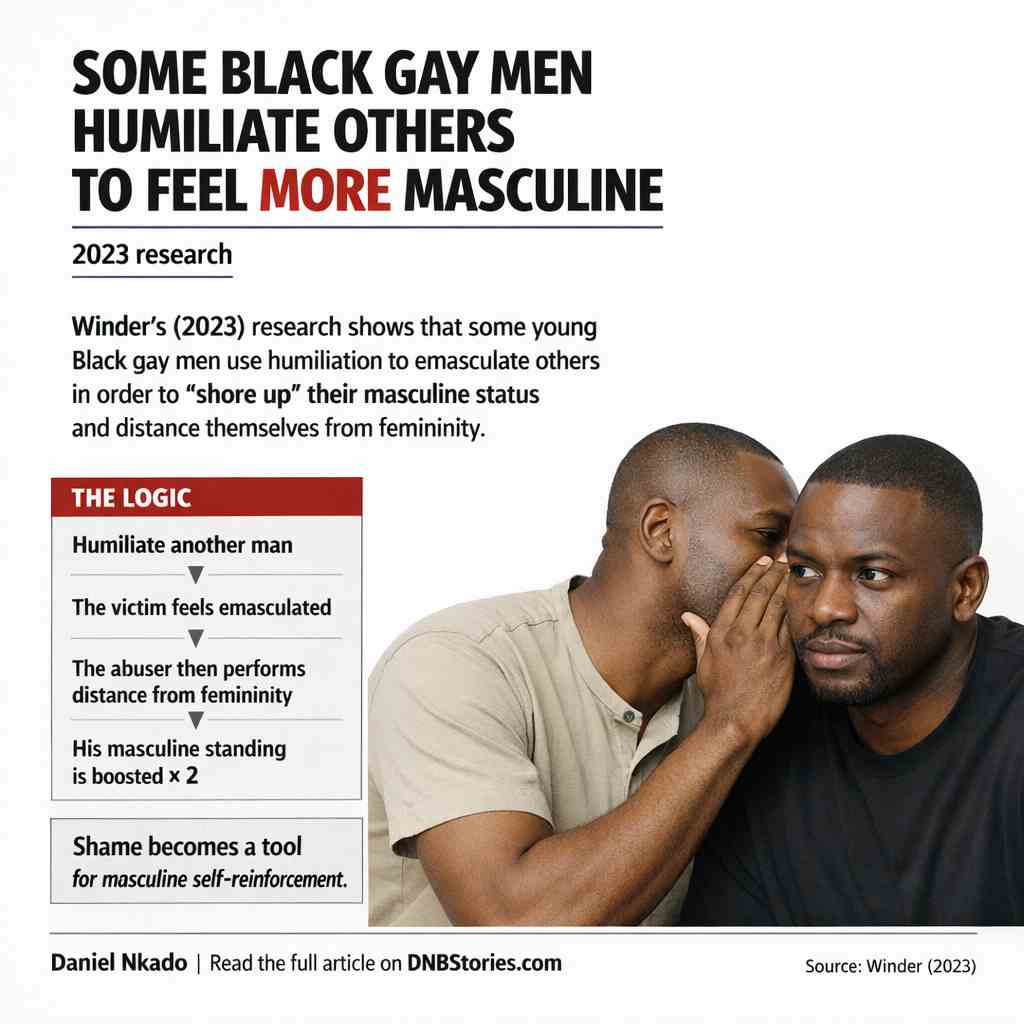
Winder’s (2023)[7] important study of bottom-shaming shows that some young Black gay men use the humiliation of other men to defend masculine status and distance themselves from femininity.
A Land of No Gentlemen?
These qualities do not grow in a vacuum. Many Black gay men in Western cultures are raised learning that softness has a price.
- Be less gay here.
- Be less Black there.
- Be less vulnerable everywhere.
That is not confusion. It is training. Over time, it teaches men to prioritise strategy over honesty, image over compassion, and masculinity over humanity. It is not a moral failure; it is survival logic. A life of constant compartmentalisation erodes character.
Harm is Harm Regardless
Cultural pressures can be forceful, but neither those pressures nor survival logic excuses harm. And however powerful they may be, social pressures are not absolute. With enough determination, any man can refuse to take part in harm, no matter how great the reward. Knowledge is one of the things that helps ignite that resistance.
Learning develops critical thinking. It teaches people to compare perspectives, question inherited scripts, and recognise manipulation for what it is. That is why learning gets dismissed as “soft stuff.” People discouraged from thinking are easier to control.
Keep young Black gay men undereducated in the language of power, and you keep them easier to manage, easier to deceive, and easier to use.
Shame, Control, and A Borrowed Mind
Yesterday, two young Black men came to my home to ask what I had gained from making my sexuality public. But it was obvious they had not come with a real question. They came carrying shame as a weapon of control.
It was immediately clear they had not come in the authority of their own thought. Someone had sent them—someone who understands far more than they do.
They could not defend the logic of their criticism. They could not distinguish visibility from disclosure, or sexuality from sex. That, in itself, was revealing. This is what a control culture produces: young men trained to repeat judgments they do not understand, enforce rules they cannot justify, and sacrifice personal growth at the altar of hierarchy.
As they were leaving, one of them took my keys—perhaps as a final attempt to carry something back to whoever had sent them. Evidence. Proof. A delivery of some kind.
I called him back, firmly, and took the key from his hand. In that brief exchange, I caught what was in his eyes. Not defiance. Not malice. Disconnectedness.
What unsettled me most was not the act itself, but how little he seemed present in it. As though he were borrowing intention rather than generating it. As though the body was acting while the self stood elsewhere, watching.
That kind of lostness can be frightening to witness. But it also points to something deeper: a buried need for change, for growth, for the difficult return to one’s own agency.
A Culture of Crippling Masculinity
A society that discourages questioning and individual thought, and places obedience to masculinity above everything else, eventually starts producing zombies. A culture that fears questioning is, at some level, always a culture afraid of death. Any culture that fears death is no longer truly organic; instead, it is driven by living forces focused on its survival because they benefit from it.
One clear symptom of an artificial culture is when tradition starts to resemble choreography. Like the unthinking undead, people fall into step, moving to a rhythm whose origin they neither know nor question—no divergence, no creation, no choosing of another path. No individuality. Only repetition, enforcement, and the quiet terror of being left alone.
Why So Many Black Gay Men Are Forced to Perform
A major pressure Black gay men in the West face is the need to edit themselves depending on the room. This goes beyond ordinary social adjustment and becomes sustained identity management under surveillance. Many men learn to appear less gay in Black family, church, or community settings; less Black in white-dominated LGBTQ spaces; less soft at work; and less vulnerable in dating[3].
Over time, this constant calibration and recalibration produce lives organised around optics rather than authenticity. Under that kind of pressure, performance feels safer than honesty. But when performance obstructs genuine human connection and weakens healthy community life, masculinity is left to carry the weight of everything: relationship counsellor, personal trainer, therapist, bodyguard, best friend, anxiety medication, and source of belonging (Crenshaw, 1989[2]; Choi et al., 2021)[1].
A life of constant compartmentalisation fractures the self, splitting values, emotions, and actions into isolated compartments that undermine coherence and make authentic living difficult.
Hashtag: Protect Masculinity by All Means.
This helps explain why masculinity is defended with such intensity, and why the struggle is rarely only personal, but deeply social. While Black men in parts of Africa can tie gele, dance on Instagram, and remain secure in their manhood, many Black gay men in the West live with an underlying terror that if masculinity collapses, life itself will collapse with it. A catastrophic erasure. The imagined extinction of “men.”
But whose extinction are we really talking about here? Certainly not all men. Certainly not all Black gay men. Femme men, at least, are not going anywhere—that lot can survive anything, even the rapture.
What is actually under threat is a particular kind of masculinity: the macho performer, the Alpha‑Dom‑Top. The twenty‑first‑century Hegemonic Hercules, the DL poser living in a country where gay men are allowed to get married.
These are identities constructed by overdosing on carefully selected ingredients from the masculinity market to produce a specific outcome. I call it the masculinity BBL: technically convincing, socially legible, but structurally fragile.
The Masculinity BBL
And like all artificial enhancements, it comes with fear. Constant vigilance. A quiet panic that someone might notice the seams, ask the wrong question, or expose what was constructed rather than grown. The dread is not of difference itself, but of discovery—of being seen as assembled rather than innate.
This fear helps explain the aggression with which such identities are defended. When masculinity functions as the scaffolding holding an entire self together, any challenge to it feels existential. Not an argument, but a threat. Not disagreement, but annihilation.
Too Few Positive Role Models
Character does not form in a vacuum. When a society offers young Black gay men no visible examples of integrity that are also safe, it hastens the internalisation of a brutal dogma: softness is dangerous, honesty is reckless, and survival belongs to those who can perform masculinity convincingly enough. In that environment, masculinity becomes overinvested—not because it is true, but because it is functional.
The result is not strength, but fragility dressed up as certainty. Masculinity must then be defended aggressively because it is being forced to do too much work. It is no longer merely a mode of gender expression; it has become both an emotional and a social infrastructure. And when one structure is made to carry everything, it cannot tolerate questioning. That is how rigidity masquerades as tradition, and fear is mistaken for virtue.
While others are channelling energy into building structural pathways to social power through professional networks, cultural capital, and institutional influence, many Black gay men in the West remain trapped in endless internal wars over masculinity and sexual desirability.
“I Don’t Like Gays Like This”—Such an Anti-Gay Gay Performance
The urge to constantly police others often disguises itself as moral superiority, when it is really anxiety looking for somewhere to sit.
The hypermasculine performer frequently claims to despise gay men who, in his words, “make their whole life about being gay,” by which he almost always means visibility. Yet he spends his time managing burner accounts across Snapchat, Grindr, Jack’d, and elsewhere, while obsessively tracking men who live without shame and are building actual lives and careers.
Why Visibility Threatens the Macho Gay Performer
Visibility threatens the macho performer because it reveals an alternative way of being—one that does not rely on masculine performance for legitimacy. Grounded Black gay men, across different expressions of masculinity, who live openly and without secrecy and shame, demonstrate quietly, but unmistakably, that masculinity is a personal identity, not a shortcut to power.
For men whose sense of self is little more than scaffolding held together by performance, that fact is intolerable. The problem is not that visibility is loud or excessive. It is that visibility unsettles the mask. It shows that masculinity, integrity, softness, and coherence can coexist without collapsing.
That exposure destabilises identities built through overinvestment rather than growth. When a straight-passing masculinity mask is doing the work of emotional regulation, self-esteem, safety, and belonging all at once, seeing someone live gay and well can feel like a provocation. The performer then attacks that life as indulgence, irresponsibility, or moral decay.
But what is actually being defended is not masculinity itself. It is the fear that without constant performance, there is no deeper structure to fall back on. The visibility of others becomes threatening not because it is extreme, but because it exposes how fragile the performance really is.
Invisibility Keeps Black Gay Men Easy to Control
Invisibility works as a social regulation. When Black gay men are discouraged from being seen, named, or heard, they become easier to manage—less able to organise, less likely to build shared language around their experiences, and more vulnerable to internalised discipline. Silence breaks the connection, and fragmentation weakens collective power.
Under invisibility, shame regains force as a weapon of control. A partner can simply say, that boy thinks you are gay, and suddenly the old fear returns and control is re-established. What looks like personal choice is often structural pressure absorbed into identity[6].
Visibility disrupts the masculinity policing economy by exposing patterns that depend on isolation and turns private strain into a shared reality. This is why invisibility is not only encouraged but protected: what remains unseen can be controlled with far less resistance.
We All Have A Role To Play.
The perceived shortage of “good” Black gay men in the West is both personal and structural. In conditions that reward self-protection faster than honesty and desirability faster than depth, it is no surprise that so many fall into line. A good man does not emerge from applause for performance. He emerges where truth is survivable, care is ordinary, and compassion is not punished as weakness. That is where this conversation belongs.
There is Hope
Black gay life in the West is not only a story of damage. That would be false. Black LGBTQ communities have repeatedly built their own institutions of visibility, care, and survival precisely because broader systems failed them.
The existence of deliberate counter‑spaces designed to reduce fragmentation, restore dignity, and create conditions for fuller selfhood is evidence of the possibility. Proof that different futures can be built. But hope is not self‑executing. It requires participation.
We can choose to use masculinity as a tool for building stronger lives and communities—grounded in honesty, care, and shared responsibility. Or we can continue using it as a weapon to divide, police, and maim one another.
The structure itself is not destiny. Its use is a choice. And that choice belongs to all of us.
The Bridge Model and Trust Restoration
The Bridge Model offers Black gay men a practical tool for repairing damaged trust and rebuilding community love. It teaches interpersonal repair, shows people how to interrupt humiliation socially, and helps communities enforce dignity systemically. It helps stop harm early, makes silence less acceptable, and gives Black gay spaces a way to protect tenderness without depending on vibes alone.
We can come together and join the Bridge Building initiative—or continue having sex with mirrors.
References
- Choi, S. K., Wilson, B. D. M., & Mallory, C. (2021). Black LGBT adults in the U.S.: Well‑being at the intersection of race. Williams Institute. https://williamsinstitute.law.ucla.edu/publications/black-lgbt-adults-in-the-us/
- Crenshaw, K. (1989). Demarginalizing the intersection of race and sex. https://chicagounbound.uchicago.edu/uclf/vol1989/iss1/8
- Lopez Bunyasi, T., & Smith, C. W. (2019). Do All Black Lives Matter Equally to Black People? Respectability Politics and the Limitations of Linked Fate. The Journal of Race, Ethnicity, and Politics, 4(1), 1–36. https://doi.org/10.1017/rep.2018.33
- Sears, B., Mallory, C., Flores, A. R., & Conron, K. J. (2025). Workplace experiences of Black LGBTQ employees. Williams Institute. https://williamsinstitute.law.ucla.edu/publications/black-lgbtq-workplace-experiences/
- Stonewall. (2018). LGBT in Britain: Home and communities. https://www.stonewall.org.uk/resources/lgbt-britain-home-and-communities-2018
- Wade, R. M., Bouris, A. M., Neilands, T. B., & Harper, G. W. (2022). Racialised sexual discrimination and psychological well-being. Sexuality Research and Social Policy, 19, 1341–1356. https://link.springer.com/article/10.1007/s13178-021-00676-6
- Winder, T. (2023). The Discursive Work of “Bottom-Shaming”: Sexual Positioning Discourse in the Construction of Black Masculinity. Gender & Society, 37(5), 774–799. https://doi.org/10.1177/08912432231186999