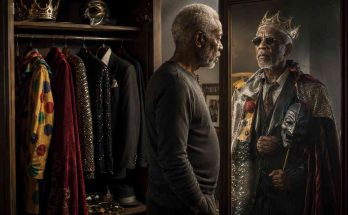
Borrowing the Cool, but Still Preserving the Hierarchy
When members of racially dominant groups, especially white queer or mainstream cultural spaces, take elements from Black queer culture—slang, fashion, performance, or Ballroom aesthetics—they often do so to make themselves appear trendier, edgier, or more culturally alive.
What they want is not closeness, equality, or genuine identification with Black queer people. What they want is the symbolic value of what Black queer communities have created. They take the parts that can raise their own status, while continuing to keep the people themselves at a distance. They consume the aesthetic while refusing the people.
In effect, the message is: I will borrow what makes you culturally useful, but I will never surrender the hierarchy that tells me that I am above you.
Real-World Example of this Dynamic
At a high-end music event, a well-known DJ from a privileged background closes his set with vogue-inspired dance moves and catchphrases borrowed from Black queer ballroom culture. The dramatic routine and adopted slang electrify the mostly mainstream crowd, enhancing his image as edgy, stylish, and culturally fluent.
Beyond the spotlight, however, he maintains no meaningful relationship with the ballroom community and offers no recognition to the creators whose style he adopts when it serves him. Black queer creators remain invisible in his world even as their innovations enhance his image and fuel his popularity. In doing so, he reveals a familiar logic: he is willing to extract cultural cachet without ever disturbing the social hierarchy that protects and privileges him.
This article examines how white desire consumes Black queer bodies in queer spaces, tracing six stages through which some white partners in power-imbalanced intimate relationships may approach Black partners for extractive reasons rather than genuine connection, equality, and mutual respect.
- Borrowing the Cool, but Still Preserving the Hierarchy
- Attraction to the Fantasy, Not the Person
- The Violence of Disposability as the Final Damage
- How Extractive Intimacy Can Create Dangerous Dependency
- The Relational Colonialism Framework: The Six E’s of Extractive Intimacy
- Conclusion
- References
Attraction to the Fantasy, Not the Person
This article is not an argument against interracial attraction, interracial love, or relationships between Black and white queer people. It is an analysis of a specific extractive pattern in which racial difference is consumed as fantasy while Black personhood is denied equal care, reciprocity, and protection.
The issue is not that all interracial desire is harmful or toxic. Attraction across race can be mutual, ethical, ordinary, and loving. The problem is a specific form of racial fetishisation in which Black bodies are not encountered as full and equal human beings, but used for the extraction of a racial function.
The Black man becomes a portal through which the more privileged white subject accesses danger, imagined raw Black masculinity, erotic intensity, rebellion, or the fantasy of reverse-power submission. In that moment, fantasy replaces personhood.
How White Desire Turns Black Queer Vulnerability Into Erotic Thrill
This section examines how the erotic consumption of Black queer bodies can operate within interracial sexual dynamics between white and Black queer men.
Many Black queer men carry histories of real physical danger, social exclusion, and precarity produced by racism, homophobia, and unequal social conditions. Yet for some privileged white men, that marginalised reality itself can become part of the attraction: fascinating, rebellious, and erotically charged precisely because it offers proximity to risk without requiring them to bear its cost.
In this way, Black queer vulnerability is converted into “thrill” or “edge.” Hardship, suffering, and lived exposure to violence are stripped of their human weight and repackaged as consumable erotic value[5]. The result is the replacement of mutual intimacy and equal respect with what I describe as a form of erotic tourism, in which Black bodies are approached for the historical or cultural charge they carry rather than engaged as equal partners. For the privileged partner, the encounter can feel daring—an experience so charged that, in some cases, he may even be willing to pay for access to it (hooks, 1992/2015).
In reality, the arrangement remains a safe thrill for the privileged white man because he can withdraw at any moment and return to the shelter of privilege[6], while the Black queer man remains inside the very reality of extractive intimacy. In that sense, the dynamic recalls a broader imperial logic visible in ancient Rome, where elite status insulated the powerful while enslaved and lower-status bodies were repeatedly rendered available for use, display, and violation.
The Violence of Disposability as the Final Damage
The final injury in this dynamic of consumption is disposability. Once a Black queer person is treated as an erotic resource rather than a complex human being, their value becomes conditional and finite. He is useful only as long as he can satisfy the appetite of the more privileged partner.
Once the white subject extracts the desired thrill, cultural cachet, or illusion of progressive self-transformation—or simply finds a more exciting replacement—he often discards the intimacy. Crucially, this interpersonal consumption does nothing to disturb systemic inequality. Instead, it quietly reproduces it, reaffirming an old and violent racial logic: that Black bodies exist to serve, animate, entertain, or awaken white ones.

What Disposal Leaves Behind: A More Disoriented Black Man
After disposal, the Black partner is often left to absorb the emotional, psychological, and sometimes material fallout of the encounter. He may feel used, replaceable, or abruptly returned to a lower social value once his function in the other person’s fantasy has ended. What promised intimacy can harden into humiliation, confusion, grief, shame, self-doubt, or anger.
In some cases, the experience intensifies existing wounds around racism[3], shame, desirability, trust, and belonging, because it confirms that he was wanted not as a full person but as a temporary experience. The white partner leaves with the thrill already extracted; the Black partner stays behind with the residue of objectification. He must continue living inside the racial and social conditions that made him vulnerable to that form of consumption in the first place.
After the extraction, the white partner can retreat seamlessly into the protections of privilege. He may even keep the social value gained from his proximity to Black queerness, presenting himself as more cultured, more radical, or more politically aware, while remaining insulated from the racism, surveillance[2], and economic exclusion that continue to shape Black life. This is part of the asymmetry. He has the luxury of opting out when the encounter no longer serves him.
The Black queer subject does not. He is left to carry the emotional exhaustion of objectification and the psychic cost of having his vulnerability mined for someone else’s pleasure, curiosity, or self-making. He remains exposed to the same intersecting pressures of racism and homophobia[4], but now with the added burden of an intimacy that promised recognition and delivered only use.
How Extractive Intimacy Can Create Dangerous Dependency
The shift from casual consumption to deep psychological dependency is one of the most insidious stages of extractive intimacy. While “Eating the Other” may sometimes end in swift disposal, longer-term extractive relationships often take a different form. In these dynamics, the privileged partner keeps the marginalised individual close, continuing to mine him for emotional labour, cultural cachet, erotic thrill, or a sense of personal transformation.
Engineered Dependency to Sustain Access
In more extreme versions of the Puppet-and-Patron Dynamic I described in my previous article, the white patron positions himself as saviour while quietly helping to intensify the very vulnerabilities from which the Black partner needs relief. He then reappears, conveniently, as the one who can solve the crisis, deliver rescue, or restore stability.
This arrangement allows him to maintain access to the Black partner for a steadier supply of emotional labour, erotic charge, cultural proximity, or personal transformation. If he once had to pay for that access, this new configuration can remove the old transactional logic and provide continuous access with no comparable material cost.
In some cases, the arrangement also gives him room to indulge an aching saviour complex. In others, he uses the Black partner for racial errands that benefit only himself, often exposing the Black man to even greater danger in the process. Over time, this does not simply exploit the marginalised partner; it weakens his independence and reorganises his survival around the patron’s presence.
What may have begun under the guise of intimacy frequently devolves into erotic consumption before hardening into a far more insidious form of engineered dependency. The deeper the control, the more destabilised the Black partner becomes.

The Relational Colonialism Framework: The Six E’s of Extractive Intimacy
This section introduces the Relational Colonialism Framework: The Six E’s of Extractive Intimacy. The framework gives language to a repeated pattern in some interracial queer relationships, where unexamined racial hierarchy can turn intimacy into consumption, destabilisation, dependency, and eventual disposal.
This piece will define the framework clearly and outline its six stages—Enticement, Exhibition, Extraction, Erosion, Ensnarement, and Expulsion—so readers can understand how the dynamic works as a whole. A fuller article will follow to explore the framework in greater depth, place it within its wider social and historical context, and apply it more directly to racialised queer relationships.
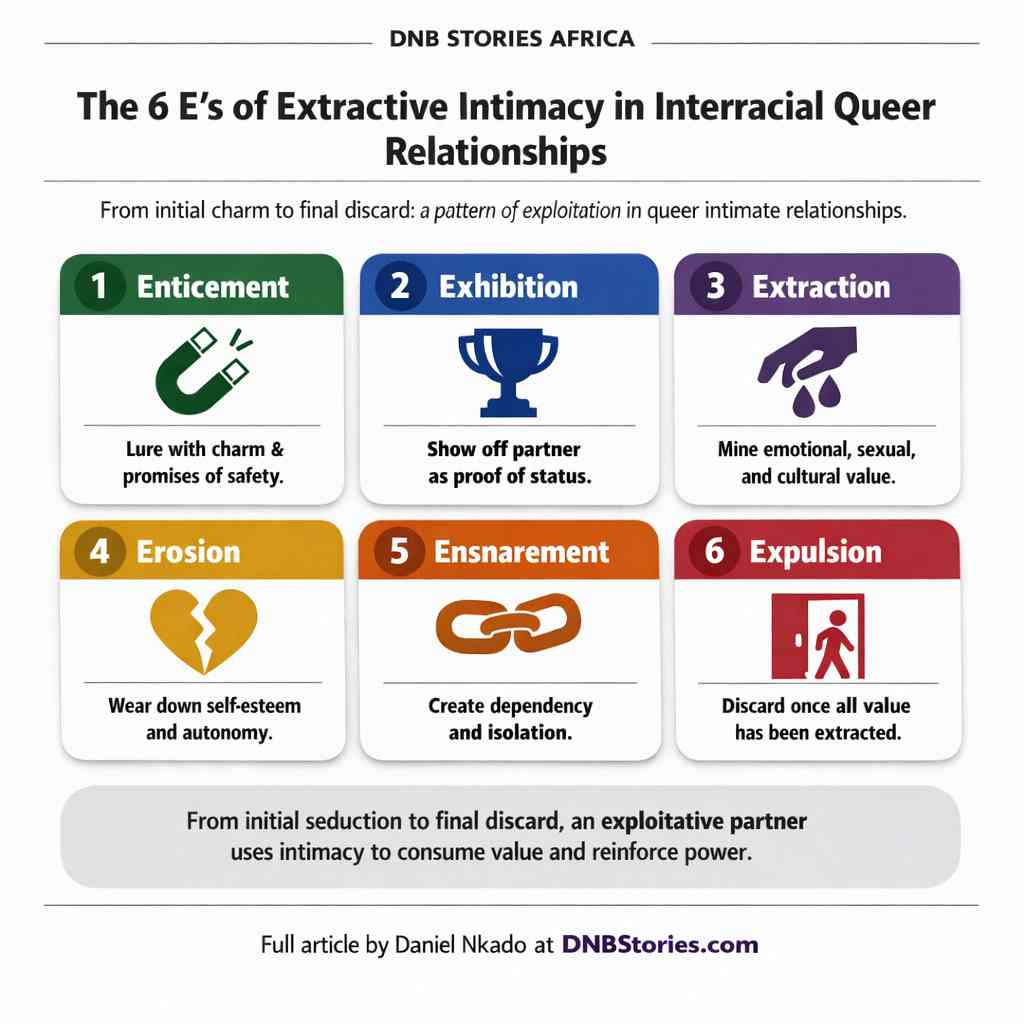
The 6 E’s of Extractive Intimacy in Interracial Queer Relationships
Picture this: a relationship between a wealthy white gay man and a Black partner begins like a dream—exciting, affirming, even transformative—but ends with the Black partner emotionally depleted, deeply destabilised, stripped of independence, and ultimately discarded.
Stage 1: Enticement – The Initial Lure
A powerful white gay man lures the Black target in through charm, flattery, material rewards, or promises of safety, understanding, and exceptional care. Example: A partner with high social power showers the other with compliments, attention, material rewards, and reassurances, creating rapid trust and a sense of being uniquely seen and valued.
Stage 2: Exhibition – The Public Display
He turns the target into a symbol, accessory, or trophy that enhances the dominant partner’s image or status, exhibiting him to his circles to create thrill and boost his image. Example: One partner publicly displays the other’s identity, background, or difference to appear more interesting, progressive, or culturally fluent, while privately treating them as a novelty rather than an equal.
Stage 3: Extraction – The Harvest of Value
He begins extracting emotional, sexual, social, cultural, or material value from the target without equal reciprocity. Example: One partner relies heavily on the other’s emotional labour, care, creativity, connections, or resources for personal benefit while offering little meaningful support in return, or considering the partner’s own emotional needs.
Stage 4: Erosion – Undermining Selfhood
The arrangement gradually starts weakening the target’s confidence, autonomy, and sense of self. Example: Through repeated criticism, control disguised as care, dismissal, contradiction, or gaslighting, the powerful partner starts to make the Black partner doubt their own feelings, judgment, values, and worth over time.
Stage 5: Ensnarement – Engineered Dependency
The engineered setup eventually creates dependency and entrapment, making the relationship increasingly difficult to leave. Example: The controlling partner isolates the Black partner from friends, options, and sources of support by controlling finances, leveraging influence—including in legal or immigration matters—or weaponising secrets, leaving the target feeling trapped.
Stage 6: Expulsion – The Final Discard
The powerful partner finally discards, replaces, or abandons the target when it becomes obvious there is nothing left to extract or that the target is no longer serving any purpose. Example: After taking what they want, the dominant partner abruptly withdraws, ends the relationship, or moves on, often blaming the target and leaving them hurt, disoriented, and unsupported.

Why This Framework Matters For Black Queer Men
The Relational Colonialism Framework is not a story of hopelessness, but a tool of clarity. By recognising the Six E’s of Extractive Intimacy, we give ourselves and our communities a language for identifying exploitation hidden beneath the appearance of love, care, or friendship. That recognition is the first step toward confronting the hierarchies that enable such harm, supporting survivors with greater honesty, and building relationships rooted in equality, reciprocity, and care.
Conclusion
Black queer men are not tools for white experimentation. We are not remedies for somebody else’s repression, alibis against accusations of racism, routes to danger or edge, or vessels for somebody else’s self-repair. The problem bell hooks identified decades ago still persists within queer culture: difference is most enthusiastically welcomed when it can be consumed (hooks, 1992/2015).
Until queer spaces confront that truth, fetishisation will continue to disguise itself as desire. Real desire recognises humanity. Fetishisation denies it.
References
- hooks, b. (1992/2015). Black looks: Race and representation. Routledge. https://doi.org/10.1215/9781478027621-007
- McConnell, E. A., Janulis, P., Phillips, G., Truong, R., & Birkett, M. (2018). Multiple minority stress and LGBT community resilience among sexual minority men. https://doi.org/10.1037/sgd0000265
- Robinson, B. A. (2015). Personal preference as the new racism in gay online dating. https://doi.org/10.1177/2332649214546870
- Salerno, J. P., Pease, M. V., Gattamorta, K. A., Fryer, C. S., & Fish, J. N. (2023). Impact of racist microaggressions and LGBTQ-related minority stressors: Effects on psychological distress among LGBTQ+ young people of color. Preventing Chronic Disease. https://www.cdc.gov/pcd/issues/2023/22_0371.htm
- Stock, K. (2015). Sexual objectification. Analysis. https://www.diva-portal.org/smash/get/diva2%3A948725/FULLTEXT01.pdf
- Tunåker, C., Sundberg, T., Yuan, S., Renz, F., Kirton-Darling, E., Carr, H., et al. (2025). There’s No Place Like Home: Uncovering LGBTQ+ youth homelessness in the UK. akt. https://www.akt.org.uk/wp-content/uploads/2025/02/akt-No-Place-Like-Home-Research-report-lgbt-youth-homelesness-2025.pdf
- Williams, A. (2024). Not My Type: Automating sexual racism in online dating. Stanford University Press. https://www.sup.org/books/sociology/not-my-type