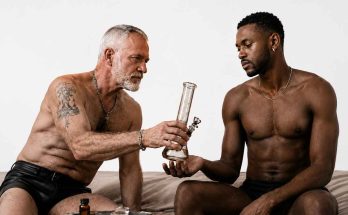
Intro: When the Crowd Feels Safer Than One Person
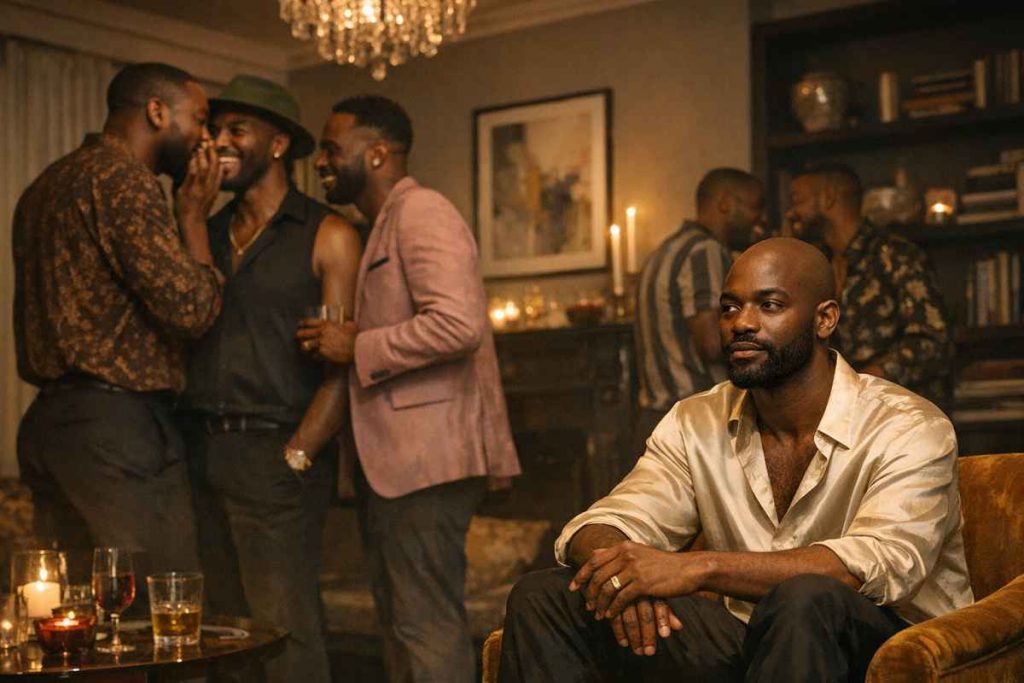
I used to wonder why so many UK Black queer people seemed to prefer group chills to visiting someone privately. Even after I had seen what often happened in those groups — people milling around, laughing too loudly, passing gossip on paper plates like anyara — I still could not fully understand the attachment to them.
Later, it all became clear.
These gatherings are not always important because they offer genuine care, intimacy, or emotional nourishment. Sometimes, their real function is social positioning. It is in these groups that people decide who has become “too much”, and reputations are softened, bent, and prepared for damage. It is there that gossip becomes consensus, and consensus becomes permission.
By the time the target is publicly shamed, the room has often already been arranged against him. He cannot even be defended by one person without that person also risking exclusion.
This article explains why some Black queer men are drawn to group chills and orgies over one-to-one meetings — and how intimacy anxiety, fear, shame, gossip, desirability, and group power can turn these spaces into engines of harm.
- Intro: When the Crowd Feels Safer Than One Person
- Group Chills and Orgies: How People Sacrifice Others to Buy Their Own Safety
- When the Group Becomes a Ranking System
- When the Group’s Plan Fails, and the Target Keeps Rising
- Why Black Queer Groups Punish and Push Out Non-Conformers
- Minority Stress and the Paradox of Toxic Belonging
- Why Punishers and Instigators Keep Group Chills Alive
- How Some Individuals Become the “Petrol” of Group Harm
- How Group Coordination Makes Cruelty Easier
- When Gentle People Join Cruel Rooms
- Poor Mental Health Keeps Trending
- How to Know When a Group Has Become Unsafe
- What Healthier Black Queer Community Requires
- Final Thoughts
- Frequently Asked Questions
- References
Not All Group Chills Are Abusive, But Many Enable Harm
This does not mean all Black queer group gatherings are harmful. Community can save lives. Chosen family, mutual aid, shared food, humour, music, sexual freedom, and friendship can offer real protection in a world that often denies Black queer people safety.
But not all communities or Black queer spaces offer automatic care and belonging. A group can be a refuge, and a group can also become a court. The difference lies in what the gathering rewards.
Group Chills and Orgies as Social Platforms of Power and Gossip
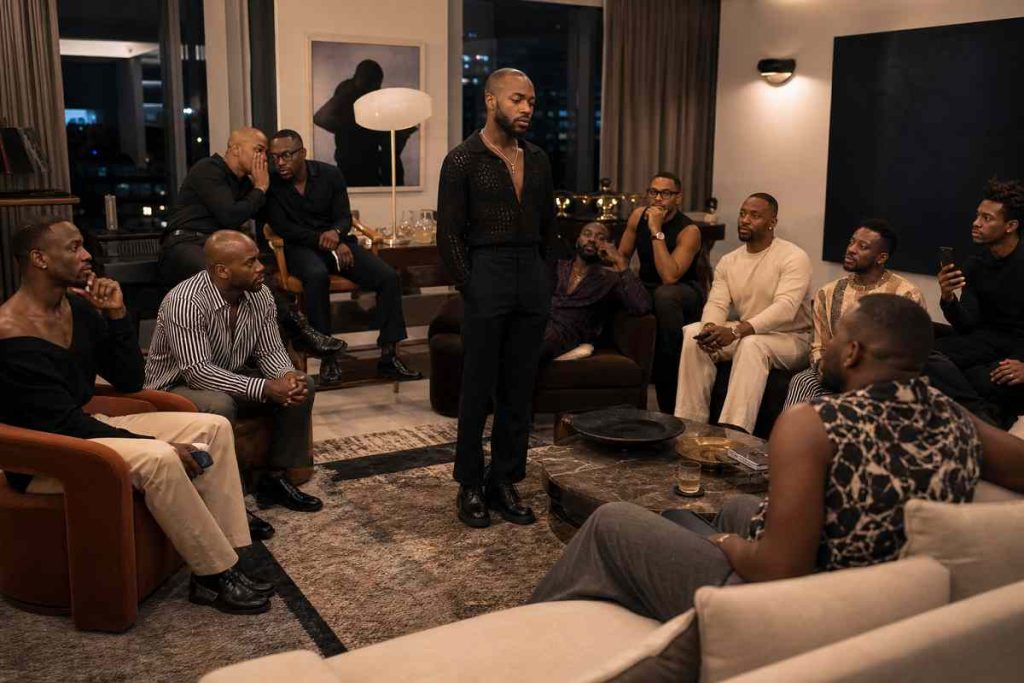
For many Black queer men, group chills and orgies are not always just about friendship, pleasure, or community.
In some Black queer spaces, people use group chills and orgies as social platforms to measure power, exchange gossip, test reputations, and negotiate belonging in real time. These gatherings may offer safety, excitement, sexual freedom, and connection, but they can also operate as informal ranking systems. People monitor who is desirable, who is losing status, who can be mocked, who gets crowned the “Father of All Tops,” and who the group is quietly preparing for exclusion.
This is why group chills and orgies in Black queer spaces cannot always be treated as neutral events. In many cases, they become stages where people perform, measure, and judge social value.
For men who fear one-to-one intimacy, the crowd can feel safer because it reduces direct emotional exposure. But when the group rewards gossip, humiliation, and status competition, that same crowd can become very dangerous. What begins as belonging can quickly become surveillance, and what looks like community can eventually turn into a machinery for power, ranking, and status wars — sometimes without members even realising it.
Group Chills as Social Insurance for People Afraid of Being Seen
For some Black queer men, one-to-one intimacy feels too exposing. A private visit asks for presence. It asks two people to sit together without an audience, a performance, a rank, or a distraction. It can reveal awkwardness, tenderness, insecurity, emotional hunger, sexual anxiety, class anxiety, shame, attraction, rejection, and desire.
A group chill offers cover. Nobody has to be fully seen or known. Nobody has to sustain a real conversation for too long. If intimacy becomes uncomfortable, the person can retreat into jokes, music, alcohol, weed, drugs, gossip, dancing, sexual display, or collective noise. The room absorbs what the individual cannot regulate.
Group Chills and Orgies: How People Sacrifice Others to Buy Their Own Safety
In some group chills and orgies, harm does not spread only because one person is cruel. It spreads because others learn that joining the cruelty, laughing along to mean jokes, staying silent in the face of harm, or helping to push a smear campaign designed to destroy someone’s reputation can protect them from becoming the next target.
It is a quiet bargain of toxic allegiance — a way of saying: I will do what you ask, laugh when you demand it, punish whoever you tell me to punish, and remain useful and loyal to the group, as long as you keep inviting me back and never make me the target.
The group marks one person for mockery, exposure, or exclusion while others buy temporary safety through silence, laughter, or compliance. This is how a gathering becomes dangerous. The room creates a moral economy where someone else’s pain becomes the price of belonging. People may not believe the gossip, but they repeat it because disagreement feels risky. They sacrifice another person’s dignity to stay close to the clique and away from the firing line.
Research on fear and group psychology suggests that people may move toward groups when anxiety or perceived threat feels high, because the presence of others can reduce the felt sense of danger (Tedeschi et al., 2021). This helps explain why some Black queer men may experience group chills as emotionally safer than one-to-one intimacy, even when the group itself is not caring, nourishing, or safe — and may even be the very engine of the threat they are trying to escape.
How Group Sex and Orgies Become Theatre Stages for Performers
The same logic can apply to orgies and group sex. This point requires care: consensual group sex is not inherently dysfunctional, immoral, or unhealthy. Adults can pursue sexual pleasure in groups ethically, safely, and joyfully. The issue is not the existence of group sex. The issue is what group sex sometimes replaces.
For some Black queer men, orgies and group sex offer touch without emotional accountability. People exchange and use each other’s bodies without having to connect directly. These encounters can offer validation without the vulnerability of being seen, understood, and chosen by one person in daylight.
Group chills and orgies also provide an avenue for boosting status: group members judge rank through visual desirability metrics, including how many people move toward one person, who attracts the most attention, and who becomes the room’s sexual centre. For “Dom Top” and hypermasculine performers, especially those carrying deep masculinity and sexual-role insecurities, the orgy can become a public stage where they display sexual authority, reinforce their image, and update their rank in real time.
Research on Group Sex and Chemsex Supports This
Research on gay men’s threesomes and group sex shows that group sexual encounters are shaped by sexual scripts, opportunity, normalisation, and social context, not simply individual appetite (Scoats, Anderson, & White, 2021).
Another related study on chemsex among gay and bisexual men also shows that sexualised settings can carry social, cultural, psychological, and identity functions, including the temporary management of shame, rejection, stress, and threatened self-esteem (Jaspal, 2022).
For Clarity: Not All Group Sessions Are Bad
This does not mean everyone at an orgy is wounded, avoidant, or emotionally unavailable. Some people enjoy group sex ethically, consensually, and joyfully. The point is not to pathologise group pleasure. The point is to ask what the space is doing emotionally and socially.
For some men, sexualised group spaces become useful because they offer “surface intimacy,” or what I have previously described as “connection-less sex,” without requiring the deeper emotional risk of connection. The body receives company while the self remains hidden. This can feel especially useful for Black queer men who fear attachment, or who have seen what attachment can do after being hurt. Some were once broken by intimacy, but instead of processing the heartbreak, they suppressed it, displaced it, and began to protect themselves through avoidance and restraint.
That is why some men can attend endless group sessions, yet feel anxious, irritated, bored, or exposed when asked to sit privately with one person. One-to-one intimacy removes the crowd. It removes the performance. It removes the backup dancers. Suddenly, the person has to bring himself. And for many Black queer men who have spent years wearing a mask, the real self may no longer feel easily accessible.
When the Group Becomes a Ranking System
In healthier communities, group gatherings usually create a sense of belonging. In unsafe ones, they create hierarchy and reward performance.
The room begins to ask silent questions. Who is desirable, who is losing desirability, and who has more money? Who gets invited first, who is now merely being tolerated, and who has become embarrassing? Then who is sleeping with whom, who has been “moving funny”, who can be laughed at without consequence?
At these group chills and orgies, some Black queer men single out the person they can touch, use, and enjoy in private, yet still deny respect and ridicule in public.
This is how group chills become status markets. People not only attend to socialise. They attend to monitor their rank, measure the competition, and identify who now threatens their position in the room.
When Social Value Drops in the Room
A private friendship can ask, “How are you?” A ranking room asks, “What is your current value?” Once that value drops, the group may not confront the person directly. It simply begins to revise his reputation.
Warm greetings disappear. His name enters conversations with a pause before it. Jokes are made. Screenshots are saved. Old stories are reinterpreted. Neutral behaviour becomes suspicious. Pain becomes “drama.” Distress becomes “proof.”
When the Group’s Plan Fails, and the Target Keeps Rising
Sometimes, the group’s plan fails: the person they tried to devalue keeps rising anyway.
This unsettles a ranking room because group exclusion depends on one central illusion — that the clique controls value, belonging, desirability, and social survival. The group behaves as if being pushed out of its circle is the worst thing that can happen.
But when the target grows outside the group, that illusion breaks. He may find a healthier community, become more visible, deepen his work, recover his confidence, or live with more peace than he had inside the room. His rise proves that the group’s judgment was never universal. It was local. It belonged to that clique, that hierarchy, that room, and that moment.
This creates a crisis. If he were truly worthless, why is he still rising? The group said he was finished without its membership, but why then is he still being seen? If the room had final authority, why did life continue beyond it?
From Exclusion To Active Sabotage
That is when passive exclusion may turn into active sabotage. The group may increase the gossip, harden the accusations, rewrite the story, weaponise old vulnerabilities, or search for new “evidence” to explain why its rejection did not destroy him. His survival unsettles the story they told themselves. His growth exposes the limits of their power.
For the target, though, rejection can become a form of redirection. Once he stops spending energy appeasing the room, managing suspicion, performing for approval, or shrinking himself to survive the hierarchy, that energy returns to him. He becomes free to build, create, rest, love, heal, and move toward people who do not require self-erasure as the price of belonging.
This is the hidden fear behind many smear campaigns: the target may discover that the group was never the whole world. And once he discovers that, the group loses one of its strongest weapons — the illusion that exclusion from them equals social death.
The greatest threat to an exclusionary clique is not anger and shouting. Sometimes it is a target who realises that the cage was never locked, steps outside, and takes flight.

Why Black Queer Groups Punish and Push Out Non-Conformers
This section uses Social Identity Theory to explain the psychology behind group exclusion: why some queer men form tight groups, protect the group’s image, and push out one of their own when he is seen as a threat to the hierarchy.
Social identity theory helps explain why some tight-knit Black queer groups punish people who do not conform. When people have faced rejection through racism, homophobia, or both, belonging to a group can feel like protection. Over time, the group becomes part of their self-worth; they begin to see the group’s reputation as their own. To protect that identity, members create unwritten rules about how people should act, dress, speak, desire, perform masculinity, and handle conflict.
Anyone who breaks those rules can begin to feel like a threat — not only to individual members, but to the group’s collective image — even when that person has done nothing seriously wrong. The group may then use gossip, nitpicking, withdrawal, mockery, or exclusion to push the person out. By rejecting the non-conformer, the group reassures itself that it is still desirable, respectable, powerful, and safe. In this way, a space meant to offer sanctuary can become a courtroom where people judge one another to uphold the hierarchy.
Minority Stress and the Paradox of Toxic Belonging
A 2025 study of Black LGBTQ+ adults complicates the automatic assumption that community belonging is always protective. The study found that belonging was generally associated with higher well-being, but under higher minority stress, a stronger community connection could intensify distress rather than reduce it. The authors argue that connection alone is not enough when community spaces lack empowerment, inclusion, resources, and repair (Tate et al., 2025).
This helps explain why highly connected Black queer communities can intensify distress rather than automatically improve well-being, especially when they reproduce exclusion, trauma bonding, shared grievance, hierarchy, or punishment without repair.
Recent work on LGBTQ+ online communities makes a similar point, showing how conflict, exclusion, and belonging can recreate school-like group dynamics in which identity, status, and group boundaries determine who is accepted, punished, or pushed out (Penfold et al., 2026).
Why Punishers and Instigators Keep Group Chills Alive
Group chills remain powerful not only because people enjoy gathering, but because certain individuals actively maintain the group’s authority and relevance. Punishers and instigators keep the room logic alive because it makes their work easier. For some people, the group becomes a tool: a place where private resentment can be dressed up as collective concern, where personal vendettas can be framed as community protection, and where cruelty can be outsourced to the crowd.
Some Black queer men have built social power from cruelty toward other Black men. They use the group to mobilise harm against a target they want removed, weakened, embarrassed, or socially diminished. Sometimes the target is someone they perceive as a threat to their own standing, status, masculinity, desirability, rank, business interests, or position in the hierarchy.
How Personal Insecurity Turns to Group Violence
A gay hypermasculinity or “Mandem” performer may mobilise group-coordinated harm against someone who exposes the fragility of his performance. A “Dom Top” performer may turn the group against someone who educates others that sexual role is not social rank. A DL performer may stir up a group he can influence to harm someone who threatens the secrecy mask that protects his image.
The same pattern can appear in social, business, or influence-based spaces. A Black queer man whose business depends on people remaining attached to performance, masking, or curated desirability may use his influence to attack someone who encourages authenticity. A manipulative queer man who relies on emotional tactics, covert relational aggression, gaslighting, dependency engineering, or strategic shaming may sponsor group harm against someone who names those dynamics clearly.
This is why instigators need the group. On their own, their motives may seem petty, insecure, jealous, or controlling. Inside the group, those motives can be disguised as concern, morality, banter, accountability, protection, or “everybody knows.” The group gives private cruelty a public costume.
And once the punisher enters, the lesson becomes clear: anyone who threatens the hierarchy can become the next example.
How Some Individuals Become the “Petrol” of Group Harm
In the first group chill I attended, there was one man whose behaviour taught me something important about how group harm spreads. I will not identify him because the point is not the person; the point is the function.
He was the kind of person I now think of as the petrol of group harm. People like this do not always start the fire, but they help it travel. They are often desperate to remain close to the room, even when the room does not fully respect them. The more desirable the group feels to them, the higher the price they are willing to pay for continued access.
Sometimes that price is silence; other times it is laughter. Sometimes it is betrayal; sometimes it is joining in harming someone else just to avoid becoming the next person pushed outside.
This is where belonging becomes dangerous. A person who feels he must pay heavily to remain included may become willing to do almost anything to stay near the centre, even if he is only allowed to stand at the balcony.
He may accept crumbs of belonging as proof of value; may mistake proximity for acceptance; may help injure another person simply because the group has made cruelty feel like the entry fee.
Why People Like That Are Particularly Dangerous
People like this are dangerous because, while they do not always start the fire, they often lack the moral centre to question it. Once the group calls on them, they arrive within seconds, ready to help spread the fire. Sometimes, they seem to tell their bosses — the instigators in the control room who hold higher positions in the group — “Stay down, my ogas. I will handle this for you.”
The group rewards his loyalty with a two-hour invite to the next group chill. Sometimes, they will not even let him into the main room; they will keep him on the balcony. Yet he may still destroy a friendship where he was treated with care and fully welcomed, just to appease the clique.
I call these people runners or errand boys. They are like parcel-deliverers of harm. They carry cruelty from one corner of the group to another, moving like blank slates with no visible internal foundation left. No independent moral centre. No pause, and no private conscience strong enough to interrupt the group’s appetite for cruelty. If the clique points at someone and says, “Help us destroy him,” he is already booking Uber and moving before the sentence is finished.
People like this are dangerous because they do not need a personal conviction to cause damage. They only need a group to give the order.

How Group Coordination Makes Cruelty Easier
Bandura’s work on moral disengagement is useful here. People can detach from their own moral standards by reframing harm as justified, minimising the injury, shifting responsibility to the group, blaming the victim, or dehumanising the person being harmed (Bandura, 1999).
In other words, cruelty becomes easier when nobody feels individually responsible.
The group says, “We all saw it.”
The coward says, “I was just there.”
The instigator says, “I did not force anyone.”
The observer says, “It was not my business.”
The target carries the consequence.
This is how social harm survives: the group spreads responsibility so thinly that nobody thinks they are holding the knife.
Hurting a Person Just to Mine for Evidence
One of the most disturbing behaviours in these environments is what I call evidence-mining: provoking distress in order to capture the distressed response.
People keep their phones ready to record. They switch on voice notes and then start disguising shaming and humiliation as banter to provoke a reaction. They stage phone disappearances, deny obvious facts, and use gaslighting to destabilise the target. Fingers hover over screenshot buttons as humiliating messages are sent, waiting for the target to respond in a way that can be captured, circulated, and later presented as “evidence.”
This is one of the most damaging forms of intracommunity cruelty because it first produces distress and then treats the distressed response as proof that the target deserved the cruelty.
The wickedness lies partly in its intimacy. The people carrying out the harm are often those the victim once trusted as friends, lovers, housemates, party companions, or at least as people granted meaningful access to his life.
Online shaming research describes public shaming as a form of social policing in which people collectively punish perceived wrongdoing by exposing reputations (Muir et al., 2023). In group-based queer conflict, this can move between physical rooms and digital platforms. A living room becomes a courtroom. A WhatsApp group becomes a witness box. A screenshot becomes a weapon. A voice note becomes a rope.
By the time a person reaches this level of calculated cruelty, return is often unlikely. Cruelty has stopped being an act and has become a foundation.
“I Gotta Put Me First”: Choosing Yourself Over the Room
Cookie Lyon said it plainly: “I gotta put me first.”
There is a reason that line lands. Many Black queer men do not think twice before sacrificing their inner peace to appease friendships, relationships, cliques, or to maintain a higher social rank than others. It is like throwing away your life for a fleeting social reward.
The moment you start tainting your inner world with ugliness, cruelty, envy, or darkness, you begin to depend more and more on those same friendships, relationships, and cliques to feel good, stay regulated, or manage unsettling emotions. At that point, the question becomes simple: which would you rather have? A strong inner mechanism that truly belongs to you, or a life subscribed to unreliable external factors?
The moment you find it difficult to leave a place where you do not feel fully welcome, go back home alone, make eba alone, and dance to your favourite song alone, you must recognise what is happening: your internal world has started to deteriorate.
This is not individualistic self-help. It is survival. If a person cannot be alone without feeling socially dead, then the group has acquired too much power over his nervous system.
Ostracism research shows that being ignored, excluded, or rejected can threaten fundamental human needs and lead to distress, sadness, anger, and attempts to regain a sense of belonging (Williams, 2007). This helps explain why people stay in rooms that harm them. Exclusion hurts.
But a room that requires you to wound your conscience for belonging is not a community. It is captivity with a soundtrack.
When Gentle People Join Cruel Rooms
There was this guy. He was not from here, and it was easy to tell that cruelty did not sit naturally on him. He had been drawn into something he did not fully know how to carry. Harming others looked terrible on him. It sat awkwardly on his spirit. Even though I was the victim of their coordinated scheme, I still pitied him.
But pity does not erase responsibility.
He had a choice. He could have refused the group’s cruelty and could have stepped back. Instead, he joined the harm because, in that circle, cruelty had been dressed up as the trendier, more masculine option.
People like him suffer differently. When your inner temperament is built more for love, care, and gentleness, yet you repeatedly force darkness through it for social approval, the mind rebels. Eventually, that contradiction becomes chaos with pointed edges.
This is one reason group cruelty is spiritually and psychologically expensive. It not only damages the victim. It can also deform the person who participates against his own better nature.
Some people are not naturally wicked. They are simply socially weak. But social weakness can still destroy lives.
If someone is trying to make you feel small,
they may be struggling to tolerate your power.If someone is trying to humiliate you,
they may have perceived your light as dimming theirs.If someone is trying to make you lose clarity,
your insight and independent thinking
may have threatened them.Once you understand the real message
behind a shame attack, you may begin to feel pity
for the shamer rather than doubt your power.Shame is often the last game
of a defeated man.
Poor Mental Health Keeps Trending
Poor mental health a na-ewu — it keeps trending.
Yet one uncomfortable truth many people avoid is that some knowingly participate in cruelty, deceit, manipulation, and reputational harm, forgetting that the very practices used to break another person can backfire and shatter their psyche in more devastating ways.
An innocent victim may survive undeserved cruelty and gain healing, wisdom, and resilience. But the person who chose harm receives no automatic protection from his own mind. The inner critic is a mean old being, older than life itself, and when it begins to speak, it does not whisper mercy. When it turns against you, there is nowhere to hide, because it knows every place you tried to bury the truth.
This is why some of us would rather face hardship than join cruelty. We know why.
We often make the mistake of thinking we fully control our own minds. But the brain’s origin is far older than the year we were born. It observes what we do, records what we excuse, and eventually turns our actions back toward us.
The evil a person spreads outside can begin to take root inside. That is when people start running from themselves, unable to live with the same harm they once inflicted on others.
Igbo culture has a way of describing a man who runs from himself. It is not a clean condition. It is messy, restless, and spiritually expensive.
How to Know When a Group Has Become Unsafe
A group has become unsafe when people are afraid to disagree with cruelty. It has become unsafe when everyone knows who is being targeted, but no one wants to explain why or demand accountability. A group has become unsafe when people laugh more loudly at humiliation than at joy!
A clique has become unsafe when phones come out before compassion, when someone’s pain is discussed as entertainment and when one person cannot be defended without the defender becoming the next target.
A group has become unsafe when silence becomes the membership fee to stay in the room.
What Healthier Black Queer Community Requires
The answer is not to demonise group chills, parties, orgies, WhatsApp and Telegram groups, or queer friendship circles. The answer is to stop confusing proximity with care.
A healthier Black queer community requires stronger norms. It requires people who can say, “No, we are not doing this to one of our own.” A safe community protects bystanders who intervene to prevent reputational harm before it becomes a full social freeze-out. It requires hosts who understand that providing a room is not enough. If you gather people, you should also shape what the room rewards.
Safe Black queer spaces must do more than gather people; they must nourish their members’ needs by emphasising care and accountability. They require Black queer men who can leave the room when the atmosphere turns ugly, and people who refuse to participate in screenshot culture, baiting, humiliation, gossip rituals, and social cruelty disguised as banter. Most of all, building healthier queer communities and spaces of belonging requires the courage to choose inner peace over social rank.
Most of all, it requires a return to private conscience. A group cannot become a substitute for morality. If your kindness only works when the clique approves it, then it is not kindness yet. It is permission-seeking.
Final Thoughts
A group can feed you.
It can rank you.
A group can hide you.
It can use you.
A group can turn you into a witness against your own conscience.
It can quietly turn you against yourself until you start running from your own mind.
The real question is not whether Black queer men should gather. We must gather. Isolation is not liberation. But isolation is still better than toxic belonging, because toxic belonging can create a deeper form of loneliness. The question is what kind of gathering we are building. A room that nourishes people is a community. A room that feeds on people and entertains itself with another person’s misery is something else.
And when a room starts asking you to trade your inner peace for belonging, leave. Go home alone. Make eba alone. Dance to your favourite song alone. You have not lost community. You have recovered yourself.
Frequently Asked Questions
Some prefer group chills because group settings can feel safer, less emotionally exposing, and more socially rewarding than one-to-one meetings. A group can offer humour, distraction, validation, sexual opportunity, and protection from direct rejection. But group settings can also become spaces of ranking, gossip, and reputational harm.
No. Group chills are not automatically bad. They can provide joy, friendship, mutual support, cultural belonging, and chosen family. The problem begins when the room rewards gossip, cruelty, exclusion, public shaming, or status competition more than care.
For some people, orgies or group sex can offer touch, desirability, and excitement without the emotional risk of being deeply known by one person. This does not make all group sex unhealthy. It simply means group sexual spaces can sometimes function as a substitute for intimacy rather than an expression of it.
Reputational harm happens when gossip, rumours, screenshots, staged narratives, public humiliation, or social exclusion are used to damage how a person is seen by the community. In small queer scenes, this can severely affect belonging, mental health, friendships, dating, and safety.
References
- Bandura, A. (1999). Moral disengagement in the perpetration of inhumanities. Personality and Social Psychology Review, 3(3), 193–209. https://doi.org/10.1207/S15327957PSPR0303_3
- Balsam, K. F., Molina, Y., Beadnell, B., Simoni, J., & Walters, K. (2011). Measuring multiple minority stress: The LGBT People of Color Microaggressions Scale. Cultural Diversity and Ethnic Minority Psychology, 17(2), 163–174. https://doi.org/10.1037/a0023244
- Jaspal, R. (2022). Chemsex, identity and sexual health among gay and bisexual men. International Journal of Environmental Research and Public Health, 19(19), Article 12124. https://doi.org/10.3390/ijerph191912124
- Meyer, I. H. (2003). Prejudice, social stress, and mental health in lesbian, gay, and bisexual populations: Conceptual issues and research evidence. Psychological Bulletin, 129(5), 674–697. https://doi.org/10.1037/0033-2909.129.5.674
- Penfold, A., Callaghan, P., & Chur-Hansen, A. (2026). “Like Going Through High School All Over Again” – A Social Identity Perspective on Conflict, Exclusion, and Belonging in Online Communities of LGBTQ+ Adults. Journal of Homosexuality, 1–26. https://doi.org/10.1080/00918369.2026.2644426
- Scoats, R., Anderson, E., & White, A. J. (2021). Exploring gay men’s threesomes: Normalisation, concerns, and sexual opportunities. Journal of Bodies, Sexualities, and Masculinities, 2(2), 82–106. https://doi.org/10.3167/jbsm.2021.020206
- Tate, M. C., Thrasher, S. S., Watts, K. J., Otachi, J. K., Griffin, D., & Moore, J. X. (2025). The Paradox of Belonging: Minority Stress, Community Belongingness, and Subjective Well-Being Among Black LGBTQ+ Adults. Behavioral Sciences, 15(12), 1604. https://doi.org/10.3390/bs15121604
- Tedeschi, E., Armand, S., Buyalskaya, A., Silston, B., & Mobbs, D. (2021). Fear in groups: Increasing group size reduces perceptions of danger. Emotion, 21(7), 1499–1510. https://doi.org/10.1037/emo0001004
- Williams, K. D. (2007). Ostracism. Annual Review of Psychology, 58, 425–452. https://doi.org/10.1146/annurev.psych.58.110405.085641