
Living in a Metallised World Demands Meta-Skills
Modern Western life is increasingly metallised—structured by hard systems, formal procedures, platforms, compliance metrics, and abstract rules that govern interaction at a distance. Much of social life now unfolds through interfaces rather than relationships, policies rather than personal evaluation, algorithms rather than conversation. Power is rarely direct; it is encoded.
To survive in a society like this requires meta‑skills: the capacity to regulate emotion, interpret systems, recognise patterns, and distinguish structural pressure from personal failure. For queer men, these skills make the difference between internalising harm and navigating it. Meta‑skills do not remove difficulty, but they preserve agency by making complexity readable.
Modern Western life can make power hard to see and harm difficult to trace. This article explains why queer men need frameworks to reduce self-blame, understand structural pressure, and navigate life with clearer agency.
Why Frameworks Become Necessary in Abstracted Societies
The more abstracted a society becomes, the more meta‑skills are required to navigate it. Meta‑skills here are not merely technical or digital competencies, but foundational and transferable capacities: self‑management, social intelligence, critical thinking, creative problem‑solving, adaptive judgement, and the ability to read systems rather than simply react to people.
In less abstracted environments, problems can often be addressed as they arise, through direct relational engagement. This works because power and responsibility remain relatively proximate and readable. In contrast, abstraction dislocates agency. One is no longer dealing with a person “bare as a leaf,” but with individuals shaped—and often constrained—by structures they may not fully recognise themselves in. In such conditions, frameworks are not optional; they are interpretive tools that prevent misrecognition, misattribution, and self‑blame.
Frameworks help queer men find language for experiences that might otherwise feel confusing, isolating, or uncanny. They make it easier to distinguish structural pressures from purely personal failures. This reduces the risk of self‑blame, supports safer forms of problem‑solving, and can even help stop certain harms from occurring in the first place.

Abstraction Without Frameworks Increases Confusion
A queer man in modern Western life may face a confusing contradiction. He may technically have rights, yet still experience alienation, workplace exhaustion, dating-app objectification, family estrangement, racialised desire hierarchies, or the psychological cost of constant self-monitoring.
External freedom can sometimes thin out intimacy rather than deepen it. Legal protection may push certain harms into more covert forms rather than eliminate them. Physical safety can move violence into emotional, social, or reputational domains. Without a framework, these pressures can be misread as personal weakness. Frameworks do not remove the difficulty of queer life. They make the difficulty legible.
In highly abstracted societies, confusion can be mistaken for incompetence, rejection for unworthiness, and fatigue for laziness. Power becomes harder to see. Harm can travel through structures and systems, moving underground rather than appearing on the surface. As a result, it becomes harder to recognise, easier to deny, and quicker to internalise. Even where physical violence declines, non‑physical harms can intensify: burnout, alienation, objectification, emotional exhaustion, and manipulation.
The Architecture of Abstraction
Western societies operate through high levels of structural mediation. A person seeking connection may not simply be “dating”; he may instead be interacting with platforms that sort visibility, desirability, distance, race, body type, and sexual presentation into market‑like categories. Research on dating‑app cultures shows that these environments can reproduce racism in sexualised ways and foster objectification, rather than simply facilitating neutral connection (Wade & Harper, 2019)[6].
The same dynamics apply beyond dating. Workplaces may speak the language of inclusion while quietly rewarding assimilation. Institutions may celebrate diversity while failing to provide psychological safety. Gay visibility may be commercially celebrated even as poorer, racialised, migrant, disabled, older, or gender‑nonconforming queer men remain structurally overlooked.
This is why structural stigma is such an important concept. Hatzenbuehler (2014)[2] defines structural stigma as societal‑level conditions, norms, and policies that restrict the opportunities, resources, and well‑being of stigmatised groups. The harm is not always caused by a single openly prejudiced person. Instead, it may be distributed across systems in ways that are harder to recognise or respond to.
Dislocated Agency and the Queer Experience
Abstraction dislocates agency. In simpler relational contexts, harm may be easier to trace: this person said this because they wanted something, or because I refused something.
In highly mediated societies, the source—and the fuller picture—of distress is often harder to identify. Even the friend you are confiding in may be shaped by pressures they did not design: workplace incentives, respectability codes, platform logics, family scripts, racial hierarchy, class anxiety, or institutional fear.
Loyalty to the hierarchy may override personal loyalty. Under conditions of poor self‑awareness, systems can push people to act in ways that do not fully reflect who they believe themselves to be.
Minority Stress Theory as a Prime Example
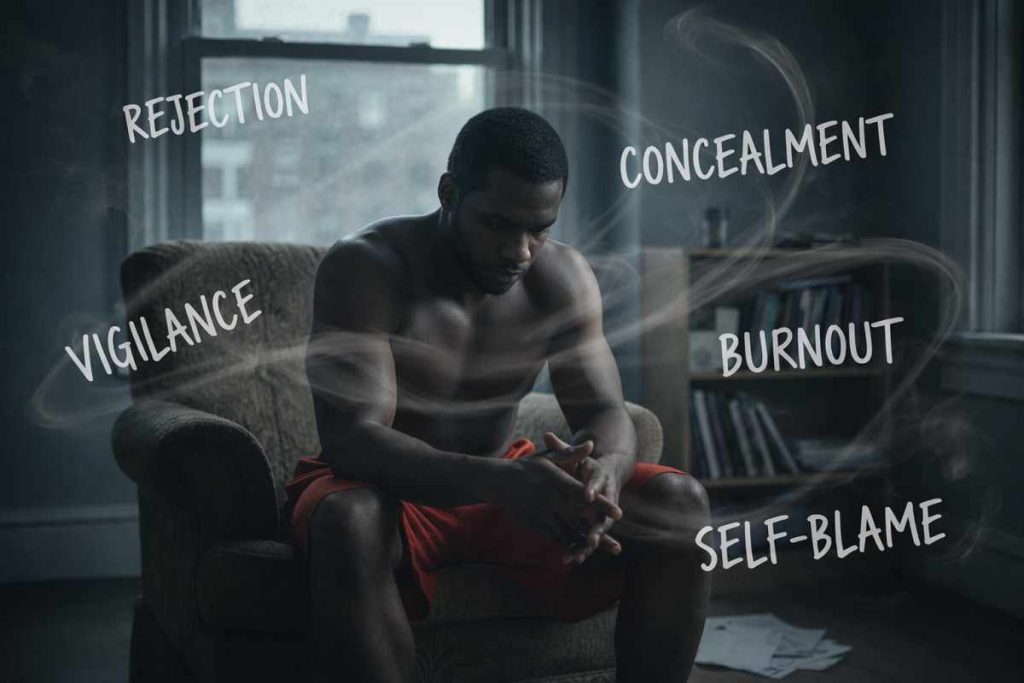
This is where minority stress theory becomes essential. Meyer (2003)[3] explains that lesbian, gay, and bisexual people experience distinct stressors linked to stigma, including prejudice, expectations of rejection, concealment, and internalised stigma.
Without this framework, a queer man may continue to interpret chronic anxiety as evidence that he is fragile. He may read his persistent loneliness as proof that he is undesirable. He may mistake exhaustion or “queer burnout” for laziness. Minority stress reframes the problem: the body and mind are responding to repeated social threat, not inventing pain out of nowhere.
How High Physical Safety Can Thin Moral Conscience
High physical safety and efficient external enforcement are essential social achievements. Strong laws, reliable policing, safeguarding systems, and institutional regulations reduce many forms of overt harm. But when people become overly dependent on external enforcement, ethical behaviour can shift from conscience to compliance.
In highly mediated societies, people may begin to ask, “Is this allowed?” or “Will this get me in trouble?” rather than, “Is this right?” or “What harm might this cause?” Morality becomes procedural instead of relational. The focus moves from responsibility to rule-following.
This can produce what might be called moral thinning: a reduced capacity to feel the human weight of one’s actions when those actions remain technically lawful, socially deniable, or institutionally protected. A person may avoid physical violence while still engaging in cruelty, exclusion, humiliation, reputational harm, emotional manipulation, or bureaucratic indifference.
Safer on the Surface, Colder Beneath
The point is not that societies with weaker law enforcement and poorer physical safety produce better people. They do not. Low-safety environments often generate fear, retaliation, trauma, and survival-based behaviour. The point is that conscience grows through more than rules alone. It also depends on proximity, empathy, consequence, reflection, and relational accountability.
High‑safety societies may reduce visible physical harm while allowing non‑physical harms to persist in subtler forms. When legality is mistaken for goodness, people may overlook their role in sustaining alienation, burnout, social cruelty, or structural harm.
Conscience may be innate, but its effectiveness is shaped by social conditions. Systems designed for safety and efficiency must therefore be paired with moral education, emotional literacy, and relational accountability. Otherwise, society may become safer on the surface while growing colder underneath.
Interpretive Frameworks as Survival Tools
Frameworks are not academic decoration. They are maps of pressure. C. Wright Mills’s sociological imagination[4] connects private troubles to public issues, showing how personal suffering can reflect wider social structures rather than individual failure. For queer men, this can be life-saving. It allows a man to ask: Is this my defect, or am I encountering a pattern?
Intersectionality, first articulated by Kimberlé Crenshaw in 1989[1], is equally vital because queer men do not experience sexuality in isolation. Race, class, gender expression, migration status, disability, age, religion, and legal status all shape access, danger, desirability, and social penalty.
A framework gives language to what confusion alone cannot hold.
Frameworks Shift Self-Blame into Structural Legibility
The greatest danger of navigating an abstracted society without a framework is misplaced self-blame. When systems remain invisible, the individual becomes the easiest explanation. He begins to fault his character for what may actually be structural friction.
Frameworks interrupt that collapse. They help queer men distinguish shame from evidence, rejection from worth, exclusion from personal failure, and institutional contradiction from individual confusion. They also clarify when a problem is interpersonal, structural, or both.
This is not about evading responsibility. It is about locating responsibility accurately.
Why This Topic Matters More for Migrant Queer Men
Migration removes familiar social scripts and places queer men inside new, highly coded systems where power is harder to read. This creates a dual burden: acculturative stress from adapting to a new society, and minority stress from managing queer identity in environments shaped by stigma.
Acculturative stress = the emotional and mental strain of adapting to a new culture, country, language, social rules, or way of life.
Minority stress = the extra stress people face because they belong to a marginalised group, such as dealing with stigma, rejection, discrimination, or pressure to hide who they are.
Immigration, documentation, and asylum systems can intensify distress by forcing LGBTQ+ migrants to relive trauma they would rather keep buried, often while struggling to fit Western expectations of queerness[5]. In digital queer spaces, migrant queer men may also face sexual racism, exclusion, or exoticisation, which dating apps often disguise as “preference.” This can be particularly painful for men who migrated from largely homogeneous societies, where racial difference may not have shaped their everyday self-understanding so aggressively.
In addition to established academic models, the frameworks developed on this platform aim to translate these ideas into practical navigation tools.
Applied Frameworks as Practical Tools
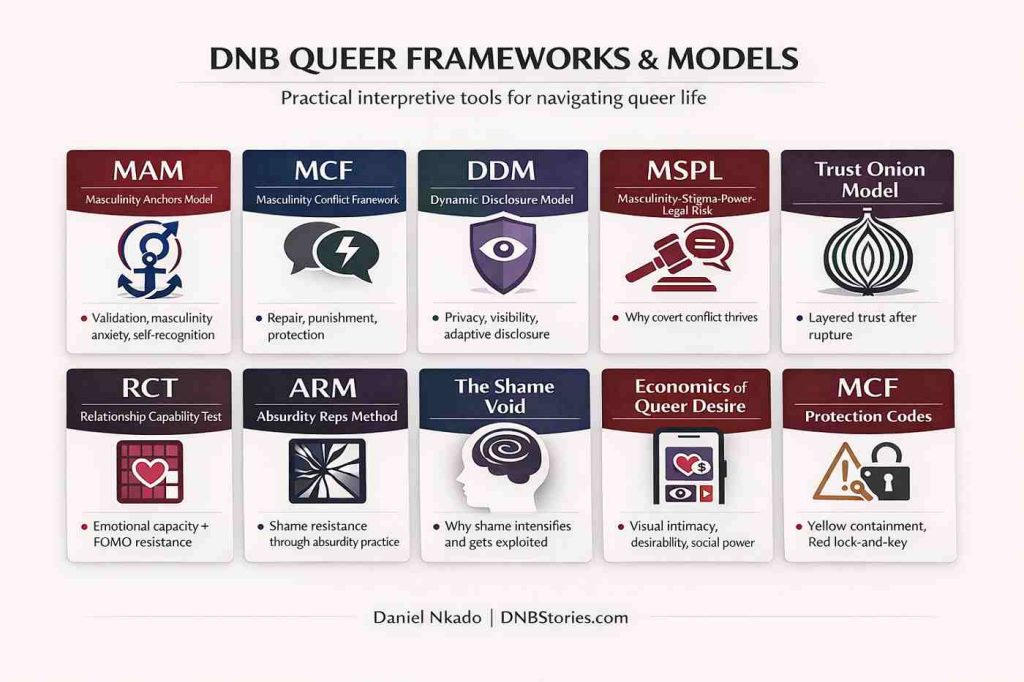
DNB’s Queer Frameworks serve as applied interpretive tools rather than clinical interventions. They are free to use and help queer men name invisible patterns, separate structural friction from personal failure, and preserve clarity under social or emotional pressure.
For example, the Masculinity Anchors Model offers language for understanding how masculinity anxiety can be shaped by social validation. The Masculinity Conflict Framework helps distinguish repairable disagreement from punishment, escalation, or control. Other models, such as The Shame Void and The Economics of Queer Desire, examine how shame, desirability, and visual culture can shape queer experience.
Their usefulness depends on reflective use. They do not remove harm, replace therapy, or solve structural inequality. At their best, they help convert confusion into language, and language into better judgment.
What DNB Queer Frameworks Do Well
DNB Queer Frameworks and Models can help queer men:
- increase pattern recognition
- improve decision-making
- preserve dignity under pressure
- reduce internalised shame and self-blame
- reduce risk in confusing or high-pressure contexts
Their Limits
Used well, these frameworks can sharpen intuition, self-efficacy, and social judgement. Used poorly, they can become distancing or overly intellectual. They do not remove harm and cannot replace therapy. They cannot fix structural inequality and require thought and reflection, not quick relief.
Misuse Risks
Frameworks can become unhelpful when misused. Examples include:
- over-intellectualising feelings
- using structure to avoid personal responsibility
- reading every problem as systemic
- replacing emotional honesty with analysis
The frameworks are intended to support navigation, not replace relationships, therapy, or community. Where distress exceeds interpretation — such as trauma, crisis, or severe mental health strain — the frameworks themselves point toward professional care, collective support, and trusted relational help.
Conclusion
Queer men need frameworks because Western life often conceals power behind politeness, bureaucracy, branding, algorithms, and the language of individual choice. In such a world, survival requires more than confidence; it requires interpretation. A framework allows a queer man to say: I am not imagining the pattern. I am learning how to read it. That shift matters. Because once a pattern becomes legible, it becomes navigable.

FAQs
Because frameworks make hidden social pressures visible. They reduce confusion, self‑blame, and the tendency to misread structural problems as personal failure.
Meta‑skills are transferable abilities that help a person think, adapt, relate, and respond across different situations—such as emotional regulation, critical thinking, empathy, and social intelligence.
Minority stress refers to the additional emotional and psychological strain people experience as a result of belonging to a marginalised group.
Acculturative stress is the strain involved in adapting to a new country, culture, language, social norms, or way of life.
Because migrant queer men may face multiple pressures at once: adapting to a new society, navigating sexuality, encountering racism or xenophobia, and managing immigration or asylum systems.
No. Frameworks do not remove difficulty, but they make difficulty easier to understand, name, and navigate.
DNB frameworks are non‑clinical interpretive tools designed to clarify patterns of pressure, not remove responsibility or eliminate hardship. They are best used as lenses, not verdicts.
References
- Crenshaw, K. (1989). Demarginalizing the intersection of race and sex: A Black feminist critique of antidiscrimination doctrine, feminist theory and antiracist politics. University of Chicago Legal Forum, 1989(1), 139–167. https://chicagounbound.uchicago.edu/uclf/vol1989/iss1/8/
- Hatzenbuehler, M. L. (2014). Structural stigma and the health of lesbian, gay, and bisexual populations. Current Directions in Psychological Science, 23(2), 127–132. https://doi.org/10.1177/0963721414523775
- Meyer, I. H. (2003). Prejudice, social stress, and mental health in lesbian, gay, and bisexual populations: Conceptual issues and research evidence. Psychological Bulletin, 129(5), 674–697. https://pmc.ncbi.nlm.nih.gov/articles/PMC2072932/
- Mills, C. W. (1959). The sociological imagination. Oxford University Press. https://global.oup.com/academic/product/the-sociological-imagination-9780195133738
- Selim, H. (2023). Asylum claims based on sexual orientation: A review of psycholegal issues in credibility assessments. Psychology, Crime & Law, 29(6), 566–590. https://doi.org/10.1080/1068316X.2022.2044038
- Wade, R. M., & Harper, G. W. (2019). Racialized Sexual Discrimination ( RSD ) in the Age of Online Sexual Networking: Are Young Black Gay/Bisexual Men ( YBGBM ) at Elevated Risk for Adverse Psychological Health? American Journal of Community Psychology, 65(3-4). https://doi.org/10.1002/ajcp.12401