Intro: Queer Desire is Not Entirely a Private Matter
In queer culture, desire is often treated as a private, individualised feeling. Many queer men understand attraction as mere “chemistry” between two people, and rejection as a simple “mismatch” of preferences. Popular relationship advice—across social media, podcasts, and coaching spaces—often reinforces this view by presenting confidence, self-esteem, and “better choices” as the main solutions to queer intimacy problems.
While these viewpoints matter, they do not explain the full picture. In many modern societies, queer intimacy can no longer be understood as a purely private matter. Beyond individual choice, wider social forces shape how queer men choose, rank, pursue, avoid, and reject one another. Desire is not simply discovered between individuals; it is shaped by social incentives, amplified by platforms, and disciplined by hierarchy.
Research shows that dating and hookup apps are not neutral channels of queer desire. Their design features and algorithmic systems can shape visibility, organise interaction, and intensify or reduce bias in intimate encounters (Hutson et al., 2018)[2].
In my original article, The Economics of Black Queer Desire, I examined the specific conditions shaping Black queer intimacy: scarcity, stigma, proof-seeking, fetishisation, masculinity pressure, and the emotional cost of being desired without being fully recognised. Queer Desirability Economics (QDE) widens that analysis by examining the broader social forces that produce and distribute queer desire through systems that rank bodies, map visibility, reward certain traits, and penalise others. This framework matters because it helps queer men recognise structural harm before they mistake it for private inadequacy.
Queer Desirability Economics (QDE) vs EBQD
The Economics of Black Queer Desire (EBQD)[5] examines what happens when Black queer people are forced to pursue intimacy within systems where recognition is scarce, unstable, conditional, or extractive. It centres the lived reality of Black queer desire: being wanted but not valued, touched but not held, hyper-visible as a body yet invisible as a full person.
This structural positioning can, over time, reshape how a group understands, experiences, and negotiates intimacy. Repeated exposure to conditional desire can become internalised, teaching Black queer people to absorb, anticipate, and sometimes reproduce the very hierarchies that first wounded them.
In racialised erotic markets, exclusion is often defended as preference. Yet research suggests that what appears as “preference” may also reflect incentive-driven patterns of exclusion, discrimination, and racialised desirability sorting (Shepherd et al., 2026[6]; Williams, 2024)[7].
Illustration of the Economics of Black Queer Desire at Play
To understand how these theories manifest in real time, consider the following scenario:
A Black queer man sets out to find love that comes with equal respect, care, and recognition. But he meets a different kind of desire. His body, sexual energy, and perceived endowment are wanted, sometimes intensely, while his character, depth, values, and inner life are treated as secondary or irrelevant. He may resist this reduction at first. But when fuller forms of recognition remain scarce, he may begin to accept what the market makes available.
Over time, the transactional logic becomes internalised. It reconditions how he understands desire, intimacy, and his own value. He learns that bodies are easier to trade than interiority, and that being wanted is not the same as being known. Eventually, he may begin to act according to the same market logic, reproducing with others the hierarchy that once reduced him.
At scale, this is how private wounds become social systems. A community searching for love, safety, and recognition can slowly become organised into buyers and sellers of bodies. This is the Black Queer Desire Market.
Queer Desirability Economics: The Social Factory of Queer Desire
Queer Desirability Economics (QDE) operates as a social factory of queer desire. It does not merely produce hierarchies that sort people according to marketable traits; it actively reconditions how queer men understand and interpret intimacy itself. QDE teaches queer men what to want, whom to notice, which bodies are worth pursuing, and which forms of connection should be dismissed as unrealistic, excessive, or too risky. In doing so, it gradually constrains individual agency, encouraging queer men to align their desires, expectations, and relational limits with the logics of the market.
For Black queer people in particular, this factory often operates through scarcity. Affirming intimacy — sexual and emotional connection that feels whole, sustaining, and marked by full recognition rather than conditional or sporadic validation — can feel exhausting, restrictive, unexciting, unfamiliar, or even risky.
The real need is bypassed in favour of visual proof and status, while the hunger for depth, recognition, or meaning persists. Sometimes, the person experiencing this cannot clearly identify what is missing. He may respond by chasing more sex without connection. Under market logic, value is often measured in numbers rather than depth of feeling.
QDE’s arguments about body-based ranking, commodified visibility, and algorithmic sorting become especially clear in dating-app environments, where platform systems shape who is seen, prioritised, filtered, or ignored (Myles et al., 2023)[4].

Social Choice Over Personal Choice
QDE ranks people through the desirability algorithms it creates, bypassing individual-specific needs. Some young Black queer men have only ever known this mode of desire: bodies over depth, visual proof over interior meaning, access over recognition, calibrated availability over emotional investment.
As these conditions are internalised through repeated exposure, they recalibrate what feels possible. Longing is disciplined through repetition. Attachment is trained by market risk. Patterned attraction begins to feel like the natural default: inevitable, instinctive, even personally chosen, despite being socially imposed. Over time, socially produced desire can be mistaken for instinct.
Market Fluctuations and Panic: Why Sexual Rejection Burns
Queer Desirability Economics is volatile. Standards shift across platforms, scenes, and contexts, producing unstable metrics that rarely remain fixed for long. Because these fluctuations often occur suddenly within a system that is not immediately readable to the people it governs, they can generate panic. Not as pathology, but as a rational response to a market where desirability can rise or collapse without notice.
Within QDE, panic emerges from the intersection of scarcity and volatility. Because affirming intimacy is already limited, particularly for Black queer people, shifts in desirability metrics carry heightened stakes. These metrics often act as substitute stabilisers for “The Void” — the unmet need for depth, recognition, care, and secure attachment.
When those stabilisers become unstable, the person is not simply reacting to rejection; he is reacting to the collapse of a system he had been using to regulate his sense of worth. This helps explain why sexual rejection can feel so intense. The pain is not only that intimacy has been denied. It is that rejection can activate a deeper fear: that being unwanted in that moment means being without value altogether.
It is like throwing a lit match onto an already combustible wound[3].
Minority Stress Theory shows how stigma, discrimination, concealment, and expectations of rejection operate as chronic social stressors, shaping how queer men experience pressure and respond to relational instability (Frost & Meyer, 2023)[1].
Fear of Disposability, Competition and Threat Elimination
This volatility produces persistent anxiety around timing, replacement, and loss. Panic is not merely emotional instability; it is a structural condition that produces learned vigilance within a system that treats desirability as perishable and endlessly substitutable.
That learned vigilance can lead people to behave as market actors rather than relational beings. They may try to maximise desirability, protect status, compete for scarce attention, humiliate perceived rivals, or punish anyone whose presence threatens their market position. In this environment, cruelty can become strategic. Humiliation becomes a tactic for lowering another person’s social value. Mind games become tools for destabilising perceived threats.
Dominant traders do what they can to remain at the top, even when that means converting intimacy into a site of competition, power struggle, or control. This helps explain why queer men shaped by this system may still pursue sex with perceived rivals, competitors, or even enemies. Under market logic, sex is not always an expression of affection, trust, or emotional safety. It can also operate as conquest, leverage, reassurance, dominance, access, or proof.

Desire Without Care: Exchange of Bodies, Zero Recognition
QDE helps explain why conflict and sexual intimacy can coexist without contradiction. A person may be competing with, undermining, or trying to destabilise an intimate partner while still engaging enthusiastically in sex. Such encounters are not anomalies but clear expressions of how desirability politics operate within an active erotic economy. Desire circulates without care, access without recognition, and pleasure without interior engagement. Visual and sexual metrics may register as highly intense even as emotional metrics remain thin, overlooked, or entirely absent.
When Emotional Needs Remain Unmet
In a desirability economy, scarcity can easily recalibrate attachment. Over time, authentic human connection can begin to feel dangerous, detachment becomes protection, and queer men may begin to seek reassurance through fast-proof signals that prioritise status, visibility, and sexual access over genuine intimacy.
The result is a repeating cycle: emotional needs are constantly activated but rarely satisfied. Not because the needs are excessive, but because the desirability economy often withholds care while encouraging access. Sexual access may increase while core emotional needs — being seen, recognised, valued, and held — remain unmet.
When emotional needs remain consistently unmet, certain patterns tend to appear:
Emotional Signs
- Persistent loneliness, emptiness, or emotional flatness
- A strong sense of disposability
- Anxiety around connection, rejection, or abandonment
- Low mood, hopelessness, or quiet depression
- Shame, self-blame, or feelings of worthlessness
Relational Signs
- Difficulty trusting care to last
- Pulling away from closeness while still craving it
- Repeating shallow, unstable, or transactional relationships
- Strong reactions to silence, distance, or perceived rejection
- Over-giving or people-pleasing, followed by resentment or burnout
- Greater risk of lashing out, spreading harm, or becoming cruel to others
Behavioural Signs
- Seeking reassurance through validation, attention, or sexual access
- Emotional withdrawal, numbness, or “keeping things casual” as protection
- Perfectionism, control, or over-functioning to feel secure
- Reliance on coping behaviours such as overworking, scrolling, substances, or compulsive sex
- Irritability or sudden emotional outbursts that feel disproportionate
Cognitive Signs
- Interpreting rejection or silence as personal failure
- Constant comparison with others
- Difficulty identifying or naming personal needs
- Believing care must be earned rather than expected
Physical Signs
- Chronic stress, fatigue, or burnout
- Sleep disturbance, tension, headaches, or digestive issues
- A persistent sense of being on edge or unable to relax
Consistently unmet emotional needs do not mean someone is needy, weak, or broken. They often signal long-term exposure to environments where genuine care has remained inconsistent, conditional, or unreliable for so long. These symptoms are best understood as survival adaptations, not personal failures.
How QDE and EBQD Interact
Queer Desirability Economics (QDE) and The Economics of Black Queer Desire (EBQD) operate as two connected levels of the same erotic economy. QDE names the wider social industry through which queer desire is organised. It explains how social conditions turn queer spaces into erotic markets shaped by scarcity, ranking metrics, uneven visibility, desirability volatility, and platform speed. These pressures operate across multiple queer desire markets, including whiteness-dominant masculinity markets, body-capital markets, age-stratified markets, and platform-optimised markets.
EBQD zooms in on one specific market formation within that wider system: the Black Queer Desire Market (BQDM). It explains how QDE’s general pressures take Black queer form under racialised and erotic conditions, becoming lived as sex scarcity, conditional recognition, fetishisation, proof-seeking, and relational instability.
DEPS → SIFR → AVR
Within BQDM, structural pressures known as DEPS — Desirability hierarchies, Economic inequality, Platform dynamics, and Safety or stigma — make affirming intimacy feel trivialised, risky, or unreachable. These conditions generate the SIFR loop: Scarcity → Insecurity → Fast proof-seeking → Reassurance fade → Repetition. Through SIFR, scarcity becomes self-reinforcing rather than resolvable.
The outcomes of this loop include desirability becoming tied to self-worth, emotional crash, panic, cruelty, defensiveness, and detachment. AVR, or Alternative Value Routes, is the primary intervention. AVR refers to non-market sources of value — friendship, care, rest, creativity, dignity, and political belonging — that reduce dependence on desirability markets for worth and safety.
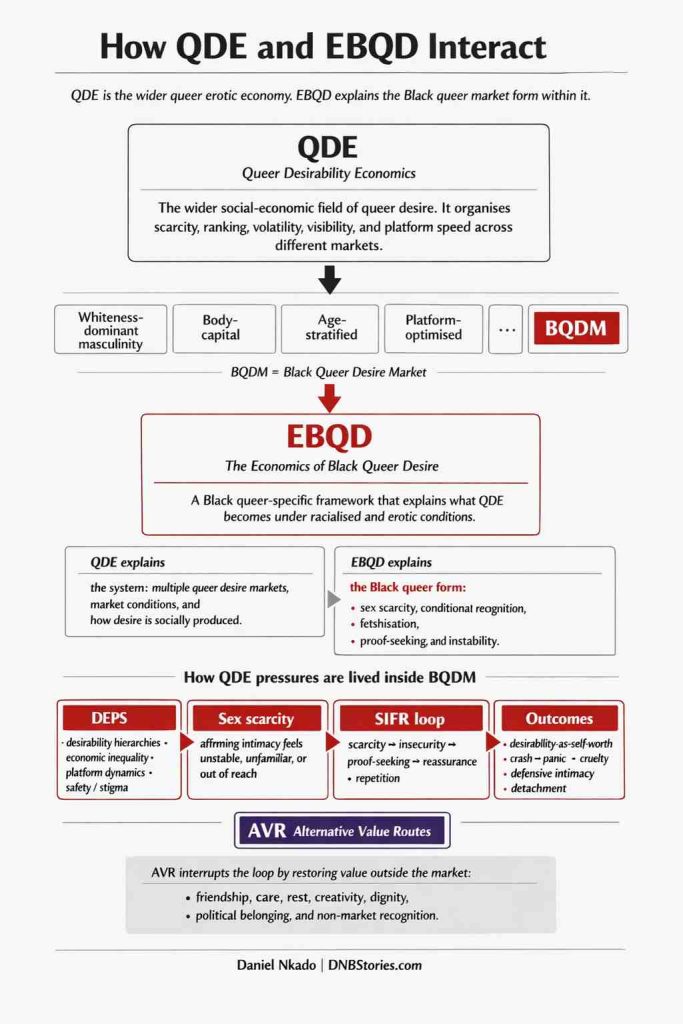
QDE shows how the market is built; EBQD explains how the Black queer market works. DEPS names the key structural pressures that organise the market; SIFR shows how scarcity drives repetition and escalation; and AVR shows how the loop can be interrupted.
Conclusion: Clarity Against Shame
Queer Desirability Economics (QDE) does not seek to equalise desire across classes, generations, or identities of queer men. Its purpose is diagnostic, not prescriptive: to explain how social systems actively retrain queer desire, shaping what is noticed, pursued, and ignored in particular places and moments.
By reframing rejection, scarcity, and status as market effects rather than personal verdicts, QDE interrupts the dangerous equation between desirability and worth. Across dating, platforms, masculinity, ageing, and mental health, the framework makes structural forces legible, enabling people to locate responsibility more accurately and loosen the grip of internalised shame.
References
- Frost, D. M., & Meyer, I. H. (2023). Minority stress theory: Application, critique, and continued relevance. Current Opinion in Psychology, 51, Article 101579. https://doi.org/10.1016/j.copsyc.2023.101579
- Hutson, J., Taft, J. G., Barocas, S., & Levy, K. (2018). Debiasing desire: Addressing bias and discrimination on intimate platforms. Proceedings of the ACM on Human-Computer Interaction, 2(CSCW), Article 73. https://doi.org/10.1145/3274342
- Meyer, I. H. (2003). Prejudice, social stress, and mental health in lesbian, gay, and bisexual populations: Conceptual issues and research evidence. Psychological Bulletin, 129(5), 674–697. https://doi.org/10.1037/0033-2909.129.5.674
- Myles, D., Duguay, S., & Flores Echaiz, L. (2023). Mapping the social implications of platform algorithms for LGBTQ+ communities. Journal of Digital Social Research, 5(4), 1–30. https://doi.org/10.33621/jdsr.v5i4.162
- Nkado, D. (2026, March 16). The economics of Black queer desire: Surviving sex scarcity. DNB Stories Africa. https://dnbstories.com/2026/03/economics-of-black-queer-desire.html
- Pachankis, J. E. (2007). The psychological implications of concealing a stigma: A cognitive-affective-behavioural model. Psychological Bulletin, 133(2), 328–345. https://doi.org/10.1037/0033-2909.133.2.328
- Williams, A. (2024). Not my type: Automating sexual racism in online dating. Stanford University Press. https://www.sup.org/books/sociology/not-my-type