Sexual and romantic rejection is a universal human experience—but for gay and bisexual men already dealing with internalised shame and stigma, it can land like a confirmation of internalised scripts of unworthiness or being “less than.” That intensity is not an “overreaction”; it reflects the accumulated weight of stigma, minority stress, and repeated exposure to social devaluation, including homophobia, racism, masculinity policing, ageism, and the privileging of body and appearance over intellect, among other pressures (Meyer, 2003[5]; Hatzenbuehler, 2016)[4].
In December 2025, I published The Queer Dating Resilience Framework (QDRF) as a supportive toolset designed specifically for this reality. It is not a clinical intervention, but rather a practical system built to help gay men metabolise rejection without falling into shame spirals, emotional shutdown, or retaliation.
This article explores the QDRF—its theoretical foundations, core components, limitations and safe application in everyday life.
LOOKING FOR COMMUNITY SUPPORT? If you want to connect with other queer people, you’re welcome to join our Telegram group, GITK by DNB.
Part 1: Why Rejection Hurts Queer Men More
For many gay and bisexual men, minority stress can turn a simple “no” into a trigger of unwantedness rather than mere disappointment. Chronic strain from stigma, discrimination, and internalised expectations of rejection can heighten vulnerability to anxiety, depression, and stress reactivity[5]. In queer culture, desirability politics often load dating with meaning beyond personal preference. When rejection occurs within systems that already rank bodies by race, body type[2], age, and sexual role, it often lands not as situational disappointment but as a message about identity.
Gay Men and Rejection Sensitivity:
Rejection sensitivity refers to gay men’s tendency to stay overly alert to rejection cues and to respond intensely to perceived signals, often before rejection fully occurs. Research on sexual and gender‑marginalised groups understands this as a learned response to repeated experiences of stigma and links it to poorer mental health outcomes (Slimowicz et al., 2020)[9].
Part 2: What QDRF Is—And What It Is Not
The Queer Dating Resilience Framework (QDRF) is a three‑level, trauma‑informed, values‑driven framework developed by Daniel Nkado to help gay men navigate sexual and romantic rejection without collapsing into shame, retaliatory anger, or withdrawal. (Hatzenbuehler, 2016)[3].
QDRF is designed for practical, self‑applied use outside clinical settings. It integrates well‑established cognitive, values‑oriented, and social regulation strategies into a culturally responsive framework to help users interpret experiences of rejection, regulate distress, and stay aligned with personal values over time. QDRF is not positioned as a replacement for evidence‑based therapies such as CBT or ACT, but as a complementary model focused on accessibility, cultural resonance, and practical application.
This model may be particularly useful for Black gay men, including myself, who face compounded challenges related to stigma, visibility, and desirability within dating contexts. QDRF is not intended to discourage engagement with therapy; rather, it may help therapy‑naïve individuals better understand the potential value of professional support and approach care with clearer language and readiness.
Part 3: The Science Behind QDRF
QDRF brings together well‑established psychological ideas and applies them directly to dating. It draws on research showing that self‑compassion reduces shame and helps buffer the effects of minority stress, and that living in line with personal values—rather than chasing approval—supports wellbeing in gay and bisexual men. QDRF also treats resilience as something people practice rather than a personality trait, and includes clear ethical limits to ensure “resilience” is not used to excuse harmful social systems. Finally, it aligns with LGBTQ‑affirmative CBT research showing that addressing minority stress directly can reduce depression and related health risks.
I designed the QDRF mainly for gay and bisexual men, but it also applies to other queer men dealing with homophobia and femmephobia.
Research Grounding: Carvalho & Guiomar (2022)[1]; Helminen et al. (2022)[3]; Neff (2023)[6]; Roberts et al. (2024)[8]; Jurček et al. (2022)[5]; Pachankis et al. (2015)[7].
“Trauma‑informed” in the context of QDRF refers to the framework’s recognition that repeated rejection, shame, and minority stress can heighten emotional sensitivity, and therefore it avoids blame while prioritising choice, safety, and empowerment.
Part 4: QDRF Explained—Compass, Map, Journey
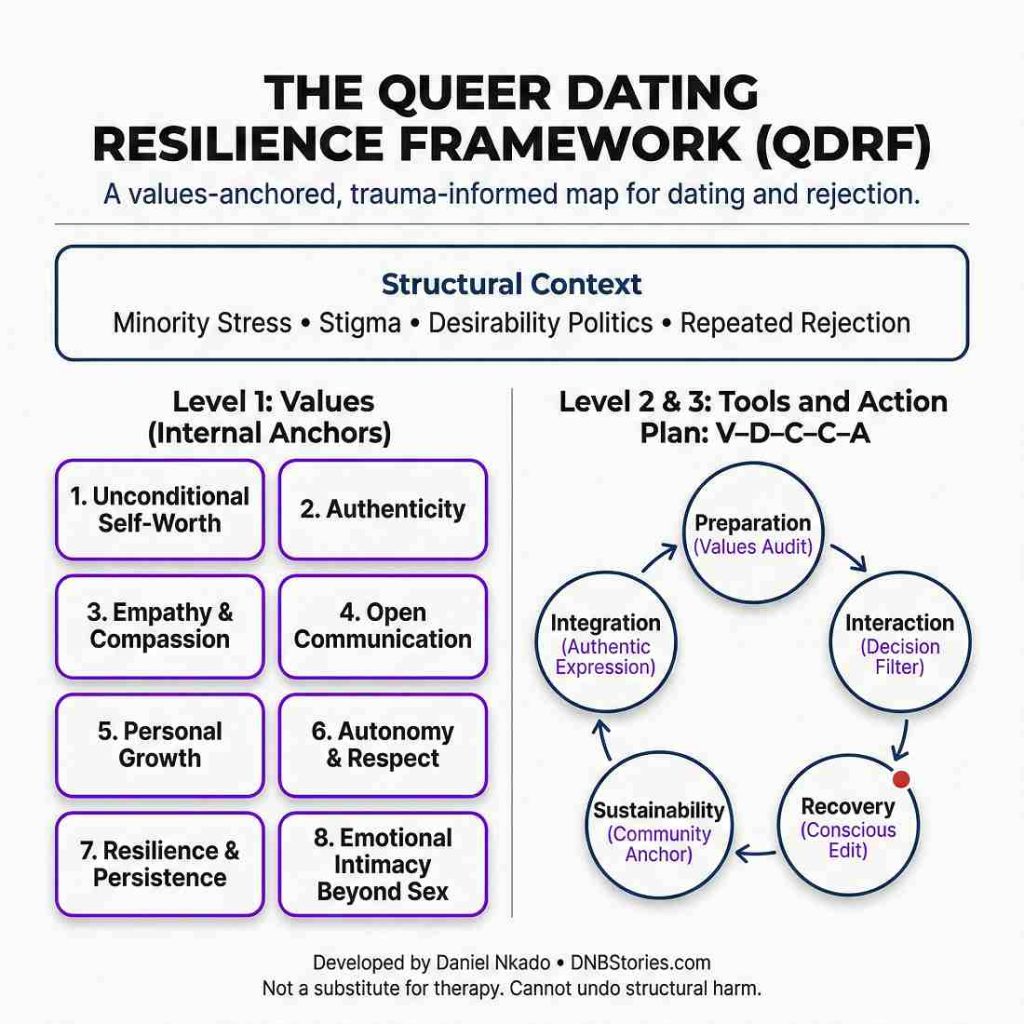
QDRF consists of three interlocking layers designed to turn rejection into data and manageable grief, rather than a verdict on your worth.
Level 1: Core Values—The Compass
When rejection spikes shame, anger, or hopelessness, values provide a fixed reference point. QDRF centres on eight core values that anchor identity and act as a cushion under pressure, including moments of rejection. These values guide everyday dating decisions and relationships.
You don’t need to consciously work with all eight values at once—most of the time, they operate quietly in the background, shaping how you relate, communicate, and set boundaries. I don’t recommend simply writing the values down or memorising them. Instead, note them down and put them into practice in everyday life, so they gradually become embodied.
These values do not replace the values you already hold. They are designed to build on what’s already there—and for many people, recognising familiar values makes the framework easier to integrate.
i. Unconditional Self‑Worth
Your value is not decided by who chooses you or passes you over.
ii. Authenticity
Showing up as yourself rather than performing for approval.
iii. Compassion (for self and others)
Extending care and understanding yourself and others.
iv. Open Communication
Expressing needs, limits, and intentions clearly and respectfully.
v. Personal Growth
Treating dating experiences as information, not verdicts.
vi. Autonomy & Respect
Maintaining agency over your choices while honouring others’ boundaries.
vii. Resilience & Persistence[1]
Staying engaged without becoming hardened or emotionally numb.
viii. Emotional Intimacy Beyond Sex
Valuing connection, care, and closeness beyond physical validation.
Together, these values function as anchors, helping gay men metabolise rejection without collapsing into shame, retaliatory anger, or withdrawal—while staying connected to themselves and others.

Core Quality of the QDRF Values
QDRF values anchor worth and identity within the person, rather than tying them to outcomes, approval, or being chosen. Many common dating “values” are really outcome goals—being desired, validated, or picked. These collapse under rejection because they depend on someone else’s response.
QDRF values are designed to remain available even when attention or validation is unavailable. That’s what makes them stabilising in a dating culture shaped by desirability politics: they give you a durable inner reference point when external feedback becomes inconsistent, cruel, or absent.
| The Trap: External Outcome Goal (Fragile) | The Anchor: Internal QDRF Value (Durable) |
| “I need them to find me attractive.” | “I treat myself with unconditional self-worth.” |
| “I hope they pick me.” | “I am seeking genuine alignment and mutual respect.” |
| “I need to impress them.” | “I am showing up with authenticity.” |
Level 2: Practical Tools — The Map
QDRF includes five practical tools that translate values into action in real moments. Together, they form a simple map you can use before, during, and after dating interactions.
The QDRF Tools (V‑D‑C‑C‑A)
| Tool | Timing | What it does |
|---|---|---|
| Values Audit | Before | Identify your top three values for a specific context (e.g., week, date, or app use). |
| Decision Filter | Before | Shifts focus from “Do they like me?” to “Do they align with my values?” |
| Conscious Edit | During | Interrupts shame spirals with grounded, compassionate reframes. |
| Community Anchor | After | Reconnects you to chosen family and affirming spaces. |
| Authentic Expression | Ongoing | Builds self‑trust through honest boundaries and truth‑telling (when safe). |
Level 3: Action Plan—The Journey
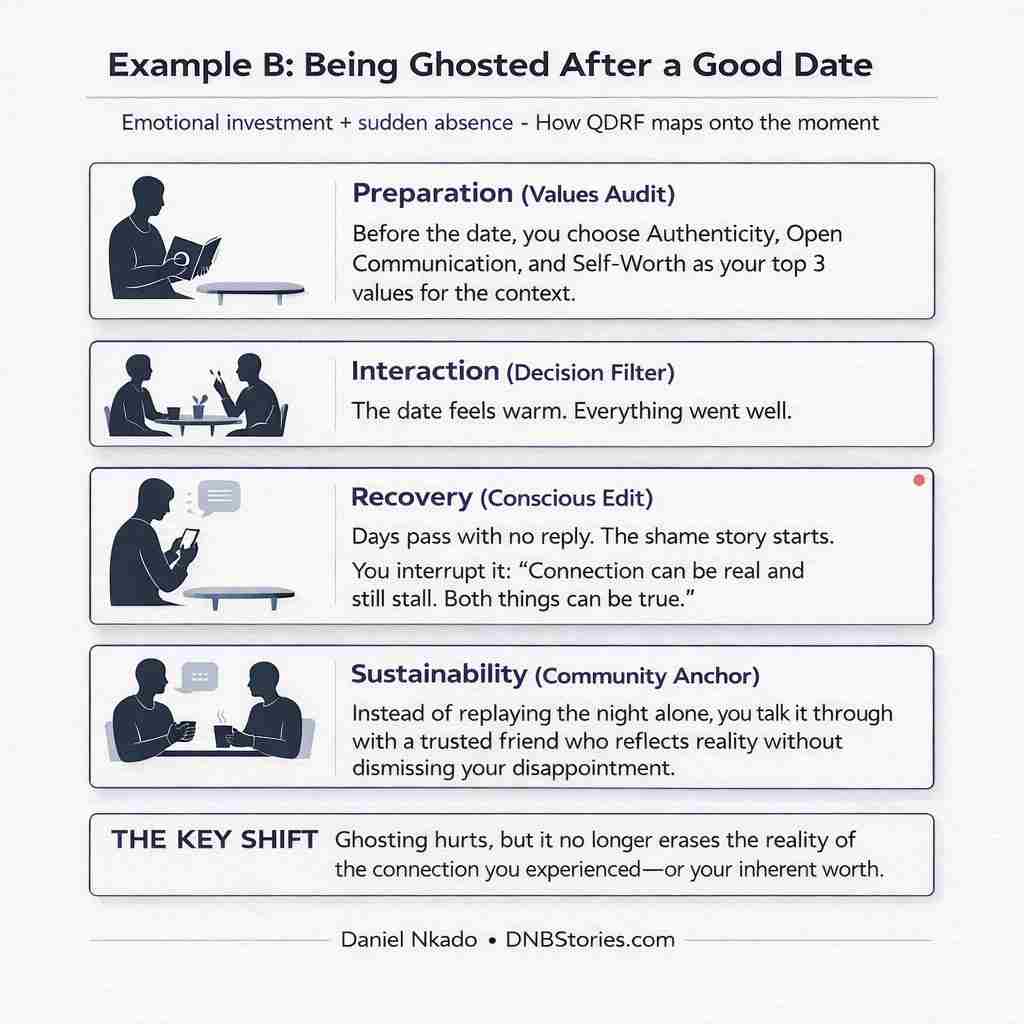
QDRF organises the tools into a repeatable sequence that supports you before, during, and after dating interactions: Preparation (Values Audit) → Interaction (Decision Filter) → Recovery (Conscious Edit) → Sustainability (Community Anchor) → Integration (Authentic Expression).
Part 5: Using QDRF in Real Life
QDRF isn’t meant to be an emergency fix you reach for in the heat of the moment. It’s a way of slowly building dating resilience over time. Most of the work happens before anything difficult occurs. Practise the values regularly so they become natural. Choose three values to carry into situations that might feel exposing. Use the Decision Filter in advance to ask whether someone is actually aligned with what matters to you.
This kind of preparation remains one of QDRF’s main strengths. By grounding yourself early and orienting toward alignment rather than approval, you reduce the chances that rejection will land as something damaging in the first place.
Real-World Use of QDRF: Opening Grindr—High Comparison, Fast Judgment
To see how the framework moves from theory to practice, let’s look at a highly relatable scenario: navigating a dating app like Grindr.
1. Preparation — Values Audit:
Before opening the app, you choose three values to carry with you. For example: Unconditional Self‑Worth, Authenticity, and Autonomy & Respect. This intentionally sets your internal orientation before any external interaction happens.
2. Interaction — Decision Filter:
Before messaging someone or replying, you pause and check for alignment. You notice a profile with a username like “DL Alpha Top” or language that comes across as dismissive. You recognise that this signals a dynamic you’re not actually seeking. Instead of pushing forward to win their validation, you exercise your agency and decide not to engage.
3. Recovery — Conscious Edit (if rejection happens):
If you misjudge and someone doesn’t reply, blocks you, or suddenly disengages, you interrupt the shame spiral early: “No reply does not mean I’m nothing.”
“This hurts—and I’m still whole.”
4. Sustainability — Community Anchor:
You ground yourself in your support system. If you don’t already have a strong community, use this as a reminder to keep working towards building one—whether that means finding chosen family, cultivating close friends you can be completely real with, or seeking spaces that hold you emotionally.
5. Integration — Authentic Expression:
You carry the experience forward without armouring up or shrinking yourself. You continue to show up honestly in future interactions, guided by your core values rather than a fear of rejection.
The Key Shift: With QDRF, rejection isn’t a verdict—it becomes information. Each cycle through these steps strengthens your self‑trust instead of eroding it.
Example Decision Filter Questions—Use Before Engagement
Instead of chasing validation with every potential match, pause and decide with full agency. The Decision Filter helps you screen for alignment before emotional investment builds.
- Respect: Are they communicating in a way that feels consistent and non‑cruel, or am I already excusing dismissiveness or edge?
- Safety: Do they put down others—race, femininity, bodies, HIV status, age—or use language that signals contempt? If so, I don’t proceed.
- Alignment: Do what they say they want, and do how they behave actually line up, or am I filling in the gaps with hope?
- Reciprocity: Is there clear, mutual interest here—or am I bargaining for basic decency or shrinking myself for attention?
Part 6: QDRF: Development, Weaknesses and Limitations
QDRF was developed by a gay man drawing on lived experience and sustained dialogue with other gay men navigating rejection. Its eight core values emerged from community‑informed conversations about what helped, what was learned over time, and what people wished they had known sooner.
This insider perspective gives the framework depth and relevance while also defining its limits. QDRF does not treat rejection itself as harm; people have the right to say no. It offers situated, practice‑based insight intended to resonate with the community it was developed for, rather than to claim statistical generalisation. While QDRF supports individuals in metabolising rejection more safely, it cannot undo structural harms—such as stigma, desirability politics, racism, ageism, or HIV stigma—which require collective and institutional change.
To avoid misuse, values should serve as orientation points (an internal compass), not as moral judgments. QDRF supports recovery and longer-term resilience, but it should not replace therapy, medication, or crisis services.
Integration Not Novel Mechanisms
Many QDRF components draw on mechanisms well represented in CBT, ACT, and social regulation models. QDRF does not claim novelty at the level of individual mechanisms; rather, it proposes an integrative and culturally specific framing of these elements, alongside increased suitability for self‑application. Nevertheless, its incremental value beyond existing evidence‑based interventions remains to be established through comparative research.
FAQs
It was designed with gay and bisexual men’s dating contexts in mind, but its components (values, self-compassion, community anchoring) can generalise to other contexts. Still, trans people and other groups may face distinct stressors that require adaptation.
QDRF supports prevention and recovery, not crisis care. Seeking help is not a failure of resilience—it’s part of ethical resilience. Professional LGBTQ-affirming care may be appropriate.
No. It assumes the opposite: these are real social harms with real psychological effects. QDRF is about protecting dignity while navigating an imperfect world.
Do a Values Audit (pick 3 values), then apply the Decision Filter on your next interaction, and practise a one-minute Conscious Edit after any sting.
Conclusion
QDRF anchors identity in values that don’t depend on being chosen, then guides behaviour through a simple cycle: prepare before you engage, recover and re-anchor if pain hits, and keep showing up as yourself. Rejection becomes something you move through—not something that defines you.
QDRF: A queer‑specific, values‑based resilience framework for gay/bi men dealing with dating and sexual rejection (including Grindr). It focuses on shame, homophobia/femmephobia, community, and how you want to live and date, not just how you want to think.
References
- Carvalho, S. A., & Guiomar, R. (2022). Self-compassion and mental health in sexual and gender minority people: A systematic review and meta-analysis. LGBT Health, 9, 5. https://doi.org/10.1089/lgbt.2021.0434
- Hatzenbuehler, M. L. (2016). Structural stigma: Research evidence and implications for psychological science. American Psychologist, 71, 8. https://doi.org/10.1037/amp0000068
- Helminen, E. C., Ducar, D. M., Scheer, J. R., Parke, K. L., Morton, M. L., & Felver, J. C. (2023). Self-compassion, minority stress, and mental health in sexual and gender minority populations: A meta-analysis and systematic review. Clinical Psychology: Science and Practice, 30, 1. https://doi.org/10.1037/cps0000104
- Jurček, A., Keogh, B., Sheaf, G., Hafford-Letchfield, T., & Higgins, A. (2022). Defining and researching the concept of resilience in LGBT+ later life: Findings from a mixed study systematic review. PLOS ONE, 17, 11. https://doi.org/10.1371/journal.pone.0277384
- Meyer, I. H. (2003). Prejudice, social stress, and mental health in lesbian, gay, and bisexual populations: Conceptual issues and research evidence. Psychological Bulletin, 129, 5. https://doi.org/10.1037/0033-2909.129.5.674
- Neff, K. D. (2023). Self-compassion: Theory, method, research, and intervention. Annual Review of Psychology, 74, 193–218. https://doi.org/10.1146/annurev-psych-032420-031047
- Pachankis, J. E., Hatzenbuehler, M. L., Jonathon, R. H., Safren, S. A., & Parsons, J. T. (2015). LGB-affirmative cognitive-behavioural therapy for young adult gay and bisexual men: A randomised controlled trial of a transdiagnostic minority stress approach. Journal of Consulting and Clinical Psychology, 83, 5. https://doi.org/10.1037/ccp0000037
- Roberts, E. R., Lee, M. F., Simpson, K., Kelley, N. J., Sedikides, C., & Angus, D. J. (2024). Authenticity, well-being, and minority stress in LGB individuals: A scoping review. Journal of Homosexuality. https://doi.org/10.1080/00918369.2024.2378738
- Slimowicz, J., Siev, J., & Brochu, P. M. (2020). Impact of status-based rejection sensitivity on depression and anxiety symptoms in gay men. International Journal of Environmental Research and Public Health, 17, 5. https://doi.org/10.3390/ijerph17051546