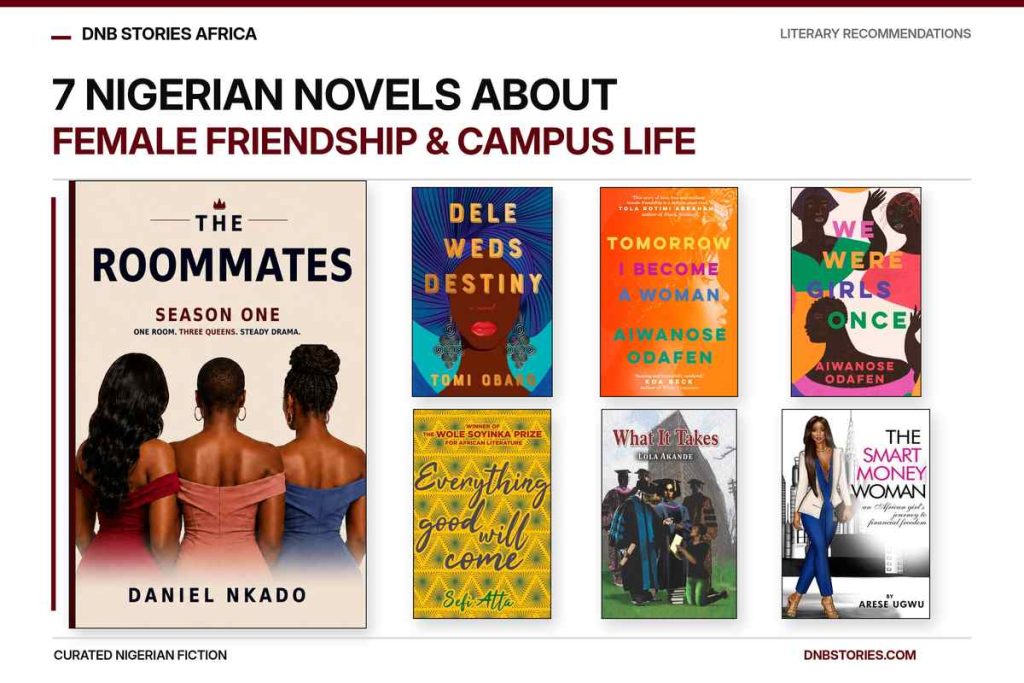
University life, complicated friendships, romantic relationships and the challenges of growing into adulthood have inspired some memorable stories in Nigerian literature.
For many young Nigerian women, university represents more than an opportunity to obtain a degree. It can also be a period of personal discovery, new relationships, financial uncertainty and growing independence from family expectations.
Friendships formed during these years can become an important source of emotional support. But they can also be tested by romantic rivalry, secrecy, personal ambition, class differences and difficult choices.
Nigerian fiction explores these experiences from different perspectives. Some novels place their characters directly within university environments, while others follow women whose friendships begin in childhood or during school and continue into adulthood.
If you are searching for Nigerian novels about female friendship and campus life, the following seven books offer different perspectives on sisterhood, university experiences, loyalty, relationships, personal identity and ambition.
The selection includes contemporary campus fiction, coming-of-age stories, literary drama and a fiction-based financial education book.
1. The Roommates — Daniel Nkado (2015; 2026 paperback edition)
Themes: Nigerian university life, female friendship, loyalty, romance, secrets and suspense.
One room. Three queens. Steady drama.
For Georgina, April and Loveth, university life was supposed to involve passing exams, managing romantic relationships, splitting rent and surviving the ordinary chaos of campus life.
But sharing accommodation soon becomes much more complicated.
In The Roommates, Daniel Nkado follows three young Nigerian women whose shared apartment becomes a place of friendship, gossip, arguments, laughter and unexpected sisterhood.
The three women have different personalities and approaches to life, but their circumstances bring them together.
Their relatively ordinary student experiences take a dangerous turn when April becomes involved with a wealthy stranger whose world is not nearly as glamorous as it initially appears.
Soon, the roommates find themselves navigating obsession, hidden motives, threatening situations and choices they never imagined they would have to make.
At the centre of the story is an increasingly difficult question: How far should friendship and loyalty go when protecting someone you care about also puts you in danger?
Why The Roommates belongs on this list
Unlike many campus stories that focus primarily on romance, The Roommates examines friendship through the pressures of shared living.
Living with other people requires compromise, emotional awareness and the ability to navigate differences.
But what happens when ordinary disagreements become less important than the need to protect one another?
The novel combines elements of Nigerian campus comedy, romantic drama and suspense to explore the changing relationships between three young women whose lives become unexpectedly intertwined.
It is particularly relevant to readers who enjoy stories about university accommodation, female loyalty, complicated friendships and dramatic events that disrupt student life.
Originally published as a serial on DNB Stories Africa in 2015, The Roommates received a paperback edition in 2026.
The story also continues in The Roommates: Season Two, where a new roommate introduces further complications.
Recommended for: Readers who enjoy Nigerian campus novels, female-centred friendship stories, university romance and suspense.
Where to read: Explore The Roommates and other Daniel Nkado books.
2. Dele Weds Destiny — Tomi Obaro (2022)
Themes: University friendship, marriage, class differences, motherhood and growing apart.
Can a friendship formed during university survive thirty years of different choices, experiences and personal disappointments?
That question sits at the centre of Tomi Obaro’s Dele Weds Destiny.
The novel follows three Nigerian women — Funmi, Enitan and Zainab — who first meet while attending university in northern Nigeria during the 1980s.
Although they come from different backgrounds and approach life differently, the women develop a friendship that becomes an important part of their identities.
Over the years, however, their lives take different directions.
Enitan moves to America, Funmi becomes wealthy and socially established, and Zainab builds a life shaped by different circumstances and responsibilities.
In 2015, the women reunite in Lagos for the wedding of Funmi’s daughter, Destiny.
Their reunion brings old memories, unresolved tensions and questions about the choices they have made.
Moving between their university years and the wedding celebrations three decades later, the novel reveals how love, social class, family expectations, marriage and motherhood have influenced their lives.
Why Dele Weds Destiny belongs on this list
Dele Weds Destiny is particularly relevant because it follows a friendship established during university into middle age.
It demonstrates how educational environments can bring people together even when their backgrounds and personalities are quite different.
The novel also examines the emotional work involved in maintaining friendships across decades.
Friendship does not necessarily mean that people continue to share the same interests, values or circumstances.
Sometimes, preserving a relationship requires acknowledging how much everyone involved has changed.
Recommended for: Readers interested in university friendships, Nigerian women’s fiction, marriage, motherhood and relationships that survive decades of change.
3. Tomorrow I Become a Woman — Aiwanose Odafen (2022)
Themes: Female friendship, university education, marriage, gender expectations and independence.
Aiwanose Odafen’s Tomorrow I Become a Woman follows Obianuju, a young Nigerian woman whose understanding of love, marriage and womanhood is shaped by the expectations surrounding her.
In 1978, Obianuju is completing her economics degree at the University of Lagos when she meets Chigozie, an older journalist who appears to offer the prospect of a respectable marriage.
Their relationship begins with considerable promise.
But as Obianuju enters married life, she discovers that the expectations attached to becoming a wife can conflict with her personal aspirations and emotional needs.
Alongside her experiences are the lives of her friends, Adaugo and Chinelo.
Through their relationships, the novel explores the different ways women negotiate marriage, friendship, social expectations and personal independence.
The story unfolds against a changing Nigerian society, where political and social pressures influence private lives.
Why Tomorrow I Become a Woman belongs on this list
The novel connects university education with the wider expectations placed on women.
Education can expand a person’s opportunities and understanding of the world, but it does not automatically remove the pressures created by family, marriage or social convention.
Odafen’s story examines the tension between personal ambition and the roles women are encouraged to occupy.
Its portrayal of friendship also offers an important perspective on how women support one another while navigating difficult circumstances.
Recommended for: Readers interested in Nigerian coming-of-age novels, female friendship, marriage, university experiences and women’s independence.
4. We Were Girls Once — Aiwanose Odafen (2024)
Themes: Female friendship, intergenerational relationships, trauma, ambition and reconciliation.
In We Were Girls Once, Aiwanose Odafen examines the lives of three Nigerian women — Ego, Zina and Eriife — whose friendship is connected to a bond established between their grandmothers many decades earlier.
Growing up in a changing Nigerian society, the three women encounter circumstances that profoundly influence their lives.
A traumatic event disrupts their relationship, and adulthood eventually takes them in different directions.
Ego becomes a successful lawyer in London, Zina pursues acting, and Eriife moves from practising medicine into a life shaped by political ambition and influence.
Despite their different experiences, their shared history continues to connect them.
When their lives become intertwined again, they must confront the past and the emotional consequences of experiences that have remained unresolved.
Why We Were Girls Once belongs on this list
The novel examines female friendship as a relationship that can endure even after serious disruption.
It does not treat friendship as a guarantee of permanent agreement, emotional safety or shared values.
Instead, it explores how personal experiences, trauma, ambition and changing social circumstances can complicate relationships that began with affection and trust.
For readers interested in the psychological and emotional dimensions of female friendship, We Were Girls Once offers a perspective extending beyond the familiar school or university setting.
Recommended for: Readers interested in complex female friendships, intergenerational relationships, psychological realism and stories about reconciliation.
5. Everything Good Will Come — Sefi Atta (2005)
Themes: Childhood friendship, womanhood, gender inequality, family expectations and personal freedom.
Sefi Atta’s Everything Good Will Come follows Enitan Taiwo, a young Nigerian girl growing up in the years following the Nigerian Civil War.
One of the most important relationships in Enitan’s early life is her friendship with Sheri Bakare, a girl whose personality and circumstances are quite different from her own.
As the two girls grow older, their lives become increasingly shaped by the expectations and restrictions surrounding Nigerian womanhood.
Through Enitan’s experiences, the novel examines family relationships, romantic choices, political developments and the struggle for personal independence.
Her friendship with Sheri provides an important perspective on the differences between women’s individual circumstances.
The two women do not always approach life in the same way, and their experiences reveal how personal choices can be constrained by social realities.
Why Everything Good Will Come belongs on this list
Although it is not primarily a university-campus novel, Everything Good Will Come offers a strong exploration of female friendship and personal development.
Its central relationship shows how two people can remain important to one another while responding differently to the expectations of their society.
The novel is particularly relevant to readers interested in how women’s lives are shaped by social class, family environments, politics and gender.
It also raises questions about what freedom means when the choices available to people are unequally distributed.
Recommended for: Readers who enjoy Nigerian literary fiction, childhood friendships, coming-of-age stories and novels examining women’s autonomy.
6. What It Takes — Lola Akande (2016)
Themes: Nigerian university life, academic ambition, institutional power, female support and resilience.
Not every novel about university life focuses on undergraduate romance, friendships or student accommodation.
Lola Akande’s What It Takes explores a different dimension of Nigerian higher education.
The story follows Funto Oyewole, an ambitious woman pursuing a doctoral degree within the Nigerian university system.
Funto begins her academic journey with enthusiasm, commitment and a determination to succeed through hard work.
But as she progresses, she encounters institutional obstacles that threaten both her academic ambitions and her personal wellbeing.
Her experiences expose problems involving favouritism, sexual harassment, academic power imbalances, ethnic prejudice and the abuse of authority.
As frustrations accumulate, Funto begins to question the relationship between personal effort, institutional recognition and the opportunities supposedly available through education.
Friendship also becomes important to her journey, particularly through the financial and emotional support offered by Folake.
Why What It Takes belongs on this list
What It Takes broadens the meaning of campus fiction.
University environments are not only places where students build friendships or pursue romantic relationships. They are also institutions with rules, hierarchies and unequal distributions of power.
Through Funto’s experiences, Akande examines how institutional behaviour can influence a person’s ambitions, emotional wellbeing and professional future.
The novel also demonstrates how supportive relationships can become important when individuals encounter institutional obstacles they cannot easily overcome alone.
It is a particularly relevant recommendation for readers who want Nigerian campus fiction exploring the less glamorous realities of academic life.
Recommended for: Readers interested in Nigerian university fiction, postgraduate education, academic politics, institutional inequality and women’s professional ambitions.
7. The Smart Money Woman — Arese Ugwu (2016)
Themes: Female friendship, careers, financial independence, love and social expectations.
What happens when a young woman appears to have everything under control but is quietly struggling to maintain the lifestyle everyone admires?
That is the situation facing Zuri, the central character in Arese Ugwu’s The Smart Money Woman.
Zuri is a successful young Nigerian professional with a good job, an attractive apartment and a lifestyle that suggests financial comfort.
But behind the appearance of success, she is struggling with debt, spending habits and the consequences of financial decisions she has not fully considered.
Her journey towards financial independence unfolds alongside the experiences of her four close friends: Tami, Lara, Adesuwa and Ladun.
Each woman represents a different set of experiences involving work, money, relationships, family expectations and personal ambition.
As they navigate their individual challenges, their friendships provide opportunities for reflection, advice and personal growth.
The Smart Money Woman is a hybrid of fictional storytelling and practical financial education. Through Zuri and her friends, Ugwu explores financial decisions while introducing lessons about budgeting, debt, spending, investing and wealth creation.
Why The Smart Money Woman belongs on this list
Although The Smart Money Woman is not set primarily within a university, female friendship is central to its narrative.
The book explores how a group of women with different careers, personalities and personal circumstances can influence one another’s understanding of success.
It also examines how friendships can become spaces for discussing problems that people may find difficult to acknowledge publicly.
In a society where financial success is often judged through visible lifestyle choices, the story raises questions about the relationship between appearance, personal independence and genuine financial stability.
For readers who enjoy stories about groups of female friends navigating adulthood together, The Smart Money Woman offers a different perspective on sisterhood.
Recommended for: Readers interested in contemporary Nigerian women’s fiction, female friendship, careers, financial independence and personal development.
Why Female Friendship Matters in Nigerian Fiction
Female friendship can serve different functions within a story.
Sometimes, it provides emotional security and a sense of belonging. In other circumstances, it becomes a relationship through which characters encounter differences in class, personal values, ambition or social expectations.
Friendship can also expose tensions between loyalty and individual responsibility.
A person may care deeply about a friend while disagreeing with their decisions. Supporting someone does not always mean approving of their behaviour, and loyalty can become complicated when protecting one person creates risks for others.
These tensions are especially visible in stories set within educational environments.
University life often requires young people to negotiate relationships outside the direct supervision of their families.
Students may encounter people from different cultural, economic and religious backgrounds. They may also experience financial pressure, relationship conflicts, competition and the challenge of establishing personal boundaries.
In The Roommates, friendship becomes intertwined with shared accommodation and the need to respond to danger.
In Dele Weds Destiny, a relationship established during university continues to influence three women decades later.
Meanwhile, Tomorrow I Become a Woman examines how education and friendship intersect with expectations surrounding marriage and womanhood.
Together, these stories illustrate why female friendship remains a compelling subject in Nigerian literature: it provides a way to explore not only the relationships between women, but also the social conditions shaping their lives.
Which Nigerian Novel Should You Read First?
The best starting point depends on the kind of story you enjoy.
| If you enjoy… | Consider reading… |
|---|---|
| Campus drama, roommates, romance and suspense | The Roommates |
| University friendships that continue into adulthood | Dele Weds Destiny |
| Friendship, marriage and gender expectations | Tomorrow I Become a Woman |
| Complicated friendships, trauma and reconciliation | We Were Girls Once |
| Coming-of-age fiction and female independence | Everything Good Will Come |
| University politics and academic ambition | What It Takes |
| Female friendships, careers and financial independence | The Smart Money Woman |
These books are not interchangeable.
Some focus on friendships women establish during education. Others examine university institutions, financial independence, marriage or relationships that change across different stages of adulthood.
What connects them is their attention to the relationships women form and the social conditions influencing their choices.
Frequently Asked Questions
Nigerian novels about female friendship include The Roommates by Daniel Nkado, Dele Weds Destiny by Tomi Obaro, Everything Good Will Come by Sefi Atta and We Were Girls Once by Aiwanose Odafen. The Smart Money Woman by Arese Ugwu also explores female friendship through a fictional narrative combined with financial education.
The Roommates by Daniel Nkado focuses on university students sharing accommodation. Dele Weds Destiny explores a friendship formed during university. What It Takes by Lola Akande examines postgraduate academic life within a Nigerian university, while Tomorrow I Become a Woman begins during its protagonist’s final months at university.
Yes. Daniel Nkado’s The Roommates follows Georgina, April and Loveth as they navigate university life, shared accommodation, friendship, romance and dangerous situations that test their loyalty.
Dele Weds Destiny by Tomi Obaro follows three friends who reunite thirty years after university. Everything Good Will Come by Sefi Atta traces a friendship from girlhood into adulthood, while We Were Girls Once by Aiwanose Odafen explores friendships shaped by shared history, trauma and separation.
No. Although romantic relationships feature in many campus stories, Nigerian university fiction can also examine friendship, class differences, institutional power, academic pressures, financial insecurity, personal identity and the challenges of young adulthood.
Further Reading and Book References
For additional information about the books featured in this article, consult the following author, publisher and bibliographic resources.
- Nkado, Daniel. The Roommates: Season One. Originally serialised in 2015; paperback edition published in 2026. Daniel Nkado Books.
- Obaro, Tomi. Dele Weds Destiny (2022). Penguin Random House.
- Odafen, Aiwanose. Tomorrow I Become a Woman (2022). Ouida Books.
- Odafen, Aiwanose. We Were Girls Once (2024). Ouida Books.
- Atta, Sefi. Everything Good Will Come (2005). Sefi Atta’s official website.
- Akande, Lola. What It Takes (2016).
- Ugwu, Arese. The Smart Money Woman (2016). Google Books: Publication Information.