
Part 1: What Is A Chosen Family?
Chosen family—also called found family or family of choice—refers to non‑biological relationships that queer people intentionally build for love, support, safety, and belonging. For many LGBTQ+ people, especially those facing rejection, silence, or conditional love from their family of origin, chosen family can mean the difference between surviving and truly living.
Love, care, safety, affirmation, and belonging are core emotional needs for queer people. For Black LGBTQ+ people—who often navigate ongoing racial prejudice, objectification, exclusion, and, in some contexts, targeted violence—the need for chosen family can run even deeper. In this reality, chosen family moves beyond “cute community vibes” and functions as essential care infrastructure—emotional, practical, and sometimes life‑saving.
The Psychology of Trust in Black Queer Life
For many Black queer people, trust rarely comes naturally. It often begins as a survival calculation, shaped by lived experiences within and outside queer spaces. Gossip, shaming, backbiting, and other forms of harm teach many of us to approach trust as a deliberate decision about safety—a careful judgement of who can hold our privacy, dignity, and vulnerability without weaponising them under pressure.
This guide explores the central role trust plays in Black queer life and how it shapes the formation of Black queer chosen families across different environments—from relatively safer cities like London and New York to high‑risk contexts such as Nigeria and Ghana, where criminalisation and stigma push relationships into secrecy and raise the stakes of trust and care[2].
It introduces Daniel Nkado’s Trust Onion Model (T-O-M) as a practical framework for building chosen family by evaluating trust and granting access with discernment rather than relying solely on familiarity or shared identity.
Why Chosen Family Matters For Black LGBTQ+ People
Chosen family does not replace a queer person’s ‘real family’—it is a real family, built through consent, care, and sustained responsibility. Whether formed openly in London or quietly in Accra, one truth holds: love becomes family when it shows up consistently, especially when the world treats queer people as unworthy of that level of care.
For Black queer people in particular, chosen family can become life‑sustaining sanctuaries—offering LGBTQ+ affirmation and cultural familiarity, without the constant work of negotiating identity.
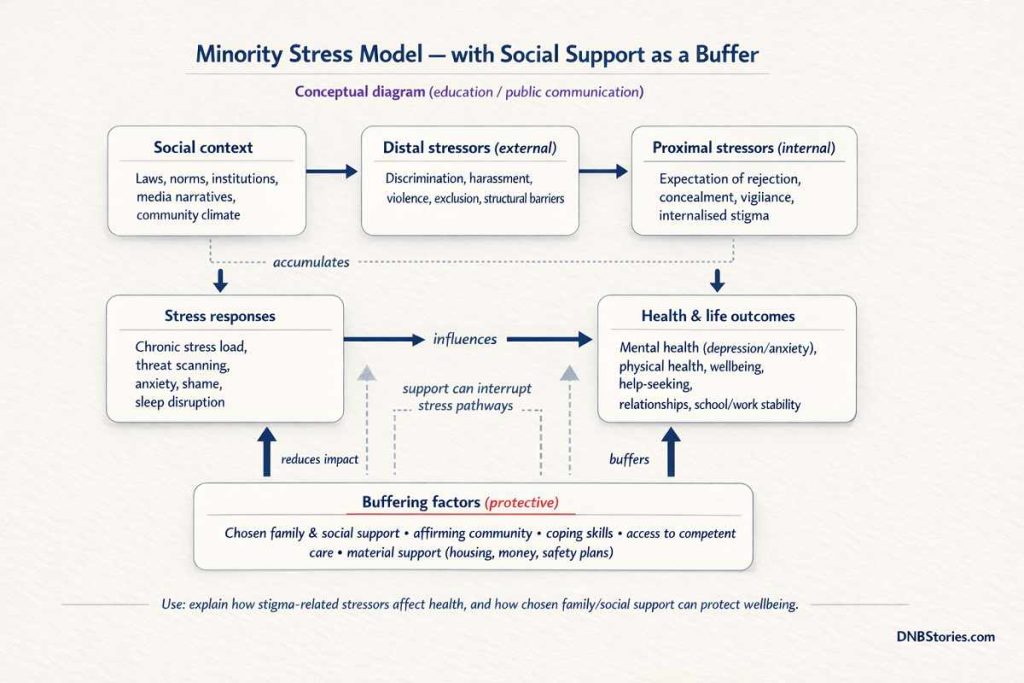
Chosen Family Reduces Stress and Risk for Black Gay Men
Three well‑established research findings show that chosen family plays a critical role in reducing stress, improving safety, and building emotional resilience for Black gay men.
a. Stress Buffer
Chosen family buffers minority stress—chronic stress from stigma, discrimination, identity concealment, and safety concerns—by creating spaces where identity does not need to be hidden, defended, or negotiated. This reduces the cumulative stress burden that undermines queer people’s mental and physical health over time (Meyer, 2003)[6].
b. Practical Support and Stability
Chosen family steps in when biological family, faith communities, or institutions respond with rejection or sanction, offering stable emotional care and practical support that protect wellbeing and sustain resilience (Frost et al., 2016)[4].
c. Reduces Isolation
Finally, chosen family reduces isolation and depression risk among Black sexual minority men by providing a reliable connection when traditional support networks run thin or fail (Dawes et al., 2024)[2].
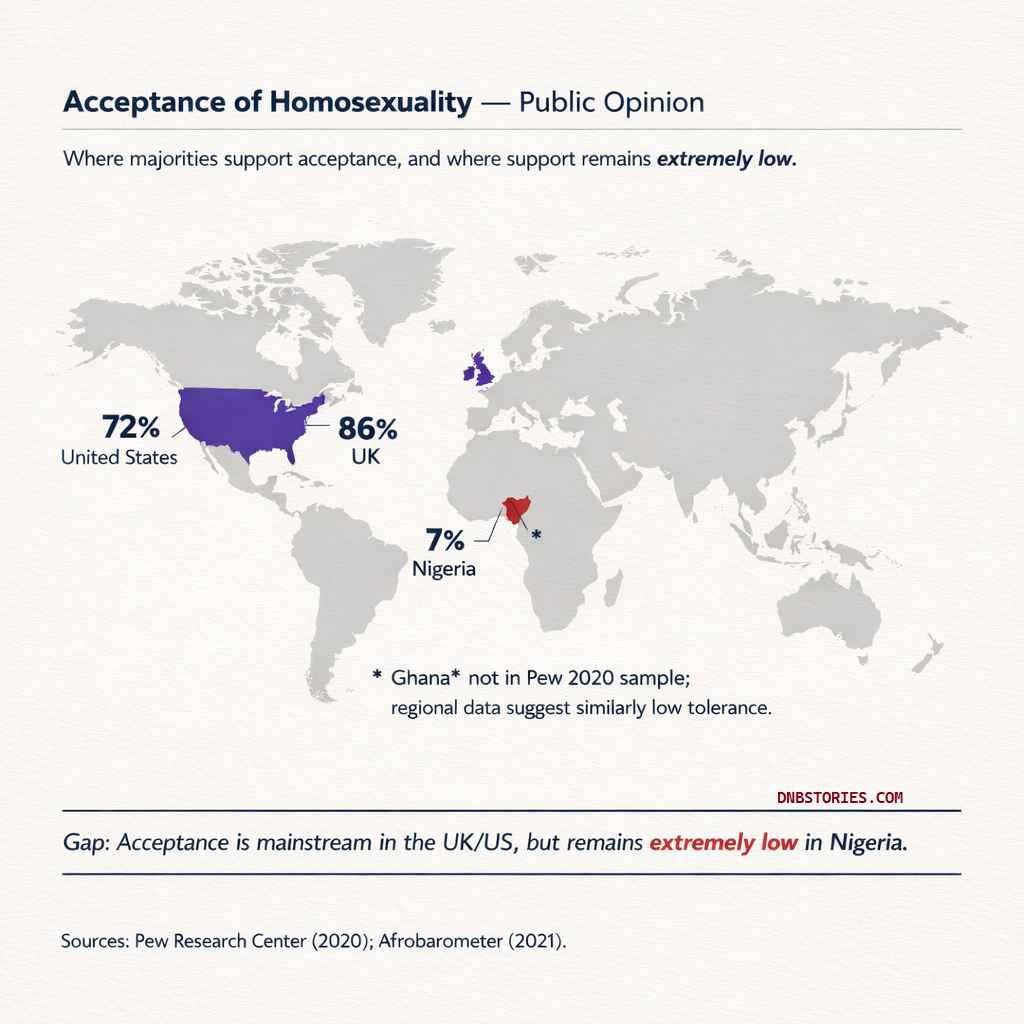
Part 2: The Geography of Queer Trust—London to Lagos
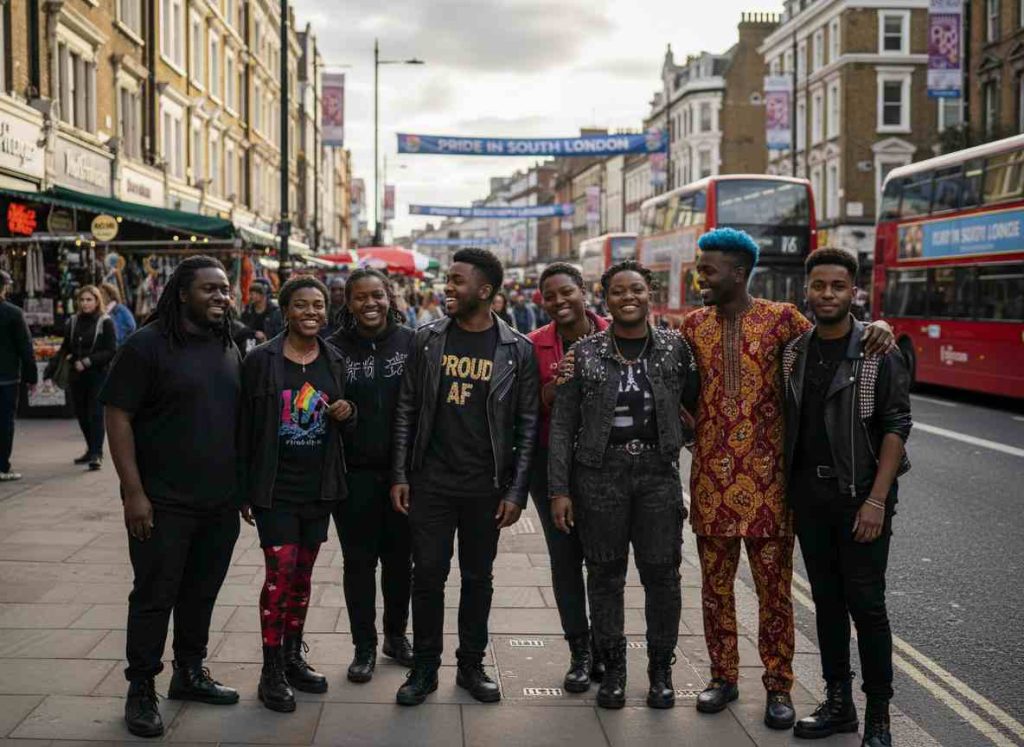
The way Black queer chosen families form depends heavily on their environment. Public acceptance of homosexuality remains high in the UK[12] and the US, allowing chosen families in cities like London and New York to form openly[13]. However, even in these queer havens, Black queer individuals still battle racism and fetishisation within mainstream LGBTQ+ spaces, and the reality that legal and medical systems default to biological relatives during a crisis[9]. Here, chosen family becomes a survival infrastructure where Blackness and queerness can coexist without negotiation, often solidified through legal proxies and cohabitation agreements.
Conversely, in high-risk settings like Nigeria and Ghana—where state laws criminalise same-sex relationships and societal stigma remains intense—chosen family primarily operates as small, carefully vetted circles. These are high-trust survival networks where people pool emergency funds, share discreet housing, and coordinate crisis responses.
Across both contexts, the rule remains the same: deep trust, proven accountability, and repair capacity must come before high access[6].
New York City Ballroom Culture
The ballroom house system represents a longstanding model of chosen family in New York City, where “mothers” and “fathers” mentor and care for “children.” Emerging from the legacy of pioneers like Crystal LaBeija, these houses developed in response to racism, transphobia, and homelessness, offering structure, support, and belonging where traditional systems failed.

The Universal Need for a Trust Framework
Whether navigating the open streets of London or the high-risk, heavily policed environments of Accra or Lagos, one universal truth remains: building a chosen family requires a reliable way to measure trust and relational safety. Deep trust, proven accountability, and the capacity to repair harm must come before high access. Relying merely on shared identity, mutual trauma, chemistry, or time spent together is not enough—and can sometimes be dangerous.
This is where Daniel Nkado’s Trust Onion Model (T-O-M) comes in.

Part 3: The Trust Onion Model—A Practical Trust Roadmap
The Trust Onion Model is a practical, four-layer framework for assessing trust, access, and relational safety in one-to-one relationships. It separates mutual feelings and shared time from earned access.
The core philosophy of the Trust Onion Model is straightforward: time doesn’t create trust—repair competence does. A relationship can span years and still be unsafe.
Ruptures—any behaviour or dynamic that causes a negative impact—are inevitable in human relationships. T-O-M doesn’t demand a rupture-free connection. Instead, it treats “rupture-and-repair” as the engine of trust: when people repair well, access deepens; when people avoid, minimise, or mishandle repair, access stalls. This makes T-O-M a highly practical roadmap for building chosen family without confusing attraction or mutuality for safety.
C-A-F-I: The 4 Layers of the Trust Onion Model
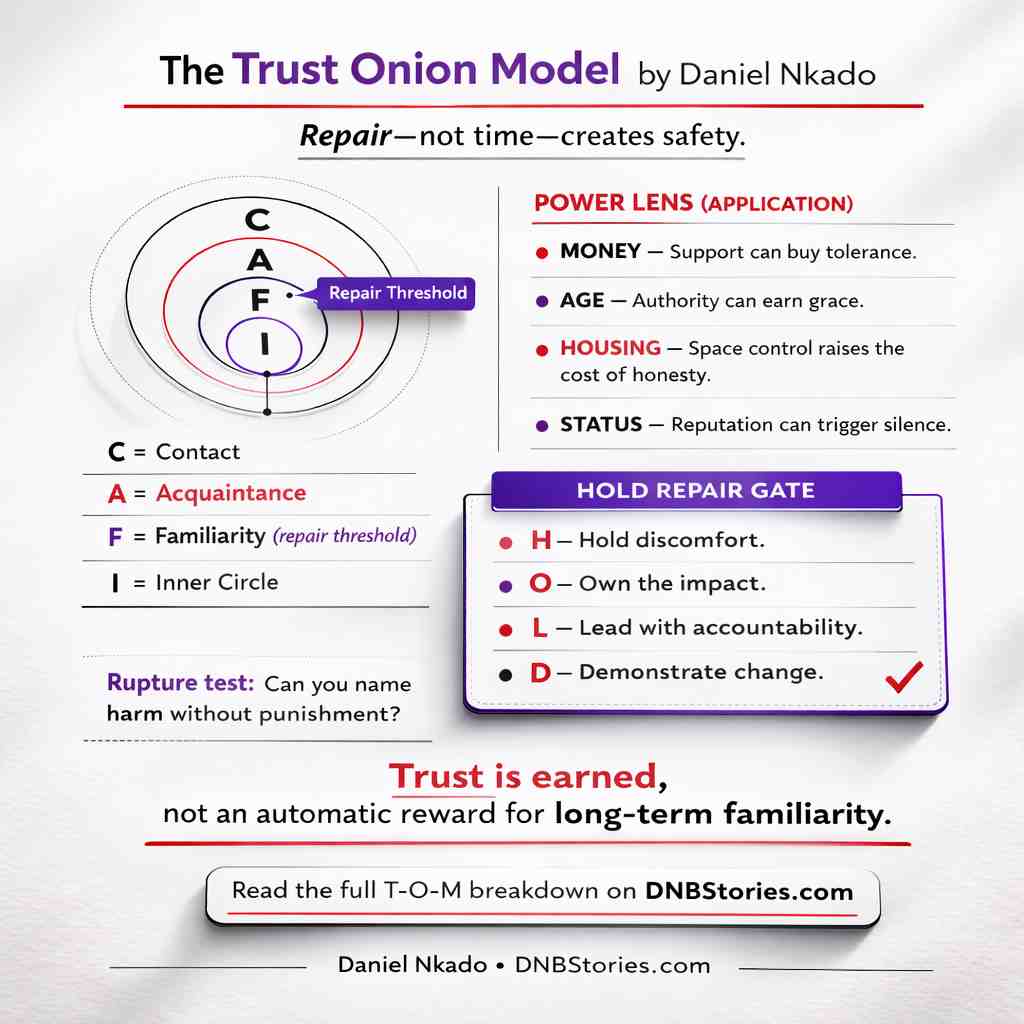
C‑A‑F‑I describes how trust earns access over time by moving through four distinct layers: Contact, Acquaintance, Familiarity, and Inner Circle. Each layer has a specific behavioural threshold that must be met before deeper access is granted—basic honesty and respect at Contact, consistency at Acquaintance, rupture‑and‑repair at Familiarity, and sustained responsibility at the Inner Circle.
Core principles of the Trust Onion Model
a. Calculate trust in layers. Grant access based on behaviour, not time.
b. Treat access as restricted. Shared identity or proximity doesn’t automatically entitle anyone to your access.
c. Use repair as the gate. Repair competence decides whether deeper access is safe.
d. Weigh patterns over promises. Repeated behaviour matters more than stated intent.
Repair Over Intent as a Measure of Trust
The Trust Onion Model treats repair competence as the clearest measure of trust for two reasons. First, in high-risk relational contexts—such as relationships between Black men—outcomes matter more than explanations. Intent, emotion, and morality stay internal and hard to verify, while repair shows observable behavioural patterns. Second, repair behaviour signals value: people may understand repair in theory, but they usually reserve real repair for the relationships they truly prioritise in practice.
Trust Onion Layers: Contact, Acquaintance, Familiarity & Inner Circle
Rather than assuming closeness through time or feeling, the Trust Onion Model treats access as restricted and earned. It separates feeling close from giving access, asking users to increase access only when someone proves they can handle it through repair competence—acknowledging harm, taking accountability, and demonstrating change. By making repair the gate to deeper intimacy, the model supports chosen family safely and intentionally, without mistaking warmth or intensity for relational safety.
Layer 1: Contact
Most relationships begin at first contact. Access remains social and situational, so disclosure stays light while you observe behaviour. Look for baseline respect, honesty, and everyday kindness—authenticity without performance. At this stage, you owe no intimacy, vulnerability, emotional labour, or loyalty. First contact prioritises observation with minimal or zero investment.
Layer 2: Acquaintance
At this layer, consistency becomes evidence. You stop asking “Are they polite?” and start asking “How reliable are they?” Track follow‑through, alignment between words and actions, and respect that holds across moods, settings, and incentives. Trust remains provisional. Familiarity still does not justify deeper access.
Layer 3: Familiarity —The Repair Threshold
This layer is the hinge. Familiarity does not guarantee safety—but it marks the point where rupture and repair shift from passive information to active decision‑makers. The core question becomes: What happens when a rupture event is named? In the Trust Onion Model, naming rupture is not an attack—it is an invitation to repair. What follows determines whether the relationship stabilises, deepens, or closes.
To move into the Inner Circle, an individual must demonstrate the ability to repair a rupture without allowing it to escalate into harm. This threshold is known as the HOLD Repair Gate.
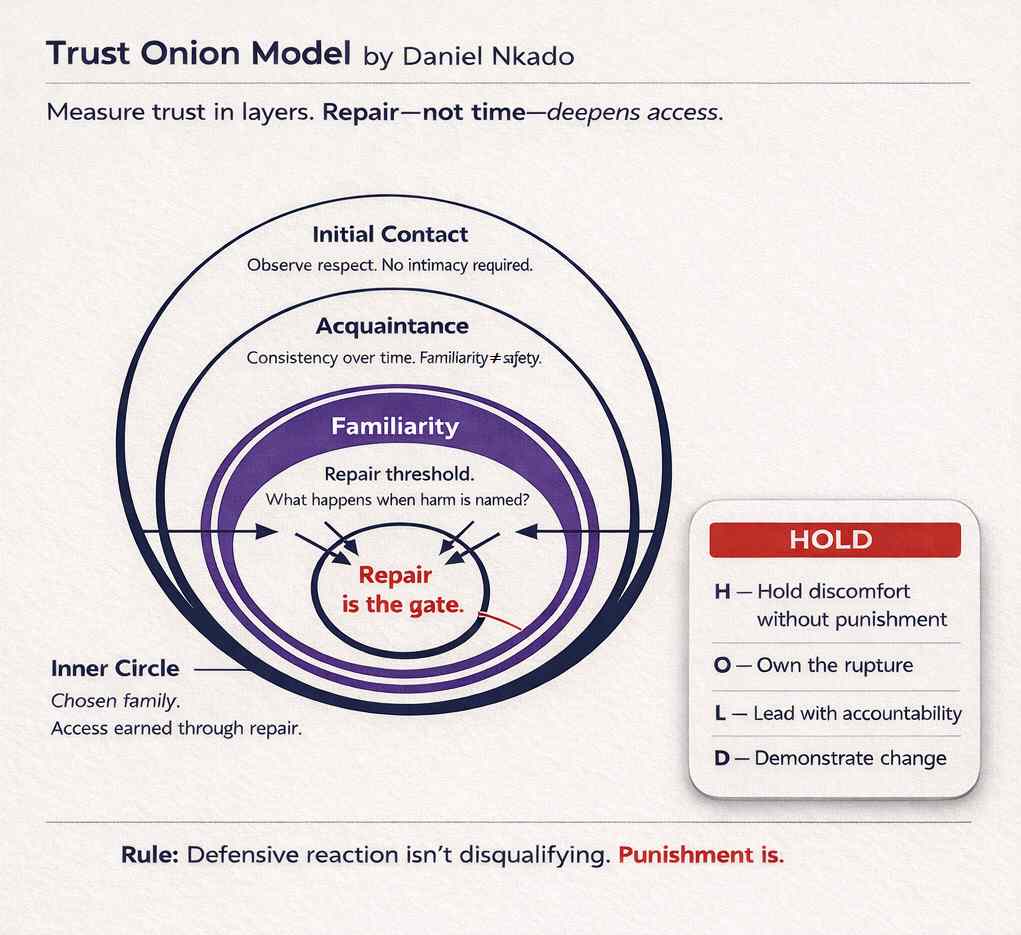
The HOLD Repair Gate: Why Time Doesn’t Equal Trust
The Trust Onion Model recognises that trust is not earned through time but through repair. A long-term connection does not guarantee relational safety.
The HOLD Repair Gate sets the behavioural threshold for moving beyond Familiarity. HOLD doesn’t demand perfection or rupture‑free connection. It measures how someone treats you when you name harm or call out negative impact. To pass the HOLD Repair Gate, a person must demonstrate four behaviours:
H—Hold discomfort: Hear impact without defensiveness, minimisation, or punishment.
O—Own the impact: Name their role without blame‑shifting or intent‑washing.
L—Lead with accountability: Take responsibility and commit to specific change.
D—Demonstrate change: Show sustained, observable adjustment over time.
Failing HOLD doesn’t make someone “bad.” It means deeper access is unsafe right now. The relationship may stabilise, stall, or close—but it should not move inward. In the Trust Onion Model, repair is not an apology—it is demonstrated responsibility that reveals both how someone handles being held accountable and how much they respect and value you.
Trust Onion: Ruptures, Repair, Return, and Downgrading
Ruptures are behaviours or dynamics that create negative impact—disrespect, misinformation, inconsistency, boundary violations, unkept promises, or social power plays. They can occur at any layer. Early on, ruptures function as information, revealing how someone behaves with limited access.
Repair becomes decisive at Familiarity, where the stakes rise because the person now holds meaningful access. In the Trust Onion Model, repair goes beyond a simple apology. It requires HOLD: holding discomfort, owning impact, leading with accountability, and demonstrating sustained change.
Return matters when someone reacts defensively at the first raising of impact. Initial reactivity is not an automatic failure; progression pauses while the model observes whether the person returns to accountability and care. When defensiveness becomes a second rupture, both the original impact and the reaction must be repaired using HOLD.
Defensiveness becomes a second rupture when it creates additional harm instead of repair:
- Invalidates impact: “You’re too sensitive,” “That’s not what I meant.”
- Shifts blame or intent‑washes: “I was stressed,” “You misunderstood.”
- Escalates power: “Now you’ve upset me,” withdrawal, anger, stonewalling.
- Punishes honesty: mockery, silence, exclusion, or social consequences.
Downgrading is a safety response, not punishment. When there is repeated serious harm or repeated repair failures, access is reduced to match what the person has proven to be safe to handle. Depending on severity, the relationship may stabilise, move outward to a lower‑access layer, or close entirely.
Layer 4: Inner Circle —e.g., Chosen Family
Only relationships that consistently pass the repair threshold belong here. Access runs high across emotional, material, and safety‑related domains. Proven repair capacity—not closeness—defines this layer. When both people can return to safety through accountability and change, rupture does not automatically become harm. Chosen family becomes possible here without constant self‑protection.
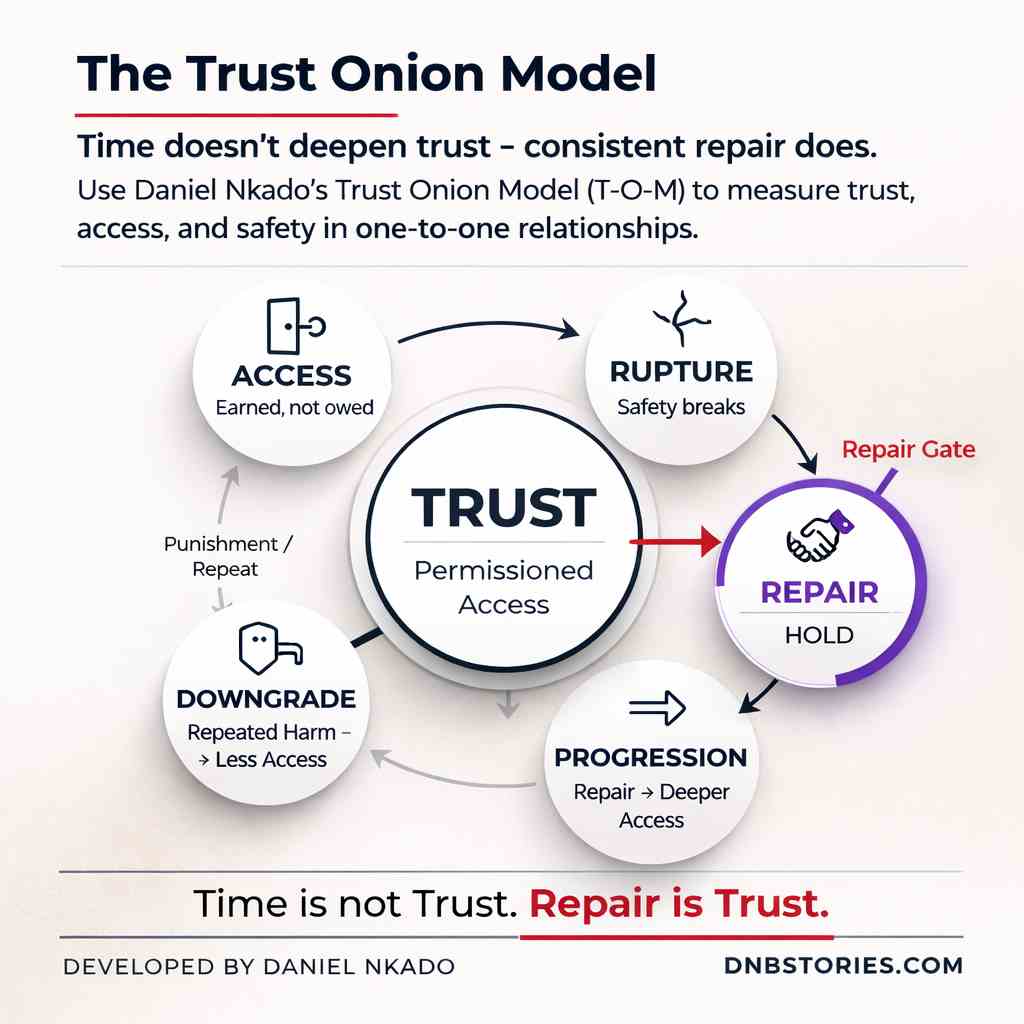
Trust Onion Logic: Repair—not Time—Creates Safety
Daniel Nkado’s Trust Onion Model (T‑O‑M) draws on Social Penetration Theory (Altman & Taylor, 1973)[1], which uses an onion metaphor to describe how relationships develop through layered self‑disclosure over time. Where SPT centres the depth and breadth of disclosure, T‑O‑M reframes trust as permissioned access earned through repair competence—particularly in high‑risk contexts where disclosure can increase vulnerability rather than signal acceptance.
This distinction is critical in Black queer life because being known does not automatically mean being safe, and trust cannot be reduced to intimacy or longevity.
Trust Onion Model: Usage, scope, and limitations
Usage:
Use the Trust Onion Model (T‑O‑M) to evaluate trust and manage permissioned access in relationships, including when building chosen family. It separates what you feel from what someone has demonstrated. T‑O‑M requires consistent behaviour and proven repair capacity (HOLD) before access deepens. Unrepaired rupture halts progression. Serious harm or repeated repair failure justifies downgrading access.
Scope:
Apply the Trust Onion Model to friendships, dating, community ties, and mutual‑aid networks. It works in both supportive and high‑risk settings because it does not treat shared identity or visibility as proof of safety. The focus is practical: who gets your disclosure, home keys, resources, network, and crisis contact.
Limitations:
T‑O‑M does not diagnose people as “good” or “bad,” and it cannot predict outcomes. It should not replace professional support or other trust frameworks that already work for you. The model also cannot resolve structural pressures—racism, homophobia, poverty, immigration stress—that shape risk. Harm can unfold slowly, accountability can be performed, and overlapping communities can make clean exits difficult. Use the Trust Onion as a safety tool to guide access, not a moral scorecard or a way to rank people.
T-O-M and The Reality of Power in Gay Relationships
In gay relationships, including chosen-family dynamics, power can quietly shape trust. When money, age, housing control, or social status enter the picture, people can override accountability—or the demand for it—or forgo naming rupture entirely. Those with resources, authority, space, or influence may maintain Inner Circle access even after failing repair, while others absorb the impact by adapting, staying silent, or “keeping peace.” The Trust Onion Model recommends tracking rupture and repair behaviour over time to spot patterns. Test whether apologies produce real change in behaviour or subtle retaliation, and notice who consistently carries the emotional labour. Separate care from what someone gets to hold, and use graduated access (quiet downgrades) to protect safety.
The core message is simple: repair creates safety only when no one uses dependency, silence, or retaliation as leverage.
Conclusion
The Trust Onion Model rests on one core principle: time does not deepen trust—consistent repair does. A relationship can last for years and still hold fragile trust. T-O-M doesn’t use visibility, chemistry, or shared identity to assess safety. Instead, it tracks observable behaviour—how someone handles power, accountability, and access under pressure. The model doesn’t advise cutting people off by default; it clarifies who gets closer, and why. It protects safety, dignity, and sustainability for building Black queer relationships and chosen family units that can hold when things get hard.
FAQ 1: General Questions
Chosen family members use whatever kin language fits the bond and feels safe—there’s no single standard. Many use terms like fam, sibling/sib, sis/bro, cousin/cuz, or auntie/uncle, and some use role-based titles like big sis for mentorship figures. The key is consent and context. Agree on names that feel affirming, and keep a more neutral option for public or high-risk settings when needed.
There’s no fixed “right” size, but most chosen families work best with a small core and a wider support circle. A practical range is 2–5 people in the inner circle (high-stakes access, crisis reliability) and 6–15 people in a wider circle (community, care, lower access). In Trust Onion terms, keep the core for people who consistently pass the repair threshold, and let everyone else sit in outer layers.
The Trust Onion Model (T-O-M) is a four-layer framework developed by Daniel Nkado to assess trust, access, and relational safety in one-to-one relationships. It treats trust as a restricted access that expands through consistent, observable behaviour—not time, intention, or closeness.
No, though they complement each other. T-O-M is a micro-level framework for assessing trust and safety in one-on-one relationships. Daniel Nkado’s Bridge Model is a macro-level framework focused on community-wide trust, collective repair in public spaces, and how groups interrupt harm. T-O-M protects your personal access; the Bridge Model shapes collective queer culture.
Because repair behaviour provides clear, observable proof of how someone handles power, accountability, and access under pressure.
FAQ 2: The Trust Onion Model in Practice
You don’t necessarily need to explain the model to the other person. T-O-M is primarily an internal framework for you to govern your own boundaries and assess how much access you grant. However, if you are moving into the Familiarity or Inner Circle layers, you can introduce the concept of repair naturally by saying something like, “For me to feel safe and close in a relationship, I need to know we can talk about hard things and repair them without it turning into a fight. How do you usually handle conflict?”
Failing the HOLD gate doesn’t mean they are a bad person, but it does mean they aren’t currently safe for Inner Circle access. The healthiest step is a “downgrade.” You don’t have to cut them off entirely, but you should move them back to the Acquaintance or Contact layer. This means restricting their access to your deepest vulnerabilities, crisis management, and highest emotional labour until they demonstrate consistent repair competence.
Yes. The Trust Onion Model uses layers rather than rigid stages because trust is dynamic and reversible. If a person takes accountability, does the work to change their behaviour, and consistently passes the HOLD gate over time, they can slowly earn back deeper access. Behaviour and proven change—not just a good apology—are the keys to moving back inward.
FAQ 3: T-O-M as a Safety Framework
T-O-M focuses on impact and safety rather than policing exact communication styles. Someone might need time to process before they can “Own the impact” (the ‘O’ in HOLD), or they might need to communicate their accountability in a non-verbal or written way. The model allows for grace and different processing speeds. However, trauma or neurodivergence does not negate the need for repair. If someone’s trauma responses consistently prevent repair and cause you harm, they still cannot safely occupy your Inner Circle, regardless of their intent.
There is no magic number. In high-risk contexts (like Nigeria or Ghana), an Inner Circle might be as few as one or two heavily vetted people for safety reasons. In lower-risk contexts, it might be slightly larger. A practical benchmark is 2–5 people in your Inner Circle (high-stakes access, crisis support) and a wider ring of 6–15 people in the Familiarity or Acquaintance layers for community and social care.
References
- Altman, I. and Taylor, D.A. (1973). Social Penetration: The Development of Interpersonal Relationships. Holt, Rinehart, & Winston, New York, 459. https://psycnet.apa.org/record/1973-28661-000
- Dawes, H. C., Eden, T. M., Hall, W. J., Srivastava, A., Williams, D. Y., & Matthews, D. D. (2024). Which types of social support matter for Black sexual minority men coping with internalised homophobia? Findings from a mediation analysis. Frontiers in Psychology, 15, Article 1235920. https://doi.org/10.3389/fpsyg.2024.1235920
- Essima, L. O. (2021, July 1). Ghanaians are united and hospitable but intolerant toward same-sex relationships (Afrobarometer Dispatch No. 461). Afrobarometer. https://www.afrobarometer.org/publication/ad461-ghanaians-are-united-and-hospitable-intolerant-toward-same-sex-relationships/
- Frost, D. M., Meyer, I. H., & Schwartz, S. (2016). Social support networks among diverse sexual minority populations. American Journal of Orthopsychiatry, 86(1), 91–102. https://doi.org/10.1037/ort0000117
- Human Dignity Trust. (2026, February 20). Ghana. https://www.humandignitytrust.org/country-profile/ghana/
- Human Dignity Trust. (2026, February 19). Nigeria. https://www.humandignitytrust.org/country-profile/nigeria/
- Meyer, I. H. (2003). Prejudice, social stress, and mental health in lesbian, gay, and bisexual populations: Conceptual issues and research evidence. Psychological Bulletin, 129(5), 674–697. https://doi.org/10.1037/0033-2909.129.5.674
- Patients Association. (2026, February 6). Next of kin. https://www.patients-association.org.uk/next-of-kin
- Pew Research Center. (2020, June 25). The global divide on homosexuality persists. https://www.pewresearch.org/global/2020/06/25/global-divide-on-homosexuality-persists/
- The Initiative for Equal Rights. (n.d.). The Initiative for Equal Rights (TIERs). Retrieved February 25, 2026, from https://www.theinitiativeforequalrights.org/
- UK Government. (n.d.). Make, register or end a lasting power of attorney. GOV.UK. Retrieved February 25, 2026, from https://www.gov.uk/power-of-attorney
- UK Parliament. (2010). Equality Act 2010 (c. 15). Legislation.gov.uk. https://www.legislation.gov.uk/ukpga/2010/15/contents
- UK Parliament. (2013). Marriage (Same Sex Couples) Act 2013 (c. 30). Legislation.gov.uk. https://www.legislation.gov.uk/ukpga/2013/30/contents/enacted