
When Conflict Avoids Clarity
Some conflicts revolve around truth, while others make the truth costly.
This distinction sits at the centre of the Masculinity Conflict Framework (MCF). A disagreement may arise from confusion, disappointment, hurt, or anger. In MCF, cause carries less weight than what the conflict eventually becomes. The first real test comes at the Clarity stage.
Repair-capable individuals are usually able to explain what they feel, identify their grievance, or at least tolerate honest engagement with the issue. Some may not be ready to discuss the conflict immediately, and that is not, by itself, a problem. As long as they do not respond to the Clarity move with punishment, repair remains possible.
The conflict, however, changes category when punishment appears. Once a genuine attempt at gaining Clarity or sincere efforts toward Repair attracts a cost not originally part of the conflict—such as mockery, retaliation, intimidation, distortion, or third-party pressure—the focus moves from seeking resolution to prioritising safety.
Why Punishers Trigger Protection.
A Punisher triggers Protection in MCF because punishment is a clear signal that their motive has shifted away from Clarity or Repair. When efforts at resolution are met with retaliatory tactics—such as covert planning or undermining—the conflict has moved from repairable to harm‑inviting. At that point, the correct response is to pause engagement and activate the appropriate layer of self‑protection.
- When Conflict Avoids Clarity
- Handling Clarity in the Masculinity Conflict Framework
- Punishment in the Masculinity Conflict Framework
- Punishment vs DATIR Signals in MCF
- Anger Is Not The Same As Punishment
- Scoring in the Masculinity Conflict Framework
- Five Signs You Are Dealing With a Punisher
- Why Protection Is Not An Overreaction
- Conclusion:
- References
Handling Clarity in the Masculinity Conflict Framework
Clarity is not a courtroom demand for a final version of what happened. In one-to-one conflict, this approach often turns disagreement into a contest of narratives. MCF uses Clarity differently. Its purpose is to read the repair position of the conflict: is this still repairable, or has it begun to harden into punishment, distortion, or refusal?
So the better question is often not just what happened? But also: what did this mean to you? This question moves the conflict away from verdict-seeking and toward interpretation, signal, and repair capacity.
In MCF, Clarity is more than just a conversation—it requires conditions that make truthful exchange possible.
a. Research shows that people in conflict often see issues mainly from their own point of view and may overestimate the other person’s opposition. This encourages defensiveness, which can escalate the conflict[1].
b. Another study found that speakers were less likely to share biased information when they felt understood by others, suggesting that feeling understood can promote more open and balanced communication[4].
This insight sits at the core of MCF’s Clarity principle: Clarity is not just about talking but also allowing the conditions that support a truthful exchange.
Punishment in the Masculinity Conflict Framework
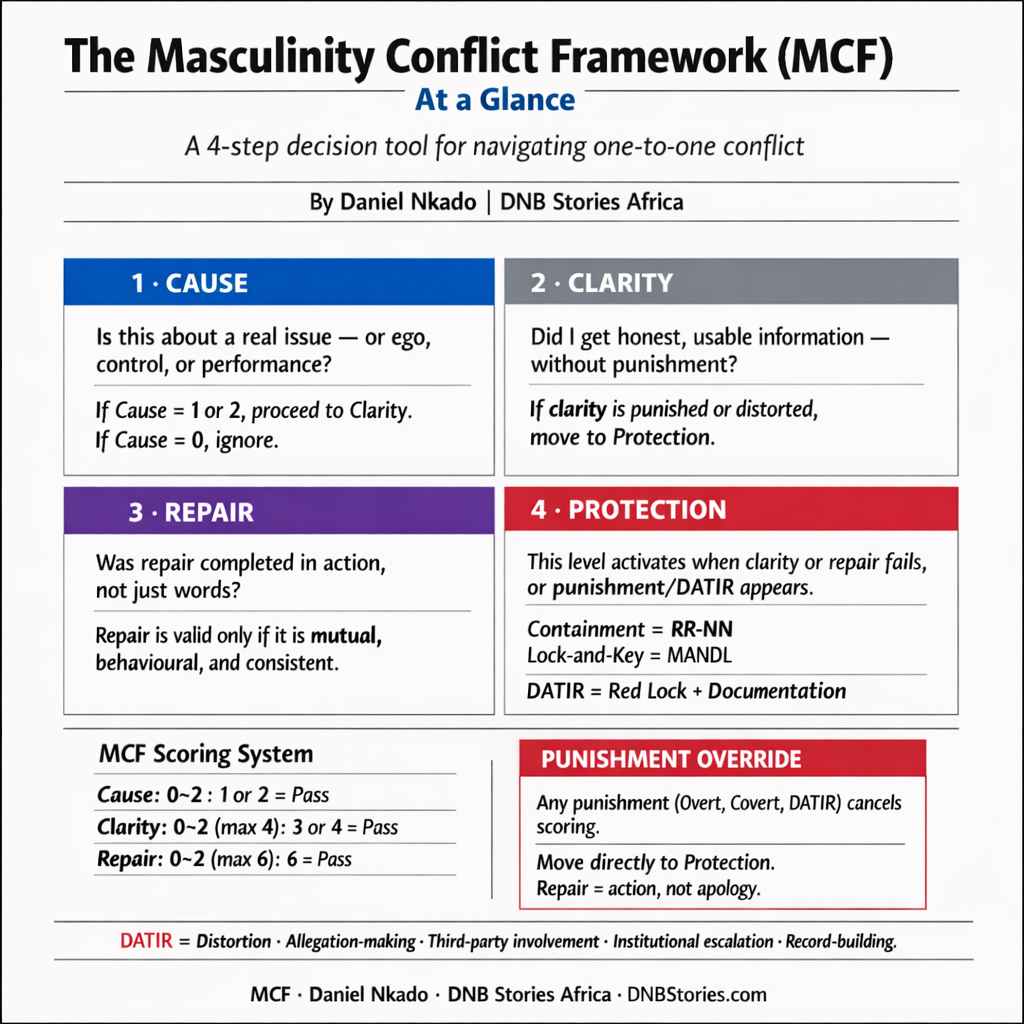
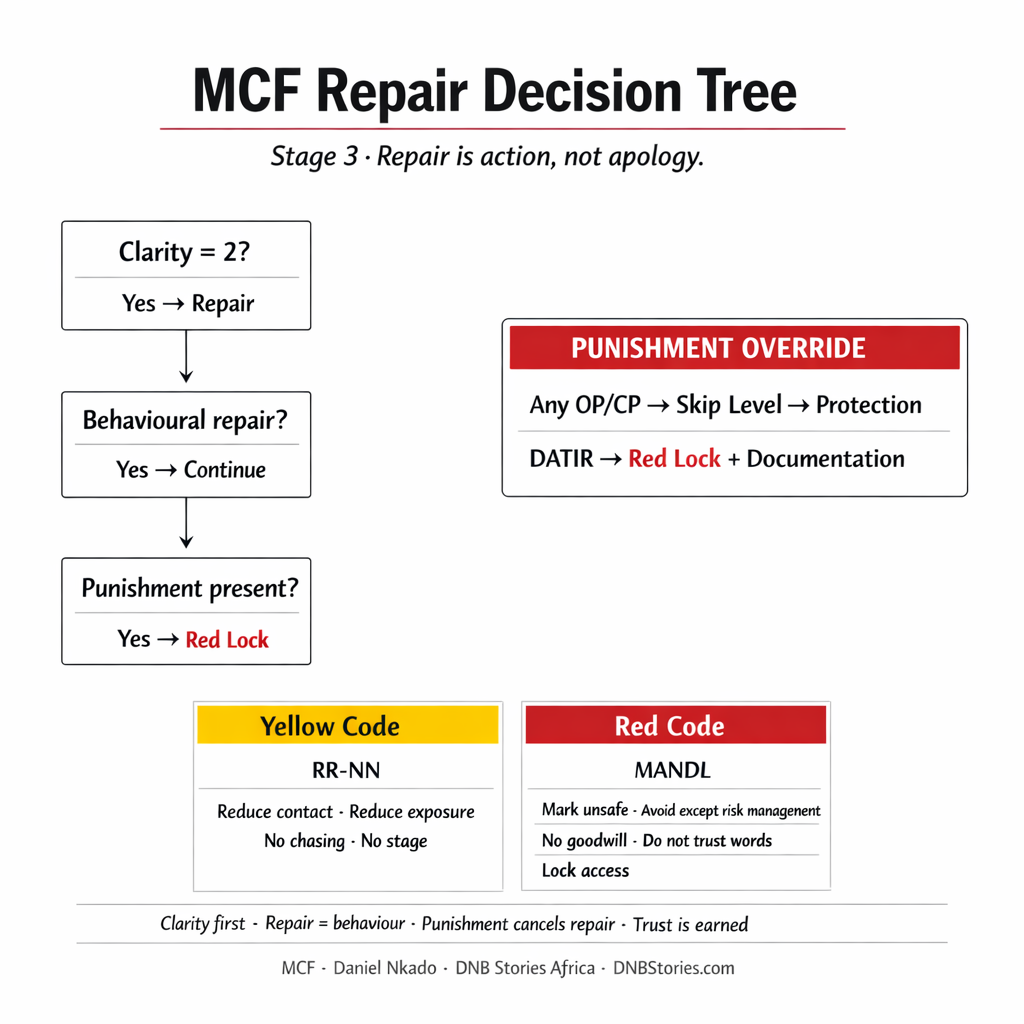
In MCF, punishment is a hard override at any stage. Once punishment appears, you may record the last completed score for reference and move immediately to Protection. If punishment appears at Clarity, Repair is not offered. If punishment appears at Repair, the Repair process is cancelled.
What Counts as Punishment in MCF
In the Masculinity Conflict Framework, an action qualifies as punishment only when all four conditions are present:
- It occurs after the conflict, rupture, or disagreement.
- It is a deliberate, self-chosen act, not an accident or impulsive misunderstanding.
- Its purpose is clearly to impose a cost, retaliate, or make the other person feel the consequence.
- It does nothing to advance resolution, repair, or mutual understanding.
The Core Test: When you seek Clarity or during Repair, do they provide information or respond with an action that clearly shows they are making you pay?
MCF Punishment Classification
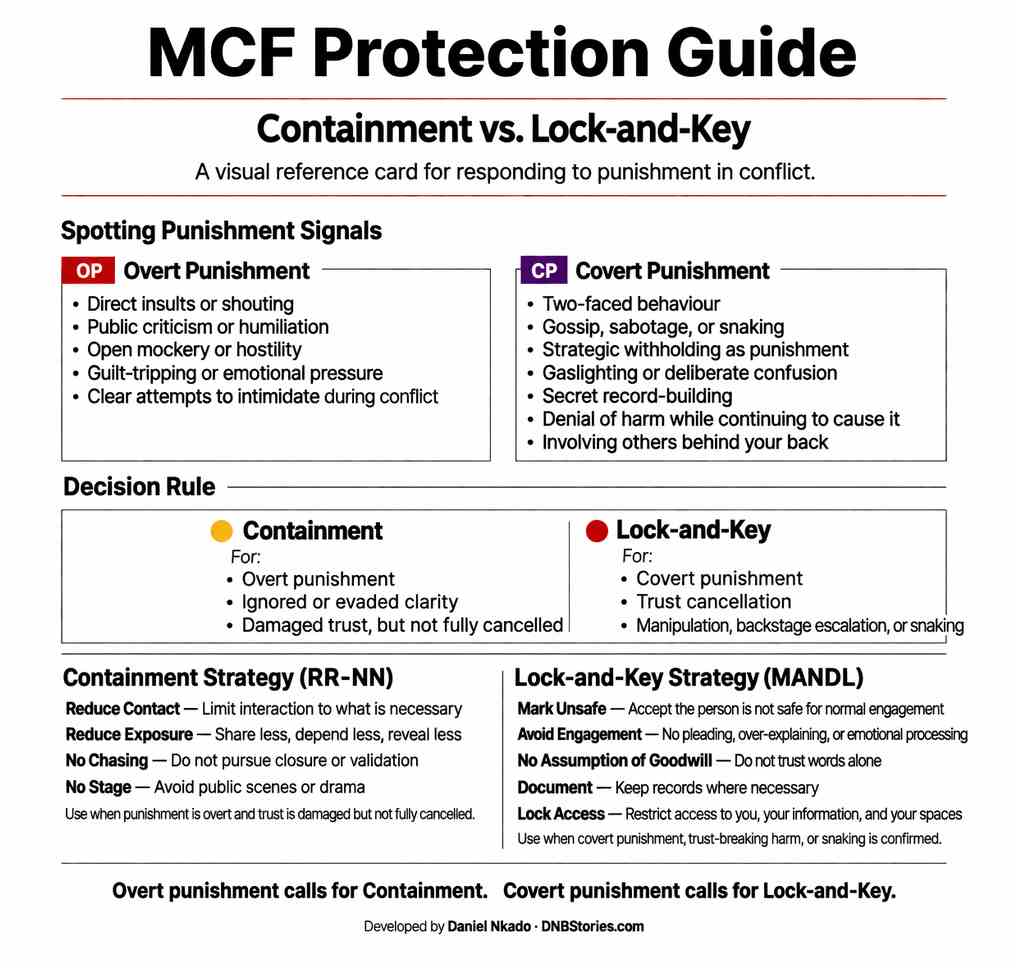
a. OP — Overt Punishment
Overt Punishment (OP) refers to punishment that is direct, visible, and ownable within the conflict. It can happen in public or private, and examples include direct humiliation, open intimidation, visible retaliation, or explicit coercive behaviour.
Overt Punishment (OP) triggers Yellow Containment (RR-NN):
Reduce contact · Reduce exposure · No chasing · No stage
b. CP — Covert Punishment
Covert Punishment (CP) refers to punishment that is hidden, indirect, or difficult to own within the conflict. Rather than open confrontation, the person imposes cost under an innocent front or through deniable actions.
Examples of Covert Punishment (CP) include triangulation, reputation damage, strategic exclusion and sabotage, narrative distortion, or quiet crowd mobilisation.
Covert Punishment (CP) triggers Red Lock & Key (MANDL):
Mark unsafe · Avoid engagement · No assumption of goodwill · Do not trust words alone · Lock access
c. Snaking — A Special Case of Covert Punishment
Snaking is treated in MCF as a special case of Covert Punishment. It refers to covert planning, underground narrative control, secret sabotage or exclusion while maintaining a surface appearance of normality or friendliness. Because snaking involves calculated, secret planning, it breaks the logic of trust and triggers an immediate Red Lock & Key (MANDL).
Researchers Kelley and Robertson (2008)[6] found that relational aggression, which MCF classifies as Covert Punishment (CP) or snaking, was a significant pattern in gay male relationships and was associated with internalised homophobia. This supports MCF’s view that gossip, exclusion, triangulation, and reputation sabotage are not trivial social drama, but serious forms of punishment that justify the Red Lock.
Public Confrontation vs Punishment
In MCF, a conflict principal who chooses stage confrontation forfeits guided clarity. He must pass Clarity unaided before any move toward Repair is offered.
A public confrontation can produce either Clarity or Punishment. If the confronting principal can state his grievance, reveal his position, and generate usable information without mocking, demeaning, distorting, or punishing, Clarity may still be passed. But if the confrontation turns punitive (e.g., shaming, name-calling, threats), the signal is no longer offered as a repair. It is being used for control.
Punishment vs DATIR Signals in MCF
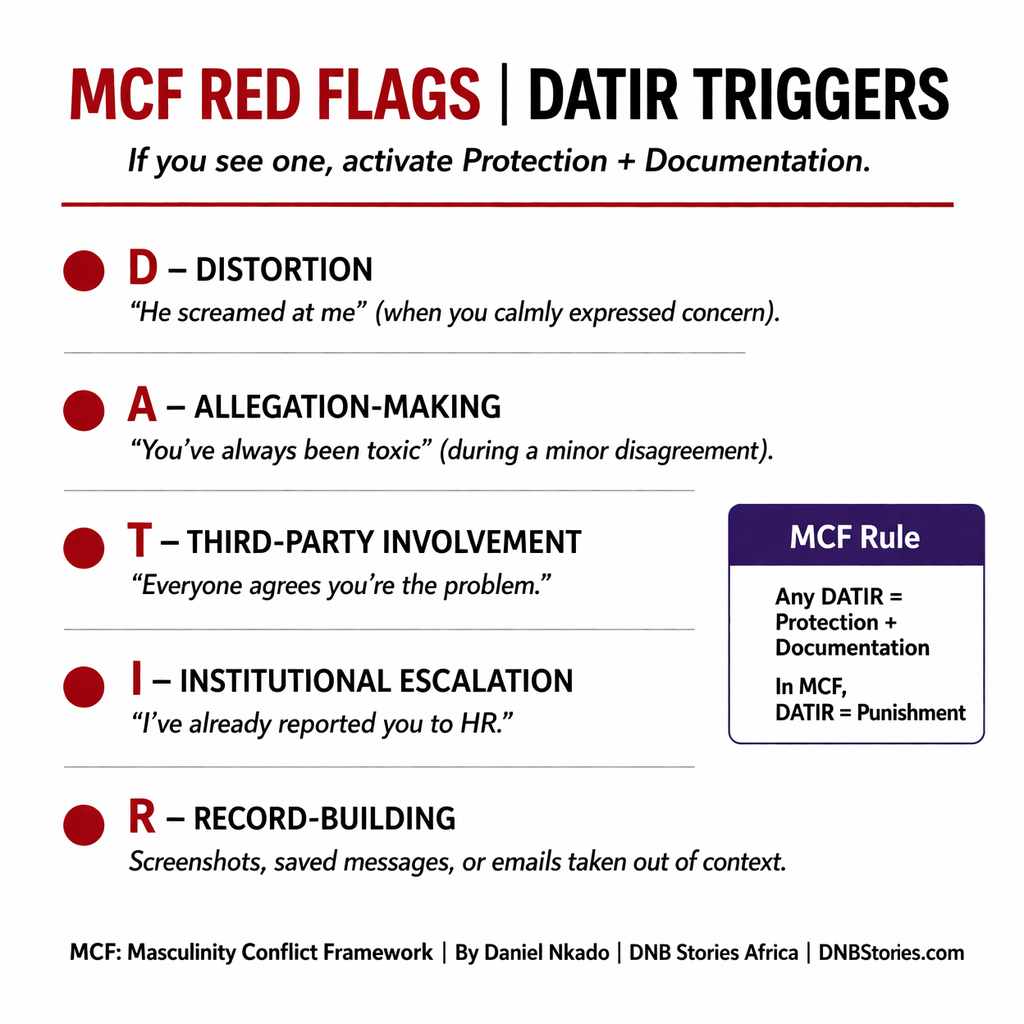
In MCF, function determines what counts as punishment. DATIR is therefore treated as punishment. The only distinction is that DATIR identifies Punishment that also requires Documentation.
Overt DATIR = Overt Punishment (OP) → Yellow Containment + Documentation
Covert DATIR = Covert Punishment (CP) → Red Lock & Key + Documentation
In Black queer male-coded spaces, conflict often travels through indirect dominance and image control rather than open rage. People distort, allege, triangulate, escalate, and build receipts in the dark. DATIR gives you a repeatable way to name the pattern before it becomes house-wide drama or real-world harm.
Anger Is Not The Same As Punishment
MCF makes a strict distinction between anger and punishment. Someone can be angry and still not punish. Someone can be upset and still want repair. What defines a punisher is not emotion, but method. A punisher turns conflict into cost. He humiliates instead of explaining. He chooses retaliation over clarity. He may recruit allies, distort events, or make further contact feel dangerous. The issue is no longer resolving conflict, but imposing cost.
Several studies support MCF’s central logic: conflict is more likely to move toward resolution when it is organised around information1, honesty, understanding4, and behavioural change5, while the emergence of distortion, undermining3, punishment2, or control6 can justify a shift toward protection and risk management.
Scoring in the Masculinity Conflict Framework
In MCF, Cause is an early read, not a verdict. Clarity is the first true test. Repair is offered only after successful Clarity. If punishment appears at any point following the rupture of conflict, the decision path moves to Protection.
MCF Sequence
Cause → Clarity → Repair → Protection
Scoring The Stages
Cause
0 = no cause
1 = ego-based cause
2 = non-ego-based cause
Clarity
0 = punished
1 = avoided
2 = welcomed and completed
Repair
0 = punished or deception appears
1 = avoided (interest or verbal agreement but no action)
2 = welcomed and completed in behaviour
Normal Scoring Path
Cause + Clarity = 0–4
Cause + Clarity + Repair = 0–6
Threshold Summary
Cause + Clarity
- 3 or 4 → Proceed to Repair
- 2 → Containment
- 1 → Lock and Key
- 0 → Ignore
Cause + Clarity + Repair
- 6 → Possible Trust Asset (PTA)
- 5 → Containment
- 4 or below → Lock and Key

Five Signs You Are Dealing With a Punisher
Within the Masculinity Conflict Framework (MCF), a punisher is someone who interprets conflict as a personal offence. Rather than welcoming clarity or moving toward repair, they respond by imposing cost.
The following five signs are among the clearest indicators.
1. Vindictive Withholding
This is one of the most common signs. They withdraw or withhold something they had previously offered, not as a clean boundary or genuine loss of capacity, but as a penalty for having offended, challenged, or disappointed them.
2. Unearthing Grudges
They repeatedly bring up your past failures, mistakes, or “sins” in order to justify present criticism or mistreatment. Rather than addressing the issue at hand, they reopen old material to strengthen their position and increase guilt.
3. Contempt and Mockery
They use sarcasm, ridicule, or so-called jokes to target your weaknesses and make you feel small, exposed, or humiliated. To intensify the impact, they may recruit mutuals, involve bystanders, or insist on public confrontation. They may use cruel humour as a low-cost means of delivering punishment.
4. Direct and Indirect Threats
Punishers use threats to force compliance. These may be direct, such as threats of violence, exposure, or retaliation, or indirect, such as emotional blackmail, strategic silence, threats to leave, or threats to withdraw something important, including support, access, or financial help.
5. Status Over Care
Saving face, maintaining control, and avoiding accountability matter more to them than resolving the issue honestly. Their priority is not mutual understanding, but positional advantage. This is often the deepest pattern-level sign. Once status matters more than truth, Clarity becomes unsafe, and Repair becomes increasingly unlikely.
How MCF Identifies a Punisher: Behaviour not Personality
In the Masculinity Conflict Framework (MCF), trait tendencies—such as defensiveness, pride, or a history of control-seeking—may increase someone’s likelihood of becoming a Punisher, but they are not definitive on their own. MCF is behaviour-based, not personality-based. The framework encourages you to observe and document behaviour—not speculate based on personality. MCF only activates Protection when these behaviours are observed in real time. This keeps the framework grounded in what’s happening—not what you fear might happen.
Why Protection Is Not An Overreaction
Not every difficult conversation belongs in Protection. Some conflicts are awkward but repairable. Some people are defensive without being punitive. Some disagreements are sharp without becoming coercive.
Punishers require careful handling because they introduce risk into the conflict. They may recruit an audience, pressure mutuals, spread distortions, or alter the atmosphere around you. In doing so, they widen the field of conflict and place a person’s dignity, reputation, and social standing under threat.
The real question is not whether the interaction felt bad. The question is whether it still leaves room for safety. Once attempts at resolution become hazardous, or contact itself becomes a channel for intimidation, the conflict has already answered the question.
In male-coded, status-conscious environments, punishment often carries extra social weight. Cruelty may be misread as strength, retaliation as dignity, and control as self-respect. MCF exists, in part, to reject this confusion.
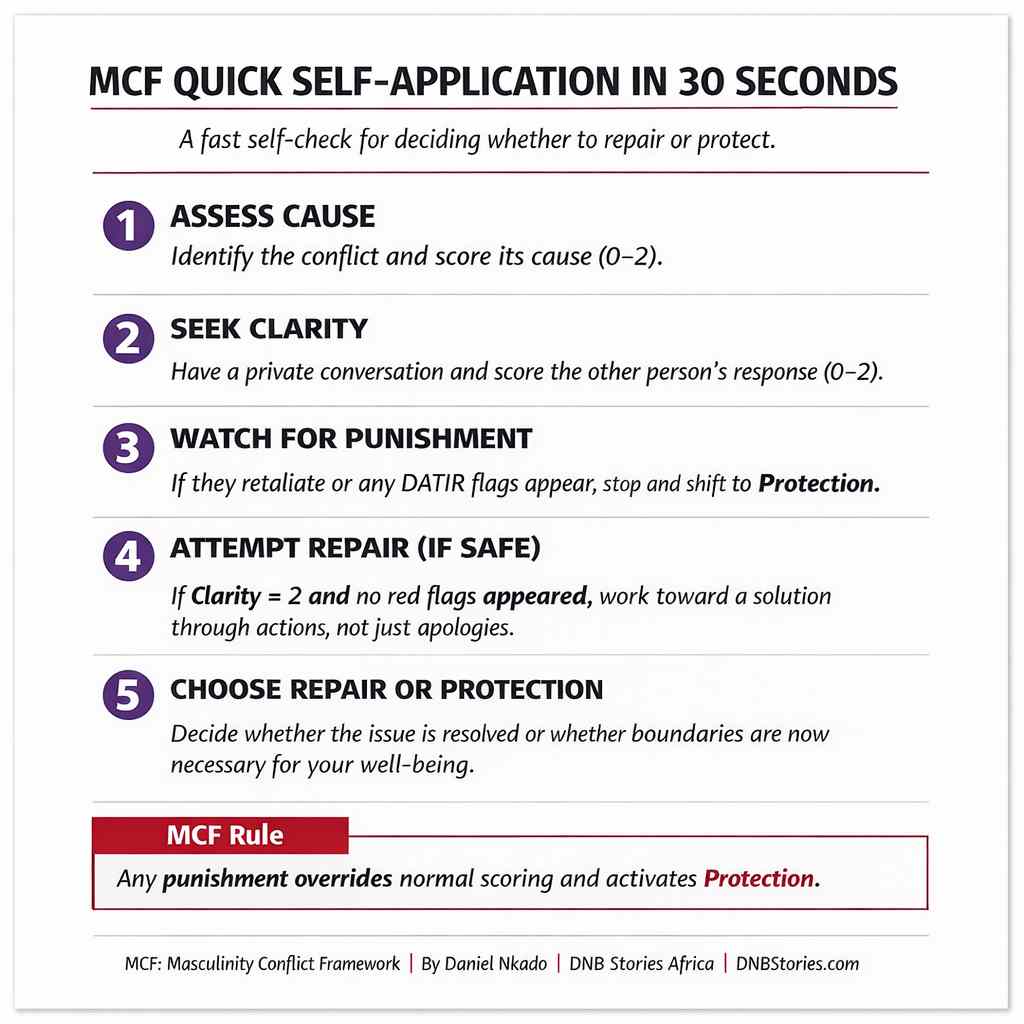
MCF 30-Second Self-Application
- Assess Cause: Is it a real issue or just ego? (Score 0, 1, or 2 – unless 0, move to Clarity regardless).
- Seek Clarity: Try a private, good-faith discussion. (Score outcome: 0, 1, or 2).
- Watch for Punishment: If they retaliate, distort, or show any DATIR sign, stop engaging and switch to Protection.
- Attempt Repair (if safe): Only pursue repair if Clarity was successful (score 2) and no red flags appeared. Engage with the other principal to mutually agree on a repair outline. Focus on actions, not apologies.
- Choose Repair or Protect: Decide if the conflict is resolved (repair successful) or if you need to maintain boundaries (protection) going forward.
A major strength of MCF lies in the speed and behavioural precision it brings to high-stakes conflict, enabling users to make decisive, harm-minimising judgements under pressure. Its caution around repair also serves a protective function—prioritising emotional safety even when that means exiting relationships that might still be repairable. In this way, MCF deliberately trades prolonged engagement and idealised resolution for safety, clarity, and dignity.
Conclusion:
The Masculinity Conflict Framework (MCF) offers a clear, structured approach to managing interpersonal conflict, particularly in high-stakes, status-sensitive environments. By prioritising clarity over cause and recognising when a conflict shifts from resolution to punishment, MCF enables early, self-protective action that minimises harm and preserves safety. It prevents users from investing energy in conflicts already framed as ego threats by the other party.
By responding to behaviour rather than assumptions, MCF ensures conflicts are either resolved in good faith or exited safely. In a world of indirect dominance and covert retaliation, it offers a low-drama, high-clarity path to self-respect and sustainable relationships.
References
- Chambers, J. R., & De Dreu, C. K. W. (2014). Egocentrism drives misunderstanding in conflict and negotiation. Journal of Experimental Social Psychology, 51, 15–26. https://doi.org/10.1016/j.jesp.2013.11.001
- Crick, N. R., & Grotpeter, J. K. (1995). Relational Aggression, Gender, and Social-Psychological Adjustment. Child Development, 66(3), 710–722. https://doi.org/10.2307/1131945
- Duffy, M. K., Ganster, D. C., & Pagon, M. (2002). Social Undermining in the Workplace. Academy of Management Journal, 45(2), 331–351. https://doi.org/10.5465/3069350
- Faulmüller, N., Mojzisch, A., Kerschreiter, R., & Schulz-Hardt, S. (2012). Do You Want to Convince Me or to Be Understood? Personality and Social Psychology Bulletin, 38(12), 1684–1696. https://doi.org/10.1177/0146167212458707
- Gillespie, N., & And Dietz, G. (2009). Trust Repair After An Organisation-Level Failure. Academy of Management Review, 34(1). https://doi.org/10.5465/AMR.2009.35713319
- Kelley, T. M., & Robertson, R. A. (2008). Relational aggression and victimization in gay male relationships: the role of internalized homophobia. Aggressive Behavior, 34(5), 475–485. https://doi.org/10.1002/ab.20264