Masculinity as a Socially Conferred Status
Many Black gay men will recognise how masculinity can feel less like a secure identity and more like something that must be continuously proven—at work, in dating, around straight men, with family, and even in queer spaces among other gay men. It can seem as though every room has its own rules for what counts as “man enough,” creating constant pressure to recalibrate.
Harder still, the final judgment often does not feel like yours to make. It rests with the room, before which you must present yourself and hope to be read favourably. A man may feel fully secure in one space, only to feel diminished in the next—not because he has changed, but because the room is using a different standard. That is what makes Black gay masculinity feel so fragile: like a status that can be questioned or withdrawn at any moment.
That is where the Masculinity Anchors Model (MAM) comes in. Developed by Daniel Nkado, the model argues that masculinity is not simply a fixed or secure trait that others naturally see and recognise. Instead, it often functions as a social status—tested in every space and judged according to what that space treats as valid proof of manhood.
At the heart of the Masculinity Anchors Model (MAM) is a simple idea: every society or social space has its own ideal masculinity. Men are measured against it, whether they realise it or not. Whether they choose to participate or not.
The Logic of Nkado’s Masculinity Anchors Model
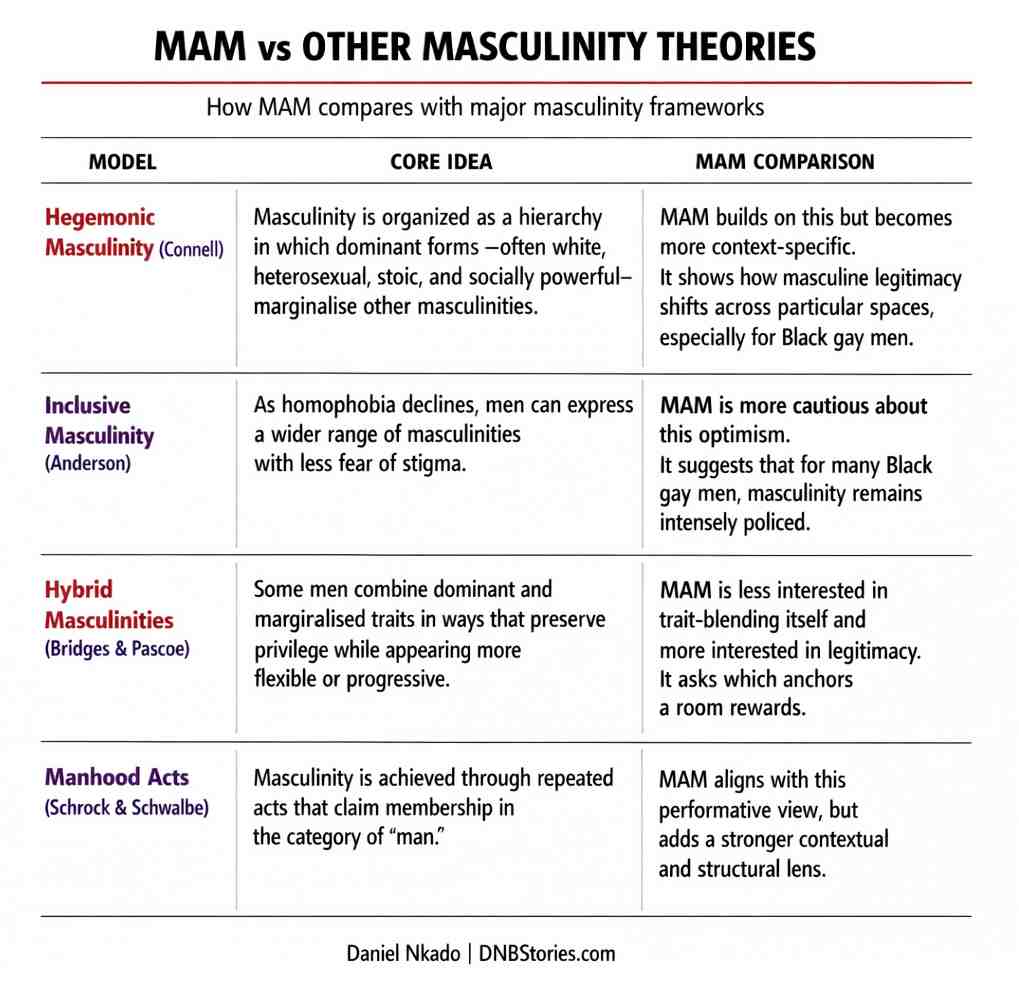
Daniel Nkado’s Masculinity Anchors Model (MAM) offers a fresh, context-dependent way to understand how masculinity is defined and negotiated across different spaces, especially for Black gay men. Unlike several established theories in masculinity studies, MAM argues that masculinity is not a fixed trait that men simply possess or lack. Instead, it functions as a social status that must be earned and affirmed by others within particular settings.
To explain this, Nkado introduces the concept of Masculinity Anchors: the external reference points—such as job status, physical demeanour, or proximity to heterosexual norms—that communities use to decide whether a man counts as masculine in a given setting. Through this lens, MAM shows why many Black gay men in Western contexts can feel trapped in a constant audition for manhood, repeatedly recalibrating their behaviour and presentation, even within LGBTQ+ spaces, to satisfy often straight-coded standards of what a “real man” should be.
Masculinity Is Not Just Something You Are. Each Room Decides.
What makes MAM especially distinctive is that it understands masculinity not simply as performance, but as a socially awarded status governed by shifting local standards—standards that Black gay men are often required to read, negotiate, and survive in real time.
MAM names this a form of masculine labour: the constant work Black gay men put in to secure masculine recognition across different spaces, each with its own standards of judgment.
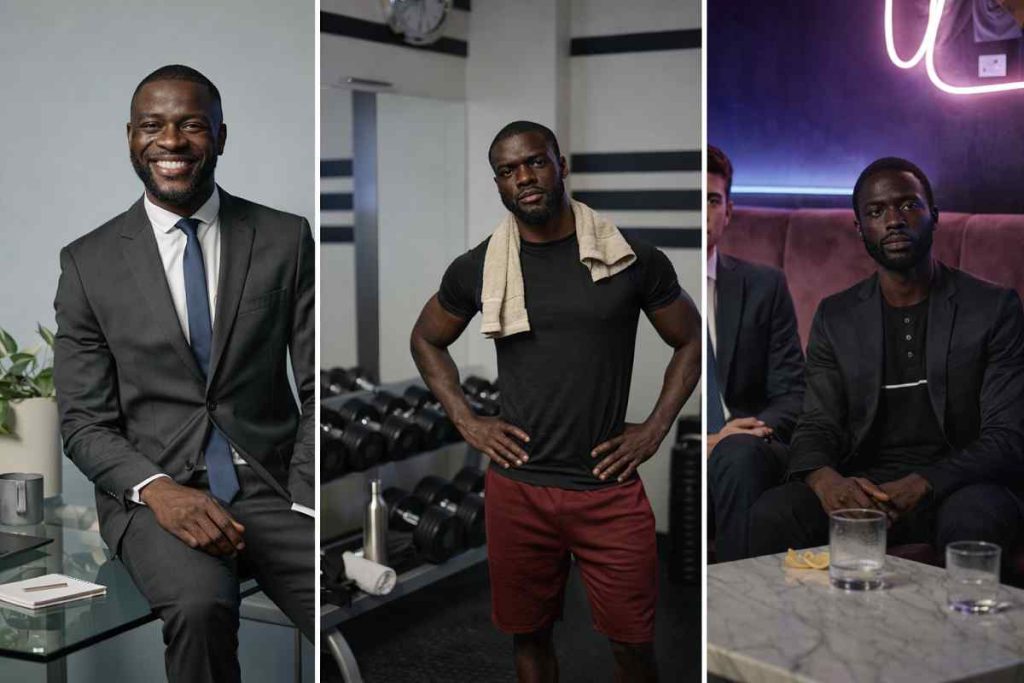
Every social setting, MAM argues, carries its own valuation system. One space may reward responsibility, competence, provision, calm leadership, or maturity. Another may reward hardness, bodily confidence, dominance, sexual positioning, straight-coded cool, or visible distance from femininity. The same man can feel entirely secure in one room and suddenly exposed in another. He has not changed; only the room’s standard has.
This helps explain a pattern many Black gay men intimately recognise, but often struggle to name. Being respected in one aspect of life, only to feel subtly disqualified in another. MAM moves the conversation away from shallow personality judgments like “he is insecure” or “he is trying too hard” and toward a more practical question: what kind of masculinity is this space rewarding?
The Two Core Anchors: Achievement and Performance
The model identifies two main anchors of masculinity.
1. Achievement-Based Masculinity (ABM)
This is masculinity grounded in receipts. Here, a man is treated as respectable, capable, or solid because of what he has built, sustained, or contributed. Education. Work. Leadership. Provision. Social reliability. Community standing. Responsibility.
In this anchor system, masculinity has evidence behind it. It is less fragile because it does not need to be theatrically repeated every five minutes. The proof is already there. The man simply has to deploy the signals effectively—or rely on others to amplify them.
The stronger the evidence, and the more closely it aligns with the room’s standards, the less labour a man must perform to secure masculine validity.
This is one reason some Black gay men can feel relatively secure in professional or family settings, only to feel suddenly insecure at the gym three hours later.
2. Performance-Based Masculinity (PBM)
This is masculinity grounded in visible cues. Voice. Body language. Physicality. Composure. Dominance. “Masculine” styling. Sexual role assumptions. Straight-passing behavior. Proximity to straight men. Not seeming “too gay,” “soft,” or “too feminine.”
Here, masculinity is not carried by receipts. It is carried by presentation, which makes it more fragile. The acceptance it brings can evaporate the moment the performance slips or no longer convinces the room. This is where anxiety enters.
If masculinity depends on real-time performance, then the man must keep scanning himself: Do I sound right? Am I moving right? Am I too expressive? Too soft, too open, too visibly queer? Saying the right thing?
The fragility of Performance-Based Masculinity also shows up in language—through verbal brand work, strategic omissions, credential props, and stories chosen less to reveal personality than to project masculine legitimacy. This is one reason performance-based masculinity can feel so exhausting: it turns ordinary social life into continuous self-monitoring and recalibration.
Straightness as a Dominant Gay Masculinity Anchor
While MAM recognises “straight-acting references” as valid signals of Performance-Based Masculinity, it also explains that in some Western queer and Black diasporic spaces, straightness can operate as a masculinity anchor in its own right.
In such settings, gay men who pass as straight—through appearance, voice, behaviour, or visibly close association with straight men—may be granted masculine legitimacy almost automatically, even without additional proof. But that legitimacy is never secure. However powerful it feels in the moment, it remains conditional, revocable, and dependent on constant renewal.
Straight-Passing Labour: Examples
- Pronoun manoeuvring: Using “they” or “my partner” to avoid outing oneself.
- Voice policing: Lowering pitch, or suppressing natural cadence to speak in a deeper voice.
- Conversational deflection: Keeping rehearsed answers ready for questions about dating or marriage.
- Tolerating hostility: Laughing along with, or staying silent during, homophobic or sexist jokes to preserve belonging.
- Pre-emptive self-deprecation: Mocking oneself first to prove one can “take a joke.”
- Feigning interests: Learning about sports, cars, or other “safe” topics for use in straight-coded convos.
- Fabricated heterosexuality: Inventing, exaggerating, or maintaining stories or relationships with women for credibility.
- Performative ogling: Pretending attraction to women to participate in straight-coded group talk.
- Using a beard: Bringing a woman as social cover at family or professional events.
- Suppressing mannerisms: Restricting gesture, posture, gait, or facial expression to avoid seeming feminine.
- Safe wardrobe curation: Dressing in strictly heteronormative ways at the expense of self-expression.
- Strategic under-grooming: Avoiding grooming or polish for fear of looking “too put together.”
- Aggressive stoicism: Suppressing warmth, vulnerability, or softness to project hardness.
- Regulated affection: Avoiding public touch or show of tenderness with another man.
- Distancing: Avoiding openly queer people and LGBTQ+ events to escape guilt by association.
- Horizontal policing: Shaming other gay men or performing strong disgust at “gay” things.
- Peer regulation: Pressuring queer friends or partners to “tone it down” around straight people.
Straightness Does Not Own Masculinity
The straight-anchored shortcut to masculine credibility can feel undeniably thrilling in the moment. If you have ever been told, “You act so straight nobody would know you are gay,” and felt a guilty flicker of pride, you recognise the pull. For many Black gay men, it feels like securing a form of validation that once seemed impossible to a queer child: temporary admission into the exclusive club of heterosexual life, where masculinity is imagined as pure, natural, and the gold standard.
But that feeling depends on a myth. Straightness does not own masculinity, nor is masculinity a biological inheritance unevenly distributed between gay and straight men. It is a socially performed, culturally interpreted, and situationally judged asset. This is precisely why a gay man can easily be read as more securely masculine than a straight man, even in environments entirely governed by heterosexual norms.
The Toll of Chasing Straight Approval
Being around straight men is okay—when they recognise and respect your queerness in full, not just the edited version that keeps them comfortable. The worst is when they assume you’re straight. Even when they know you’re gay, acceptance often comes with unspoken rules: don’t make it awkward, don’t challenge their comfort. Straight men who don’t respect queerness in all its forms can’t truly treat you as one of their own just because you’re good at blending in.
You end up working overtime to maintain their approval. It becomes a quiet performance—laughing at homophobic jokes, partaking in shaming other gays, playing the single straight lad when their girlfriends come, going on dates you didn’t ask for. The deeper you go, the more of yourself you lose. Until one day, you’re the Black gay man who despises everything about being gay—but still can’t stop using Grindr in secret.
The Cost of Concealment and Straight-Passing Labour
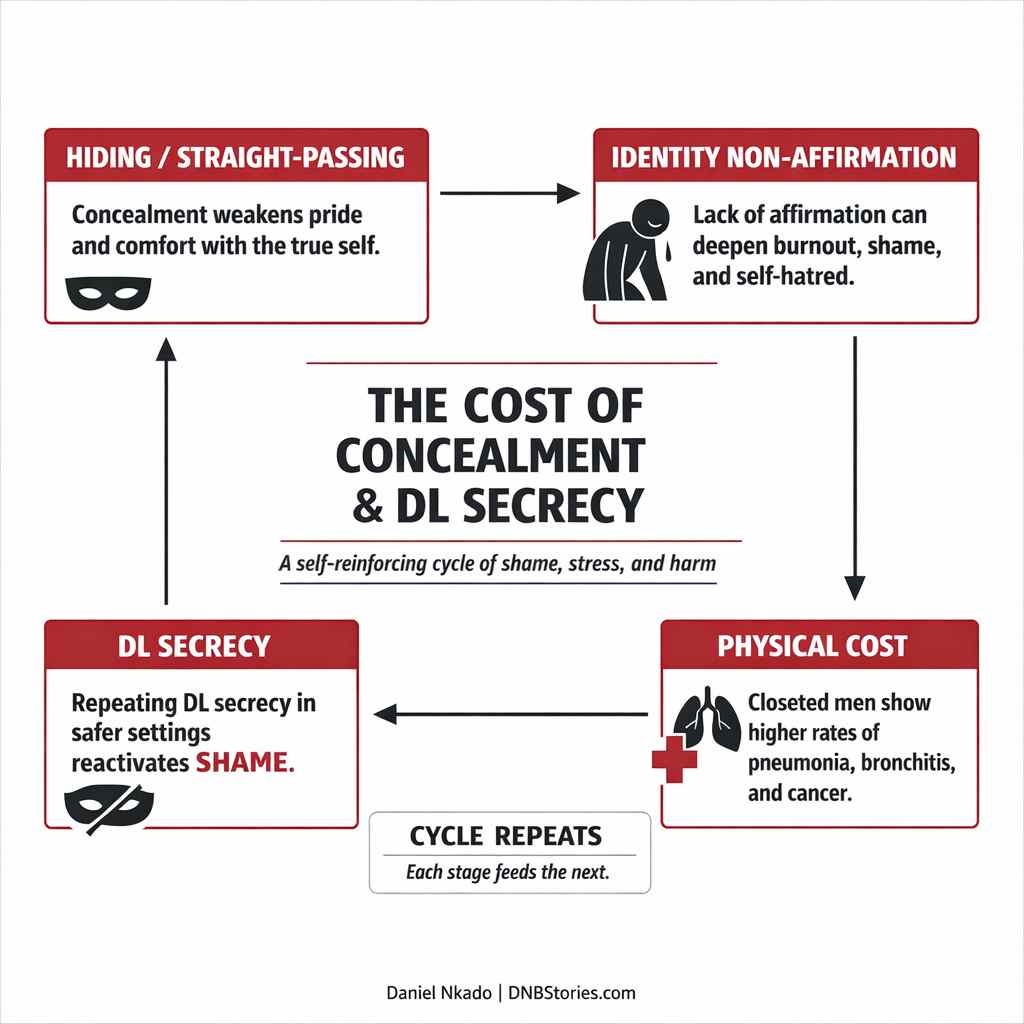
Constantly hiding and changing yourself to keep straight friends comfortable can lead gay men to internalise the message that their true selves are shameful or unfit for public life. Over time, this diminishes identity affirmation—pride and satisfaction with one’s true identity.
The cost does not stop at mental health or self-esteem. It can affect physical health too. A landmark psychoneuroimmunology study found that men who regularly concealed their sexual orientation showed higher rates of infectious diseases such as pneumonia and bronchitis, as well as cancer. The researchers concluded that chronic autonomic nervous system arousal—the prolonged stress required to maintain a false identity—can degrade the body’s cellular immunity.
Positive identity affirmation is associated with better psychological well-being, greater emotional resilience, and a stronger sense of self that can support greater confidence in social life.
This is one reason why the continued re-enactment of DL (down-low) secrecy in contexts where external safety is no longer the primary concern can be especially harmful.
Performing DL identities in relatively safe environments often relies on reanimating the fear and shame many gay men have internalised about their sexuality—pushing them to start hiding, modifying, or suppressing parts of themselves for safety and acceptance, even when they do not explicitly identify with the DL label.
The “DL” (Down-Low) Secrecy in Western Gay Culture
MAM shows how, in many Western settings, straightness often functions as a dominant masculinity anchor—the benchmark some gay spaces use to judge manhood. Even though this logic plainly ignores the existence of effeminate straight men, MAM makes clear how powerful the pressure can be. In cities like London or New York, where immediate physical danger is no longer a central concern, some Black gay men continue to perform strong patterns of DL (down-low) secrecy. In doing so, they deliberately reproduce the fear, shame, and concealment pressure associated with queerness, while using the DL persona as a shortcut to attain masculine legitimacy.
Masculine Competition in Black Gay Social Life
The Masculinity Anchors Model (MAM) explains how masculinity functions not as an internal truth but as a socially conferred status. In many Western Black queer spaces, masculinity is granted or withheld based on how well a man performs the dominant signals a particular space is rewarding—such as muscularity, stoicism, smooth control, dominant energy, macho styling, or proximity to straightness. The more fragile or weak a man’s anchor references are, the more anxious and desperate he becomes, often also the more exaggerated his performance becomes.
🧠 Masculine Competition Under Signal Over-Saturation
In many Black gay social and dating spaces, status is often experienced as an ordinal hierarchy—that is, as though only a limited number of “top” positions are available. If masculine recognition follows a pass-or-fail logic, then for one man to rise, another must fall. When a space is experiencing signal over-saturation, masculinity can start functioning like a scarce resource, causing men to begin competing for recognition, credibility, and rank. Under these conditions, the pursuit of masculine status can take on a more openly dominating character. Men may try to climb the hierarchy not only by elevating themselves, but by actively lowering others.
MAM helps explain why some queer spaces can feel so tense, hierarchical, and emotionally unsafe, even among men who share broadly similar identities. It gives language to patterns many Black gay men recognise immediately but may not always have known how to name.
Common Patterns That Can Emerge Under Masculine Signal Saturation
- 🎭 Over-performance: exaggerating masculine cues through hyper-aggression, excessive stoicism, hyper-independence, or performative “top energy.”
- 🧱 Mixed-stacking: combining signals from multiple anchor systems—such as streetwear dominance with academic prestige or cultural capital—to build a stronger masculine profile.
- 👀 Signal surveillance: becoming highly alert to any deviation from the dominant anchor, such as slips in voice, posture, softness, or emotional expression that could lower status.
- 🗣️ Verbal branding: using curated storytelling, name-dropping, strategic humour, or status claims to reinforce one’s place in the hierarchy.
- 🤝 Masculine alliances: aligning with men who already carry valued masculine signals in order to strengthen one’s own legitimacy and improve the chances of passing the room’s test.
- 🧍♂️ Policing and shaming: mocking, correcting, or subtly disciplining others’ perceived failures to perform masculinity “properly,” often under the cover of banter.
- 🚪 Exclusion: distancing, sidelining, or withholding warmth from those seen as insufficiently masculine, too soft, too expressive, or too visibly queer.
- 💄 Femmephobia: treating femininity in men as a status failure, and using distance from femininity as proof of masculine superiority.
- 🧊 Cold, competitive spaces: as signals lose distinctiveness, social environments can become guarded, transactional, and low in warmth, with rivalry replacing ease.
- 💪 Hypermasculinity cues: increased reliance on hardness, dominance, sexual bravado, emotional restriction, gym-coded aesthetics, or “untouchable” composure to secure rank.
- 🎯 Elimination tactics: using humiliation, intimidation, gossip, or exposure to discredit rivals, weaken their masculine credibility, and push them toward the margins of the room.
- 🔺 Sexual role anxiety as status anxiety: when sexual positioning becomes a masculinity signal, anxiety about being seen as a “real top,” or about avoiding feminised coding, becomes less about desire and more about rank, legitimacy, and loss of status.
Contextual Competence and Masculinity Anchor Signalling
MAM recognises that Black gay men often adjust their masculine presentation depending on the space they are in—softening, switching, or suppressing certain signals in order to remain legible and avoid exclusion. This reflects the model’s core insight: different environments reward different masculinity anchors, and moving through them requires skill. That is why MAM reframes code-switching not as dishonesty, but as contextual competence.
A man might lean into polish and wit at a book club, then shift toward assertiveness and restraint at a house party. MAM reads this not as a betrayal of authenticity, but as a survival strategy shaped by lived experience. This view also resonates with queer African and diasporic scholarship, which warns against flattening Black queer life into a single Western script. Masculine pressure is never separate from history, migration, race, or local norms. MAM helps name that complexity and affirms the adaptive intelligence behind code-switching in a world where Black masculinity remains under constant surveillance.

Why MAM Matters Beyond Theory
One underrated strength of MAM is how it shifts blame in moments when a Black gay man feels “not man enough.” Instead of treating the problem as a personal deficiency, the model asks him to examine the room first. If a space rewards hardness over care, restraint over expressiveness, straightness over visible queerness, and dominance over softness, then the issue is not his lack but the room’s narrowness.
This shift is psychologically powerful because it turns private shame into a recognisable social pattern. It is also politically useful. Once communities understand how masculine legitimacy is distributed, they can stop rewarding the same tired cues and broaden the meaning of strength to include emotional steadiness, care, creativity, softness, mentorship, elegance, humour, and honesty.
Towards A More Stable Black Gay Masculinity
The Masculinity Anchors Model helps explain why some Black gay men appear too invested in straight approval, starting a family, or performing hardness or dominance by revealing the kind of social worlds that reward and sustain each strategy. It also invites us to examine our own role in upholding the standards of different rooms we have been in: the signals we have helped to reward, the forms of masculinity we have sidelined, and what those choices have meant to us. Once masculinity is understood as a socially conferred status, as MAM explains, it becomes easier to see that the grading system is neither natural nor fixed. With that clarity, Black gay men are better placed to reject borrowed legitimacy and build a masculinity that does not collapse the moment the room changes.
MAM’s Solution: An Internally Anchored Masculinity (I-AM)
I-AM refers to a form of masculinity that is self-defined and self-sustaining. Unlike masculinity that depends on external validation—such as straight approval or dominant cues—I-AM is rooted in internal coherence, personal values, and relational integrity. It does not rise or fall based on how others perceive you, nor does it require dominance, comparison, or conformity to stay valid. Instead, I-AM offers Black gay men the freedom to move through different spaces without surrendering their sense of self to shifting standards. It reframes masculinity as something expansive, self-authored and durable, rather than a fragile status conferred by others.
References
- Bridges, T., & Pascoe, C. J. (2014). Hybrid Masculinities: New Directions in the Sociology of Men and Masculinities. Sociology Compass, 8(3), 246–258. https://doi.org/10.1111/soc4.12134
- Cole, S. W., Kemeny, M. E., Taylor, S. E., & Visscher, B. R. (1996). Elevated physical health risk among gay men who conceal their homosexual identity. Health Psychology, 15(4), 243–251. https://doi.org/10.1037/0278-6133.15.4.243
- Connell, R. W., & Messerschmidt, J. W. (2005). Hegemonic Masculinity: Rethinking the Concept. Gender & Society, 19(6), 829–859. https://doi.org/10.1177/0891243205278639
- Han, C. (2017). Examining identity development among gay men of colour. Sociology Compass, 11(9), e12503. https://doi.org/10.1111/soc4.12503
- Hunt, C. J., Morandini, J., Dar-Nimrod, I., & Barlow, F. K. (2020). Why Do Some Gay Men Identify as “Straight-Acting” and How Is It Related to Well-Being?. Archives of Sexual Behaviour, 49(5), 1713–1723. https://doi.org/10.1007/s10508-020-01702-1
- Lu, A., LeBlanc, A. J., & Frost, D. M. (2018). Masculinity and Minority Stress among Men in Same-sex Relationships. Society and Mental Health, 9(2), 215686931877342. https://doi.org/10.1177/2156869318773425
- Meyer, I. H. (2003). Prejudice, social stress, and mental health in lesbian, gay, and bisexual populations: Conceptual issues and research evidence. Psychological Bulletin, 129(5), 674–697. https://doi.org/10.1037/0033-2909.129.5.674
- Nkado, D. (2026, February 7). Masculinity Anchors Model: Why Black Gay Men Chase Straight Validation – DNB Stories Africa. DNB Stories Africa. https://dnbstories.com/2026/02/masculinity-anchors-model-black-gay-men.html
- Schrock, D., & Schwalbe, M. (2009). Men, Masculinity, and Manhood Acts. Annual Review of Sociology, 35(1), 277–295. https://doi.org/10.1146/annurev-soc-070308-115933