For decades, the dominant narrative of queer life in the West has focused on “coming out of the closet.” This metaphor suggests a linear journey from a dark, restrictive place (secrecy) to a liberated, open existence (pride). While this model has empowered millions, it often fails to account for the complex realities of Black, Brown, and non-Western queer individuals for whom “full visibility” can be dangerous or culturally dissonant.
Daniel Nkado’s Dynamic Disclosure Model (DDM) of 2025 offers a fresh perspective. This recently proposed framework moves away from the binary of “in vs. out” toward a strategy of continuous negotiation.
This article explores the Dynamic Disclosure Model in depth, providing a comparative analysis against established psychological frameworks (Cass, D’Augelli, and Fassinger) to help readers understand the shifting landscape of LGBTQ+ identity management.
The Reality of Risk: Why New Queer Models Matter
To understand why the Dynamic Disclosure Model (DDM) is necessary, we must examine the data on intersectionality and safety. The traditional imperative to “come out” assumes a level of safety that not all queer people have equal access to.
a. Disproportionate Risk: In the United States, Black LGBTQ+ people experience higher rates of violent victimisation and housing discrimination than white LGBTQ+ people.
b. Mental Health Context: The Trevor Project’s 2023 survey found that 41% of LGBTQ+ youth (13–24) seriously considered suicide in the past year, and while 54% reported depressive symptoms overall, rates were higher among Black LGBTQ+ youth (56%) than white peers (50%).
c. Global Context: In over 60 countries, consensual same-sex relations are still criminalised. In these environments, the Western ideal of “being out” is not just culturally foreign but also a legal and safety liability.
It is within this high-stakes context that Nkado’s model emerges—not as a rejection of pride, but as a survival manual for navigation.
Deep Dive: Nkado’s Dynamic Disclosure Model (DDM)
Developed by Daniel Nkado, the Dynamic Disclosure Model (DDM) describes how Black gay men (and by extension, other marginalised queer groups) manage visibility. Unlike older models that view “the closet” as a shame-filled place to escape, DDM views disclosure as a spectrum of choices tailored to safety and survival.
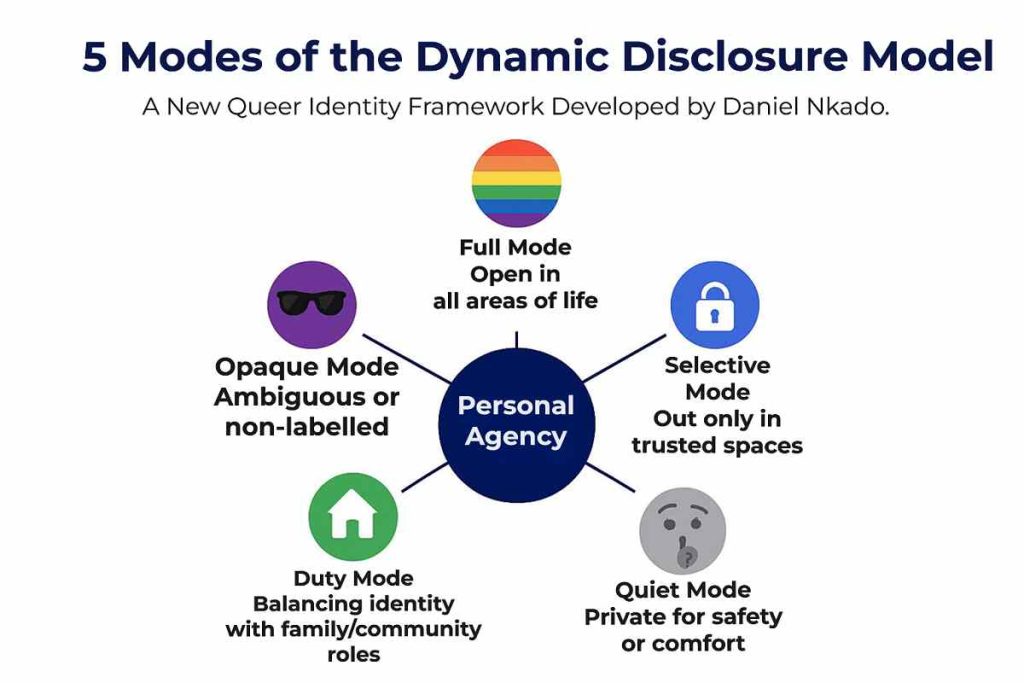
The model proposes five distinct “Modes” that an individual can adopt, switch, or combine depending on their environment:
1. Full Mode 🌈
- Definition: Being completely open about one’s queer identity in all realms of life.
- Context: This aligns with the Western ideal of being “out.” It usually occurs in environments where the individual feels physically safe and legally protected.
2. Selective Mode 🔒
- Definition: Disclosing only in specific safe spaces or to trusted individuals.
- Context: A person might be out to their university friends or inner circle but remain guarded with extended family or employers. This is a strategic compartmentalisation to maintain support systems while mitigating risk.
3. Quiet Mode 🤫
- Definition: Choosing to live with a high degree of privacy or “invisibility.”
- Context: This is often a rational response to danger. For example, a queer person living in a region with anti-sodomy laws may adopt Quiet Mode for self-preservation. It is not necessarily “internalised homophobia,” but rather a calculation of safety.
4. Opaque Mode 🕶️
- Definition: Neither confirming nor denying one’s queerness.
- Context: This involves embracing ambiguity. An individual allows others to speculate but refuses to label themselves explicitly. It effectively neutralises the weaponisation of their identity by refusing to hand over a “confession.”
5. Duty Mode 🏠
- Definition: Prioritising familial or cultural duties over open disclosure.
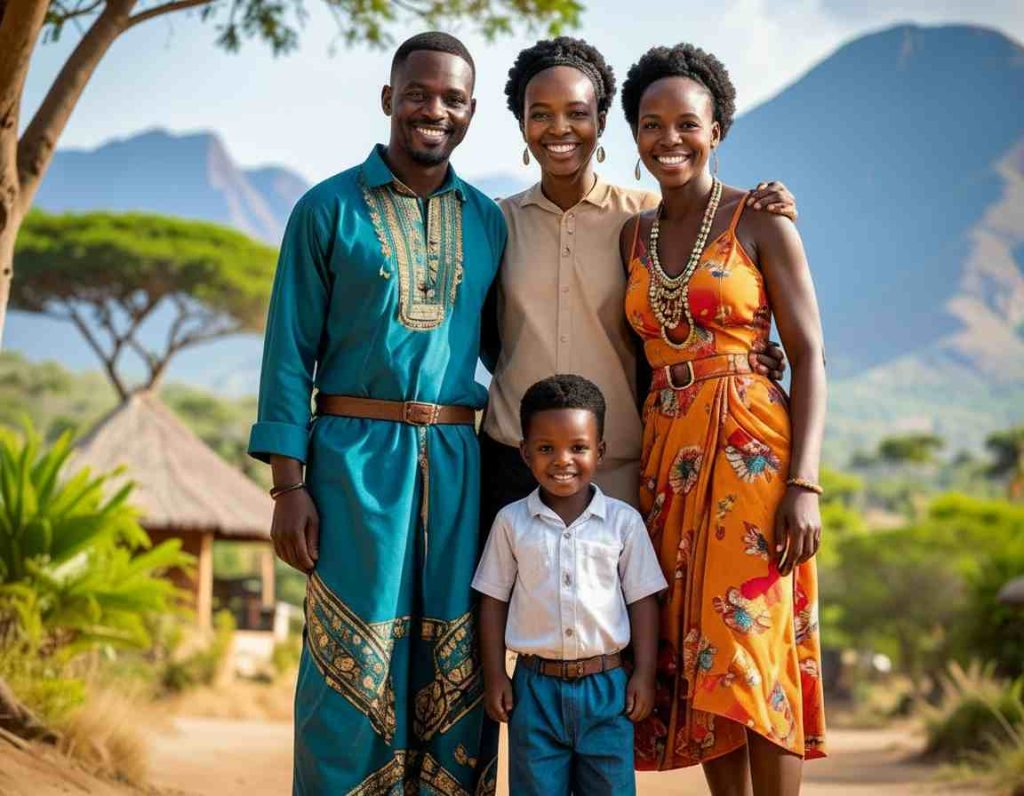
- Context: This creates a tension between personal identity and communal responsibility. For example, a man might enter a heterosexual marriage to satisfy cultural expectations of procreation while privately maintaining a queer identity. In collectivist cultures, “duty” often supersedes “individualism.”
Nkado emphasises honesty with immediate partners—such as a spouse or co-parent—as a priority within Duty Mode for safety. This transparency prevents harm, supports informed consent, and clearly distinguishes Dynamic Disclosure from deceptive or exploitative secrecy.
Core Pillars of the DDM Framework
The Dynamic Disclosure Model (DDM) is defined by three specific characteristics that differentiate it from its predecessors:
1. Non-Linearity
Traditional models suggest a ladder: you start at the bottom (closeted) and climb to the top (out). Nkado’s model is a dashboard. A Black gay man might operate in Full Mode with friends, Quiet Mode at work, and Duty Mode at a family gathering—all in the same week. This fluidity reflects the mental agility required to navigate hostile spaces.
2. Safety as a Priority
The model reframes silence. In older psychological frameworks, staying in the closet was often pathologised as “cowardice” or “immaturity.” DDM reframes it as a survival strategy.
As the framework’s introductory page on DNB Stories Africa notes, “for many, silence is a survival strategy—not a lack of courage” (Nkado, 2025). Naming silence this way can ease the internal shame many people carry when full visibility isn’t safe or possible.
3. Agency and Control
The central innovation here is Agency. The model empowers individuals to be the architects of their own visibility. By validating Opaque or Selective modes as success strategies, this approach removes pressure to follow a Western blueprint that doesn’t fit their cultural reality.
Comparative Analysis: DDM vs. Established Models
To assess DDM’s place within the history of queer psychology, we must compare it with the “Big Three” identity development models.
1. The Cass Identity Model (1979)
- The Theory: A six-stage linear model moving from Identity Confusion to Identity Synthesis[1].
- The Vibe: “The only way out is through.”
- Comparison: Cass views the “closet” as a hindrance to the synthesis of identity. DDM argues that, for some, the closet serves as a shield. While Cass emphasises internal psychological consistency, DDM emphasises external sociological safety.
2. D’Augelli’s LGB Lifespan Model (1994)
- The Theory: A human development perspective that views identity as a lifelong process influenced by social contexts[2].
- The Vibe: “Identity is a marathon, not a sprint.”
- Comparison: D’Augelli introduced the idea that environment matters. However, DDM takes this further by specifically addressing the racial and cultural specifics of that environment, particularly for Black men navigating masculinity and racism.
3. Fassinger’s Inclusive Dual Process Model (1996)
- The Theory: Separates the process into two parallel tracks: internal individual identity (self-acceptance)[3] and external group identity (community membership).
- The Vibe: “You can be okay with yourself without being an activist.”
- Comparison: Fassinger is the closest predecessor to Nkado’s Dynamic Disclosure Model because it acknowledges that one can be internally healthy without being publicly vocal. However, DDM introduces specific, actionable “modes” (e.g., Duty Mode) that describe how to manage that disconnect, particularly in non-Western contexts.
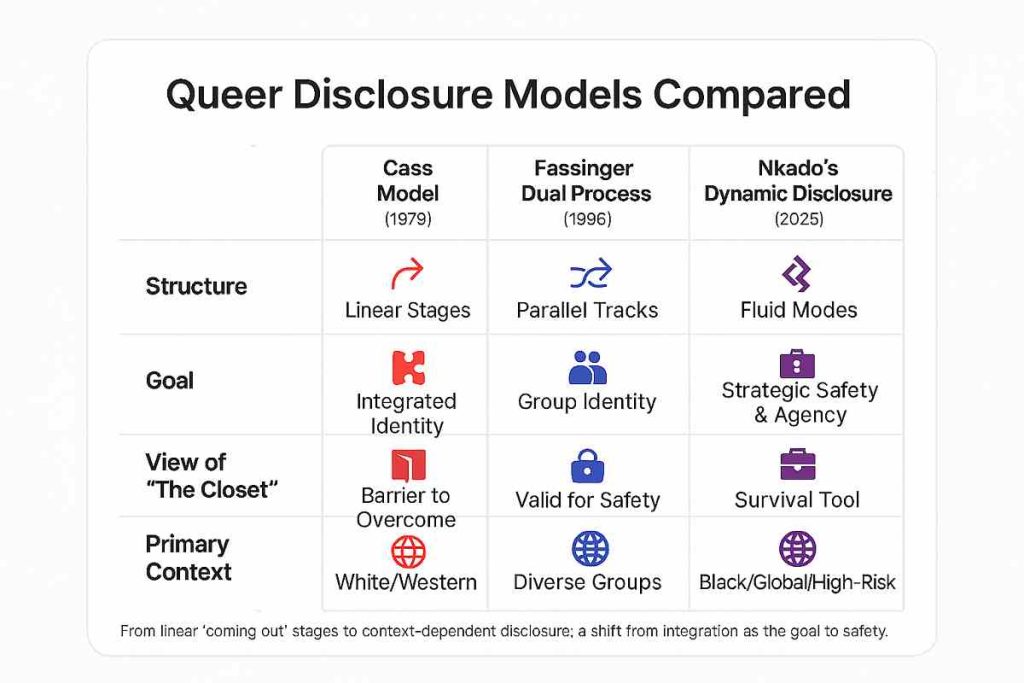
Summary Comparison Table
| Feature | Cass (1979) | D’Augelli (1994) | Fassinger (1996) | Nkado (DDM) (2025) |
| Structure | Linear Stages | Lifespan Processes | Dual Tracks (Private/Public) | Fluid Modes |
| Goal | Integrated Identity | Identity Fulfillment | Group Membership | Strategic Safety & Agency |
| View of “The Closet” | A barrier to overcome | A starting point | Valid for public protection | A tool for survival |
| Primary Context | White/Western | Social/Lifespan | Diverse Groups | Black/Global/High-Risk |
Critical Assessment: Strengths and Limitations of DDM
Strengths
- Destigmatization: By labelling non-disclosure as “Quiet Mode” or “Duty Mode,” the model reduces the stigma associated with being “closeted.”
- Inclusivity: It aligns with E. Patrick Johnson’s “Quare” theory, inserting race and culture into the centre of the conversation rather than treating them as afterthoughts.
- Pragmatism: It offers practical strategies for the 42.7% of Black LGBTQ+ youth who report feeling unsafe in at least one school setting (HRC, 2024), validating their need for caution.
Limitations
- Lack of Empirical Data: As a 2025 conceptual framework, DDM is a theoretical tool. It lacks the decades of longitudinal studies that back Cass or Fassinger.
- Potential for Misuse: Critics might argue that “Duty Mode” could be used to justify remaining in oppressive situations longer than necessary, potentially delaying personal self-actualisation.
Areas for Growth
As a 2025 framework, DDM is primarily an analytic tool. Unlike the Cass or Fassinger models, which have been tested over decades, DDM lacks extensive empirical data regarding long-term mental health outcomes. Additionally, while it excels at describing the experience of Black gay men, further work is needed to see how these modes apply to transgender and non-binary individuals, where “visibility” involves different physical and social dynamics.
Conclusion
Traditional models, such as Cass’s, taught us that coming out is a journey of courage. Later models, like Fassinger’s, taught us that this journey is complex. Daniel Nkado’s Dynamic Disclosure Model (DDM) teaches that the process is ours to control.
By shifting the focus from “coming out” to “managing disclosure,” DDM validates the daily reality of millions of people who balance identity and safety. It confirms that silence is not always a lack of pride—sometimes, it is the ultimate form of self-preservation.
For Black queer men and others navigating the intersection of racism, homophobia, and cultural expectation, DDM offers a liberating vocabulary. It shifts the question from “Why aren’t you out?” to “Which mode is keeping you safe and authentic at the moment?” In a world that is still hostile to difference, this shift from visibility to agency is not just theoretical—it is essential.
Frequently Asked Questions
No. Traditional Western models might label Duty Mode as “living a lie,” but the Dynamic Disclosure Model reframes it as a conscious strategy for cultural harmony. In Duty Mode, an individual isn’t necessarily ashamed of their identity; they simply prioritise the safety and stability of their community and family over their individual expression. It is an act of negotiation, not necessarily denial. Nkado recommends full transparency and honesty in this mode.
Yes. One of the core strengths of the Dynamic Disclosure Model is its fluidity. You can be in Full Mode with your best friends (openly queer), Selective Mode at work (out to a few trusted colleagues), and Quiet Mode with your grandparents (private). The model encourages you to switch modes based on who you are with, rather than forcing you to be “all in” or “all out” everywhere.
Research shows that pressuring LGBTQ+ people to “come out” in unsafe situations—or outing them without consent—can worsen psychological distress. By validating options such as Quiet Mode or Opaque Mode, the DDM framework mitigates the guilt associated with secrecy. It helps individuals feel empowered to make choices that keep them safe, rather than feeling they are failing to be their “authentic selves.”
References
- Cass, V. C. (1979). Homosexual identity formation: A theoretical model. Journal of Homosexuality, 4(3), 219–235. https://doi.org/10.1300/j082v04n03_01
- D’Augelli, A. R., Hershberger, S. L., & Pilkington, N. W. (1998). Lesbian, gay, and bisexual youth and their families: Disclosure of sexual orientation and its consequences. American Journal of Orthopsychiatry, 68(3), 361–371. https://doi.org/10.1037/h0080345
- Fassinger, R. E., & Miller, B. A. (1997). Validation of an Inclusive Model of Sexual Minority Identity Formation on a Sample of Gay Men. Journal of Homosexuality, 32(2), 53–78. https://doi.org/10.1300/j082v32n02_04
- Human Rights Campaign (HRC). (2024). Black LGBTQ+ Youth Report: https://hrc-prod-requests.s3-us-west-2.amazonaws.com/2024-Black-LGBTQ-Youth-Report.cleaned.pdf
- Johnson, E. P. (2001). “Quare” studies, or (almost) everything I know about queer studies, I learned from my grandmother. Text and Performance Quarterly, 21(1), 1–25. https://doi.org/10.1080/10462930128119
- Nkado, D. (2025, December 31). Why Black Gay Men Don’t Have to “Come Out” Like Other Races – DNB Stories Africa. DNB Stories Africa. https://dnbstories.com/2025/12/black-gay-men-coming-out-framework.html
- Pachankis, J. E., Cochran, S. D., & Mays, V. M. (2015). The mental health of sexual minority adults in and out of the closet: A population-based study. Journal of Consulting and Clinical Psychology, 83(5), 890–901. https://doi.org/10.1037/ccp0000047
- The Trevor Project. (2023). 2023 U.S. National Survey on the Mental Health of LGBTQ Young People. The Trevor Project. https://www.thetrevorproject.org/survey-2023/