Note To Readers:
📢 This article is for informational purposes only and is not a substitute for professional medical assessment. Anal pain and muscle tightening can have multiple causes, and only a qualified clinician can make a reliable diagnosis.

Black Gay Men and the Weight of Surveillance
For many Black gay men, intimacy does not begin in the bedroom. It begins long before that—in every room we walk into, spaces already marked by surveillance. We learn early that we are being watched and assessed in real time, and we adapt accordingly, trying never to be caught off guard. We enter spaces carrying a quiet but persistent worry: How am I being read here?
Many of us live under multiple systems of surveillance at once. The straight gaze teaches vigilance against ridicule, danger, and exposure. The white gaze shapes how Black bodies are interpreted, valued, and ranked within mainstream gay spaces. Then there is the Black gaze, which structures how we read one another. Even in spaces meant to feel like home, we watch, assess, and sort each other into rigid and often divisive hierarchies—around masculinity, sexual preferences, or even the darkness of our skin.
And finally, there is the internal gaze we carry within ourselves. It polices our voice, gait, gesture, and emotion before they even surface, ensuring we do not “give ourselves away” or do anything to betray masculinity. By the time intimacy begins, many of us have already spent years performing for safety.
The More We Lose Ourselves, the Better the Performance
When you live under this many layers of surveillance, intimacy can become something you rehearse rather than something you simply enter. Caution steps in early, sorting desire before it even has a chance to unfold. That is the paradox: the very traits we are taught to associate with high desirability—emotional restraint, dominance, and cool composure—often become the same traits that make genuine connection harder, and sometimes nearly impossible. You cannot be fully known if you are always wearing a mask, and you cannot be truly held if you never let go.
Over time, we begin to feel the weight of the mask. It shows up in many painful ways, but in my view, its deepest cost is distance—from ourselves, from our partners, and from our community. We may be present in body, sometimes even in desire, but never truly or fully there. When we turn toward each other, you often can catch it—the flicker, the sudden shift, the quick return to form, the subtle jump of recalibration, as though the eyes had triggered an alarm.

- Black Gay Men and the Weight of Surveillance
- Scope of Article and Definition of Terms
- Pelvic Armouring and Bottoming Pain in Black Gay Men
- Sexual Role Anxiety and Role of Shame
- The Connection Between Shame and Pelvic Armouring
- The Shame–Armouring Loop (SAPPCR)
- Bottoming for Yourself: A Practical Strategy for Breaking Armouring
- Frequently Asked Questions
- References
Scope of Article and Definition of Terms
This article explores how sexual role anxiety, shame, and pelvic armouring can create a cycle of tension and bottoming pain in Black gay men, and why bottoming for yourself can help interrupt that loop.
a. Sexual Role Anxiety
Sexual Role Anxiety, as used here, refers to the chronic stress some gay men experience due to intense pressure to meet the expectations of the sexual role they have publicly claimed, fearing that any perceived deviation will diminish their masculine credibility, desirability, or social standing.
b. Pelvic Armouring
In this article, pelvic armouring refers to a protective tightening some gay men experience in the pelvic area during bottoming. It is not an official diagnosis, but a term used to describe a common community-observed experience. The closest clinical terms are hypertonic pelvic floor or pelvic floor dysfunction.
Pelvic armouring refers specifically to involuntary tightening and difficulty relaxing, particularly when the person is actively trying to relax. It should not be confused with consciously clenching the anal area to perform tightness, create an idea of novelty, or shape a sexual impression (as discussed in this older article).
Pelvic Armouring and Bottoming Pain in Black Gay Men
Pelvic armouring describes a recurrent pattern of muscle tightening, resistance, and difficulty staying relaxed that some gay men experience during penetrative sex or other forms of anal engagement, such as rimming or toy play. It is sometimes accompanied by a sense of panic or physical struggle.
While it overlaps with established clinical concepts—such as a hypertonic or non-relaxing pelvic floor—the term is used here in a non-diagnostic sense to describe a pattern of lived experience that many Black gay men will recognise, without any intent to pathologise anyone. In this way, pelvic armouring is understood as a conditioned response to psychological distress that manifests as physical and behavioural signs of tension and resistance. It may be shaped by repeated exposure to anxiety, surveillance, or other forms of internal conflict.
The term armouring draws in part on Wilhelm Reich’s earlier concept of muscular armour, but it is used here in a narrower, non-diagnostic sense to describe a lived pattern of protective tightening familiar to some gay men. This article does not adopt or endorse Reich’s broader theoretical system.
Signs of Pelvic Armouring:
- Discomfort or pain during anal engagement.
- A feeling of resistance or blockage that makes relaxation difficult, sometimes described as “being in the head.”
- Sudden clenching or panic responses despite conscious willingness.
- Difficulty remaining present or relaxed, sometimes accompanied by physical struggle.
Many men are taught to interpret this tightening as the body simply “failing to relax”—an interpretation that is too simplistic to capture the forces that may be at play. Rather than signalling a failure, the body may be responding protectively to something it has learned to register as a threat (Chen & Kalichman, 2024)[1].
Research suggests that pelvic-floor tension can function as a protective, defensive response to perceived threat, often outside conscious control. This involuntary “armouring” may be part of a broader bodily response to physical, emotional, or sexual stress, rather than a deliberate choice. (van der Velde & Everaerd, 2001; Grabski & Kasparek, 2020)[3].
Sexual Role Anxiety and Role of Shame
In Black gay culture, sexual roles like “top” and “bottom” often carry social meaning deeper than their function as a private language of intimacy.
I introduced Sexual Role Anxiety last year to describe a community-recognised condition where some gay men experience intense distress out of fear of not fulfilling the expectations of their publicly claimed sexual role. This anxiety is often driven by concern that any perceived deviation—whether in behaviour, desire, or performance—might threaten their masculinity, desirability, or social standing.
Common Signs of Sexual Role Anxiety:
- Chronic concealment of genuine desires.
- Strategic misrepresentation or lying about sexual interests.
- Hypermasculine posturing.
- Constant self‑monitoring of voice, body language, or behaviour.
- Compulsive verbal brand work—such as repeatedly stating “I’m strictly a top” or “I don’t do that”—not to express desire, but to preserve status or rank.
- Bottoming Tourism—travelling abroad to bottom while publicly maintaining “a total top” status at home.
The Connection Between Shame and Pelvic Armouring
When bottoming is consistently regarded as something shameful or emasculating, the body may start to see the act as risky, bracing itself long before sex even occurs — even when the conscious mind desires it. Just the anticipation of being judged — by a partner, peers, or the community — can create tension before any physical contact takes place.
In this sense, the body is responding to what it has learned to interpret as a threat. Pelvic armouring can be seen as part of this response: a way the body attempts to protect itself from scrutiny, judgment, and potential loss of status, even when desire and consent are present.
Why Shaming Others Makes It Worse
When sexual roles are used to shame or rank others, the pressure does not stay with the person being targeted—it spreads through the entire community, beginning with the shamer himself. Bottom‑shaming reinforces the idea that receptive anal sex is incompatible with masculinity, respectability, or being “a real man.” Even those who are never directly targeted, including the person doing the shaming, internalise the same warning: this is what happens if you slip.
The result is heightened vigilance, concealment, and fear, often manifesting as difficulty relaxing during anal sex. Attempts to manage this anxiety through dominance‑bottoming—using aggression, control, or hypermasculine cues to offset negative messages about receptivity—offer little relief. Rather than resolving the tension, these strategies simply repackage it, keeping masculinity under constant negotiation and the body locked in a defensive state (Zamboni & Crawford, 2006[6]; Winder, 2023)[5].
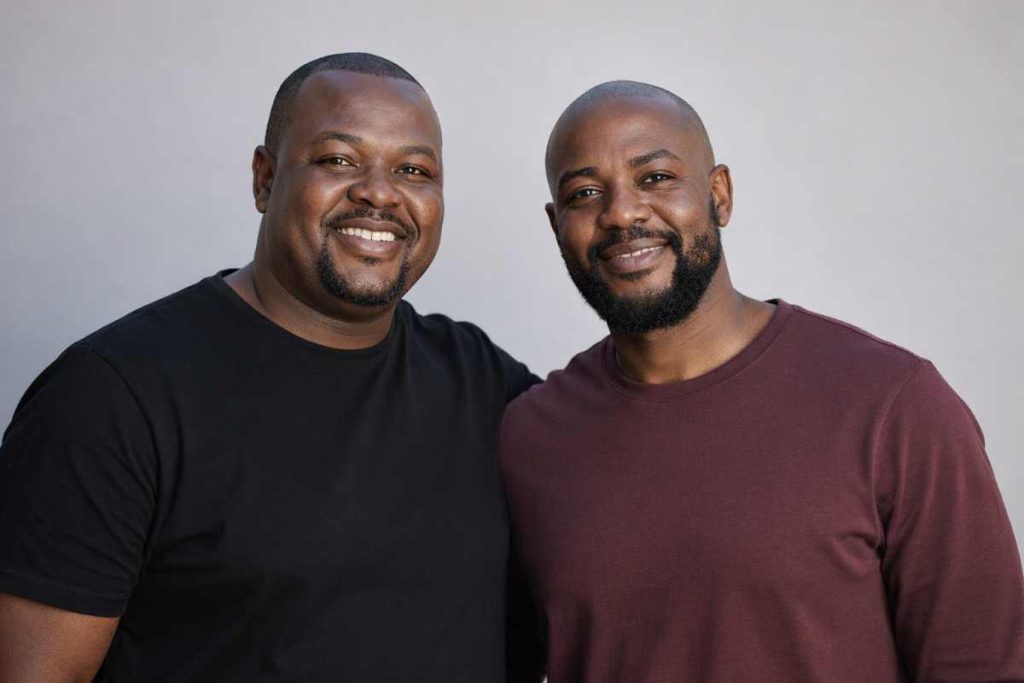
This ongoing self-monitoring highlights a double burden of racial and sexual minority stress.
Shame Does Not Spare Anyone
Shaming and femmephobia do not strengthen masculinity. They simply undermine intimacy for everyone by increasing anxiety, limiting emotional safety, and making protective bodily responses such as pelvic armouring more likely to happen. What may look like an individual difficulty with relaxing is often the product of a wider culture that the person may—or may not—have helped construct.
A 2020 study of gay and bisexual men found that performance anxiety and internalised homophobia were significant predictors of the intensity of pain men experience during bottoming(Grabski & Kasparek, 2020)[3]. That does not mean every case of bottoming pain or difficulty is psychological. It means the psychological environment matters more than many people admit.
The Shame–Armouring Loop (SAPPCR)
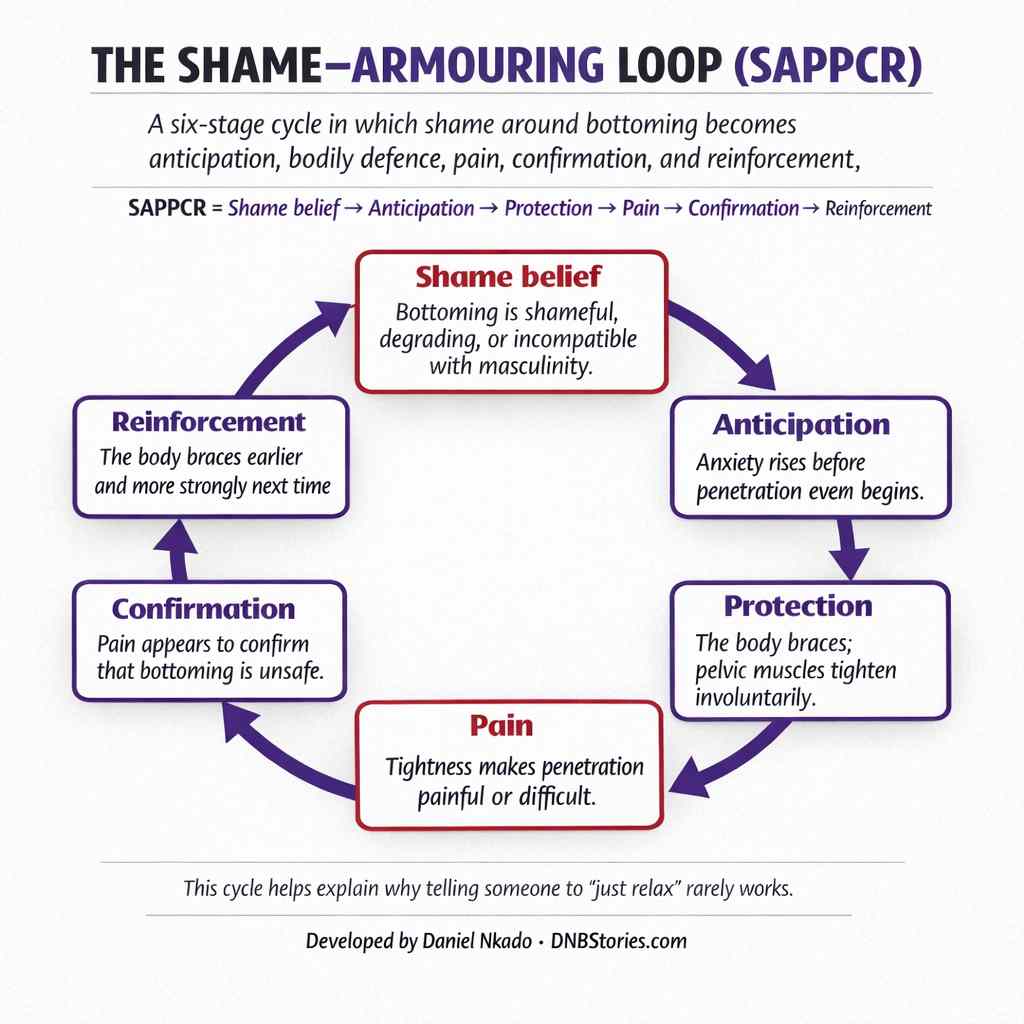
This is a self-reinforcing cycle in which shame-based beliefs about bottoming lead to anticipation, protection, pain, confirmation, and reinforcement.
The SAPPCR cycle is a compact way to outline the six stages of the Shame–Armouring Loop:
It stands for:
Shame belief → Anticipation → Protection → Pain → Confirmation → Reinforcement
S — Shame belief
The starting belief is that bottoming is shameful, degrading, or incompatible with masculinity.
A — Anticipation
Because of that belief, anxiety begins to rise before penetration even starts.
P — Protection
The body responds defensively. Pelvic muscles tighten, brace, or guard.
P — Pain
This tightening makes penetration painful, difficult, or more stressful.
C — Confirmation
The experience of pain or discomfort confirms the original fear to the brain: this is unsafe, emasculating, or not for me.
R — Reinforcement
The cycle strengthens itself, so the body begins bracing earlier and more intensely next time.
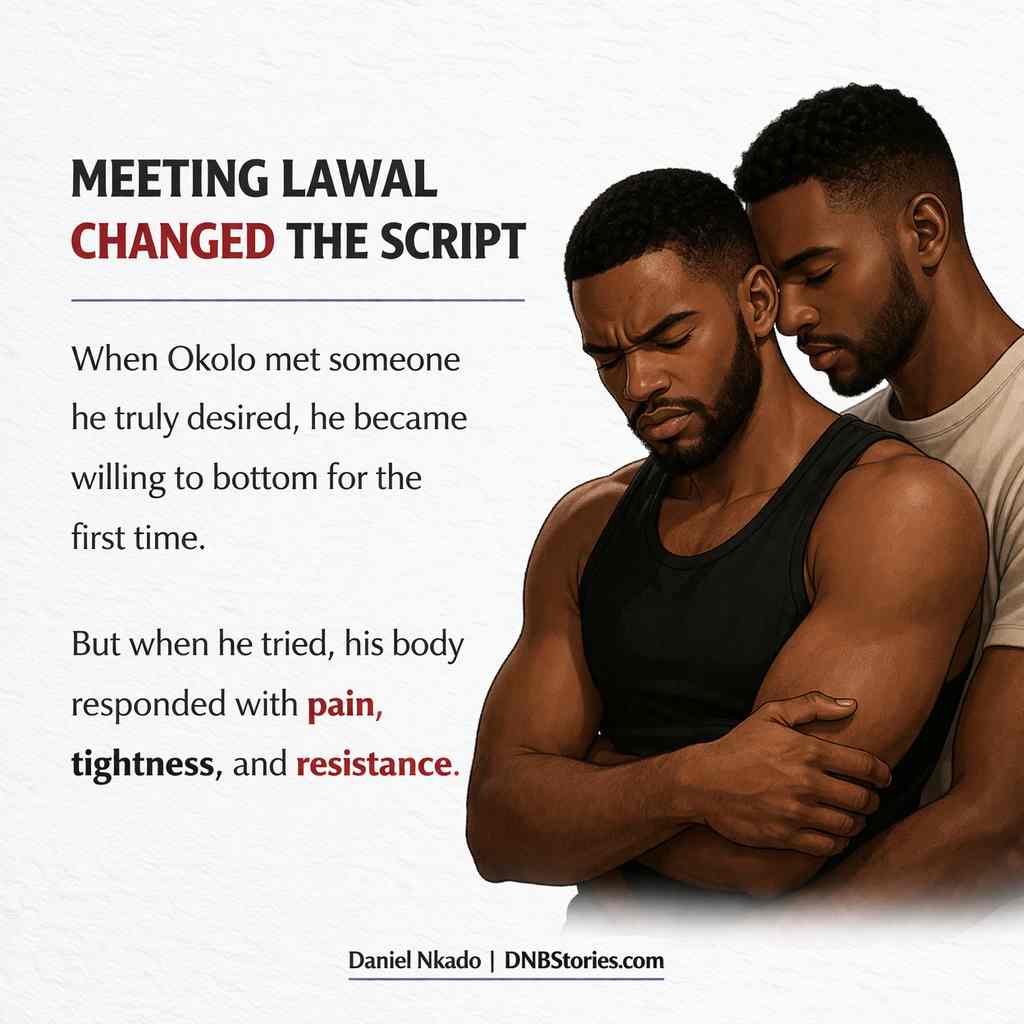
Okolo’s Story:
Okolo’s story illustrates the Shame–Armouring Loop clearly (read here). What appears on the surface as difficulty relaxing may, underneath, be tied to shame, role anxiety, and a body that has learned to treat receptivity as risky.
📢 Like many conceptual models, the Shame–Armouring Loop simplifies reality. It is intended to illuminate one recurring pattern, not to account for every case of bottoming pain, every Black gay experience, or every form of pelvic tension. It should not be used to self-diagnose or to replace professional care.
Bottoming for Yourself: A Practical Strategy for Breaking Armouring
One of the most powerful ways to interrupt the armouring loop is to treat bottoming as something you do for yourself, rather than as something that determines your rank, masculinity, or value.
Bottoming for yourself means choosing to bottom because you want the sensation or pleasure. During the act, you focus on how safe, comfortable, and respected you feel—rather than on your partner’s masculinity, size, or how you might be perceived and judged.
When bottoming—and the pleasure anticipated from it—becomes tied to external factors such as a partner’s traits or concerns about what others might say, the nervous system remains on high alert, scanning to ensure “safe” conditions are met.
When pleasure is centred internally rather than socially, the brain receives a different signal. It stays with you, instead of constantly monitoring how you are being read.
For many Black gay men, this reframe matters because it disrupts a long-standing social script. Research on Black men who have sex with men shows how tightly masculinity is policed, while Minority Stress Theory helps explain why chronic vigilance and shame become costly over time (Fields et al., 2015[2]; Meyer, 2003)[4].
Bottoming for yourself is not about doing it “better.” It is about doing it without having to prove anything. I know from experience that making this mental shift can make a real difference.
What This Shift Can Look Like in Practice
Bottoming for yourself can include:
- Slowing the pace and practising stopping without apology or explanation.
- Choosing positions where you can more easily control depth and speed.
- Choosing partners you can trust to listen, respect your boundaries, and prioritise your safety, rather than basing the experience on traits such as masculinity, size, or dominance.
- Redirecting attention from performance to sensation.
- Addressing shame and Sexual Role Anxiety openly, rather than through silence or withdrawal.
- Seeking pelvic-health, trauma-informed, or other professional support when needed.
Related Frameworks That May Help:
- Sexual Role Anxiety (SRA) explains the pressure to live up to a publicly claimed sexual role
- The Shame–Armouring Loop shows how shame can turn into anticipation, tension, pain, and reinforcement.
- The Masculinity Anchors Model helps explain why masculinity becomes so over-defended.
- The Dynamic Disclosure Model clarifies how surveillance and self-monitoring shape the conditions of intimacy.
- The Trust Onion Model highlights why safety, boundaries, and earned trust matter more than dominance-coded traits.
Frequently Asked Questions
Sexual Role Anxiety refers to the chronic stress some gay men experience due to pressure to live up to the expectations of their publicly claimed sexual role. This anxiety is mostly driven by fear that perceived deviation could ruin their masculinity or desirability status.
Pelvic armouring describes a commonly recognised pattern of involuntary tightening of the pelvic muscles during bottoming or anal play. The term is used here to describe lived experience rather than as a medical diagnosis.
No. Pelvic armouring is not an official diagnosis. Related clinical terms may include hypertonic pelvic floor or pelvic floor dysfunction.
The Shame–Armouring Loop is a self‑reinforcing cycle in which shame‑based beliefs increase anxiety and trigger involuntary bodily tightening, which leads to pain, and reinforces the original fear.
Because for many Black gay men, bottoming is shaped not only by personal desire but also by pressures related to masculinity, stigma, surveillance, and social judgment. These factors can increase vigilance and difficulty relaxing during sex.
Bottoming for yourself means choosing to bottom because you desire the sensation or pleasure, and centring the experience on how you feel—rather than on your partner’s traits or worry about being judged.
References
- Chen, A. B., & Kalichman, L. (2024). Pelvic Floor Disorders Due to Anal Sexual Activity in People of All Genders: A Narrative Review. Archives of Sexual Behaviour. https://doi.org/10.1007/s10508-024-02995-2
- Fields, E. L., Bogart, L. M., Smith, K. C., Malebranche, D. J., Ellen, J., & Schuster, M. A. (2015). “I Always Felt I Had to Prove My Manhood”: Homosexuality, Masculinity, Gender Role Strain, and HIV Risk Among Young Black Men Who Have Sex With Men. American Journal of Public Health, 105(1), 122–131. https://doi.org/10.2105/ajph.2013.301866
- Grabski, B., & Kasparek, K. (2020). Sexual Anal Pain in Gay and Bisexual Men: In Search of Explanatory Factors. The Journal of Sexual Medicine, 17(4), 716–730. https://doi.org/10.1016/j.jsxm.2020.01.020
- Meyer, I. H. (2003). Prejudice, social stress, and mental health in lesbian, gay, and bisexual populations: Conceptual issues and research evidence. Psychological Bulletin, 129(5), 674–697. https://doi.org/10.1037/0033-2909.129.5.674
- Winder, T. J. A. (2023). The Discursive Work of “Bottom-Shaming”: Sexual Positioning Discourse in the Construction of Black Masculinity. Gender & Society, 37(5), 774–799. https://doi.org/10.1177/08912432231186999
- Zamboni, B. D., & Crawford, I. (2006). Minority Stress and Sexual Problems among African American Gay and Bisexual Men. Archives of Sexual Behaviour, 36(4), 569–578. https://doi.org/10.1007/s10508-006-9081-z