1. Black Gay Men Over 30 and the ‘Bus Stop Effect’
For many Black gay men in their 30s and beyond, dating does not collapse through dramatic betrayal or obvious incompatibility. More often, it stalls quietly—through mixed signals, endless “talking stages,” and continued hesitation to decide. I call this “The Bus Stop Effect.”
The Bus Stop Effect refers to a common pattern in modern gay dating where two men stay romantically connected without moving into a committed relationship, often driven by the belief that something better is still coming.
They stay in contact, talking and checking in on each other, and may even continue sleeping together, but the relationship remains undefined. It is ongoing contact without commitment, attention without intention, and chemistry without the capability for a relationship.
In many Bus Stop Effect situations, one person deliberately delays commitment out of fear of settling, using the other as a placeholder while remaining oriented toward better options—or the fantasy of them. They enjoy the benefits of a relationship without paying the necessary toll of commitment. The person left waiting at the “bus stop” is unknowingly subsidising the other person’s endless window-shopping.

- 1. Black Gay Men Over 30 and the 'Bus Stop Effect'
- 2. Why FOMO Keeps Black Gay Men at the Bus Stop
- 3. Embracing Intentional Dating As A Black Gay Man
- 4. What Intentionality in Gay Dating Actually Looks Like
- 5. Leaving The Bus Stop: Intentionality in Gay Dating
- 6. Shifting The Measure of Attraction: From Desirability To Safety
- 7. The Relationship Capability Test (RCT) by Daniel Nkado
- 8. Why Love Does Not Appear in the RCT
- Conclusion
- References
- Frequently Asked Questions
2. Why FOMO Keeps Black Gay Men at the Bus Stop
A major driver of the Bus Stop effect or relationship stalling is FOMO — the fear of missing out — or, in more technical terms, the illusion of endless opportunity.
Dating apps like Grindr and Jack’d create the impression that there is always someone better just beyond the current conversation. Although this abundance may seem liberating, it has a more destabilising psychological effect on people.
Research on dating shows that believing there are many available alternatives can overwhelm individuals with choices, encouraging a more rejecting mindset. Over time, repeated exposure to large pools of potential partners while remaining single can lead to anxious thoughts and lower momentary self-esteem. (Thomas et al., 2022[6]; Pronk & Denissen, 2020)[4].
What Cancels the Bus Stop Effect?
Intense chemistry, age, or courage do not cancel the Bus Stop Effect. Only one thing genuinely does: tiredness. When someone becomes tired of suspended possibility—tired of being kept waiting, tired of hedging, tired of preserving emotional space for an imagined better option—they get up, dust themselves off, and leave. The bus stop holds people in place for as long as hope in the unseen remains stronger than dissatisfaction with the present. But once that hope decays into exhaustion, the pull slackens, and people get up and leave.
Warning Signs: How to Spot the Bus Stop Effect
The Bus Stop Effect is chemistry without commitment—a romantic connection without relational decision. Two people waiting together in possibility until one quietly leaves. If you feel emotionally involved but structurally unchosen, you are not being patient. You are waiting at the bus stop.
Common Signs Include:
- Regular communication and checking up without any conversation about exclusivity, direction, or a shared future.
- Sex and intimacy, while both people remain openly available to other partners.
- Avoidant phrases such as “Let’s just see where this goes” or “I don’t want to rush into anything” repeated over months without any decision or clarity.
- Private closeness without public integration—you are not named, introduced, or positioned as someone significant in their life.
- You feel a lingering sense of suspension that you cannot shake off.
3. Embracing Intentional Dating As A Black Gay Man
Finding a lasting relationship as a Black gay man aged 30 or over, in this age and time, requires strict intentionality. You need to stop looking for travellers chasing the thrill of adventure, those still longing for it, and those standing at the bus stop waiting for the next tour bus.
Instead, look for someone who has left the bus stop—or is walking home from it. Someone who is tired of browsing. Tired of being kept waiting or holding space for a “better option” that feels more like fantasy than reality. Tired of someone else turning them into this placeholder without their own choosing.
You’ll recognise this shift when you come across it.
You’ll see it on their face. In their gait. In the way they open Grindr, scan the messages, and close it again without replying, even in the way they leave the club early to go home and sleep and the way they keep cancelling the group sex invitation that once excited them.
Surviving Grindr and The FOMO Ruin
Dating apps do not simply expand choice. They encourage a mindset in which every connection feels provisional and temporary. Even when something is going well, a familiar question lingers: What if there is someone better? This is where FOMO does its most serious damage. It frames commitment as loss rather than as a meaningful act of selection. It keeps people half‑invested, cautious, and emotionally reversible.
The contrast here is not between romance and realism. It is between maximising and choosing.
4. What Intentionality in Gay Dating Actually Looks Like
Embracing intentionality means choosing clarity over momentum and selection over endless possibility. It’s a shift from letting dating happen to you to actively deciding how—and with whom—you invest your emotional energy. It doesn’t guarantee love.
But it guarantees that if love comes, it won’t require you to abandon yourself to keep it.
Here’s what this looks like in practice:
i. You Stop Confusing Chemistry With Capacity
Intentionality in gay dating means recognising that wanting a relationship and being ready for one are not the same thing. Many people genuinely “like the idea” of a partnership but remain psychologically unprepared for what it requires: narrowing options, tolerating uncertainty, and choosing one person over many. Intentionality means you assess capacity, not just chemistry.
Research on commitment readiness shows that readiness is what predicts whether people actually initiate, enter, and sustain relationships—not desire alone (Hadden et al., 2018)[2].
ii. You Understand Commitment As A Choice, Not A Loss
FOMO treats commitment as giving something up—freedom, novelty, imagined alternatives, missing out on the fun still to come. Intentionality reframes commitment as a deliberate act of selection. You accept that every meaningful choice involves closing other doors, and you no longer see that decision as a narrowing of fun or an abrupt exit from the scene, but as a mature choice—one that only a few queer people, at this time, are truly able to make.
Dating researchers define commitment not as a feeling, but as the intention to maintain a relationship over time (Stanley et al., 2010)[5].
iii. You Move From Maximising to Choosing
Intentionality means stepping out of the maximiser mindset[3]—the constant scanning for the “better” options—and into a choosing mindset. Instead of asking, “Could there be someone better?” you ask, “Is this safe, aligned with what I’m looking for and sustainable?”
iv. You Prioritise Behaviour Over Narrative
Embracing intentionality means you stop being persuaded by potential, vibes, or promises and start paying attention to patterns. You look for honesty, care, and consistency—not as ideals, but as repeatable behaviours. Someone can speak fluently about love and still avoid it in practice. Intentionality keeps you grounded in what’s observable.
v. You Allow Timing to Matter
Intentionality includes accepting that timing is not romantic trivia—it’s structural. You don’t personalise someone else’s unreadiness or try to out‑wait it. If someone is still attached to browsing, options, or a provisional connection, you treat that as information rather than a challenge or a flaw. Remember, there was a time you were there too. Choosing intentionality means choosing people who are already walking away from the bus stop—not those still waiting for the next ride.
vi. You Protect Your Emotional Stamina
For Black gay men over 30, intentionality is also an act of self‑protection. You recognise that ambiguity, situationships, and FOMO‑driven dynamics drain emotional energy faster than rejection ever did. Intentionality allows you to conserve stamina for connections that can actually deepen—not giving husband‑level energy to Grindr hookups who only remember you when they’re high.
5. Leaving The Bus Stop: Intentionality in Gay Dating
Leaving the bus stop does not mean settling. It means refusing to remain stuck in comparison and the endless cycle of testing and hoping for better options. You quiet your desire for what‑could‑be and begin engaging with the real person in front of you. This tired state is not confirmed by the disappearance of possibilities—whether real or imagined—but by the decision to acknowledge them and still turn around and leave with the person who chooses you too. You leave the bus stop and board the relationship with them.
Why Situationships Are Unhealthy For 30-Plus Black Gay Men
Turning thirty is not a biological switch, but it often marks a shift in emotional orientation. By this stage, many people approach dating with more memory, sharper pattern recognition, and a clearer sense of what emotional stamina actually costs. What once felt flexible now feels expensive. That is why situationships cost more after 30. Ambiguity is no longer neutral when one person is carrying the weight of hope, interpretation, and waiting.
At this point, many Black gay men are not asking for fairy tales. They are asking for fewer drains on attention, fewer ambiguous loops, and clearer evidence that a connection is genuinely going somewhere.
Because Black gay dating happens alongside pressures of stigma and social strain[1], it becomes even more crucial to avoid unnecessary emotional labour.
6. Shifting The Measure of Attraction: From Desirability To Safety
One of the hardest—but most necessary—shifts in intentional dating is redefining what counts as attractive. In many gay male spaces, desirability is measured through aesthetics, youth, status, appearance, and performance. But these signals do not reliably predict how someone will behave in a relationship. They fluctuate with trends, algorithms, rooms, and age. What endures is quieter: honesty, care, follow‑through, emotional steadiness, and the ability to repair conflict. This is where the central dating question changes.
Instead of asking, Do they want me?
The more mature question becomes, Are they safe for me?
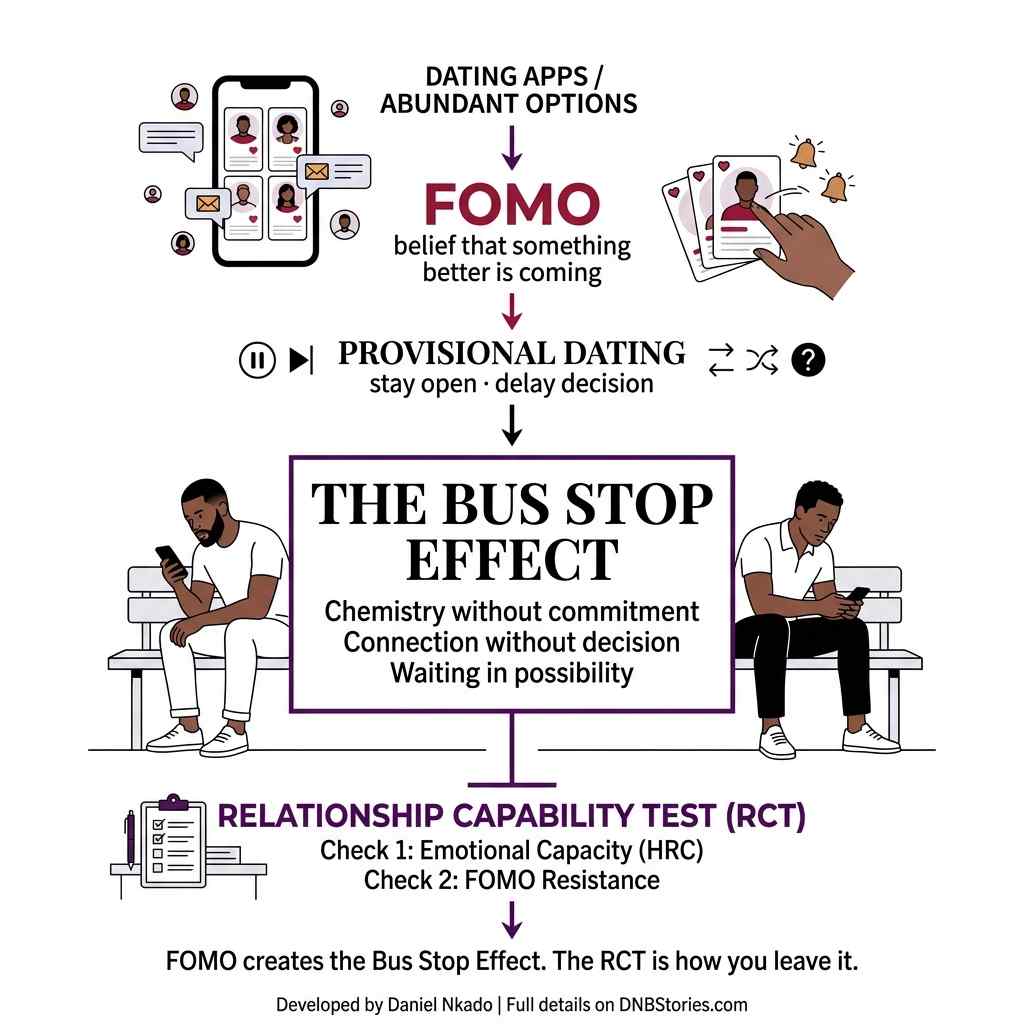
The Bus Stop Effect happens when a real connection exists, but the lure of better options keeps commitment on hold.
Do not let anyone turn you into a placeholder.
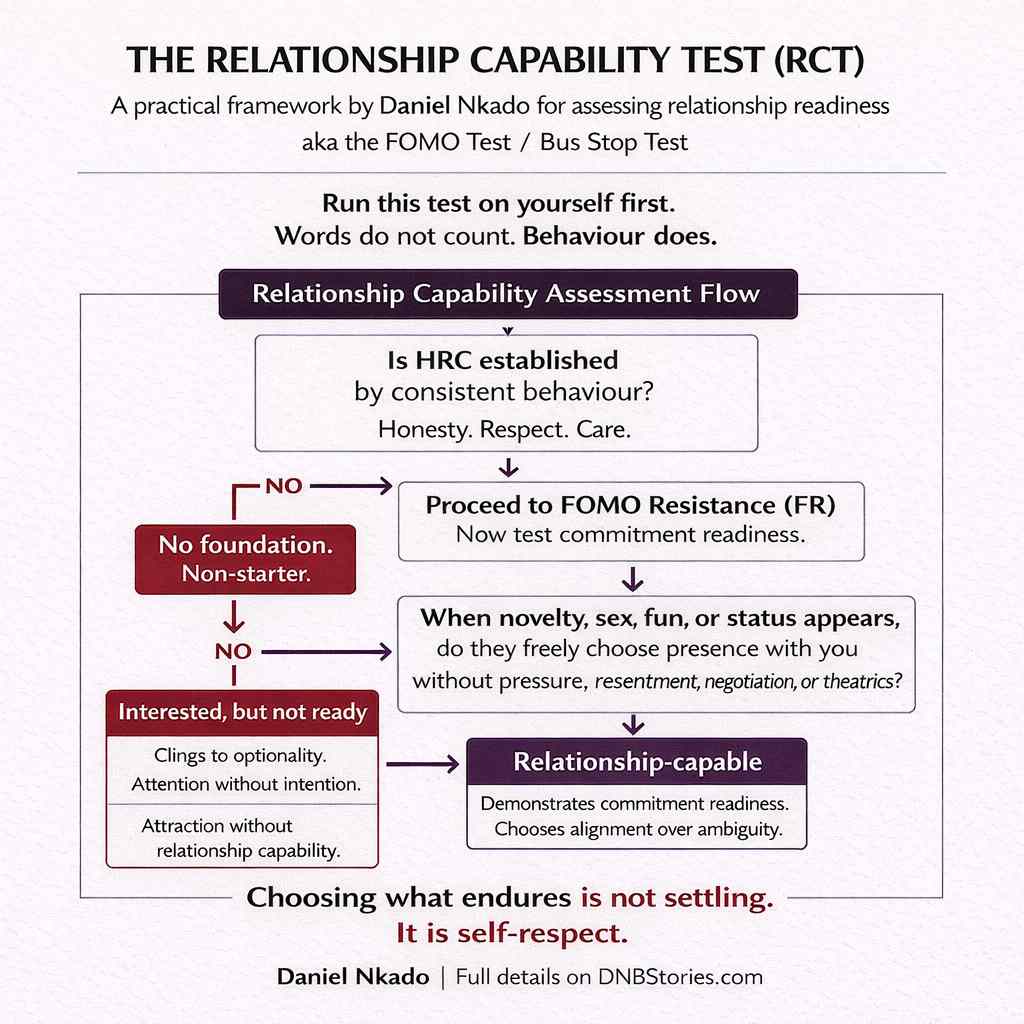
7. The Relationship Capability Test (RCT) by Daniel Nkado
Not everyone who says they want a relationship is actually ready for one—or capable of holding one. For that reason, I developed the Relationship Capability Test (RCT). You could also call it the FOMO Test, or, more informally, the Bus Stop Test.
Each name points to the same question: not Do they want a relationship? ❌
But can they actually choose one and stay in it? ✔️
How to Carry Out the Relationship Capability Test (RCT)
You must run the Relationship Capability Test (RCT) on yourself first—and pass it—before running it on anyone else.
RCT has two test stages:
1. Emotional Capacity (EC)
This checks whether the relational basics are actually present.
2. FOMO Resistance (FR)
This checks commitment capability: whether someone can choose a relationship and remain inside that choice while other options still exist.
Step 1: Emotional Capacity (EC)
Look for patterns of behaviour, not verbal performance. In the RCT, words are treated as verbal branding. They may describe intention, but they do not prove capacity.
There are 6 core Emotional Capacity qualities:
- Honesty
- Respect
- Care
- Follow-through
- Emotional steadiness
- Ability to repair conflict
Baseline rule
EC has 6 qualities, so the baseline is half the list: 3 out of 6. This minimum baseline is called HRC:
- Honesty
- Respect
- Care
If HRC is missing, stop there. Do not proceed to the next stage. No romantic interpretation, and no “let’s just see where it goes.” Without HRC, there is no viable foundation for a relationship.
The other three qualities—follow-through, emotional steadiness, and repair ability—strengthen the score and tell you whether the person can sustain what their baseline appears to promise.
Step 2: FOMO Resistance (FR)
If HRC is established, proceed to FOMO Resistance.
The key question is:
When a real opportunity for novelty, sex, fun or status appears, do they freely choose presence with you—without pressure, resentment, negotiation, or theatrics?
This is not a test of obedience, sacrifice, or emotional submission. It is a test of commitment readiness.
- If choosing you requires guilt, bargaining, competition, emotional scoring, or repeated reassurance → fail
- If choosing you feels calm, unforced, unprompted, and clean → pass
Someone who can calmly remain present with you, even while alternatives—or the promise of alternatives—still exist, shows that commitment does not feel like deprivation to them. It feels aligned. In relationship science, they are demonstrating commitment readiness: the core evidence of relationship capability, not the passive enjoyment of ambiguity.
RCT Result Card
- HRC + FR = Relationship-capable
- HRC without FR = Interested, but not ready
- No HRC = Non-starter
The more consistently someone passes the FR check over time, the stronger their RCT score.
The Core Principle of RCT
The RCT does not ask: Do you want a relationship?
It asks: Can you choose one—and stay in it—while other options still exist?
That is the difference between chemistry and capability.
8. Why Love Does Not Appear in the RCT
By 30, I stopped using the language of love in dating. Not because I stopped valuing love, but because the word had become too ambiguous—emotionally loaded, non-quantifiable, and dangerously easy to misread. “Love” was saying too much while proving too little. It allowed people to project a gigantic intention without ever demonstrating it, and to signal depth without offering evidence.
So I changed the language. I began using more pragmatic terms: care, honesty, and consistency. Not because they are colder, but because they are clearer. They are observable. Verifiable. They reduce the interpretive load and heighten clarity.
Care is not a feeling. It is behaviour.
Honesty is not a vibe. It is truth told even when inconvenient.
Consistency is not intensity. It is repeatable behaviour that becomes predictable over time.
Love Without Care is Manipulation
The decision to drop love from my dating register is deliberate. Love invites fantasy. It can be claimed early and withdrawn easily. In practice, it is often a marketing word used to cover the absence of action. Care is visible. Its impact can be tested. When someone shows up, follows through, repairs harm, and consistently tells the truth, there is little ambiguity about what is happening.
Love does not appear in the Relationship Capability Test because RCT does not measure emotional declarations or verbal performance. It measures relational behaviour. At this stage of life, I am less interested in how someone says they feel about me and more interested in how they treat me—especially after novelty fades.
Conclusion
Intentional dating does not guarantee you will find a partner. It does something more basic: it protects your peace. For Black gay men over 30, dating success may look quieter than the apps suggest. It may mean fewer connections, clearer conversations, less anxiety, and greater emotional stability. It may mean refusing to confuse admiration with safety, intensity with care, or availability with readiness.
In this sense, intentionality is not rigidity. It is discernment—the decision to stop treating desirability as proof and to start paying attention to patterns that actually sustain intimacy. In a dating culture fueled by FOMO, choosing what endures is not settling.
It is high‑class wisdom practised by those who understand the cost of distraction.
References
- Frost, D. M., & Meyer, I. H. (2023). Minority stress theory: Application, critique, and continued relevance. Current Opinion in Psychology, 51. https://doi.org/10.1016/j.copsyc.2023.101579
- Hadden, B. W., Agnew, C. R., & Tan, K. (2018). Commitment Readiness and Relationship Formation. Personality and Social Psychology Bulletin, 44(8), 1242–1257. https://doi.org/10.1177/0146167218764668
- Mikkelson, A. C., & Pauley, P. M. (2013). Maximising Relationship Possibilities: Relational Maximisation in Romantic Relationships. The Journal of Social Psychology, 153(4), 467–485. https://doi.org/10.1080/00224545.2013.767776
- Pronk, T. M., & Denissen, J. J. A. (2020). A Rejection Mind-Set: Choice Overload in Online Dating. Social Psychological and Personality Science, 11(3), 194855061986618. https://doi.org/10.1177/1948550619866189
- Stanley, S. M., Rhoades, G. K., & Whitton, S. W. (2010). Commitment: Functions, Formation, and the Securing of Romantic Attachment. Journal of Family Theory & Review, 2(4), 243–257. https://doi.org/10.1111/j.1756-2589.2010.00060.x
- Thomas, M. F., Binder, A., & Matthes, J. (2022). The agony of partner choice: The effect of excessive partner availability on fear of being single, self-esteem, and partner choice overload. Computers in Human Behaviour, 126, 106977. https://doi.org/10.1016/j.chb.2021.106977
Frequently Asked Questions
The Bus Stop Effect is a common pattern in gay dating where two men remain in romantic contact without moving into a committed relationship, often driven by the belief that something better is still coming.
Dating apps make commitment harder by creating the illusion of endless alternatives. This often increases comparison, hesitation, and fear of choosing the wrong person.
Situationships often feel harder after 30 because people usually have less patience for ambiguity and a sharper awareness of emotional cost. Delayed clarity feels more draining at this stage of life.
The Relationship Capability Test is a framework developed by Daniel Nkado for assessing whether someone is truly ready and able to sustain a relationship. It measures emotional capacity and resistance to FOMO.
Love is not included in the Relationship Capability Test (RCT) because it is easy to claim but difficult to verify. The test focuses on observable behaviour such as care, honesty, consistency, and repair.