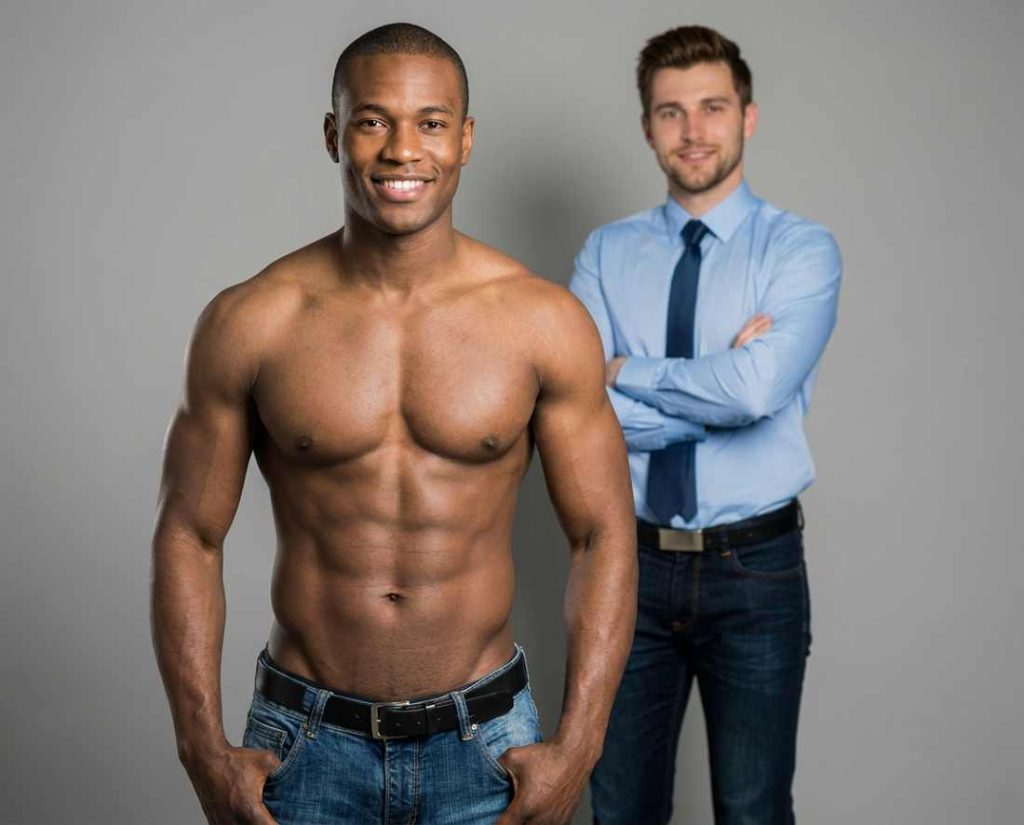
Malik’s phone lit up with messages the way it always did—fire emojis, quick compliments, the same shorthand that reduced him to a silhouette. He had just posted a photo from a book reading with a caption about the new novel he loved. The replies he got, however, kept circling the same questions about his lean frame, ‘bulge’, and masculine pose. After a while, he stopped mentioning books altogether.
“It felt like I was advertising a product,” he told me. “So I learned to hide the library.”
That sentence—I learned to hide the library—captures a deep and often overlooked harm in queer dating culture.
It is not simply that people have become shallow. It is the stark reality that intellect is routinely erased as a legitimate marker of status for Black gay men, both in interracial contexts and, more critically, within Black queer communities themselves.
The White Mind vs. Black Body Divide
Historically, Black people have primarily been viewed as physical or sexual beings (bodies), while White men were seen as the embodiment of intellect and reason (minds). This false hierarchy, born of slavery and colonialism, has endured in modern societies, dictating how the value of Black people is perceived across cultures and even among themselves.
White people = Minds—fit for civilisation, leadership, and full humanity.
Black people = Bodies—fit for physical labour, toughness, and aggressive sex.
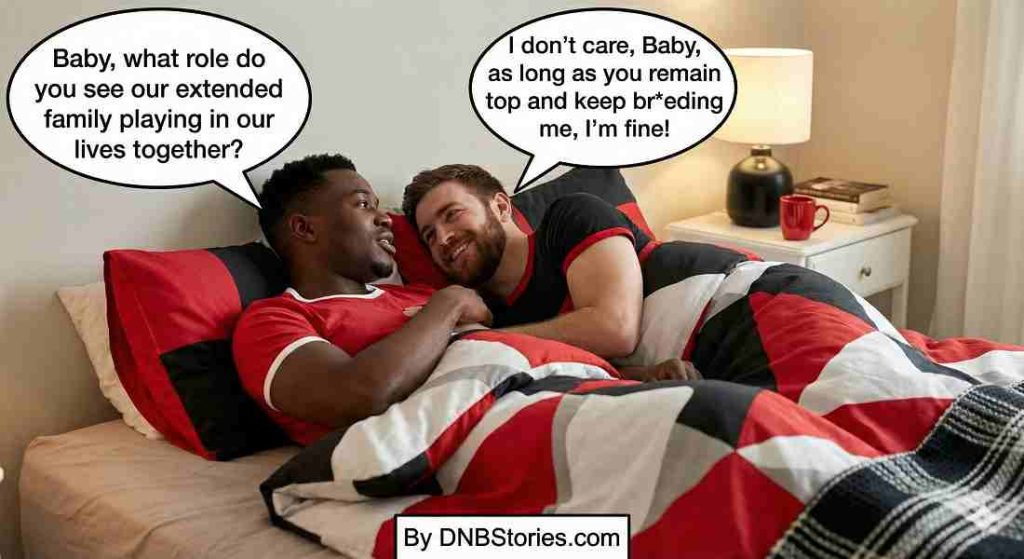
When Black gay men are objectified on apps like Grindr (“come and breed me”) or conditioned into using labels like “dominant top” or “aggressive top” to claim high status, reducing their overall value to sexual performance, we are reenacting a 400-year-old colonial script. I call it our small contribution to keeping things the way the slave masters made them.
Black Literacy: The Threat of a Thinking People
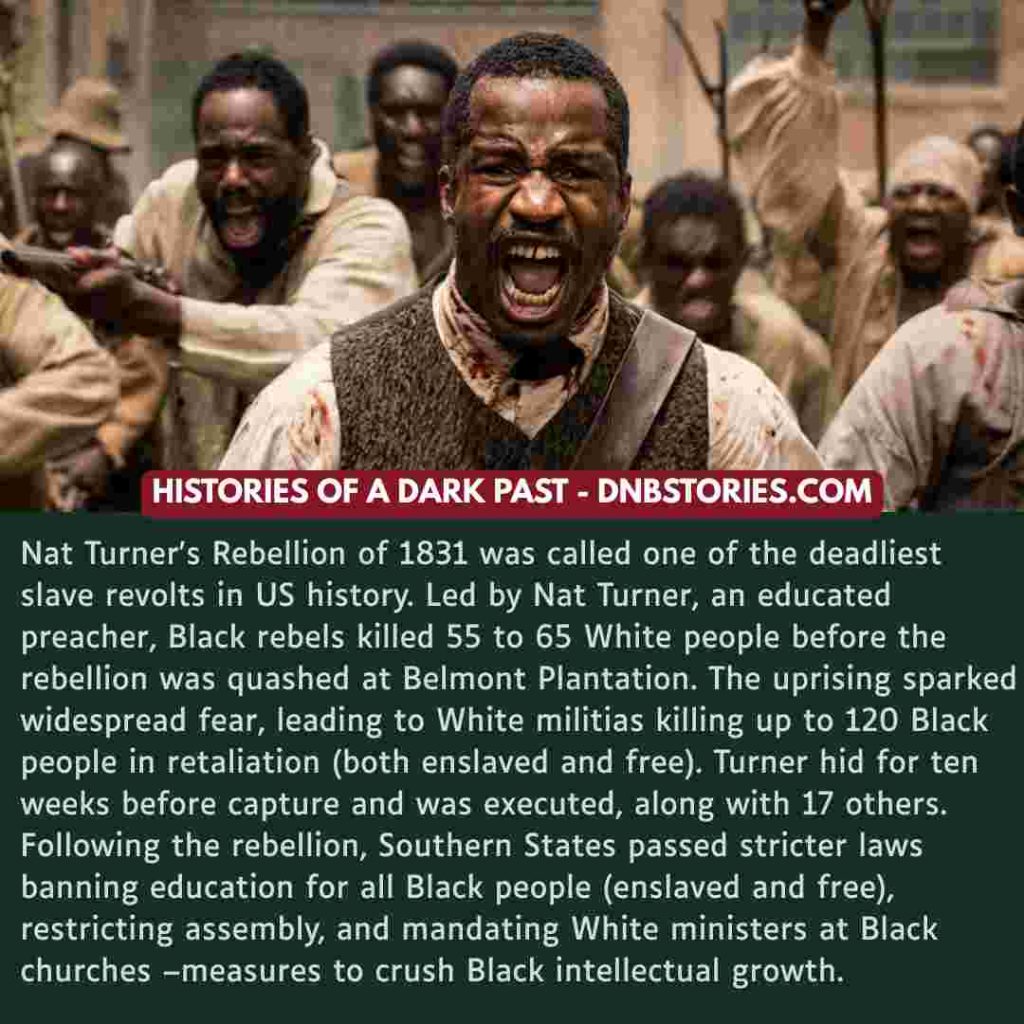
For centuries, enslavers feared Black literacy, viewing it as the main, if not the only, threat to the institution of slavery. To ensure enslaved people did not become literate, they criminalised teaching them to read and write. Social reformer Frederick Douglass wrote that learning to read and write made him “unfit for slavery” by making him understand the injustice of his condition (Douglass, 2006)2.
My Dad put it succinctly when he often said:
“The white man who imagines himself as better than every other race was never afraid of the Black man’s physical strength. He knew that, with something as small as a whisper, he could turn the Black man against his own kin.
What sent a deep chill through him was the realisation that, just like him, the Black man had something in his head.
He knew a man like that he could not easily manipulate.”
Erasure of Black Minds: A Calculated Strategy
At slavery auction blocks, slave traders paraded Black men and intending buyers valued and priced them based on their bodies and physical strength. Enslavers rewarded signs of endurance, toughness, and rugged masculinity—traits that translated to more profit on the plantations. They dismissed cognitive ability, emotional depth and intellect in enslaved me—sometimes treating them as dangerous or criminal.
The suppression and dismissal of Black intellect was not an accidental byproduct of slavery; it was the foundational pillar of the system itself. An educated enslaved person is a threat to the entire system.
When enslaved Black men consistently saw their value tied to their bodies and physical strength, they began to see intellect as something that had no value and would only bring trouble. To make matters worse, anti-literacy laws made it criminal to pursue learning. This environment created conditions that promoted deeper internalisation of the myth of Black inferiority, giving enslavers even more power to maintain control. In this way, White supremacists built a system that erased intellect as a valid source of respect, authority, or status for Black men (Jorati, 2025)4.
The echoes of this system are still visible today.
It is reinforced each time we:
- mock a Black brother’s academic achievement or articulate speech as “talking white”,
- dismiss curiosity or emotional nuance as “acting soft and bougie”,
- treat “rugged masculinity” as a prize,
- equate “authentic Blackness” with a type of street masculinity,
- continue to pick body over mind, even amongst ourselves.
- discard a Black person over the size of their penis, not being “top” enough, or acting too “soft”.
How Black Gay Culture Re-enacts Old Oppressive Systems
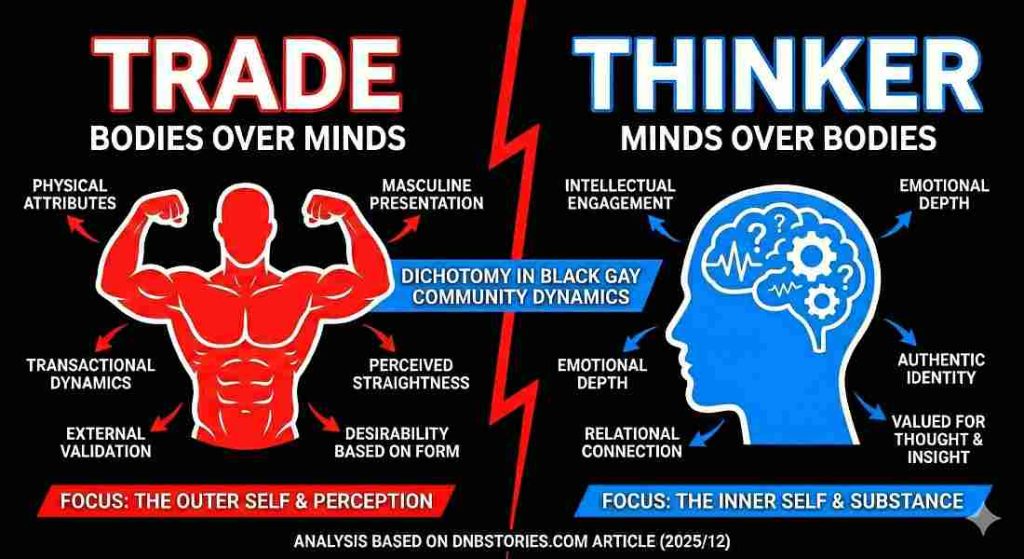
This is the part we don’t always want to face: The internal desirability cultures within Black LGBTQ+ communities frequently mirror the same oppressive systems—particularly the mind–body script that has long been used to dehumanise Black people.
C. Winter Han’s work on sexual racism shows that so‑called sexual preferences are deeply political, shaped by racial hierarchies that influence desire, belonging, status, and self‑worth among gay men of colour (Han, 2021)3.
a. Trade Over Intellect
In many Black gay spaces, there is a cultural premium placed on “trade”—a performance of masculinity tied to heterosexuality, street culture, and hyper‑masculine aesthetics. Within this framework, intellect, softness, and emotional or cognitive depth are often minimised, dismissed, or even penalised.
Calling intellect a white trait is an insult to our ancestors who stole torn pages from their enslavers’ libraries, hid them in their clothes, and taught themselves to read in the shadows.
b. The “Acting White” Trap
A Black man who leads with his intellect, takes pride in his academic achievements or speaks articulately may be accused of “acting white” or “bougie.” His Blackness is questioned because it does not align with the “rugged” archetype of the plantation Buck (Collins, 2004)1.

If Black people were truly inherently averse to knowledge, why the fear? Why pass laws banning Black literacy—why whip, jail, and criminalise learning—if enslavers genuinely believed Black people were incapable of it?
c. Femmephobia and Anti-Intellectualism
Femmephobia goes beyond the hatred of feminine qualities.
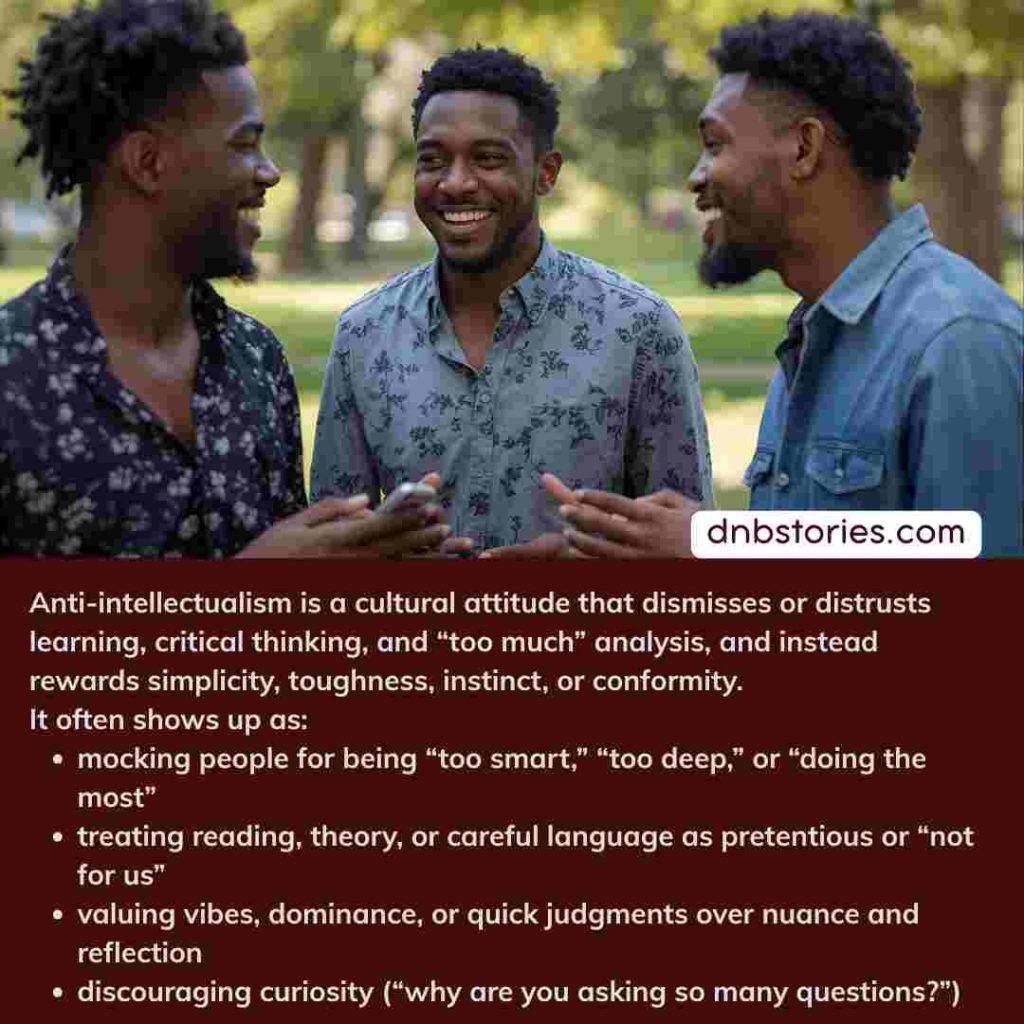
Intracommunity femmephobia reinforces anti-intellectualism by punishing the very traits that make intellectual intimacy possible—reflection, nuance, emotional and articulate literacy—while at the same time elevating hardness, dominance and stamina as authentic Black masculinity. This mirrors the same colonial mind/body script that historically cast Black men as bodies rather than minds. The result is a status hierarchy where outward display of strength/power is valued over intellectual depth (performance over substance).
Relatable real-world example:
A Black man with a PhD, a love for cinema, or a gentle emotional nature may find that these traits do not “count” toward desirability on apps like Jack’d. To be desired by his own community, he may feel pressured to perform a “hood” aesthetic that does not reflect who he is.
Why We ‘Hide the Library’: A Protective Adaptation
When Black men realise that leading with their minds yields fewer matches—or worse, leads to rejection, negative messages or instant blocking—two things usually happen:
- Some Adapt and Edit:
- They start showing the world exactly what it rewards: bios shrink, wit and curiosity get muted, and the grid fills with abs, rugged poses, and carefully curated hardness. And truly, no one performs better than a Black gay man who has both the body and the mind.
- Others Simply Leave:
- For them, their essence matters more than joining a troupe of performers, and stepping away becomes an act of self‑preservation rather than defeat.
In a Chicago sample of young MSM and young transgender women (aged 16-29), Grindr use was significantly higher among White non‑Hispanic participants (75.6%) than among Black non‑Hispanic participants (36.5%). When the most dominant platforms don’t feel equally usable—or equally welcoming—people respond in predictable ways: some reshape themselves to match what the platform rewards, while others withdraw entirely to protect their dignity (Risher et al., 2024)5.
Other studies on app‑based sexual racism and fetishisation show similar patterns: men of colour report being boxed into racialised stereotypes, reduced to body parts, and denied fuller intimacy—particularly in digital spaces where whiteness operates as the default ideal (Stacey et al., 20216; Wade et al., 2022)7.
Rethinking Intellect and Masculinity in Black Queer Life
Ending the erasure of intellect requires a cultural shift in how we see and value Black men—both externally and internally.
Brains Are Masculine Too: Rewriting the Script
Black queer masculinity has been trapped inside narrow scripts about what counts as authentic, strong, or desirable Black manhood. No matter what anybody tells you, intellect, tenderness, and emotional depth do not weaken masculinity. They make it fuller. Rewriting the script means refusing those limits and building a better standard of connection.
Rethinking Authenticity: Beyond the “Trade” Aesthetic
For too long, Black masculinity has been reduced to hardness, “trade worship”, and hypermasculine performance. Softness, the quirkiness that comes from being queer, and “nerdy” interests get treated as suspect or low-status, even though Blackness has always held tenderness, nuance, art, intelligence, and ambition. Authenticity is not hardness alone. It supports both range and complexity.
To shift the culture, Black queer men must affirm that range out loud. In group chats, DMs, and everyday conversation, praise softness and intellect. Say, “I really like how you think”, not only “How big is it?”
Redefining Strength: Emotional Articulation Is Power
Another old script treats emotional language and thoughtful questions as “doing too much,” while silence gets mistaken for strength. The result is that connections become shallow as people are forced to hide what they feel in order to appear “easy to be around”. When emotional literacy feels risky, men fall back on body talk and surface jokes just to stay safe. But curiosity is not weakness. Thoughtfulness and emotional clarity are masculine strengths. Change the reward system. Make “Your mind is sexy” as normal as “You’re fine,” and ask one real question before asking for a picture.
Reclaiming Intellect: Brilliance Belongs to Blackness
One of the most damaging lies told to Black men is that intellect sounds white. Articulate speech, academic interests, and intellectual confidence are too often read as “bougie” or inauthentic. That pressure teaches men to edit themselves to avoid peer policing. But Black brilliance is not borrowed. It is ancestral.
Strategy, storytelling, invention, and scholarship already belong to Black life, long before colonial systems tried to position intelligence as white property. So please, drop the gatekeeping, brother. When you catch yourself thinking, “He sounds white,” interrupt the reflex and replace it with: “Let him be brilliant. It is our culture.”
Revaluing Softness: Dismantling the Fear of the Femme
Another harmful script frames femme, soft, or tender traits as weak and treats sensitivity as a threat to Black men’s social value. The cost is intimacy and care. Reflection, empathy, and vulnerability get treated as liabilities rather than strengths.
But softness is not weakness. It never has been. It is infrastructure, holding trust, care, and depth together. Reward emotional honesty. Refuse to mock earnestness. Normalise care for yourself and those around you. Stop using survival, violence, and hardship as proof of Black masculinity. Soft life has always been Black.
Reframing Status: Role Is Not Rank
A final script equates dominance with status, as though being a “Top” or “Dom” makes someone inherently superior. That logic breeds performance anxiety and pushes men toward status protection over connection. It turns sexual roles into hierarchy, borrowing from racial logics that have long reduced Black men to unintelligent, hypersexual bodies fit only for labour, aggression, and sex.
But role is not rank. A sexual position describes mechanics, not masculinity, intellect, or human worth. Separate the role from the soul. Stop reading a whole personality from a label. Ask what someone actually likes, not what they are.

Conclusion: Black genius is not a myth
The goal is not to stop finding our bodies attractive—it is to stop pretending that the body is the only thing a Black man brings to the table. Because it is not.
True intimacy needs intellectual connection. Refusing to engage with a Black man’s mind is a continuation of historical dehumanisation. The Black gay community must take active steps to restore value in both acquiring intellect and showcasing it. It is time to put the library back in the profile. More importantly, it is time for the Black gay community to recognise the value of what is on those shelves.
References
- Collins, P. H. (2004). Black Sexual Politics. Routledge. https://doi.org/10.4324/9780203309506
- Douglass, F. (2006). Narrative of the Life of Frederick Douglass, an American Slave. In Project Gutenberg (Original work published 1845). Signet Classics. https://www.gutenberg.org/ebooks/23
- Han, W. C. (2021). Racial erotics: gay men of colour, sexual racism, and the politics of desire. Seattle University Of Washington Press. https://uwapress.uw.edu/book/9780295749099/racial-erotics/
- Jorati, J. (2025). The Effects of Slavery on Enslaved People and Eighteenth-Century Antislavery Arguments. Journal of Modern Philosophy, 6(2). https://doi.org/10.25894/jmp.2498
- Risher, K., Adams, M. A., & Greene, G. J. (2024). Racial and ethnic differences in mobile app use for meeting sexual partners among young men who have sex with men. JMIR Public Health and Surveillance, 10, e54215. https://publichealth.jmir.org/2024/1/e54215
- Stacey, L., & Forbes, T. D. (2021). Feeling Like a Fetish: Racialised Feelings, Fetishisation, and the Contours of Sexual Racism on Gay Dating Apps. The Journal of Sex Research, 59(3), 1–13. https://doi.org/10.1080/00224499.2021.1979455
- Wade, R. M., & Pear, M. M. (2022). A Good App Is Hard to Find: Examining Differences in Racialised Sexual Discrimination across Online Intimate Partner-Seeking Venues. International Journal of Environmental Research and Public Health, 19(14), 8727. https://doi.org/10.3390/ijerph19148727