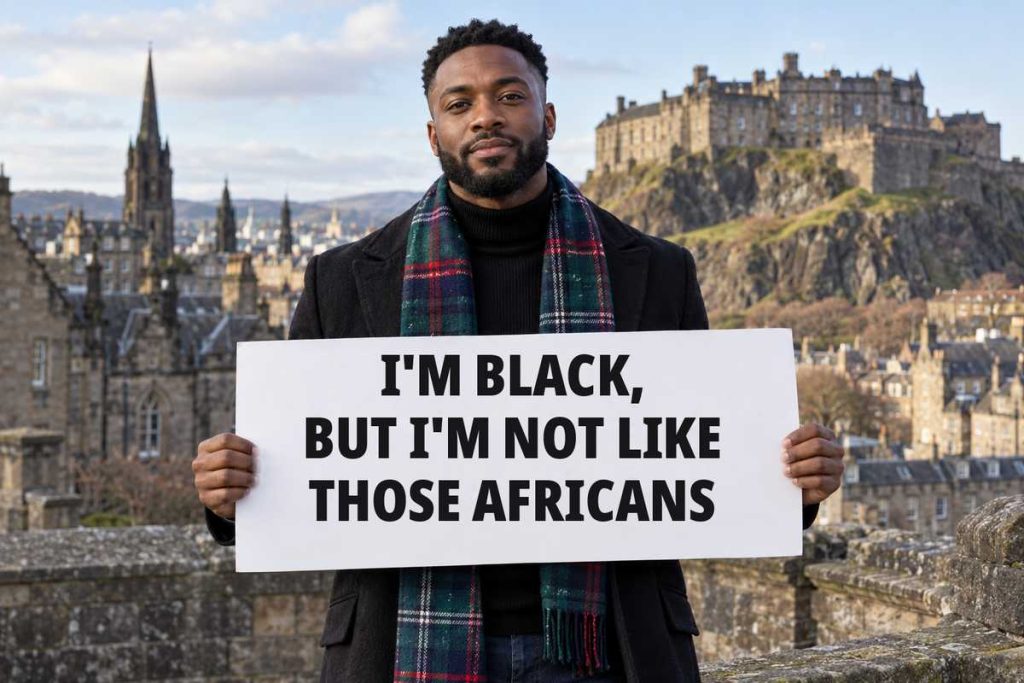
What happens when a Black person begins treating other Black people as a threat to their own social acceptance?
- What Is “Black Stigma”, and Who Created It?
- The Connection Between Racialised Shame and Black Stigma
- Why Some Black People Feel the Need to Prove They Are Different
- The Psychology of “I'm Not Like Other Black People”
- How Distancing From Black Stigma Can Reinforce Racism
- The Difference Between Individuality and Internalised Racism
- Research Foundation and Further Reading
Racial stigma does not affect everyone in the same way. While some Black people challenge the stereotypes attached to their identity, others may negotiate them, resist them only in private or attempt to minimise their exposure to discriminatory treatment.
But a more troubling response can emerge when a Black individual begins treating association with other Black people, or certain expressions of Blackness, as something that could diminish their own social standing.
Rather than challenging the racial prejudice that produces the stigma, they may attempt to escape its consequences by demonstrating that they are different from the people being stigmatised.
This creates a peculiar psychological arrangement in which a Black person seeks protection from racial prejudice rather than rejecting the assumptions that sustain it. Some may do this by participating in the social distancing, judgment or the discrediting of other Black people, or certain versions of Black life.
Understanding this behaviour requires examining not only how racism shapes the treatment of Black people, but also how some Black people come to perceive, evaluate and rank themselves according to standards shaped by white racial hierarchies.
What Is “Black Stigma”, and Who Created It?
The phrase Black stigma, as used in this article, refers to negative stereotypes, assumptions and social judgments attached to Black racial identity.
These may include historically constructed associations between Blackness and criminality, intellectual inferiority, aggression, poverty, poor education or cultural backwardness.
Such stereotypes are not inherent characteristics of Black people. They are racialised social judgments shaped and reproduced through historical inequalities, institutional practices, political stereotyping and unfair representations.
The effects can extend beyond direct discrimination. When particular accents, hairstyles, cultural expressions or ways of speaking are repeatedly treated as less respectable, some Black people may begin concealing, modifying or distancing themselves from aspects of their identity that attract negative attention.
In societies where whiteness has historically been associated with authority, refinement and professionalism, some Black people may feel pressured to demonstrate their own “refinement” by visibly distancing themselves from behaviours stereotypically associated with Blackness, hoping to gain social acceptance or status in the process.
Black stigma does not originate in Black identity. It emerges from the social meanings imposed upon that identity. Yet the psychological burden of navigating those meanings frequently falls on the very people being stigmatised.
The Connection Between Racialised Shame and Black Stigma
Black stigma and racialised shame are closely related, but they are not the same.
While Black stigma refers to negative social meanings imposed upon Black identity, racialised shame can develop when individuals begin experiencing aspects of their identity as embarrassing, undesirable or socially diminishing.
Not everyone exposed to racial stigma internalises it. But when repeated negative judgments become psychologically influential, some Black people may begin distancing themselves from the cultural expressions, behaviours or social associations that attract those judgments.
Racialised shame may not always appear as an open rejection of Black identity. Sometimes, it manifests as an intense desire to be perceived as a different, more acceptable kind of Black person.
Why Some Black People Feel the Need to Prove They Are Different
One response to “Black stigma” is to attempt to escape its consequences through individual distinction.
The danger emerges when this distinction depends on distancing oneself from Blackness, or certain expressions of Black identity, while treating white recognition or proximity as evidence of superior social standing.
This does not necessarily mean the individual dislikes being Black. Sometimes, the impulse is less about rejecting Black identity than avoiding the shame, suspicion or negative judgment associated with it.
A Black person may genuinely appreciate their racial identity while simultaneously feeling pressured to distance themselves from aspects of Black life that attract social stigma.
In my book Black & Shameless, I explore this relationship between racialised shame, social acceptance and the psychological pressures that can make some Black people feel compelled to prove they are different.
“To be Black is to be shamelessly Black.”
— Daniel Nkado, author of Black & Shameless
Social psychologists describe a related process as self-group distancing: a response in which members of stigmatised groups seek to improve their individual standing by distancing themselves from the group or characteristics associated with its negative social status.
In a 2020 review, Ruth van Veelen and colleagues examined how self-group distancing can function as a coping mechanism within unequal social environments.
Their analysis suggests that distancing may sometimes offer short-term individual advantages while potentially reinforcing existing inequalities.
Applied to racial identity, this distinction becomes crucial.
A Black person may attempt to escape racial stigma by presenting themselves as an exception, without questioning why the wider group is considered inferior in the first place.
The individual becomes invested in proving that they are not like the people being stereotyped, while the stereotype itself remains intact.

The Psychology of “I’m Not Like Other Black People”
The statement “I’m not like other Black people” can communicate more than genuine differences in personality, upbringing, interests or cultural preferences. In racially hierarchical environments, it can become an attempt to secure acceptance through separation from stigmatised aspects of Blackness.
Consider a Black professional who repeatedly emphasises that they do not behave like other Black people. They may describe themselves as more sophisticated, less confrontational, better exposed to other cultures or more comfortable in predominantly white social environments.
The problem is not being different. It is treating one’s difference as evidence that other Black people deserve the stigma attached to them.
This form of distancing can create a sense of conditional safety.
The individual may come to believe that discrimination is less likely to affect them because they have successfully distinguished themselves from the negative stereotypes associated with their racial identity.
But racial prejudice does not necessarily respect the distinctions individuals make within their own communities. A person may reject the stereotypes associated with Blackness and still experience racial discrimination.
The social hierarchy they hoped to escape may continue to judge them through their Black identity, regardless of how hard they have worked to distance themselves from any stigma attached to it.
How Distancing From Black Stigma Can Reinforce Racism
Distancing oneself from racial stigma may seem like an individual solution to an individual problem. But racism operates through collective classifications that are not necessarily overridden by individual differences.
If a Black person responds to negative stereotypes about Blackness by claiming to be an exception, that response can become a means of preserving the very stereotypes that should be challenged.
The result can be a hierarchy of perceived acceptability within the same racial group.
The pursuit of this acceptability may encourage some Black people to seek endorsement from white social and institutional authorities. White proximity, recognition and cultural assimilation can then become markers of respectability and superior social standing.
In this arrangement, being considered a “respectable Black person” may depend less on personal character or achievement than on perceived distance from versions of Blackness that challenge white centrality.
This connects to my earlier analysis of The Black Market for White Approval, where external recognition can become a source of social status and influence within Black communities.
This is one way racial domination can continue to operate within Black and African communities, even without explicitly discriminatory laws or the direct presence of white authority. The hierarchy survives through the social standards people have learned to reproduce within their own communities.

The Difference Between Individuality and Internalised Racism
Not every Black person who distances themselves from a particular cultural environment is experiencing internalised racism. Black people are not a culturally uniform population. They differ in nationality, ethnicity, language, religion, class, personality, values and personal experiences.
A Black person may prefer different social environments, reject particular cultural expectations or criticise harmful practices within their community without rejecting Black identity. Similarly, someone who changes their accent or professional presentation to navigate an unequal institution may be exercising practical judgment rather than expressing racial self-hatred.
The important question to examine is whether an individual is making independent choices or simply treating the racial devaluation of other Black people as legitimate. A Black person can develop an independent identity without using other Black people as the negative comparison through which that independence is established.
The goal should not be to become the Black person who escapes racial stigma by proving that other Black people deserve it. The goal should be to challenge the legitimacy of the stigma itself.
Research Foundation and Further Reading
1. Van Veelen, R., Veldman, J., Van Laar, C., and Derks, B. (2020). Distancing from a Stigmatized Social Identity: State of the Art and Future Research Agenda on Self-Group Distancing. European Journal of Social Psychology.
https://doi.org/10.1002/ejsp.2714
2. David, E. J. R., Schroeder, T. M., and Fernandez, J. (2019). Internalized Racism: A Systematic Review of the Psychological Literature on Racism’s Most Insidious Consequence. Journal of Social Issues.
https://doi.org/10.1111/josi.12350
3. Higginbotham, E. B. (1993). Righteous Discontent: The Women’s Movement in the Black Baptist Church, 1880–1920. Harvard University Press.
https://books.google.com/books/about/Righteous_Discontent.html
4. McCluney, C. L., et al. (2021). To Be, or Not to Be…Black: The Effects of Racial Codeswitching on Perceived Professionalism in the Workplace. Journal of Experimental Social Psychology.
https://doi.org/10.1016/j.jesp.2021.104199
5. Branscombe, N. R., Schmitt, M. T., and Harvey, R. D. (1999). Perceiving Pervasive Discrimination Among African Americans: Implications for Group Identification and Well-Being. Journal of Personality and Social Psychology.