
A Sexual Act Is Not a Full Identity
There is a common mistake people make when discussing sexuality. They treat a sexual act as if it were the same thing as a person’s complete identity.
It is not.
Having sex with men and being gay can overlap, but they are not identical. One is behaviour. The other relates to orientation, identity, attraction, self-understanding, community, and sometimes language.
A person’s sexual behaviour can tell you something about what happened. It cannot tell you everything about who that person is. This distinction matters because unclear or careless language can create harm, fuel shame and encourage outing. It can turn private behaviour into public accusation or make people panic about experience rather than think clearly about desire, consent, safety, and self-knowledge.
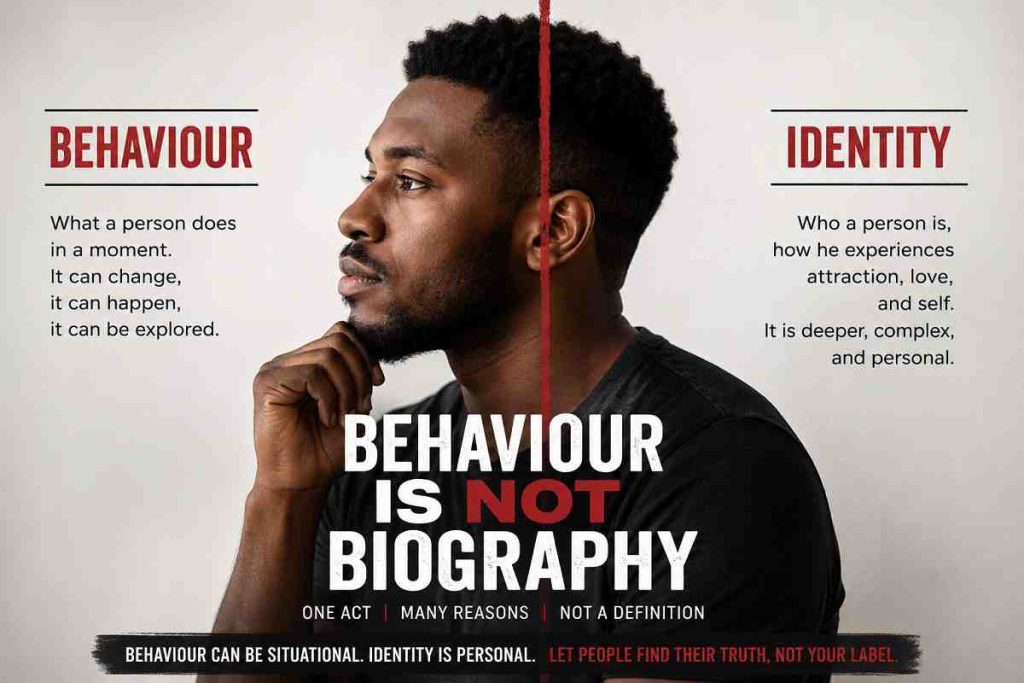
A sexual act is behaviour, not a full biography. This article explains the difference between attraction, identity, sexual behaviour, and sexuality—and why treating them as the same thing fuels stigma, shame, and harm.
- A Sexual Act Is Not a Full Identity
- The Four-Layer Difference: Attraction, Identity, Behaviour & Sexuality
- The Intersection: Alignment and Misalignment
- Why Sex With Men Doesn’t Automatically “Make” You Gay
- Why Sex Does Not Prove Gay Identity
- Why This Confusion Creates Stigma and Other Bad Outcomes
- Why Straight Men Cannot Be “Converted” Into Gay Men
- Why Some Gay Men Become Obsessed With Straight Performance
- The Trap of Chasing Straightness
- Why Clear Sexuality Language Matters Under Nigeria’s SSMPA Law
- Better Questions Than “So What Are You?”
- Frequently Asked Questions
- References
The Four-Layer Difference: Attraction, Identity, Behaviour & Sexuality
The clearest way to understand this is to separate four related but different concepts.
a. Attraction
Attraction is about desire. It refers to who you are emotionally, romantically, or sexually drawn to—the patterns that keep showing up in your body, imagination, longing, affection, or intimacy. In many cases, attraction marks a man’s earliest recognition of his sexual orientation, long before he has the language to name it.
b. Identity
Identity is about self-recognition and language. It is the word, if any, a man uses to make sense of himself: gay, bisexual, queer, straight, questioning, unlabeled, fluid, or something else. Identity often grows out of self-understanding. In many cases, it also carries some truth about self-acceptance, because the man is no longer only feeling something privately; he is beginning to name it, organise it, and recognise himself through it.
c. Sexual Behaviour
Sexual behaviour is about what a man does sexually. It refers to who he has sex with, what experiences he has had, and the choices, pressures, curiosities, risks, or contexts that shaped those encounters.
A man may kiss another man out of curiosity without that automatically meaning he is gay. He may engage in a sexual act because of pressure, opportunity, survival, secrecy, or the promise of reward. He may have once understood himself as fully straight, only to later recognise that his sexuality is more complex than he first believed. An otherwise straight man may become emotionally attached to another man and struggle to separate intimacy, admiration, intensity, and desire.
d. Sexuality / Sexual Orientation
Sexuality, or sexual orientation, is the deeper pattern that helps explain a man’s attraction, identity, and behaviour.
It refers to the enduring internal frame that shapes romantic, emotional, or sexual desire. A man may recognise it early, struggle with it for years, deny it because of fear or shame, or only find language for it after certain experiences. But sexual orientation is not created by one isolated act. It is revealed through the wider pattern of desire, recognition, and self-understanding.
The Intersection: Alignment and Misalignment
These four layers can align. A man may be attracted to men, identify as gay, understand his sexual orientation as gay, and have sex with men. In that case, attraction, identity, orientation, and behaviour are moving in the same direction.
But they do not always align so neatly.
A man may have sex with men and still not identify as gay. A man may be gay and celibate. He may be attracted to men but avoid acting on that attraction because of religion, fear, culture, family pressure, safety concerns, shame, or internal conflict. He may experiment once and later realise that the experience did not reflect a deeper pattern of desire. Another may have many encounters before finding the language that fits him.
Human sexuality is not a courtroom where one act becomes permanent evidence.
I have explored this complex idea across multiple works, including my fiction. In Something Bigger Than Love, for example, the main character, Obinna, has a sexual experience with another man when he is younger, even though he is not gay. That experience matters, but it does not define him completely. It becomes one part of his story, not the final verdict on his identity.
Why Sex With Men Doesn’t Automatically “Make” You Gay
A man having sex with another man does not automatically mean he is gay.
It may mean he is gay. It may mean he is bisexual, questioning, experimenting or acting on his curiosity. In other cases, it could mean that the encounter occurred under pressure, in secrecy, for survival, amid loneliness, during intoxication, through coercion, out of opportunity, from curiosity, or amid emotional confusion. It may also mean he is still working out what the experience means to him.
This is why “gotcha” sexuality politics is so harmful. People see one act, one rumour, one message, one video, one confession, or one encounter, and immediately rush to assign a permanent identity.
But behaviour is not the same as self-understanding.
MSM Describes Behaviour, Not Identity
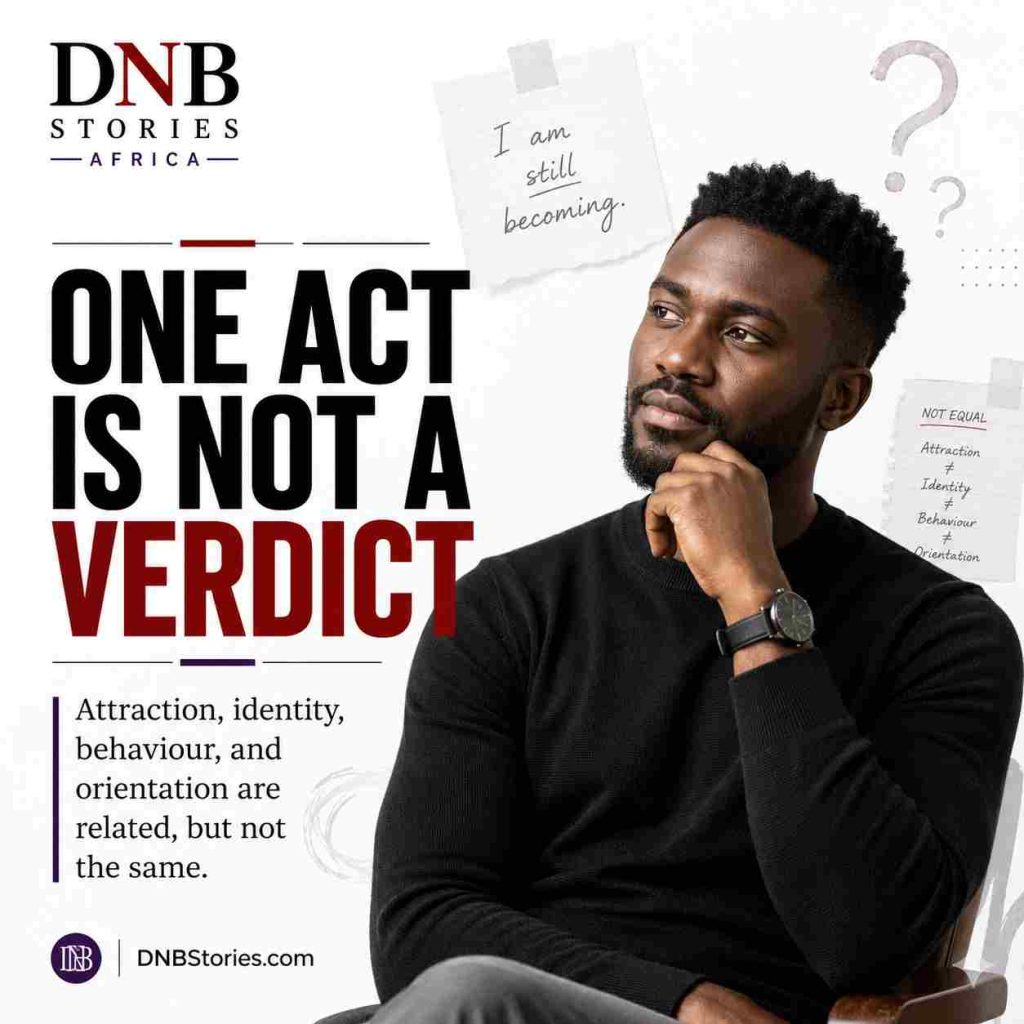
There is a reason public health language often uses the term MSM, meaning men who have sex with men. It is not an identity label. It is a behavioural category. The term allows health workers and researchers to talk about risk, prevention, screening, and care without assuming that every man in that category identifies as gay or bisexual. CDC guidance uses MSM in this behavioural and clinical context, especially around STI screening, sexual history, and prevention.
This distinction is important.
A health worker may need to ask, “Do you have sex with men?” because the answer affects sexual health advice. But that is not the same as asking, “Are you gay?” One question is about behaviour and care. The other is about identity and self-recognition.
Confusing the two can make people avoid care. If a man believes that telling a doctor he has had sex with men means he will be labelled, judged, exposed, or morally reduced, he may stay silent. That silence can increase risk. This is one way misunderstood language creates harm.
Why Sex Does Not Prove Gay Identity
The confusion also works in the opposite direction. Some people think being gay must be proved through sexual experience. That is also false.
A gay man who has never had sex is still gay if that is the truth of his orientation and self-understanding. Celibacy does not erase orientation. Virginity does not cancel attraction. Lack of sexual experience does not make a person’s identity imaginary.
This matters especially for young people, religious people, closeted people, traumatised people, people in unsafe environments, people living under homophobic laws, and people still finding language for themselves.
Nobody should have to perform sex in order to be believed. Sexual orientation is not a certificate earned through activity. It is not validated by body count. It is not cancelled by abstinence, and it does not need proof by touch.
A person may know something about their desire before they ever act on it. Many people understand their attraction long before any sexual encounter happens. Others understand it only after years of confusion. Both routes exist. The point is not to force people into labels quickly. And to stop treating sex as the only legitimate evidence of identity.
Why This Confusion Creates Stigma and Other Bad Outcomes
When people collapse attraction, identity, behaviour, and sexuality into one crude label, the consequences are serious.
First, it creates shame. A person with a single experience may spiral into fear because they think one act has permanently defined them. Instead of reflecting honestly, they panic.
Second, it fuels outing culture. People begin to treat private sexual behaviour as public property. They use it as evidence, insult, punishment, or gossip.
Third, it damages consent conversations. When people are too ashamed to speak clearly about desire, limits, risk, and history, communication weakens. Shame does not make sex safer. Silence does not protect anyone.
Fourth, it pushes people away from healthcare. A man who fears being labelled may avoid STI testing, PrEP conversations, HIV prevention, counselling, or honest sexual history discussions. The result is not morality. The result is risk.
Fifth, it traps people inside performance. Some gay men may perform straightness to avoid suspicion. Others may perform queerness before they are ready. Some may turn to denial, some to aggression, and others may attack people around them to hide their own fear.
None of this produces freedom. Clear language does.
Why Straight Men Cannot Be “Converted” Into Gay Men
Some gay men also need to release the fantasy that straight men can be “converted” into gay men through sex, attention, seduction, emotional closeness, or repeated exposure.
This idea misunderstands sexuality in the same way stigma does. If one sexual act does not automatically make a man gay, then sex with a gay man does not magically turn a straight man gay either. A straight man may experiment. He may enjoy attention. He may become emotionally close to another man. A man may even have a sexual experience and later realise it did not reflect a deeper pattern of desire for him.
If a man’s enduring orientation is not toward men, no one can manufacture that orientation for him. Desire can be discovered. It can be admitted, clarified, named and renamed. But it cannot be forced into existence.
This matters because the fantasy of “turning” straight men often produces harm. It can encourage boundary-crossing, emotional manipulation, obsession, disrespect for self-definition, and refusal to accept what a person has clearly said about himself.
The same principle applies both ways: behaviour is not biography, and desire is not something another person gets to impose.
Why Some Gay Men Become Obsessed With Straight Performance
Some gay men become attached not only to men, but to the performance of straightness itself.
This often comes from the same confusion this article has been unpacking. When sexual behaviour, identity, and orientation are collapsed into one, a “straight” man who flirts, accepts attention, experiments, or has sex can begin to look like a hidden prize. His straightness becomes part of the fantasy. The desire is no longer only for the person. It becomes a desire to conquer, decode, or be chosen by straightness.
But a straight presentation is not always a closet waiting to be unlocked. A man may present as straight because he is actually straight. He may present as straight because he is afraid of living his truth. He may present as straight to tap into the false hierarchy and social status that straight-passing labour can offer in some queer communities. A queer man may also use straightness as a performance, a cover, or a source of power. These possibilities are not the same.
The Trap
This is where some gay men get trapped in the straight chase. They mistake ambiguity for depth, secrecy for intimacy, and inconsistency for some weird form of hidden passion. They begin to romanticise poor relational behaviour because they have attached meaning to the performance rather than to the actual health of the connection. This explains how toxic behaviours become fantasy for some gay men
The obsession is rarely just about sex. Sometimes it is about status. Sometimes it is about masculinity validation. Other times, it is about wanting to be chosen by the very standard that society has taught gay men to admire, fear, or measure themselves against.
The Trap of Chasing Straightness
Desire becomes dangerous when it starts ignoring reality. A straight-performing man is not automatically a secretly gay man waiting to be discovered. A queer man who has embraced his truth and lives authentically is not less valuable than one who has spent years investing in straight-passing labour and performative secrecy. And a gay man’s longing does not give him the right to impose identity, meaning, or desire onto someone else.
Freedom from shame begins with honesty. The work is not to chase straightness until it confesses. The work is to choose where truth lives.
Why Clear Sexuality Language Matters Under Nigeria’s SSMPA Law
In Nigeria, clear sexuality language is not only educational. It can also be protective.
Nigeria’s Same Sex Marriage (Prohibition) Act, commonly called the SSMPA, does more than prohibit same-sex marriage. Its wording also targets civil unions, gay clubs, societies, organisations, meetings, and the “public show of same sex amorous relationships.” That broad language means the law can extend beyond marriage to encompass association, visibility, social conduct, and perceived sexuality.
This is why precision matters. Gay, MSM, sexual behaviour, sexual orientation, and identity are not interchangeable terms. A man may have sex with men without identifying as gay. A gay man may not be sexually active. A person may be perceived as queer without publicly identifying as such.
Under a law like the SSMPA, careless language can become dangerous. It can turn suspicion into accusation, gossip into blackmail, and private behaviour into public punishment. Human Rights Watch has reported that the SSMPA intensified vulnerability to extortion, violence, restrictions on organisations, and reduced access to essential services for LGBT people in Nigeria.
So this is not just semantics. In a criminalising environment, clear language can support dignity, safety, access to healthcare, and harm reduction.
Better Questions Than “So What Are You?”
“So what are you?” is often the wrong question.
It sounds direct, but it can also be invasive, impatient, and loaded with judgment. It asks a person to resolve their entire sexuality for someone else’s comfort.
Better questions are slower. More ethical. More human.
Instead of forcing a label, someone might ask better questions.
Instead of asking, “So, are you gay or bi?” ask:
What are you actually drawn to?
Not what will people say? Not what label do you think will destroy you? But what pattern of desire keeps returning for you?
Instead of asking, “So you had sex with a man?” ask:
What did that experience mean to you?
Was it curiosity? Pleasure? Pressure? Connection? Confusion? Survival? Experimentation? A deeper truth? A mistake? A beginning?
Instead of asking, “When did you become gay?” ask:
Do you feel safe enough to think about this honestly?
Shame often pushes people into denial or forced certainty. Honesty requires safety.
Instead of asking, “Why are you hiding who you are?” ask:
What language feels true to you without feeling forced?
Some people know quickly. Others need time. Some use labels. Some do not. The goal is not performance. The goal is clarity.
Instead of saying, “I can’t help you if I don’t know what you are,” ask:
What kind of care or support do you need now?
This may mean STI testing. It may mean counselling. In some cases, it may simply mean a private conversation with someone safe. It may mean rest, safety, or leaving a harmful environment. It may mean learning more before deciding what words fit.
Better questions create better outcomes. They move people away from panic and toward responsibility.
A Necessary Clarification on Secrecy and Harm
This distinction should not be misused to excuse men in safer contexts who turn secrecy into a tool of control. There is a difference between someone navigating fear, stigma, criminalisation, or uncertainty, and someone using concealment, hypermasculinity, or “DL” performance to dominate, deceive, shame, or manage others.
Compassion should never be used as a cover for harm. Clarity should protect vulnerable people, not enable manipulation.
Frequently Asked Questions
Not automatically. Having sex with a man is a sexual behaviour. Being gay is about sexual orientation, identity, attraction, and self-understanding. The two can overlap, but one act does not automatically define a man’s whole identity. A sexual experience may raise questions, but it should not be treated as a final verdict on who a person is.
Because sexual orientation is not proven by sexual experience. A person may recognise who they are drawn to emotionally, romantically, or sexually long before they ever act on that attraction. Many people know their patterns of desire through longing, imagination, affection, emotional attachment, fantasy, or the kind of intimacy they naturally seek. Sex can confirm something for some people, but it is not the only way a person understands themselves.
People live under pressure, fear, shame, religion, family expectations, criminalisation, curiosity, confusion, and safety concerns. A man may feel attraction before he has language for it, have sex before he understands what it means, or identify publicly in a way that protects him. These layers can overlap, but they do not always move at the same speed.
References
- American Psychological Association. (n.d.). Sexual orientation and gender diversity. https://www.apa.org/topics/lgbtq
- American Psychological Association. (n.d.). Sexual orientation. APA Style. https://apastyle.apa.org/style-grammar-guidelines/bias-free-language/sexual-orientation
- Centers for Disease Control and Prevention. (2021). Men who have sex with men (MSM): STI treatment guidelines. https://www.cdc.gov/std/treatment-guidelines/msm.htm
- Schwartz, S. R., Nowak, R. G., Orazulike, I., Keshinro, B., Ake, J., Kennedy, S., Njoku, O., Blattner, W. A., Charurat, M. E., & Baral, S. D. (2015). The immediate effect of the Same-Sex Marriage Prohibition Act on stigma, discrimination, and engagement on HIV prevention and treatment services in men who have sex with men in Nigeria: Analysis of prospective data from the TRUST cohort. The Lancet HIV, 2(7), e299–e306. https://doi.org/10.1016/S2352-3018(15)00078-8