
Content note: This article discusses social manipulation, sex, reputational harm, police involvement, intoxication, racism, sexual shame, and friendship betrayal. Names and identifying details have been changed or withheld. This is a personal account and analysis of my lived experience, not a court finding about any named person.
In this part of my UK Black Queer Social Cruelty Experience, I examine how friendship can become dangerous when access is weaponised.
This article explores triangulation, ressentiment, hypermasculinity, belonging starvation, and the painful process through which a friend can become reachable to a cruel social system.
Find earlier parts HERE.
- Introduction: How a Friend Is Trained to Sell a Friend
- Resistance Needs Strong Inner Grounding
- The Tender Points They Found
- Proximity to Whiteness and the Migrant Hierarchy
- Betrayal as the Price of Belonging
- Where I Also Carry Some Blame
- Lived Experience Is Not Social Literacy
- And So The Conversion Proceeded
- Resentment as Social Currency
- I Have Never Been the One to Hide My Friendships
- Why Inner Safety and Inner Peace Are Paramount
- Friendships Are Great, But They Must Not Replace the Self
- How I Discovered Ray-Jay Was Sabotaging Me
- Onye Osu Imi
- The Meaning of Contempt
- The Confrontation and Aftermath
- What Yellow Containment Meant
- A Young Witch
- Finding Information For The Clique
- Returning Care With Cruelty
- What Ray-Jay Found
- Final Discard
- Returning to Macos-Macho: White Puppet Extraordinaire
- The Last Escort Gathering
- Minority Stress and Concealment Pressure in UK Black Queer Spaces
- Black, Queer, and Still Masculine
- A Fight For Wounded Masculinity
- Ressentiment vs Ordinary Resentment
- Why Ostracism Needs a Reaction
- What This Part Is Really About
- References
Introduction: How a Friend Is Trained to Sell a Friend
I do not believe Ray-Jay entered my life as an enemy. The record of that friendship shows warmth, affection, concern, dependency, laughter, and moments of real care. That is what made the later fracture so painful.
The danger was not that he was fake from the beginning. The danger was that he was reachable.
He had too many tender points: masculine validation, sexual curiosity, party access need, fear, money pressure, belonging starvation, and the desire to remain liked by everyone. In a healthier environment, those would have been ordinary human vulnerabilities. In a manipulative one, they became entry points.
This is how triangulation works in intimate community spaces. It does not always need a formal conspiracy. Sometimes it only needs the right pressure placed on the right insecurity. A friend who still cares about you can begin to act against your safety because someone has made his need for belonging louder than his loyalty.
He Was Not Fake From the Beginning. He Was Just Reachable.
That is the painful truth.
Some betrayals do not begin as betrayal. They begin as weakness, hunger, fear, insecurity, and poor boundaries. A person does not have to hate you to become useful to those harming you. Sometimes, all they need is a tender point that someone else knows how to press.
And once that tender point is activated, the friendship begins to change shape. What once looked like care would start to resemble mere access-seeking. What once looked like closeness starts becoming surveillance. The same thing that once felt like emotional support now carries the weight of risk.
That is why I describe Ray-Jay not as the original architect of harm, but as a converted friend.
Not evil from the beginning. Just reachable. Porous. Available to pressure.
And in a socially cruel environment, that can be enough.
Resistance Needs Strong Inner Grounding
You see, social cruelty rarely begins with a person waking up one morning and deciding to become evil. Sometimes, people are converted slowly. Sometimes, they are recruited through insecurity. Other times, the most dangerous harm comes from someone who still remembers when they liked you, but has now entered a social system that rewards them for betraying you.
That is what I believe happened here.
The instigators did not need Ray-Jay to hate me from the beginning. They only needed to find a tender point — in his case, there were multiple — and keep pressing it until resentment starts to appear useful to him.
But you do not create hatred out of nowhere. The tender point I mention is the gap already harboured inside a person: the private insecurity, envy, shame, hunger, or quiet resentment waiting for the right social permission to express itself.
The Tender Points They Found
The first and most significant tender point was hypermasculinity.
Not masculinity itself. Masculinity is not the problem. Healthy masculinity can be protective, disciplined, tender, self-reliant, and deeply moral. The problem is the frantic performance of masculinity: the constant need to be seen as harder, more dominant, more sexually powerful, more DL-coded, more “top,” more emotionally unreachable, and more desired by the men treated as valuable in the room.
That kind of masculinity is not strength. It is hunger.
And hunger is easy to manipulate.
The instigators identified Ray-Jay’s tender point around hypermasculine association and sexual validation. Like straight-craving, this kind of tender point can become a potent site of manipulation. Once a person is desperate to be chosen by a certain group of men, they can be moved with very little effort.
In addition to the constant gossip they fed him, there were staged threesomes and group situations in which hypermasculine-performing, DL-performing, and dom-performing men he liked seemed to pay me more attention. I do not believe this was because they liked me better. I believe it formed part of a wider isolation scheme: create jealousy, create insecurity, create comparison, and then use the emotional fallout to separate me from the people close to me.
From all indications, I was the target.
Ray-Jay was just one of the devices.
That is how triangulation works. It does not always say, “Attack him.” Sometimes it simply arranges the room, activates the wound, and waits for the humiliated person to become useful.
Proximity to Whiteness and the Migrant Hierarchy
Another tender point was proximity to whiteness.
In global queer dynamics, some Black queer men may perform manipulation inside the room, but white queer power often supplies the older architecture: the ranking systems, desirability hierarchies, access economy, erotic scripts, and quiet rewards given to those who keep Black men divided.
There were times Ray-Jay would invite or summon a white man, only for that same man to begin asking after me instead. I do not read this as a genuine desire. I read it as manipulation: a staged desirability game designed to create comparison, activate insecurity, and make him feel displaced.
Unfortunately, Ray-Jay was not equipped to read between the lines. He mistook the performance for evidence. He could not see that the attention itself was the bait.
The final tender point was the artificially orchestrated hierarchy between UK-born Nigerians and Nigerian-born African queer men who migrated. Because I belonged to the latter group — the group Ray-Jay had been encouraged to see as beneath him — any moment where his idealised partners appeared to choose me created a deeper resentment.
It was not only sexual jealousy.
It was a status injury.
The scheme worked because it pressed several wounds at once: masculinity insecurity, proximity to whiteness, migrant hierarchy, sexual comparison, and belonging starvation. They did not need to create the resentment from scratch. They only needed to stage the room until the resentment found permission to speak.
And in this case, the resentment did not merely speak.
It screamed.
Coupled with other tender points — sexual curiosity, party access, fear, money pressure, reputation pressure, and the desire to remain liked by everyone — the friendship was already compromised long before the clique gave him a single task to perform.
Betrayal as the Price of Belonging
The price of entry into the new social system — which he perceived as highly influential — was betrayal. And once a person has paid that price, they often have to double down to make the investment feel worthwhile.
At that point, relationships are no longer understood in terms of care, memory, loyalty, or truth. They are understood through utility.
Your value was high when it was just you and them: when your friendship gave them warmth, recognition, access, and closeness. But the group has now enticed them with something that appears far more valuable: numbers, protection, status, belonging, and the illusion of power.
Because of this contrast — one friend versus an entire social system — betrayal starts to feel rational to them. It stops feeling like betrayal and becomes a strategy.
This is worsened by belonging starvation. If the person already fears exclusion, they may begin to believe that refusing to participate in targeting you will make them the next target. So betrayal becomes a survival mechanism.
They are not simply choosing the group over you.
They are choosing the version of themselves that the group has promised to reward.
Where I Also Carry Some Blame
I also share some of the blame here — not as regret, but as simple acknowledgement.
Not as even the slightest excuse for what was done to me, but as an acknowledgement of how I exposed my friendships to these behaviours, and how I handled the early signs.
I thought refusing to acknowledge the scheming was enough. I thought that if a man pretended to like me over my friend, and I did not respond to the performance, my friend would see the fallacy for himself. My reasoning was that my refusal to play along was evidence enough.
I was wrong.
I assumed too much. The way I saw it was that he would understand the social environment he grew up in better than I did. I remember thinking: he was born here; I cannot come from Nigeria and start teaching a UK Black son how the UK Black queer environment works.
But experience is not the same as literacy.
No, it is not.
Nwa Onye Nkụzi did not realise this on time.
Lived Experience Is Not Social Literacy
A person can grow up inside a system and still not understand its mechanics. A person can know the slang, the parties, the codes, the men, the sexual scripts, the rooms, the WhatsApp groups, the DL performances, and still not understand how power is moving through all of it.
That was my mistake.
Maybe, in those early days, I could have sat Ray-Jay down and explained that desire can be weaponised, staged, and used to divide. Maybe I could have explained that not every man giving attention is expressing genuine desire; sometimes, attention is being deployed as a social tool.
But even then, I am not sure the intervention would have landed. The migrant hierarchy had already done its work. It had trained him to believe he knew more, deserved more, and understood the terrain better simply because he was born here, while I came from elsewhere.
That kind of conditioning can block correction before the correction even begins.
And So The Conversion Proceeded
Gossip by gossip, threesome by threesome, group-sex scene by group-sex scene — whether I was physically present in the room or not — the separation finally worked.
Once a friend becomes jealous, he becomes easier to move against the person he once loved. Jealousy does not automatically make someone malicious, but it can make them suggestible. It can make them interpret everything through the lens of injury. It can make them available to anyone who offers an explanation that flatters their resentment.
And in a socially cruel environment, resentment is currency.

Resentment as Social Currency
In highly competitive social environments, resentment can become a form of social currency. It signals loyalty, buys influence, and helps secure protection. A cruelty-motivated group often uses organised hostility to maintain order, meaning that betraying a friendship may stop looking like betrayal to the new inductee. It begins to feel like a performance of belonging: a way of saying, “I am with you, and I am willing to act against them.”
Research on intergroup conflict shows that competition can increase people’s willingness to harm those framed as outsiders or threats, while costly signalling theory helps explain why people may perform visible acts of commitment to prove loyalty to a group (Barker & Barclay, 2016).
I Have Never Been the One to Hide My Friendships
I understand that sometimes it may be wise to hide certain friendships, partnerships, and close associations from the evil eye. Some bonds need privacy, and some relationships need protection. Some people cannot see tenderness without trying to corrupt it.
But I do not usually live that way, for two reasons.
First, the stress of concealment is too much for what I genuinely prefer to focus on. I know how my mind works. Anything I move into the protection box, my brain builds a priority script around it. Once I decide something must be hidden, it begins to demand mental energy. I start guarding it. Studying it. Managing it. Anticipating threats against it.
To me, that is too much stress and mental energy to give to an external factor.
Second, and probably most significant, I prioritise myself.
I do not know the scientific language for this exact process, but I know my own mind. After years of sick childhood days, I developed a special relationship with my brain. It became less like a machine and more like a partner. A confidant. A second self that kept me company when illness, isolation, and recovery forced me inward.
That is why I do not easily get lonely by myself. It is why I can have big, bold conversations with myself when I am alone, speaking as if to another person; why I can dance alone and feel genuinely entertained. It is why solitude has never felt like emptiness to me.
The relationship I have with myself is the only relationship I trust completely, so I prioritise it above any friendship. Some people who once interacted with me may have heard me say this:
In times of personal crisis, I only need to have myself to survive.
That remains true.
Friendship Is Good, But Not Worth Selling Your Inner Peace For
Friendship is good, and some friendships can be beautiful. But friendship has never ranked above self-protection for me. I learned that from my dad: protect yourself first, then decide who deserves access to you.
Once I find myself in a situation where I smell disrespect, my brain does not say, “Call your friend for rescue.”
It says:
“Ngwa, anyị laa.”
Come. Let’s go home.
Why Inner Safety and Inner Peace Are Paramount
There is a reason I value my inner world so strongly.
When you fill your heart with love, peace, tenderness, and care for others, even your inner critic begins to speak in the language of compassion rather than shame. This is why some of us would rather face hardship than join in cruelty. We know why.
We often make the mistake of thinking we fully control our own minds. But the brain’s origin is far older than the year we were born. It observes what we do. It records what we excuse. And eventually, it turns our actions back toward us.
The evil a person spreads outside can begin to take root inside. That is when people start running from themselves, unable to live with the same harm they once inflicted on others.
Igbo culture has a way of describing a man who runs from himself. It is not a clean condition. It is messy, restless, and spiritually expensive.
This is not motivational talk.
This is survival architecture.

Friendships Are Great, But They Must Not Replace the Self
Research on sexual-minority support networks has found that gay and bisexual men may rely heavily on chosen families and other LGBTQ+ people for major support, while racial and ethnic minority LGB people may have fewer dimensions of support available to them overall (Frost, Meyer, & Schwartz, 2016).
This shows that, for many queer people, friendship is not simply leisure. It can become chosen family, emotional refuge, practical support, and social protection.
That is why the betrayal of a friendship can cut so deeply. It not only wounds affection. It threatens a person’s support infrastructure.
But even chosen family must not replace self-trust. When you lose touch with yourself, you become too dependent on rooms that may later turn against you.
That is why my first home has to be me.
How I Discovered Ray-Jay Was Sabotaging Me
The danger with Ray-Jay was access.
Not everyone can destroy you. Many people can gossip, insult and exclude you. Many can pretend not to know you. But only a person with deep access can become a real device of destruction.
A person with access knows your routines, your weakness, your living space, your friendships, your wounds, your private jokes, your emotional rhythms, your history, your documents, your vulnerabilities, and the difference between what would embarrass you and what would actually hurt you.
That is why his role was so risky. He did not just betray friendship; he weaponised access.
And that kind of evil follows a person. Not because anyone needs to chase them, punish them, or return harm for harm, but because the mind records what the hands have done. When you use closeness as a weapon, you do not leave the betrayal behind. You carry it into every room you enter.
Onye Osu Imi
The day I knew Ray-Jay could no longer be trusted was the day a reaction leaked out of him. It happened during a three-person argument involving me, a fair, gigantic man I will call Ochi, and Ray-Jay. As I was speaking, I caught a glimpse of an expression Ray-Jay made. In my culture, we call it osu imi — that subtle nose-flicking, face-twisting, contempt-signalling gesture someone makes when they think their true feelings have not been seen.
And believe me, that thing tells you a lot.
It is not an ordinary disagreement. It is a show of contempt. Often, internalised contempt. Resentment that has had time to accumulate and is now leaking through the body.
My grandmother, when she was alive, used to say it is better to dine with your full and open enemy than with an osu imi friend.
I understood her that day.
The Meaning of Contempt
Contempt is one of the most dangerous emotions in a close relationship because it carries superiority. It says: “I am above you. I see you as beneath me.” Psychologist Paul Ekman’s work on facial expressions describes contempt as having a distinctive, asymmetrical expression and notes that it can signal superiority, power, and a lack of need to accommodate or engage with the other person (Ekman Group, n.d.).
That is why contempt is so corrosive. Anger may still believe the relationship matters. Hurt may still want repair. Disappointment may still carry grief.
But contempt has already withdrawn conscience from the relationship.

The Confrontation and Aftermath
So I confronted Ray-Jay immediately and asked both him and Ochi to leave my house. I blocked Ray-Jay afterwards.
But he put so much pressure on me. He apologised, explained and insisted I was wrong. He said he did not grow up in Nigeria and therefore could not have known what osu imi meant or how to perform it.
I did not accept that explanation.
The cultural name may be Igbo, but the behaviour is human. Contempt is not exclusive to one ethnic group. The body has many languages, and disdain is one of the most widely understood. It may be safe when done openly as a joke or playful teasing. But when done secretly, during conflict, behind the face of friendship, it carries danger.
Serious danger.
Still, because I remembered the earlier kindness, I moved him from what I call Red Lock to Yellow Containment. This was long before I formalised my Masculinity Conflict Framework in public-facing language. The framework now explains these self-protection strategies in detail.
On the surface, it looked like forgiveness.
In reality, he became a data mine.
What Yellow Containment Meant
In its earliest conceptualisation, Yellow Containment represented a lack of full trust. It is not intimacy, not a restored friendship, but an observation stage.
It means: I no longer consider you a trusted person, but I will watch what your behaviour reveals. I will not fight you every day, and I will not announce every suspicion. I will let the pattern speak for itself.
Ray-Jay often messaged me only after his nights out — intoxicated, muddled, and strangely uncertain. It was almost as if he was unsure whether he had truly gained the access, status, and respect they had promised him, or whether he was still outside the room trying to prove he deserved entry.
At least, in those moments, he seemed to remember the person he once called a buddy. And in the messiness of intoxication, his cruelty would twitch. Some days, it revealed things.
This is one of the problems with associating with cruelty. Cruel cliques may pretend to include you, but they do not nourish you. They do not help you become wiser, cleaner, stronger, kinder, or freer inside. They feed excitement, status, the thrill of access and the excitement of being chosen.
But they steal your peace. And once they steal your inner peace by getting you involved in cruelty, they have turned you into a witch. A witch cannot survive without a coven. That is how dependence is built. That is why it becomes hard to leave.
I wrote a 100,000-word book about the way of witches, so believe me, I know.

A Young Witch
Ray-Jay was what I would describe as a young witch — newly initiated, still messy, still needing guidance, still unable to deliver harm cleanly without excitement leaking out of him. Sometimes, in the middle of intoxication or social stimulation, comments would slip out.
One of them was something like:
What if I have been manipulating you all this while? How would you know?
I would give a dry answer, but I documented the data.
When people think cruelty has made them powerful, they often cannot resist showing you a corner of the weapon.
Finding Information For The Clique
That is how I interpreted what happened one morning when a heavyset, DL-performing Caribbean man I will call P-Wave came around and appeared to manoeuvre me out of the house, leaving Ray-Jay alone inside.
Recruiting Ray-Jay was important to the group, in my view, because he had the most access to me at that time.
At first, I wanted to hesitate. But I also needed clarity. I needed a real act — something direct enough to stop me from making excuses for Ray-Jay.
One thing I know about myself is that I can hold on too long to old kindness. If someone once showed me care, a part of me keeps returning to that earlier version of them. I keep thinking, but remember when they were good? Remember when they helped? When they laughed with you? Remember when they seemed sincere?
That morning, I needed reality to cancel nostalgia.
Returning Care With Cruelty
So while P-Wave delayed me, I pretended to enjoy the restaurant he took me to. On one level, we were just out. On another level, I felt I was watching two people I had once cared about participate in something so coordinated and so cruel against me.
Wave had his own possible motive. He ran a DL event group, and I believe my constant preaching of self-acceptance — alongside my criticism of performative masculinity and secrecy in UK Black queer contexts — threatened the emotional economy of what he was selling.
He appeared to blame voices like mine for dwindling ticket sales, even though the wider UK night-time economy had been under pressure for a long time. The Night Time Industries Association reported that the UK night-time economy was 28.2% smaller than before COVID, with nightclubs down by more than 35% since 2020 and late-night venues continuing to decline in 2025 (NTIA, 2026).
People did not need to be DL to buy tickets to his event. He knew that. I was not performing DL, and I had attended once myself. I have never had even the slightest intention of causing a Black brother to lose food; that would go against everything I preach.
In other words, not every business decline is caused by someone telling Black queer men to stop hiding.
Sometimes, the market is simply changing.
What Ray-Jay Found
Ray-Jay did not get much.
From what I gathered, he found medical documents in my drawer. But illness, hospitals, medicines, and clinical treatment have been part of my life since childhood. From HbSC sickle cell disease to microcytic anaemia, asthma, and GERD, medical drama is not a shame tender point for me.
As long as I breathe, I represent a survival miracle.
That is another thing people often miscalculate.
They assume everyone is hiding from the same wound. They assume that if something would shame them, it must shame you too. But my life has already trained me through things some people are still terrified to name. A medical document cannot destroy someone who has already survived the medical story.
Still, I believe he presented what he found.
And I believe the group hoped for more.
Surely this Nigerian boy living alone in an expensive apartment in East London could not be this boring. Surely there had to be something he was hiding. A secret. A scandal. A private shame. A contradiction. A document. A habit. Some criminal side hustle. Some proof that the public confidence was fraudulent.
But there was not much.
Final Discard
Eventually, I blocked Ray-Jay completely when I felt he was no longer producing any useful data for me.
By then, I would say he had become useless in both directions: useless to me as a friend and, I suspect, increasingly useless to the group as a source. They had hoped for more. He could not deliver.
In fact, the small and Slim man they appeared to replace him with produced more material than Ray-Jay ever did. That showed me something important: my former friend was never proper cruelty material.
But that type can still become dangerous. Sometimes, the person who is not naturally inclined toward cruelty becomes the most reckless participant because the desire to appease, prove loyalty, or show efficiency can push him to commit the most atrocious harm.

Returning to Macos-Macho: White Puppet Extraordinaire
Coming back to Chief Instigator Macos-Macho — white puppet extraordinaire — his agenda felt multi-pronged.
He appeared to have a hold on several Black men in the community all at once, activating responses at his pleasure. In my reading, he could punish people when they disrespected him, or act as a runner for a white patron’s dirty work in exchange for reward, access, or status.
Meanwhile, with his impeccable performance of mandem masculinity, he maintained access to many rooms by engineering isolation and dependence. It is no surprise how easily he could turn any Black brother — even a medical doctor — into his runner. He performed the exact copy of masculinity that many UK Black queer men have been trained to worship.
For someone with no real claim to status, intellectual contribution, community work, emotional maturity, or male respect beyond masculinity performance and mind control, this must have felt like ultimate Black queer power.
And that is the tragedy of it.
When a man has not built deep power, he may become obsessed with controlling smaller rooms. At his age, and with his level of charisma, I can imagine what he might have achieved through clean, honest work if he had pursued it.
The Last Escort Gathering
One evening, I was invited to a hangout with other Black men in the escort business.
As I touched on in Part 2, Black men who escort often occupy the peak of what some UK queer spaces define as Black masculinity: endowed and sexually desirable, physically confident, masculine-coded, discreet, dominant, and racially eroticised.
Somehow, not by my own choosing, I was a member of this group.
The white man who organised the hangout was what I would describe as an ultimate patron: the kind of man with enough money, distance, and social protection to turn many Black queer escorts into orbiting figures while remaining aloof, amused, and sometimes pretending not to understand the power he holds.
In that gathering, the elite escort brothers were present.
Soon, the room devolved into a battle over who could maintain the straightest straight-passing posture through laughable verbal branding: nonexistent girlfriends, female conquests, and exaggerated distance from queerness. Black men in their 30s and 40s were competing to prove their straightness, bi-ness, DL-ness, and general non-belonging to the very queerness that had gathered them in the room.
It was laughable.
But it was also serious.
Because these performances are not harmless. They fan queer shame and concealment, train Black men to distance themselves from authenticity, and make secrecy look like value. These performative displays of masculinity and straightness make emotional honesty look like weakness. They keep people distracted by masculinity theatre instead of building structural power: money, intellectual contribution, community work, health, ownership, leadership, and self-determined life.
Minority Stress and Concealment Pressure in UK Black Queer Spaces
Minority stress research shows that sexual-minority people can experience chronic pressure through prejudice, expectations of rejection, concealment, and internalised stigma. In a room where Black queer men are rewarded for performing distance from queerness, concealment stops being merely personal and becomes cultural.
That culture serves anyone who profits from keeping Black men controlled by shame, distracted by masculinity, consumed by non-nourishing desire, and available for dirty social work.
Black, Queer, and Still Masculine
That invitation, I later came to believe, was part of my marking for exclusion in the escort industry. Unbeknownst to them, I never really belonged there.
Macos-Macho was invited last. And that was where I saw again that masculine performance is not real masculinity. I stood in a room full of men sharing fabricated or exaggerated stories of their straight lives, and I remained exactly what I was: Black, queer, Nigerian, and masculine as hell.
No hiding, no apology, no DL costume, no shame performance. No “I’m not really like that” theatre.
Just presence. In that room, I saw what I believed was a vulnerability in Macos-Macho that I had not seen before. Being thrown into a field of so many masculine Black men seemed to activate his masculinity insecurity. For a brief moment, I imagined what a grounded, sweet man he could have been if the performance-and-masculinity warfare had not taken root.
That thought did not last long.
A Fight For Wounded Masculinity
Macos-Macho came over to publicly declare that he had topped me.
I read it immediately as a masculinity-threat response.
Apparently, I was wearing the invisible Nigerian crown that named me the most masculine man in the room, and he needed to stitch up his threatened image. When I did not react the way he expected, he awkwardly softened the statement by adding that “we both topped ourselves.”
The tall, slim, light-skinned man he came with started taking pictures, which felt like a clear violation.
Still, I did not react.
Whatever the prank was, whatever humiliation they were trying to stage, whatever reaction they were hoping to capture, Nwa Onye Nkụzi paid it zero attention.
I went to the white patron, collected the payment he had promised everyone who attended, and left the group shortly after, despite the patron telling me to stay longer.
That was the end of my performance in that room.
Ressentiment vs Ordinary Resentment
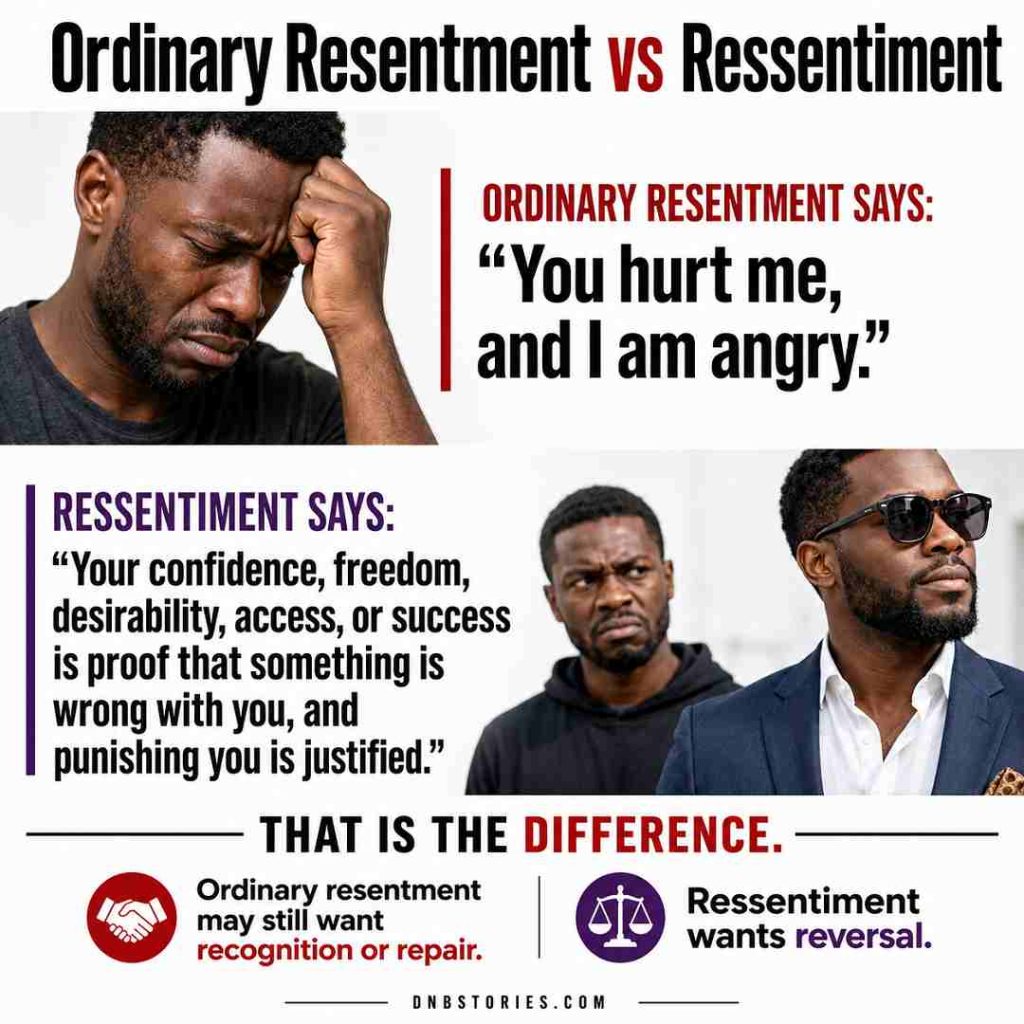
Ressentiment is not ordinary resentment.
Ordinary resentment may arise from a specific wound: someone hurt you, disrespected you, betrayed your trust, or caused real harm. It has a clearer object and, in some cases, can still be addressed through accountability, repair, distance, or justice.
Ressentiment is more dangerous because it turns humiliation, envy, powerlessness, and status injury into morally justified hostility. The resentful person no longer experiences their feeling as envy or insecurity. They experience it as righteousness (Capelos & Demertzis, 2022).
The target is no longer simply someone they dislike. The target becomes someone who must be humbled.
That is how social cruelty begins to feel like justice to the people performing it.
Why Cruel People Convert Private Insecurity into Public Punishment
Research by Salmela and Capelos is particularly useful here. The study describes ressentiment as an emotional mechanism triggered by envy, shame, and powerless anger, then strengthened through social sharing.
This matters because resentment rarely stays private inside a cruel group. The group gives it language, permission, and a target.
A person who cannot say, “I feel displaced,” may begin to say, “He is arrogant.” A person who cannot say, “I envy his confidence,” may begin to say, “He needs to be humbled.” That is how private insecurity becomes public hostility (Salmela & Capelos, 2021).
Powerless anger = The person feels angry, but also powerless, inferior, or unable to change the situation directly.
Why Ostracism Needs a Reaction
This is also another important angle: social cruelty often needs the target’s reaction to complete the story.
Without your reaction, they only have behaviour.
With your reaction, they can create a narrative.
That is why people provoke you in public. That is why they photograph, delay, whisper, smirk, exclude, and stage little scenes around you. They are not only trying to hurt you. They are trying to produce evidence of your instability.
Research on ostracism shows that being ignored, excluded, or rejected can trigger immediate distress, sadness, anger, and pose threats to fundamental needs such as belonging, self-esteem, control, and meaningful existence (Williams, 2007).
A manipulative group understands this instinctively. They may not have the academic language, but they understand the method: isolate someone, unsettle them, provoke them, watch them react, then use the reaction as proof that they deserved the isolation.
That is why non-reaction can be powerful.
Not passive.
Powerful.
What This Part Is Really About
This part is not really about Ray-Jay alone.
It is about access. About how a person close to you can become useful to people trying to harm you.
It is about how jealousy can be manufactured. About how hypermasculinity creates tender points in men who think they are hard.
It is about how shame-based sexual rooms recruit people into self-betrayal. About how contempt leaks before evidence arrives.
It is about how a friend can move from kindness to surveillance. It is about how some communities do not need truth to punish you; they only need a rumour, a reaction, and a few men willing to carry cruelty in exchange for access.
But it is also about self-protection.
Because when every room becomes unstable, your inner world must become disciplined. When friendship becomes a weapon, solitude should stand in as sanctuary. When people try to turn your openness against you, you must learn the difference between love and access.
I do not regret being open. But I have learned that not everyone who enters your life is entering as a witness to your humanity. Some enter as collectors. Others enter as messengers. Some as devices, some as men already sent by a hunger they do not fully understand.
And when you finally smell disrespect, you do not need to hold a committee meeting with your wound.
You can simply say:
Ngwa, anyị laa.
Come. Let’s go home.
That same weekend, Macos-Macho came to my house to finally fight for his stitched-up masculinity on life support.
The story continues in Part 4.
References
- Barker, J. L., & Barclay, P. (2016). Local competition increases people’s willingness to harm others. Evolution and Human Behavior : Official Journal of the Human Behavior and Evolution Society, 37(4), 315–322. https://doi.org/10.1016/j.evolhumbehav.2016.02.001
- Capelos, T., & Demertzis, N. (2022). Sour grapes: ressentiment as the affective response of grievance politics. Innovation: The European Journal of Social Science Research, 35(1), 107–129. https://doi.org/10.1080/13511610.2021.2023005
- Frost, D. M., Meyer, I. H., & Schwartz, S. (2016). Social support networks among diverse sexual minority populations. American Journal of Orthopsychiatry, 86(1), 91–102. https://doi.org/10.1037/ort0000117
- NTIA. (2026, February 19). 28% of Businesses Gone, 75,000 Jobs Lost: NTIA Warns Government Is Allowing Its £160bn Night-Time Economy Collapse – NTIA. NTIA – Illuminating the Night-Time Industry’s Potential. https://ntia.co.uk/28-of-businesses-gone-75000-jobs-lost-ntia-warns-government-is-allowing-its-160bn-night-time-economy-collapse/
- Salmela, M., & Capelos, T. (2021). Ressentiment: A Complex Emotion or an Emotional Mechanism of Psychic Defences? Politics and Governance, 9(3), 191–203. https://doi.org/10.17645/pag.v9i3.4251
- Williams, K. D. (2007). Ostracism. Annual Review of Psychology, 58(1), 425–452. https://doi.org/10.1146/annurev.psych.58.110405.085641