
Narcissistic Cruelty, Gossip, Shame, and Control
Malignant narcissistic behaviour describes a severe pattern of destructive personality traits where narcissistic entitlement combines with cruelty, manipulation, paranoia, revenge, and disregard for the harm done to others.
It is important to handle this topic with care. Malignant narcissism is not a standalone DSM diagnosis. It is better understood as a clinical and psychological concept describing a particularly harmful configuration of traits.
Not every narcissistic person is malignant. Not every arrogant person is narcissistic. And not every cruel person has a personality disorder.
But when a person repeatedly shows entitlement, lack of remorse, emotional exploitation, calculated humiliation, revenge-seeking, and pleasure in another person’s distress, the behaviour becomes socially and psychologically dangerous.
At that point, the issue is no longer ordinary arrogance or difficult behaviour. It has become a pattern of harm, control, and unchecked cruelty.
What Makes Malignant Narcissistic Behaviour So Harmful?
Ordinary narcissistic behaviour may involve elevated self-importance, grandiosity, attention-seeking, superiority, or a constant need for admiration. Malignant narcissistic behaviour goes further. It does not only seek admiration; it seeks domination. It not only avoids shame but also tries to transfer it onto others. This behaviour not only defends the ego. It punishes anyone who threatens it.
This is why people who display this pattern can be so destructive in families, workplaces, friendships, romantic relationships, religious groups, creative scenes, and small communities. They often do not simply want to be seen as special. They want others to feel smaller.
Common Features of Malignant Narcissistic Behaviour
Common features may include:
- Grandiosity: an inflated sense of importance, superiority, entitlement, or specialness.
- Manipulation: using charm, guilt, fear, confusion, secrecy, or emotional pressure to control people.
- Lack of remorse: causing harm without any care, genuine accountability or concern.
- Antisocial behaviour: constant lying, intimidation, exploitation, rule-breaking, or disregard for other people’s rights.
- Sadistic cruelty: gaining emotional satisfaction, power, or pleasure from humiliating, frightening, or hurting others.
- Paranoia: interpreting disagreement, criticism, independence, or boundaries as betrayal or attack.
- Obsessive revenge: responding to ego injury with punishment, smear campaigns, sabotage, social exclusion, or calculated harm.
How This Behaviour Operates Socially
Malignant narcissistic behaviour rarely exists in isolation. It often depends on the social environment.
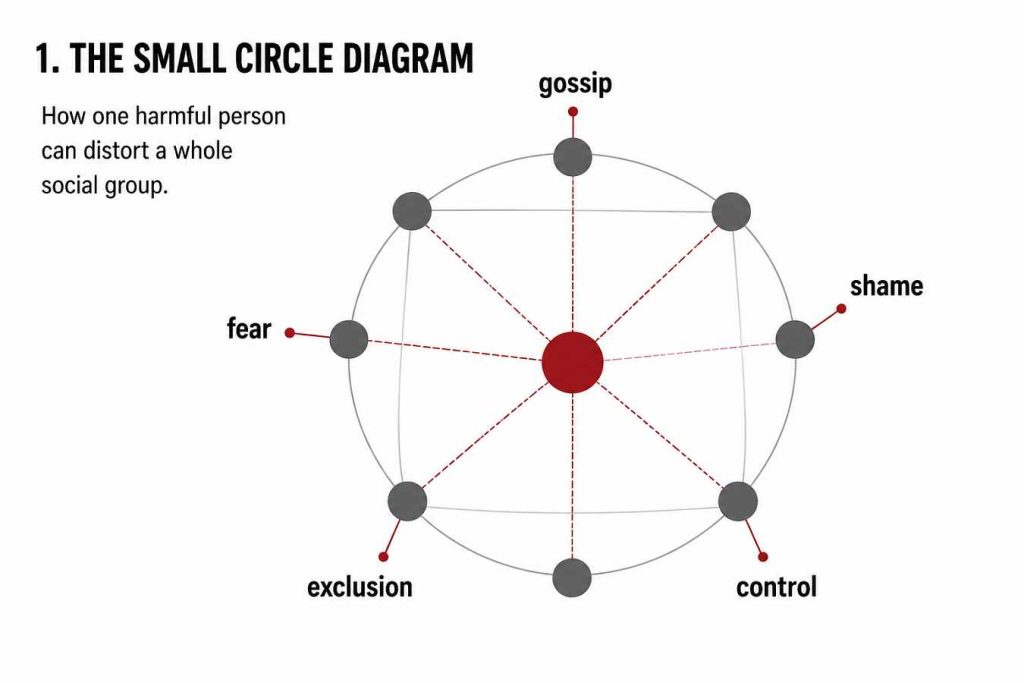
The person studies the room. They identify who wants approval, who fears exclusion, who is lonely, who is insecure, who has social status, who can be manipulated, and who can be easily turned against another person.
People who show this pattern often build influence by flattering some people while belittling others. They may perform charm, victimhood, innocence, woundedness, masculine authority, feminine softness, or social power — whichever role gives them the most control in that moment. They sow confusion until others begin to doubt their own judgment. Over time, the social environment starts to reorganise itself around their needs, moods, grievances, and punishments.
In this environment:
- Gossip becomes a weapon.
- Vulnerability becomes information.
- Friendship becomes surveillance.
- Silence becomes protection for the harmful person.
People may begin to cooperate with cruelty, not always because they are cruel themselves, but because they are afraid of becoming the next target.
Why Small Communities Can Be Vulnerable
Small communities can be especially vulnerable to this pattern because reputation, belonging, access, and social approval often carry high emotional value.
When everyone knows everyone, a smear campaign can travel quickly. When people depend on the same social spaces, exclusion can feel devastating. And when there are limited places to belong, people may become more willing to tolerate harmful behaviour just to remain close to power, desirability, popularity, money, status, or protection.
This is why narcissistic cruelty can cause damage beyond one relationship. It can distort the wider social field. It can make people suspicious, performative, fearful, divided, and emotionally unsafe around one another.

Narcissistic Cruelty in Black Queer Communities
In Black queer communities, this pattern can take on particular complexities. When destructive personality patterns operate inside Black queer social spaces, they can intersect with shame, secrecy, desirability politics, racism, homophobia, class anxiety, migration pressure, masculinity performance, sexual hierarchy, and the hunger for belonging.
This intersection creates a social environment in which harm can be difficult to name clearly.
- Cruelty can be dressed up as humour.
- Exclusion may be presented as a preference.
- Gossip may be framed as concern.
- Sexual ranking may be presented as truth-telling.
- Manipulation may hide behind trauma dumping, performed masculinity, sexual desirability, or the language of survival.
In these spaces, malignant narcissistic behaviour may manifest as public humiliation, sexual ranking, reputation attacks, emotional triangulation, calculated exclusion, social baiting, or the recruitment of “friends” to punish a target.
The harm moves from personal to communal. It teaches people to fear honesty and hide their vulnerability. It teaches people that belonging requires silence and constant performance. People may start to believe that aligning with cruelty will protect them from becoming its next target.
Why Naming the Behaviour Matters
Naming this behaviour is not about turning clinical language into an insult. It is not about diagnosing people from a distance. It is about equipping more people, especially those most vulnerable to manipulation and social exclusion, with the knowledge to recognise these recurring patterns of harm.
Do not look only at single isolated events. Watch for patterns: repeated humiliation, manipulation, coercive control, calculated gossip, revenge campaigns, emotional exploitation, lack of remorse, and the use of other people’s pain as entertainment, punishment, or power.
This matters because communities cannot heal from what they are forbidden to name, and people cannot protect themselves from harm they have not been taught to recognise.
How to Protect Yourself from Malignant Narcissistic Behaviour
People who show this pattern can be highly manipulative, resistant to accountability, and skilled at turning emotional conversations into confusion, blame, or control. If you are dealing with repeated humiliation, intimidation, coercion, revenge-seeking, calculated gossip, or emotional exploitation, the priority is not to try to win. The priority is to protect yourself.
1. Establish firm boundaries
Communicate only what is necessary, keep conversations focused on facts, and avoid being pulled into emotional arguments designed to confuse, exhaust, or destabilise you.
2. Create physical, emotional, and social distance where possible
This means reducing private access, limiting contact, leaving unsafe group chats, avoiding unnecessary explanations, and refusing situations where your vulnerability can be used against you.
3. Document serious patterns of harm
Where reputation, work, housing, money, safety, or mental health is affected, keep records of messages, incidents, threats, or repeated behaviour. Documentation can help you stay grounded when the person tries to rewrite events.
4. Seek support when necessary
Speaking with a qualified therapist, counsellor, trusted adviser, workplace authority, legal professional, or safeguarding service can help you assess the situation clearly and make safer decisions.
ALWAYS REMEMBER THIS:
The goal is not to defeat the person, force them into self-awareness, or win a moral argument. The goal is to stop organising your life around their need for control.
Closing Thought
Malignant narcissistic behaviour is not simply vanity. It is entitlement married to cruelty. It is ego organised around punishment. A deep-seated insecurity projected onto others in a form of control. And when it enters a vulnerable social environment, it can turn belonging itself into a weapon. That is why social literacy matters. Not so we can diagnose everyone, but so we can recognise harm early, protect ourselves clearly, and build communities where cruelty is no longer mistaken for power.
Research Background
This article draws on three important layers of research: a foundational clinical framework, an exploratory empirical study, and a contemporary review of malignant narcissism.
1. Foundational clinical framework: Otto F. Kernberg
Otto F. Kernberg’s work on severe personality disorders helped establish malignant narcissism as a destructive personality configuration involving narcissistic grandiosity, antisocial features, ego-syntonic sadism or aggression, and paranoid orientation. His framework is useful because it shows why this pattern is not simply vanity or arrogance, but a more severe organisation of entitlement, cruelty, punishment, and domination.
2. Empirical exploratory study: Lenzenweger, Clarkin, Caligor, Cain, and Kernberg
A later empirical study by Lenzenweger, Clarkin, Caligor, Cain, and Kernberg examined malignant narcissism in relation to clinical change among people diagnosed with borderline personality disorder. The study found that higher levels of malignant narcissism were associated with slower improvement in global functioning and anxiety, suggesting that this pattern may carry clinical significance beyond ordinary narcissistic traits.
3. Modern synthesis: Goldner-Vukov and Moore
Goldner-Vukov and Moore’s review, “Malignant Narcissism: From Fairy Tales to Harsh Reality,” provides a broader synthesis of the concept. The authors describe malignant narcissism as involving narcissistic personality disorder, antisocial behaviour, ego-syntonic sadism, and paranoid orientation, while also noting that there is no single structured diagnostic tool for identifying it.
Together, these sources support a careful public-education approach: malignant narcissistic behaviour can describe a serious and socially damaging pattern, but it should not be used casually as an insult or as a remote diagnosis.
References
- Goldner-Vukov, M., & Moore, L. J. (2010). Malignant narcissism: From fairy tales to harsh reality. Psychiatria Danubina, 22(3), 392–405.
- Kernberg, O. F. (1984). Severe personality disorders: Psychotherapeutic strategies. Yale University Press.
- Lenzenweger, M. F., Clarkin, J. F., Caligor, E., Cain, N. M., & Kernberg, O. F. (2018). Malignant narcissism in relation to clinical change in borderline personality disorder: An exploratory study. Psychopathology, 51(5), 318–325. https://doi.org/10.1159/000492228