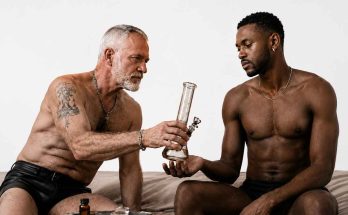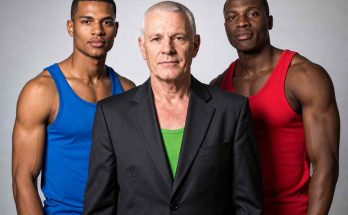
Content Note: This article discusses social manipulation, sexual objectification, police involvement, a sexual offence allegation, sex work, racism, and psychological distress. Names and identifying details have been changed or withheld. This is a personal account and analysis of my lived experience, not a court finding about any named person.
In Part 2 of this personal series, Daniel Nkado examines the manipulation, gaslighting, racialised desire, law enforcement fear and white saviour dynamics he survived inside UK Black queer social spaces.
Blending lived experience with research-supported analysis, the article explores how hypermasculinity, social cruelty, sexual racism, law enforcement fear, and community silence can be used to isolate, punish, and control Black queer men.
Read Part One of the series HERE.
- Introduction: Why Part Two Needs Context
- 1. Meeting the Grand Instigator
- An Overload of Signals — A Masculinity Performance Like No Other
- Instigators Feed on the Ignorance of Black Queer Men
- Why Power Feels Different in the UK Black Queer Context
- Education and Learning are a Necessity for Black Queer Survival
- The Anatomy of a Fake Masculinity Armour
- Knowledge Will Save a Black Queer Man Long Before Masculinity Does
- 2. The White-Centred Desire Market
- 3. Meeting the White Patron
- 4. The Police Case and the Collapse of Safety
- 5. Going Back to Elijah
- 6. Black Men and Silence
- References
Introduction: Why Part Two Needs Context
A little context is needed for this second part.
This is not only a story about one difficult social encounter, one older white man, one Black male performer, or one police case. It is about how power can move through people before the target understands what is happening. It is about coded meetings, strategic affection, sexual ranking, manipulation, class performance, racialised desire, and the way Black queer men can be pulled into social harm systems they did not design but still help maintain.
Sociological Gaslighting is Different
When sociologist Paige Sweet argues that gaslighting relies on social inequalities, she is making an important point: an abuser does not always need to invent a new way to make you doubt yourself. Sometimes, they only need to activate the prejudices society already holds against you.
For a Black queer person, this means gaslighting can draw power from an existing mix of anti-Black racism, homophobia, femmephobia, transphobia, and respectability politics. The abuser does not stand alone. They borrow the weight of the social world.
They know which stereotypes already exist; know which rooms are already primed to misunderstand you; know which version of you will be easiest for others to believe (Sweet, 2019)[9].
For example, a gaslighter may provoke you, push you, corner you, or violate a boundary, and then suddenly say:
“You are making me feel unsafe right now.”
That sentence may sound neutral, but in context, it can activate an old racial script that already casts Black men as dangerous. The gaslighter does not need to prove you are threatening. They only need to place the suggestion in a room already trained to fear Black male anger.
That is what makes sociological gaslighting so dangerous. It not only distorts reality between two people; it recruits the surrounding culture to give the distortion credibility, force, and greater social consequence.
That is the frame for this part.
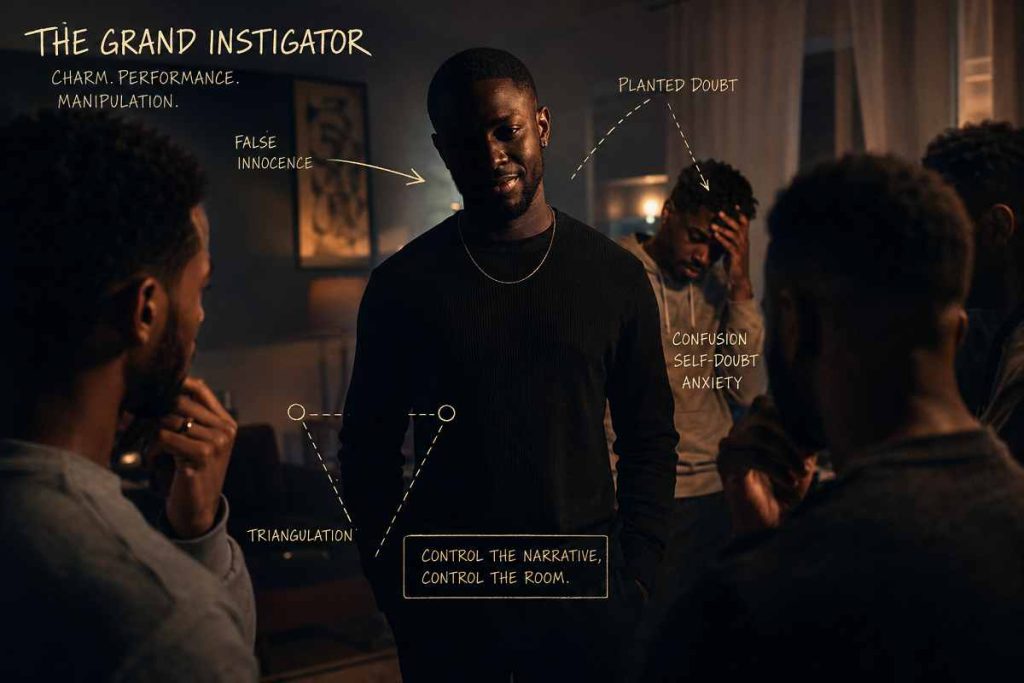
1. Meeting the Grand Instigator
I met a guy I will call Macos-Macho sometime in mid-2024. This was a period when I still moved through the UK like a free bird, unaware of the power influences, coded messages, social scripts, and “chance” meetings that had already been organised before I arrived in the room.
Macos-Macho embodied what I would describe as peak hypermasculinity performance: a carefully blended display of UK mandem aesthetics, US-style macho posturing, sexual dominance signalling, and the kind of smooth self-presentation that makes manipulation look like charisma. He was not simply masculine. He performed masculinity as a weapon, currency, shield, bait, and social licence—all at once.
An Overload of Signals — A Masculinity Performance Like No Other
The moment I met him, I sensed a mask — not a simple one, not any kind I had encountered before, but a dense one. Even the masking felt like a performance of its own, nested inside another performance. There was too much signal, too much smoothness, too much triangulation, but no clarity. Not a single iota of it. I could not read one clean signal from him, and that became the first warning.
That night, he made my friend — the person who had invited him and paid for his Uber — believe he liked me more. At the same time, he tried to create the impression that I was the one pursuing him. It was petty, but it was also instructive. He was manufacturing tension between two people while keeping himself clean. And this was on the very first night of meeting him. That was heavy data.
This is how some social instigators operate. They do not always attack directly; they arrange perception. They feed one person insecurity, another person confusion, and then stand in the middle of the chaos they created, performing innocence and confusion.
Instigators Feed on the Ignorance of Black Queer Men
Instigators often try to make other Black men believe that education, learning, analysis, and emotional intelligence are things to avoid — or worse, things that make them less masculine. This is not accidental. People who profit from confusion need others to remain unread, untrained, and unable to recognise manipulation as it happens.
That night, my friend became upset and went into another room. But by then, I had already learned too much about human behaviour to let petty manipulation destroy my mood. I recognised the pattern early: tension was being manufactured, perception was being managed, and the person creating the confusion was trying to keep himself clean.
So I stayed calm. I watched.
Research on relational aggression describes this kind of behaviour as the use of social manipulation to undermine someone’s relationships, status, reputation, or sense of belonging. It can include rumour-spreading, group exclusion, intentional neglect, and peer-network manipulation (Jiang et al., 2024)[5].
Why Power Feels Different in the UK Black Queer Context
Before continuing, it is important to explain something about the UK context.
In Nigeria, men may earn respect through wealth, intellectual contribution, academic achievement, career advancement, fame, community leadership, family standing, religious authority, and personal integrity. Not perfectly, of course. Nigeria has its own hierarchies and distortions. But there are multiple recognised routes to male value. In that sense, male status can be relatively open-sourced: a man can build respect through whichever path best suits his skills, temperament, ambition, talents, or available opportunities.
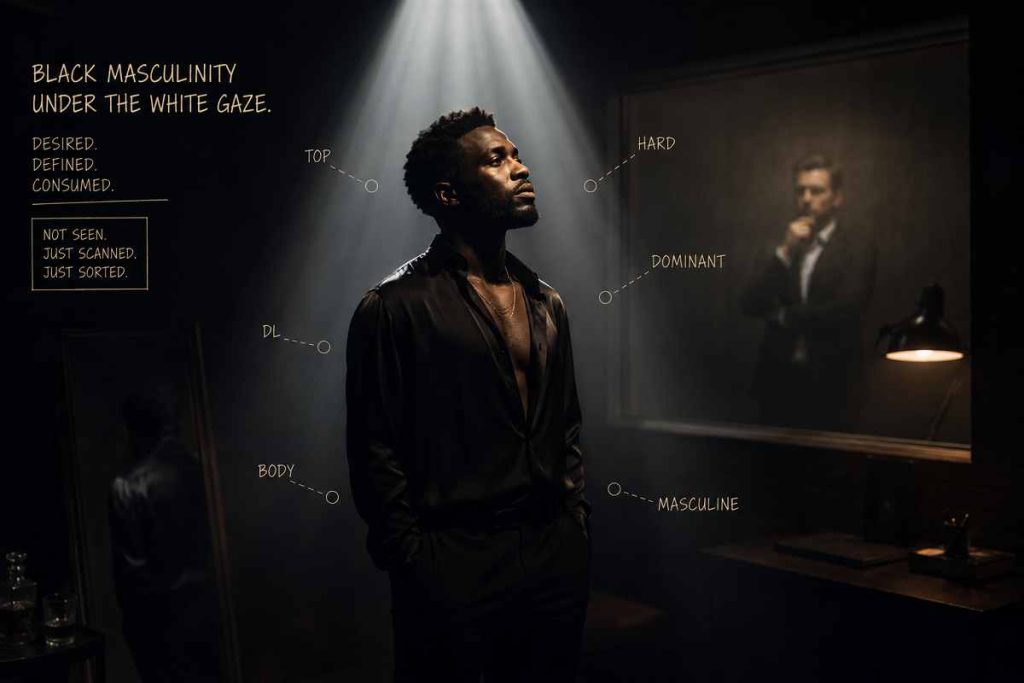
In some UK Black queer spaces, however, the routes can feel much narrower. Power often becomes attached to masculinity — especially the performance of hypermasculinity, macho posturing, “hood” aesthetics, DL-coded presentation, straight-passing labour, being perceived as a “top,” dominance performance, gym body, sexual confidence, and the ability to appear emotionally unreachable.
My Masculinity Anchors Model (MAM) clarifies this logic well: when masculinity becomes the primary route to recognition, men begin to organise themselves around the performances most likely to secure attention, desire, protection, or status.
This is not a critique of working-class Black culture, masculinity, or street aesthetics in themselves. The issue is the ranking system. When a community under pressure begins to treat hardness — and the sustained performance of hardness — as the highest form of value, tenderness becomes risky, intellect becomes “too much,” emotional honesty becomes weakness, and care becomes something people exploit rather than honour.
Education and Learning are a Necessity for Black Queer Survival
Connell and Messerschmidt’s work on hegemonic masculinity is useful here because it shows that masculinity is not simply personal behaviour. It is more like a social arrangement that rewards some male performances over others (Connell & Messerschmidt, 2005)[2].
In queer spaces, this logic can become even more pronounced. To conceal any perceived deficiency in masculinity and to align themselves with a dominant masculinity model often falsely attached to straightness, some Black queer men turn to hypermasculine performance. This may involve the deliberate exaggeration of ordinary masculine traits: dominance posturing, “total top” branding, aggression talk, voice-deepening, emotional hardness, gym-body signalling, and the rejection of anything coded as soft, feminine, tender, or vulnerable.
The Anatomy of a Fake Masculinity Armour
The fragility of hypermasculinity performance becomes clearer when we examine which traits are exaggerated. They are usually the most visible cues: voice, body, posture, sexual role, aggression talk, dominance, and emotional hardness. These are easy to perform and easy for the room to recognise.
But the deeper qualities often associated with mature masculinity — independent thought, responsibility, emotional stability, protection of the vulnerable, community commitment, and courage under pressure — are much harder to fake.
Knowledge Will Save a Black Queer Man Long Before Masculinity Does
The irony here is sharp: men who have already been harmed by rigid gender expectations can begin reproducing those same divisions inside their own immediate community instead of rejecting them. This is how social training works. A harmful system not only survives by dominating people from the outside; it also survives when people internalise its logic and begin enforcing it among themselves.
This is why I believe Black queer men in the UK need to read more, study power more seriously, and develop sharper tools for recognising manipulation. A community that rewards only body, dominance, trade, sexual role, and emotional hardness becomes easy to control. The wrong people can take charge of the room because everyone else is busy chasing the wrong value indicators.
Without education, people mistake performance for power; without analysis, they mistake cruelty for confidence. Without reflection, they mistake domination for masculinity.
2. The White-Centred Desire Market
At the time I met Macos-Macho, I had not fully understood the degree to which racialised desire structures Black queer social life in the UK. I had not yet recognised the social engineering that trains Black queer men on what to like, who to desire, who to discard, which traits to associate with masculinity, and which traits to reject as threats to Black male value.
In other words, I had not fully understood how much of this Black masculinity was being governed by the white gaze.
What I was witnessing was not simply attraction, preference, or community culture. It was Black masculinity being organised under the white gaze — trained to perform hardness, reject softness, sexualise dominance, and mistake racialised consumption for power.
How White Authority Programmes Black Queer Desire
Black gay and bisexual men in Britain have long reported being objectified and eroticised by white gay men, often through assumptions about Black bodies, sexual dominance, penis size, and hypermasculinity. In one qualitative study of Black and South Asian gay men in Britain, McKeown and colleagues found that Black African and Caribbean men described being reduced to erotic stereotypes and treated as sexual bodies rather than full romantic subjects (McKeown et al., 2010)[6].
That research matters because it shows that what I experienced was not isolated. The white gay gaze can turn Black masculinity into a consumable object. The Black man becomes desirable when he performs hardness, dominance, sexual prowess, aggression, bodily power, and emotional coldness. He becomes less desirable when he appears intellectual, gentle, emotionally complex, spiritually grounded, or socially ambitious beyond the erotic role assigned to him.
This is where the danger sits. When Black queer men internalise this gaze, they may begin to perform for it even when no white man is present. We start ranking one another through the same racial script. We reward the men who look most consumable to white desire and punish the men who refuse to stay inside that script.
That is not liberation. It is the reproduction of inherited harm under the language of confidence, desirability, and social power.
My Brief Dabble Into Escorting
When I first came to the UK as a student, I worked as a male escort a number of times. The money was good — the kind of money that can make a young Black queer man reconsider other routes to survival, especially when immigration pressure, school, rent, loneliness, and economic instability are all pressing on him at once.
I am not ashamed of that period. But I also refuse to romanticise it.
Sex work itself is not the moral problem. The problem is the market around it: stigma, racial fetishisation, economic vulnerability, weak protection, and the way desire can become another form of control. Amnesty International notes that sex workers are at heightened risk of violence, discrimination, extortion, and abuse, especially where stigma and criminalisation make it harder to seek protection or report harm (Amnesty International, 2016)[1].
For me, escorting was never part of any plan I had. It was a temporary route, and I did it with sense. I often declined calls, guarded my purpose, and refused to become permanently available to the market. Ironically, that made the demand rise. Basic market logic: scarcity raises interest. Sometimes, a white man would offer to pay double just to get me to come.
Sacred Boundaries Around Escort Money
Another layer of friction that shaped my limited attachment to escorting was a spiritual logic inherited from my kin. It discouraged using money made from “selling one’s body” for anything important, concrete, or destiny-aligned.
I made quick money sometimes, but I never felt settled enough to save it, build with it, or invest it into my true purpose. The money moved quickly. I burned through it on clothes, nights out, parties, and the online shopping habit I was still learning to control.
Male Sex Work in the UK Taught Me Another Lesson
Escorting taught me one of my clearest lessons about racialised desire: a Black queer man can be highly desired in a market that still does not honour him[8]. He can be paid, praised, chased, and fetishised while remaining trapped inside a role that distracts him from deeper, more liberating forms of power — wealth-building, education, leadership, creative work, community responsibility, and self-determined purpose. I explored this dynamic in more detail in my previous article on how white authority controls and consumes Black queer lives.
The way I understand it, this is one of white authority’s most effective preservation tactics: keeping Black queer men desirable enough for consumption, but completely distracted from building the deeper forms of power that could secure real freedom.
3. Meeting the White Patron
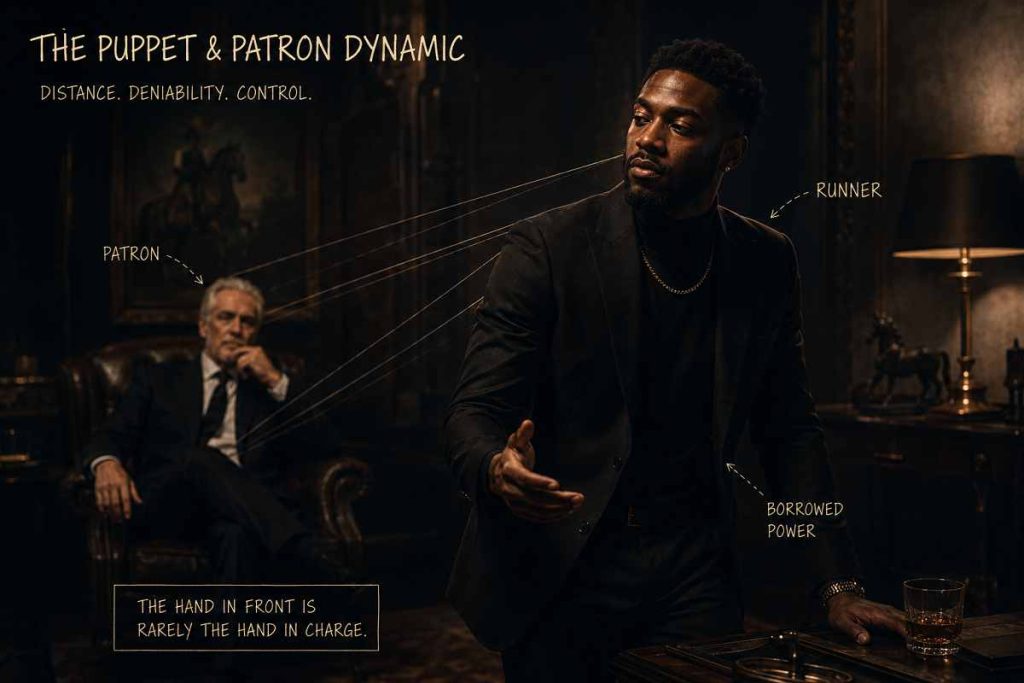
In previous articles, I discussed the puppet-and-patron dynamic: the relationship between a powerful figure who benefits from distance and deniability and a socially useful intermediary who carries out the messy emotional, sexual, or reputational work.
Through Macos-Macho, I met a wealthy white man I will call Elijah. He was not simply comfortable. He was rich in the real sense of it — resourced, established, socially protected, and used to being obeyed by the world around him.
At first, I liked him. He appeared grounded and accomplished, and I have always admired accomplishment, especially when it comes with calmness and intelligence. I could not immediately tell why Macos-Macho introduced us. Maybe he wanted to show me the rich and powerful people he knew. That was part of his performance: name-dropping, proximity to wealth, proximity to fame, proximity to white approval.
Or maybe something more strategic was happening. I cannot prove every link in the chain, so I will not present suspicion as fact. What I can say is this: over time, I came to believe that Macos-Macho functioned less like an independent friend and more like a runner and a puppet — someone useful to men with more money, more social cover, and more distance from consequence. He appeared to have carved out a comfortable livelihood by carrying out internal social work for white power holders.
Like many Black puppets in the puppet-and-patron dynamic, he may convince himself that he is acting independently and exercising real social power. In reality, he is performing a racial script much older than he is — one that offers him crumbs of reward for helping to keep his community divided and distracted, while ensuring that true power remains where it has always been: in white hands.
Genuine Anger or Still Part of the Performance?
After Elijah contacted me directly, Macos-Macho sounded furious on the phone. I use “sounded” carefully because with someone who is committed to performance — grade-A performance—even anger can be theatre.
Nothing about him felt clean. His social style appeared organised around performance, use, cheating, and the selling of access to other Black men, all while pretending to be one of the boys.
Getting Close to Elijah
My relationship with Elijah developed quickly. He appeared kind, generous, and genuinely interested in my growth. He spoke about us entering a proper relationship, but my trust never fully opened. It was performance again, only this time the performance was not hardness. It was care.
That can be the worst kind of performance for someone like me, because care gets through. Care softens my defences. Care makes me stay long enough to question the warnings my body is already giving me.
Activating A Framework of Trust
I was already using what would later become my Trust Onion Model, even though I had not yet formalised it into language. Through that lens, he remained stuck around the third level: the Familiarity Level. There was access, intimacy, sex, money, and routine, but not full safety. Even though I genuinely liked him, something in my internal world refused to settle fully around him.
Over time, I realised why. He was not positioning me as an equal partner. He was positioning me as a sexual tool: the big-dick Black man who could top him when he wanted, perform masculinity when he wanted, stay hard when he wanted, and provide the erotic charge that whiteness often demands from Black male bodies.
One comment clarified everything. I once mentioned using a bidet because of digestive issues. His reply was:
“Baby, tops don’t use that.”
He used one himself. He was also much older than I was. Yet he was positioning himself as someone entitled to softness, comfort, tenderness, and bodily care, while I was supposed to remain permanently tough, masculine, available, and functional.
That was not a partnership. That was a racial sexual script.
Black Bodies as Consumable Objects
Research on UK queer spaces supports this reading: Duffus and Colliver found that Black male bodies can become constructed as consumable for white sexual gratification, with Black men often read through assumptions about masculinity, penis size, and being a “top” (Duffus & Colliver, 2024)[4].
Wade and Piasecki’s study of young sexual minority Black men also shows that racialised sexual discrimination intersects with sexual positioning, including assumptions attached to being top, bottom, or versatile (Wade & Piasecki, 2025)[10].
I Started Distancing Myself From the Rich White Patron
I started distancing myself from Elijah and his dating offers. At this time, I also began to distance myself from Macos-Macho after what I suspected was a strategic triangulation attempt one night involving two other Nigerians and me.
That night, he deliberately arrived with a fourth person and performed affection with him in front of my friend and me. I read the move as an attempt to create tension between my friend and me — now an ex-friend — whom I will call Sino. The aim, as I understood it, was to make it appear as though I was the one chasing Macos-Macho.
At the time, Sino and I were close. We had known each other from Nigeria, so there was a proper Nigerian-brotherhood familiarity between us. Macos-Macho’s tactic worked because Sino became upset and left that night. He also seemed fully convinced that I was the one pursuing Macos-Macho.
A Successful Move to Split a Friendship
What I believe Macos-Macho wanted was simple: to isolate Sino from me, and me from Sino. By nature, I have never been someone who fights hard over friendships or goes to extreme lengths to preserve them — precisely because of situations like this. I value friendship, but I also know that friendship can become a vulnerability when an instigator learns how to weaponise it. People like Macos-Macho know how to use attachment, insecurity, jealousy, silence, and misread signals to cause harm.
Not everyone thinks the way I do. Not everyone is interested in learning what I have learned. In many UK Black queer spaces, performers are often followed long before authenticity is given a second look. As I later formalised in my Masculinity Conflict Framework (MCF), self-protection must sometimes take precedence over a one-sided pursuit of clarity.
That is exactly why men like Macos-Macho can move so effectively. They understand the room’s appetite before the room understands their method.
4. The Police Case and the Collapse of Safety
Three months after it became clear to Elijah that I was no longer coming around, I was arrested over an allegation that I had drugged and raped someone.
I want to be precise here. Rape is an extremely serious offence. People who experience sexual violence must be able to report it, and every allegation deserves a careful, evidence-led investigation. At the same time, a false allegation, when it occurs, can devastate the person accused. The Crown Prosecution Service states that false allegations of rape are rare, while also recognising the serious harm they can cause (CPS, 2020)[3].
My main reason for sharing this detail is to document what the accusation did within the broader social context I was already experiencing. The complainant was a Black man from a threesome in which I had paid little attention to him. Another man present, whom I will call Ray-Jay, was someone I had considered a friend. He later became a co-defendant in the case. At the time, I did not realise he would become central to my understanding of what had been happening around me.
What I Experienced That Night
That night, something strange happened before the allegation. At one point, while Ray-Jay and I were talking, the complainant kept looking at him. Ray-Jay was making gestures I did not understand. Then the complainant said, more than once:
“Sorry, are you guys talking about me?”
The second time he said this, another mixed-race guy, whom I will call Lashmal, had joined us. At the time, I did not yet have the language for what I now understand as possible perception manipulation — making someone feel watched, discussed, filmed, mocked, or socially targeted until their anxiety is activated. All I registered then was confusion.
This happened on a Sunday. I was arrested on Tuesday. I had just returned from the gym when the police knocked.
Before I told anyone about the police case, Macos-Macho called me, pretending to check on me, and made a sly comment about me giving people “concoctions.” That comment stayed with me because it arrived too early. It carried too much knowledge. It felt less like concern and more like confirmation that information was already circulating through channels I had not entered.
What an Arrest Does to the Body
For someone who had never been in a police cell in my thirty-four years of life — not even in Nigeria, where influence can easily be abused — the arrest devastated me. I knew my own moral boundary. If my life depended on violating someone sexually, I would choose death.
What devastated me was not the arrest itself, but the accusation. The idea that my name, body, sexuality, and personhood could be pulled into that kind of claim felt spiritually violent. It struck the deepest layer of self.
Another angle that disturbed me profoundly was the racialised sexual script beneath the allegation. In my view, I had been recreated as a hypersexual beast: a Black man supposedly so desperate to top my accuser that I would drug him, even though, in his own messages, he had revealed feeling “unwanted” that night.
UK Justice, Race, and the Weaponisation of Law Enforcement
This is where race matters too. The UK criminal justice system cannot be discussed as if its outcomes are racially neutral. The Ministry of Justice’s 2024 ethnicity statistics report notes that minority ethnic groups appear over-represented at many stages of the criminal justice system in England and Wales, with Black individuals often the most over-represented among minority ethnic groups. The report also cautions that summary statistics alone do not prove causation or direct bias (Ministry of Justice, 2025)[7].
For a Black queer man, the terror is layered. You are not only dealing with an allegation. You are dealing with the racial imagination that may already have a story prepared for your body: dangerous, excessive, hypersexual, disposable, and guilty before the facts have been fully examined.
5. Going Back to Elijah
After my arrest, I was miserable. I felt spiritually contaminated by the accusation. I felt socially unsafe. Most nights, I stayed up crying. I considered taking my own life, and once or twice, the thought of jumping from my balcony crossed my mind.
My parents’ calls saved me. Every few minutes, my mother was either calling, sending a prayer voice note, or telling me to leave “their evil country” and come back home — to where I belonged, to where conscience still carried weight, to where people did not betray their own conscience simply to cause harm or retaliate against rejection.
What broke me most was the possibility that Black men around me could participate in harm so severe and still smile.
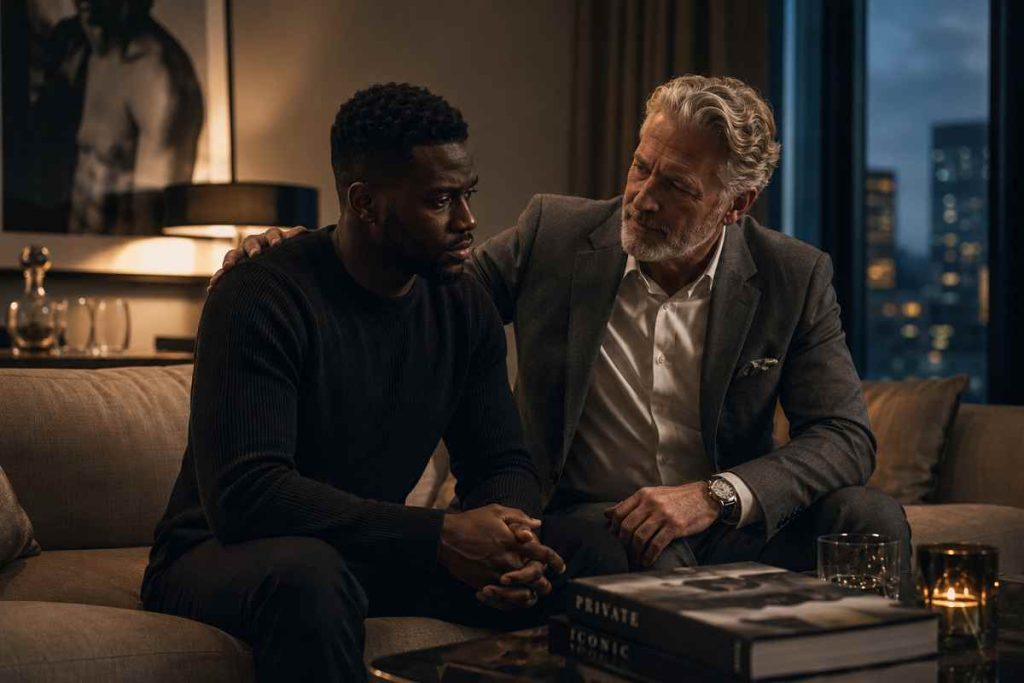
So I went back to Elijah…
That is one of the most painful truths of this story. A white man who had already reduced me to a racial sexual role suddenly looked like safety because the Black social environment around me had become too dangerous. He positioned himself as the one person I could trust — my white saviour. At that moment, I believed him because I needed somewhere to place my fear.
This is how the white saviour trap works. It does not always begin with open domination. Sometimes, it begins when Black communal betrayal makes white proximity feel like rescue.
Elijah became more generous during that period. He pressured me to move in with him. Thank God I did not.
We were together for about six months. But, as unpredictable as I can be, I did not become more attached to him. I started growing out of him. My internal world kept signalling that something was wrong. I could not yet fully explain it, but I could feel the darkness beneath the comfort.
The first night we travelled outside London together, I could not sleep. For me, that is usually a signal. My body often recognises danger before my mind has gathered enough evidence to explain it.
Then one night, during a minor argument, he called me a cunt.
That was emotional leakage. The mask slipped. I knew immediately that I had to end the affair, and I did.
The Moment I Chose Myself Again
What shocked him, I think, was not that I ended it. It was that I could still stand.
He had seen me after the arrest; he had seen me shaken, frightened, humiliated, and in need of support. He had seen how a false or weaponised narrative — whether carefully planned or opportunistically used — could collapse a person’s world, leaving them so vulnerable that survival felt impossible without a saviour—he knows quite well how money, affection, and rescue could create dependence.
But he had misread me.
I may be hurt, may be delayed, may grieve, and may even return temporarily to the wrong place when pain confuses my judgment. But my inner world does not die easily. Something in me keeps watching and keeps taking notes. Something in me can still identify the moment care becomes control.
That is what saved me. Once I recognise that shift, the part of me that fights back comes alive.
Something About That Night Did Not Go According To Plan
Something about that night did not go according to plan; I felt very sure of this. The disruption, I believe, was Ray-Jay being named as a co-defendant in the case. That felt like a sudden pinprick in the plan because he, too, was arrested and had to face investigation.
It may have been an error of strategy. It may have been a spiritual intervention. Or it may simply have been one of those moments where a person associates with harm, only to discover that harm rarely protects its own instruments.
Who knows, maybe the control room decided to use one stone to catch two birds — including the bird that thought wearing the uniform would protect it.
My ‘No’ Always Seems to Trigger Punishment
People had rejected me many times, and I always accepted it. I took it, absorbed it, and moved on. But the moment I said no, enforced a boundary, or refused someone access to me, a desire to punish me often seemed to be triggered.
I do not yet have a full explanation for it, or even a perfect name for it. But it feels as though some people believed I did not deserve the right to reject anyone — as though my refusal was an insult, a betrayal, or a humiliation that needed correcting.
Even people who had rejected me at first and moved on with someone else would sometimes return later. Yet when I said no, they suddenly seemed to feel entitled to punish me. It was not simply disappointment. Most times, it felt like boundary punishment — the attempt to degrade someone for daring to refuse access after he had once been made available for rejection.
6. Black Men and Silence
I would later learn that what happened to me may have happened to other immigrant Black queer men too — almost like a taming strategy, a way of cutting men down when they become too visible, too confident, or too difficult to control. But as Black as we are, silence often takes precedence over naming harm, especially when that harm appears structural or could invite shame and judgment.
Many of us have been trained to survive quietly. We minimise and rationalise, and we tell ourselves not to make noise, not to appear weak, not to expose what is being done to us, and not to give outsiders more ammunition to shame us.
But silence can become the perfect shelter for repeated harm. It protects the system far more than it protects the wounded.
What This Part Is Really About
This part is not about demonising Black men, sex work, masculinity, white partners, or the police in simplistic terms. It is about pattern recognition. It is about how social cruelty becomes possible when a community rewards performance over character.
This piece is about how hypermasculinity can become a costume for manipulation. It is about how white-centred desire markets can train Black queer men to value themselves through the same stereotypes that diminish them.
It is about how a white patron can appear generous while still keeping a Black man inside a box he controls. A personal essay about how Black men can be recruited into harm against other Black men, especially when envy, status anxiety, sexual competition, or proximity to white approval is involved.
And it is about how gaslighting becomes most dangerous when the target is surrounded by people who already benefit from his confusion.
We Deserve Better Than This
UK Black queer spaces deserve better than this. Black queer men deserve forms of power that are not limited to body, hardness, sexual role, DL aesthetics, gym status, dominance, or proximity to wealthy white men. We deserve intellectual power, emotional power, spiritual power, financial power, creative power, community power, and the power to leave any room that requires our self-betrayal as the price of belonging.
***
Part Three will discuss how I discovered that Ray-Jay had been sabotaging me all along while I treated him as a friend, how the Macos-Macho dynamic finally unravelled, and how other actors were gradually recruited into the machinery of cruelty.
References
- Amnesty International. (2016, May 26). Amnesty International publishes policy and research on the protection of sex workers’ rights. Amnesty.org. https://www.amnesty.org/en/latest/news/2016/05/amnesty-international-publishes-policy-and-research-on-protection-of-sex-workers-rights/
- Connell, R. W., & Messerschmidt, J. W. (2005). Hegemonic Masculinity: Rethinking the Concept. Gender & Society, 19(6), 829–859. https://doi.org/10.1177/0891243205278639
- Crown Prosecution Service. (2020, October 19). Key Facts about How the CPS Prosecutes Allegations of Rape | the Crown Prosecution Service. https://www.cps.gov.uk/publication/key-facts-about-how-CPS-prosecutes-allegations-rape
- Duffus, M., & Colliver, B. (2023). Gender, sexuality and race: An intersectional analysis of racial consumption and exclusion in Birmingham’s gay village. Sexualities, 27(8), 136346072311570. https://doi.org/10.1177/13634607231157068
- Jiang, Y., Tong, L., Cao, W., & Wang, H. (2024). Dark Triad and relational aggression: the mediating role of relative deprivation and hostile attribution bias. Frontiers in Psychology, 15. https://doi.org/10.3389/fpsyg.2024.1487970
- McKeown, E., Nelson, S., Anderson, J., Low, N., & Elford, J. (2010). Disclosure, discrimination and desire: experiences of Black and South Asian gay men in Britain. Culture, Health & Sexuality, 12(7), 843–856. https://doi.org/10.1080/13691058.2010.499963
- Ministry of Justice. (2025, November 27). Ethnicity and the Criminal Justice System 2024. GOV.UK. https://www.gov.uk/government/statistics/ethnicity-and-the-criminal-justice-system-2024
- Souleymanov, R., Brennan, D. J., George, C., Utama, R., & Ceranto, A. (2018). Experiences of racism, sexual objectification and alcohol use among gay and bisexual men of colour. Ethnicity & Health, 25(4), 1–17. https://doi.org/10.1080/13557858.2018.1439895
- Sweet, P. L. (2019). The Sociology of Gaslighting. American Sociological Review, 84(5), 851–875. https://doi.org/10.1177/0003122419874843
- Wade, R. M., & Piasecki, M. (2025). Whose role is it anyway? Sexual racism and sexual positioning among young sexual minority Black men. The Journal of Sex Research, 62(2), 187–198. https://doi.org/10.1080/00224499.2024.2305823