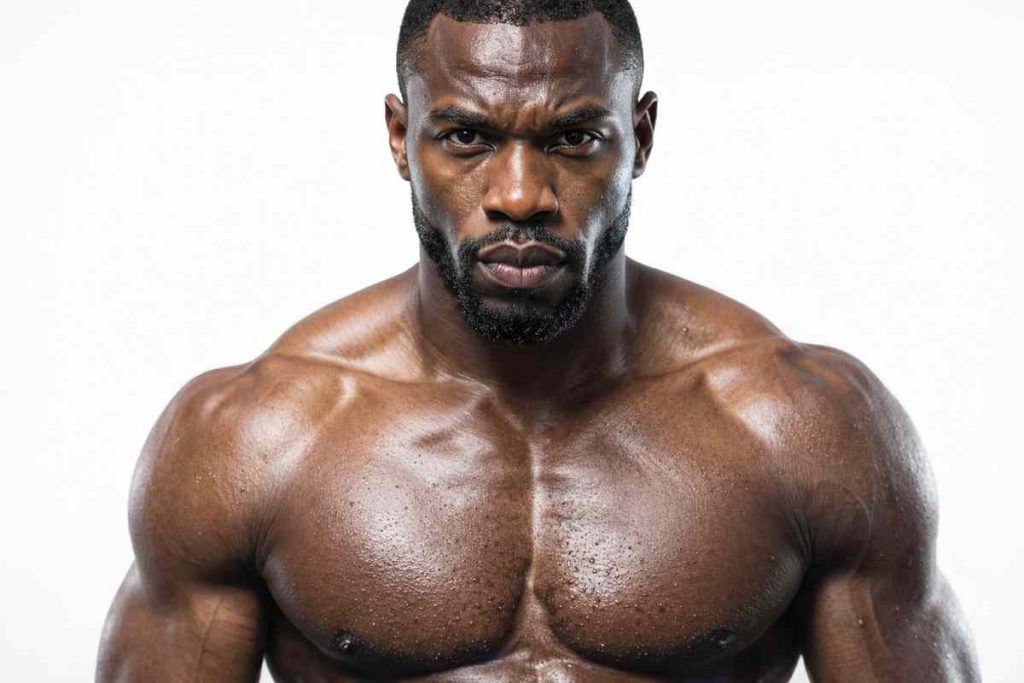
A. Intro: Hypermasculinity is not ‘Premium’ Masculinity
Hypermasculinity rarely reflects true confidence. Many men use exaggerated displays of masculinity to mask feelings of shame or boost social standing.
While it may appear to be a sign of strength or toughness on the surface, hypermasculinity typically develops from a contrary logic. Pressures like shaming, homophobia, gender policing, and racialised expectations push some queer men to adopt a macho persona to hide any feminine traits or increase social acceptability. In Black gay communities, where so many forces collide, this performance can function as a strategy to hide shame or avoid stigma.
Understanding the specific origins of hypermasculine behaviour in Black men allows researchers to see how it functions across different contexts—sometimes as a strategy for gaining social status, and at other times as a hardened exterior concealing fear of punishment and shame tied to insecure masculinity (Goffman, 1963)[3].
This article maps the psychological cycle that produces the macho act in Black gay men: Femininity → Shame → Punishment → Correction → Overcorrection—and discusses the many ways this performance causes harm. It concludes with concrete, evidence‑informed tools for breaking the cycle.
- A. Intro: Hypermasculinity is not 'Premium' Masculinity
- B. The Cycle: From Femininity to Overcorrection
- 1. Femininity as Risk: Why Black Men Fear Softness
- 2. How Shame and Punishment Control Black Masculinity
- C. The Hidden Harms of Hypermasculinity in Black Gay Men
- D. Societal Harms of Hypermasculinity
- a. 4 Common Harms of Hypermasculinity in Wider Society
- b. 7 Harms of Hypermasculinity in Black Gay Communities
- E. Repair: How To Disrupt Hypermasculine Performance
- FAQs
- References
B. The Cycle: From Femininity to Overcorrection
Research shows that anti-gay stigma increases the pressure to “prove” masculinity—especially among men who fear being perceived as gay.
This pressure often follows a predictable five-stage cycle.
1. Femininity as Risk: Why Black Men Fear Softness
Many cultures devalue femininity, treating it as weakness or something that requires correction. In Black cultures, however, centuries of enslavement and racial violence added an extra pressure: shame. Survival once depended on physical endurance and emotional restraint. This led to softness in men being cast as dangerous rather than merely undesirable. These beliefs were passed down across generations, long before “queer” became associated with sexuality, as a way to police behaviour and ensure survival.
This history helps explain why homophobia feels so intense in Black communities, and why Black gay men ultimately became the pressure point where layered fears, punishments, and projections converged.
In environments where femininity in men attracts not only ridicule but punishment, avoidance alone became insufficient. Men learned to build defensive armours—stoicism, aggression, dominance, sexual bravado—to prevent being read as feminine at all.
2. How Shame and Punishment Control Black Masculinity
A crucial distinction needs to be made in this section: the punishment of femininity operates differently for straight and gay Black men.
a. Femininity Shaming in Straight vs. Gay Black Men
Straight and gay Black men respond differently to being shamed for femininity because the consequences are not the same. For straight Black men, being called “feminine” is primarily an attack on masculinity. For gay Black men, it is an attack on both masculinity and sexuality.
b. How Fragile Masculinity Fuels Homophobia
When a straight Black man is shamed for seeming feminine, the fear underneath is simple and immediate:
“People will think I’m not a real man.”
Masculinity is one of the few social currencies Black men are allowed to hold without punishment. When that currency feels threatened, the response is often sharp and defensive—posturing, aggression, over‑correcting into hardness, mocking others to redirect scrutiny, or distancing themselves from queer men.
This reflex is taught early, reinforced constantly, and helps explain how men themselves become engines of homophobia—gender insecurity turned into social defence[8].
c. Why Gay Black Men Face Harsher Punishment for Femininity
Where straight men are shamed for appearing feminine—treated as deviation—femininity in gay Black men is read as evidence: confirmation of queerness, assumed sexual role, and perceived social rank. This punishment operates across multiple levels at once, coming from wider society, straight peers, and within Black gay communities themselves.
Within Black gay spaces, masculine and feminine traits carry real social weight, shaping desirability, safety, and belonging. Gay Black men learn quickly—often regardless of accuracy—that softness can cost them respect, protection, or access to intimacy. As a result, many are pushed into constant self‑monitoring: adjusting voice, posture, expression, labels, and behaviour to avoid ridicule or exclusion.
Human beings are capable of consciously adjusting their gender expression, and many gay men modulate their masculinity to suit their immediate environment. Those who feel most at risk of scrutiny—or most insecure about their masculinity—often push it to the extreme.
This is why researchers describe hypermasculinity as an overcorrection—a compensatory performance designed to cover perceived inadequacies in masculinity.
d. Three Functions of Hypermasculinity in Gay Black Men
For gay Black men, femininity often gets treated as confirmation, exposure, and escalation. This perception carries deep social, sexual, and safety consequences for gay Black men.
Hypermasculinity in gay Black men reflects a strategic, not random, response to surveillance, punishment, and fear of exclusion. Understanding its functions clarifies why it feels protective in the short term despite causing serious harm in the long term.
i. Protection from Punishment and Exposure
Exaggerating masculine traits can reduce the risk of being perceived as feminine, queer, or vulnerable. This performance prioritises safety from ridicule, violence, and unwanted exposure over authenticity. But it carries a hidden cost. People often sense the strain behind an overcorrection. This tension can subtly influence perceptions of one’s character, confidence, and even trustworthiness[2].
ii. Access to Status, Desire, and Belonging
Within Black gay communities, masculinity often functions as social currency. Despite reports of a declining influence in some corners—particularly among younger gay demographics—masculinity remains one of the most persistent hierarchies in Black gay culture, shaping desirability, respect, and social standing. In this context, hypermasculinity and macho signalling become strategic resources, deliberately displayed to secure status, intimacy, and social acceptance.
iii. Psychological Defence Against Shame
For men who have internalised repeated messages that femininity signals weakness, failure, or inferiority, exaggerated masculinity becomes a way to manage shame. But this function of hypermasculinity is internal, which creates a deeper problem. Rather than countering the internalised beliefs that compound stress[7], the performance of false strength, control, and dominance often reinforces them—intensifying shame at the expense of emotional openness or self‑acceptance, the very qualities that support resilience and psychological flexibility. The outcome is predictable: more fear, more shame, more anxiety.
e. How to Tell If Someone is Performing Hypermasculinity
When a man feels his manhood is questioned, or he is shamed for being “soft”, he may respond by projecting hypermasculine behaviour to restore his status.
A simple, practical way to differentiate between hypermasculinity and healthy masculinity:
Think of it in terms of flexibility vs rigidity:
i. Healthy masculinity or a man who is just muscular: He is flexible, has emotional range—warmth, fear, care. He apologises when he hurts someone, and vulnerability does not scare him. He does not try to assert rank or police others.
ii. Hypermasculinity performance: He is rigid, audience-dependent, and reactive when the script is disrupted. He repeatedly uses dominance narratives—stories of conquest, danger, labour, violence—as social proof, and becomes defensive or aggressive when that proof isn’t rewarded.
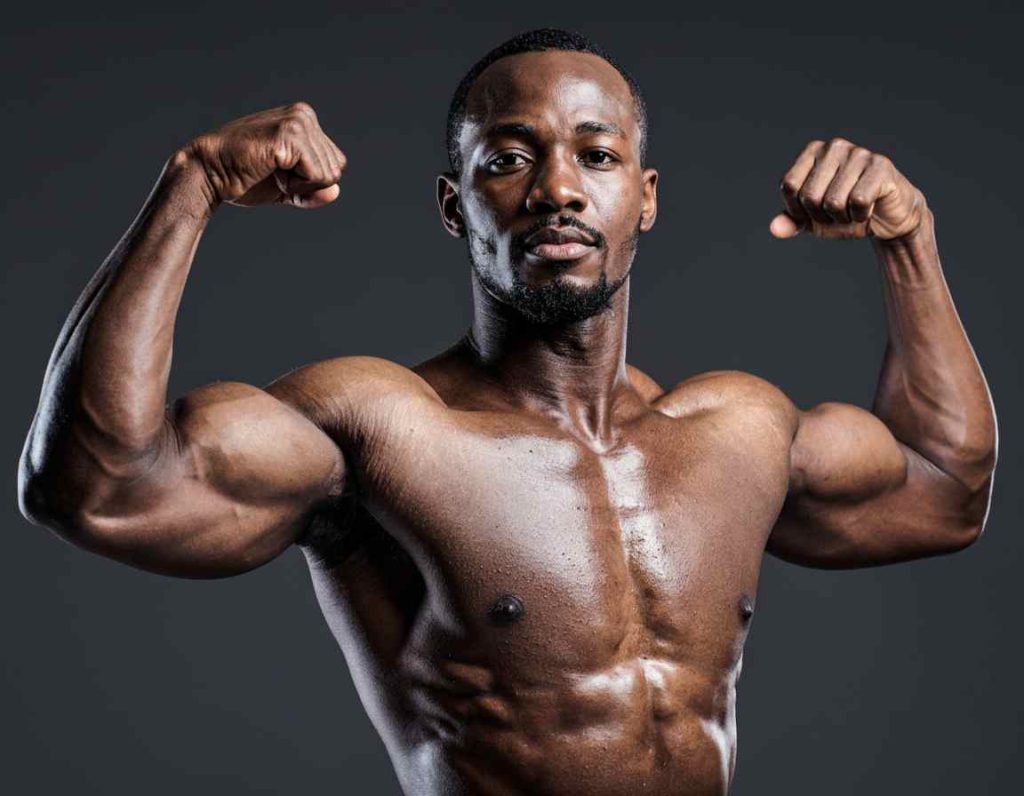
Behavioural signals that point toward hypermasculinity
- Policing or mocking anything seen as “soft” or feminine.
- Consistent emotional narrowing—showing only anger or contempt; no tenderness[6].
- Dominance posturing—always needing to have the last word, centre stage, or to prove toughness.
- Sexual bravado and conquest stories—used to assert status rather than connect.
One sign alone does not prove hypermasculinity. When several signs recur across different contexts, they form a reliable benchmark. For in-depth guidance, refer to our article on Distinguishing Muscularity vs. Hypermasculinity.
C. The Hidden Harms of Hypermasculinity in Black Gay Men
Sustained hypermasculinity and macho posturing—especially for people whose natural temperament is softer—can take a serious toll on mental health, physical wellbeing, and the quality of their relationships.
1. How Macho Performance Harms the Individual
Across older masculinity systems, performing the “macho” ideal often bought status at the cost of emotional freedom. Manhood was defined through self-control and honour, so shame was managed through toughness, distance, and sometimes aggression. Modern research echoes the same pattern: when men fear being seen as “not masculine enough,” they overcompensate.
Hypermasculinity pushes dominance, toughness, aggression, and emotional shutdown to extremes—often beyond what an individual’s biological and emotional systems can sustain. That is where harm begins.
a. Chronic stress that elevates cardiovascular and metabolic risk
A strain‑based mechanism known as masculine discrepancy stress often sustains hypermasculine performance. This refers to the pressure to meet an imagined, constantly shifting, and often unattainable standard of manhood[9]. This stress drives higher‑risk violent behaviour in men. It also activates chronic stress pathways that impose measurable physiological costs, including elevated cardiovascular and metabolic risk and stress‑related gastrointestinal conditions such as IBS.
b. Other psychological and emotional harms caused by hypermasculinity
i. Emotional suppression resurfaces as anger, contempt and numbness:
While some individuals naturally experience a narrower emotional range, hypermasculinity enforces deliberate emotional restriction—suppressing genuine feelings such as grief, fear, and tenderness. Those feelings don’t just disappear; they leak out as irritability, rage, or performative unconcern, driving unresolved stress and emotional disconnection.
ii. Higher levels of anxiety and depression:
Research syntheses across multiple studies show that stronger conformity to traditional masculine norms is associated with worse mental health outcomes, including anxiety and depression[10].
iii. Lower levels of emotional resilience:
Rather than building toughness, hypermasculinity weakens emotional resilience by replacing adaptability with endurance, awareness with suppression, and recovery with prolonged strain. Men may appear composed on the surface, but internally they become less able to absorb stress, recover from setbacks, or respond flexibly to emotional challenge.
This is why hypermasculinity often produces fragility beneath the performance. Like the immune system, resilience grows through exposure and range—not restriction. Emotional strength develops by engaging with feeling, not by shutting it down.
Resilience is an adaptive capacity, not emotional absence.
c. Physical and behavioural risks associated with hypermasculinity
Hypermasculinity can push men toward risky behaviour—reckless driving, heavy substance use, aggressive sex, and violence—as proof of “real manhood.”
Research on masculine discrepancy stress—the fear of not being “man enough”—links this pressure to greater risk-taking and higher harm (Reidy et al., 2015)[9].
d. Social and relational consequences
A life of constant performance, mask-wearing, and emotional repression frequently blocks the formation of deep support networks and reliable emotional bonds, leaving men isolated even when socially surrounded.
Dominance‑based scripts can flatten empathy and make repair difficult. Men engage in conflict not because it serves them but because it serves the badge of masculinity they are wearing. When tenderness and vulnerability are treated as shameful, men may default to control, manipulation, or aggression in moments that require emotional skill and openness.
Bottom line: Hypermasculinity often looks like toughness and composure on the outside, but beneath the mask, the performer is burning. This is the cost of trading emotional range, health, and intimacy for short‑term safety and status.
D. Societal Harms of Hypermasculinity
When hypermasculinity is rewarded across society, it normalises violence, deepens inequality, and intensifies bullying and policing of anyone who fails to perform the “approved” manhood[5].
a. 4 Common Harms of Hypermasculinity in Wider Society
i. Violence becomes normalised: The framing of aggression as proof of manhood—often excused through “boys will be boys” logic—normalises violence in war, public life, and intimate relationships.
ii. Inequality is structurally reinforced: Dominant masculine ideals elevate some men while positioning women and gender‑nonconforming people as inferior, legitimising exclusion and control.
iii. Conflict escalates rather than repairs: Disputes become status contests where dominance matters more than resolution, making de‑escalation and accountability harder.
iv. Gender policing and bullying intensify: Communities enforce narrow standards of manhood through ridicule, bullying, and surveillance, punishing deviation and producing chronic shame.
b. 7 Harms of Hypermasculinity in Black Gay Communities
Hypermasculinity in Black gay spaces carries profound consequences. It reshapes communal life by rewarding hierarchy over inclusion, performance and concealment over authenticity, and reputation management over collective care.
i. Femophobia: Why hypermasculine actors police and shame other men
When masculinity is a fragile performance held together by fear, it demands constant validation. Like an actor, the macho performer treats every interaction as a test of his act’s effectiveness. He turns every room he enters into a stage and remains hyper‑aware of eyes and judgment.
To protect their performance, hypermasculine men police and shame those who are gentle, expressive, femme‑presenting, or simply visible, positioning themselves as self-appointed custodians of “real” masculinity[1]. This policing redirects scrutiny away from the performer and onto others, securing status by fuelling a culture of shaming, surveillance, and femophobia. This is how the performer buys long‑term protection against exposure.
Wokephobia: Hypermasculinity and the Fear of Knowledge
Hypermasculinity often carries a deep suspicion of learning, reflection, and being “woke” for a predictable reason: knowledge threatens performance. Books, language, and critical frameworks expose the mechanics behind the macho act—revealing how masculinity is constructed, rehearsed, and maintained.
For the hypermasculine performer, learning is dangerous not because it is wrong, but because it risks unmasking the tricks that keep the hierarchy intact. Questioning gender norms threatens the story that keeps his status and safety in place.
ii. Performance Over Authenticity
A hierarchy that equates masculinity with value encourages a culture of exaggerated performances and posturing, in which men adopt strategic personas far removed from their authentic selves to secure respect and status. Examples include DL posers on Grindr and “Dominant Tops” looking for other “Dominant Tops.”
iii. Massive Distrust Among Black Gay Men
A performer, whether occasional or full-time, cannot trust another performer. Even genuine men are viewed with suspicion.
iv. Emotional Intimacy Becomes Impossible
Sex becomes transactional. Bodies meet, but people don’t. A trade-by-barter dynamic replaces intimacy.
v. Performative Secrecy and DL Posing
Discretion often features in the hypermasculine starter kit, leading some “posers” to exaggerate secrecy. Men may invent distant girlfriends or wives, or project a “not in the scene” or “not for everybody” mystique to manufacture status—even when, in practice, they are more publicly visible than most.
vi. Labels Over Care
As masculinity turns into gatekeeping, mentorship and mutual protection give way to competition, undermining collective safety and belonging. Men engage in loveless behaviours—bullying, shaming, exclusion, and fragmentation—not out of cruelty, but in defence of status or a mere label, often creating harm without recognising the impact of their actions.
vii. Collective Mental Health Decline
A life built on performance requires constant self‑monitoring and reputation management. When desirability becomes the measure of worth, men chase sexual validation endlessly.
Hypermasculinity operates like a cultural virus, spreading trauma through othering, shaming, manipulation, and humiliation. Individuals may enter as participants, but over time, the logic of the performance takes hold, turning them into carriers of the very harm they once tried to escape[4].
Bridge forward: Hypermasculinity causes severe harm, but it does not have to persist. Individuals and communities can dismantle these corrosive norms through collective action and sustained commitment. The next section presents evidence‑based tools that disrupt cycles of harm at the personal, group, and community levels.
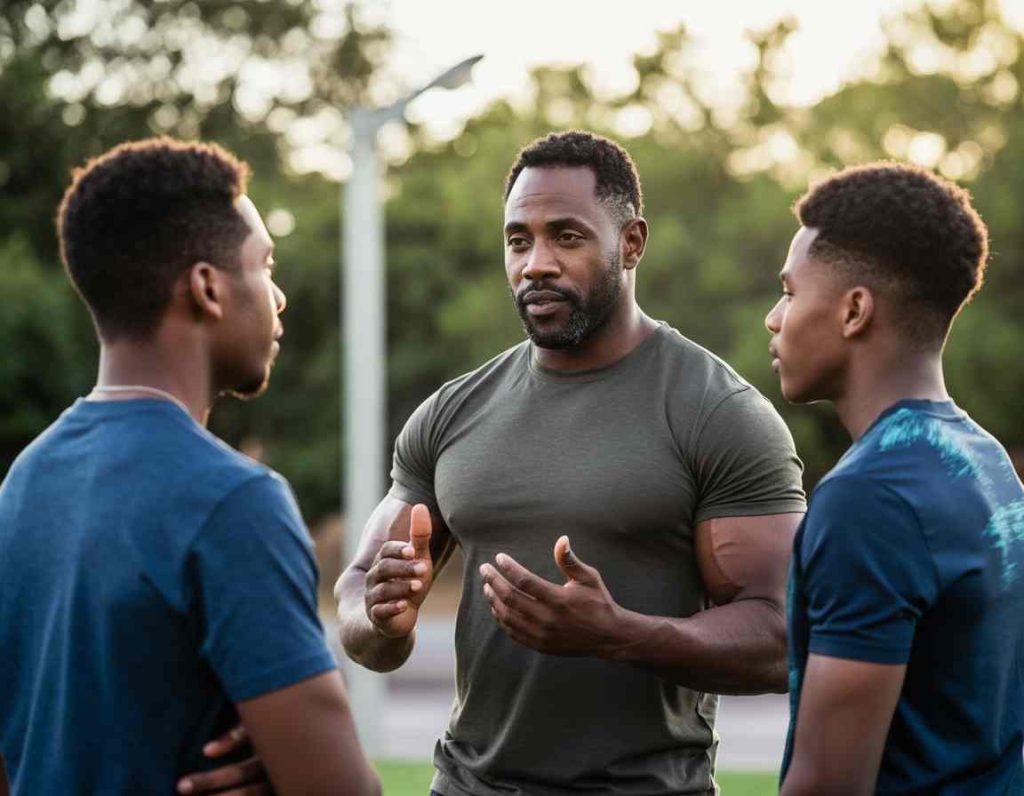
E. Repair: How To Disrupt Hypermasculine Performance
The time for diagnosis has passed. What remains now is repair.
1. Using the Bridge Model by Daniel Nkado to Break the Cycle and Harm
The Bridge Model is Daniel Nkado’s three‑level framework for repairing community wounds in high‑pressure spaces. Applied to hypermasculinity, it interrupts performance not by shaming men out of it, but by changing the conditions that make wearing an armour feel necessary.
The model works across three levels of care—personal effort, small‑group norms, and community systems. Together, individual and collective action reduce fear, shame, and status anxiety and replace them with environments where care is reliable and dignity is non‑negotiable.
Level 1: Personal Effort — One‑to‑One Influence
Level 1 is not about “fixing the performer.” It is about what Bridge Builders reward, tolerate, and correct in everyday interactions—because private standards become public incentives.
The original Level 1 sequence is PPP–RR–C, expressed through six core practices:
- Practise radical empathy
- Prioritise fixing it over defensiveness
- Practise flexibility during meet-ups
- Recognise your power and share it
- Reward honesty, not performance
- Counter misinformation by encouraging fact-checking
For hypermasculinity specifically, Bridge Builders have three main leverage points:
- Practise radical empathy—without validating the performance.
- Reward honesty, not performance.
- Counter misinformation—fact‑check masculinity myths.
Example scripts:
- Radical empathy: “He’s not ‘fem’—he’s being authentic. Continue your story.”
- Reward honesty: “I invite honest people first.”
- Counter misinformation: “Hypermasculinity doesn’t make him more masculine than you.”
Level 2: Small‑Group Norms — Friends, Dates, Group Chats
Goal: Remove masculinity as social currency.
Practices:
- Bystander interrupts—short, calm, public.
- Maintain peace without rewarding armour
Sample interrupts:
- “We’re not ranking masculinity here.”
- “Let’s not make ‘fem’ the punchline.”
- “Masculinity is not shaming others.”
Level 3: Community Systems of Care — Platforms, Organisers, Media, Elders
Goal: Make dignity predictable and care structural.
Tools:
- Code of conduct: ban femininity‑shaming and “masc vs fem” ranking.
- Non‑negotiable inclusivity: protect femme and soft men publicly.
- Moderator standards: enforce consistently so safety is predictable.
- Media and mentorship: reward emotional competence, repair, and accountability—not armour.
Core shift: Hypermasculinity survives when groups reward it with laughter, flirting, status, or silence. The Bridge Model reverses these incentives across all three levels.
FAQs
1. Is every muscular guy performing hypermasculinity? How can I tell?
No. Having muscles is a physical trait; hypermasculinity is a psychological defence. To tell the difference, look for the motivation behind the behaviour. A man who is simply muscular can usually still be gentle, vulnerable, or playful. A man performing hypermasculinity, however, uses his size as a “hard shell” to avoid detection. If his strength feels like a “shield” against ever looking soft or weak, it is likely rooted in a performance of hypermasculinity.
2. I just discovered that my “hard” boyfriend has another man he is soft for. How can I act?
This discovery can be painful, but it confirms a key truth: his hardness is most likely a mask and not his permanent personality. Hypermasculinity hides the vulnerability of shame. The fact that he is soft elsewhere proves that his “macho” persona is a performance he turns on and off.
He has likely found a space with that person where he does not fear the “punishment” usually associated with femininity. If you want to address this, focus on the lack of safety he feels with you versus with that other person.
Ask: “What makes you feel safe enough to be soft there, but not here?” This bypasses the anger of the betrayal and targets the root of the behaviour: his need for a place to drop the shield.
References
- Connell, R. W., & Messerschmidt, J. W. (2005). Hegemonic Masculinity: Rethinking the Concept. Gender & Society, 19(6), 829–859. https://doi.org/10.1177/0891243205278639
- Elopre, L., Hussen, S. A., Ott, C., Mugavero, M. J., & Turan, J. M. (2021). A Qualitative Study: The Journey to Self-Acceptance of Sexual Identity among Young, Black MSM in the South. Behavioral Medicine, 47(4), 324–334. https://doi.org/10.1080/08964289.2020.1870428
- Goffman, E. (1963). Stigma: Notes on the Management of Spoiled Identity. Touchstone. https://ia601503.us.archive.org/22/items/in.ernet.dli.2015.264015/2015.264015.Stigma.pdf
- Herek, G. M. (2007). Confronting Sexual Stigma and Prejudice: Theory and Practice. Journal of Social Issues, 63(4), 905–925. https://doi.org/10.1111/j.1540-4560.2007.00544.x
- Ingram, K. M., Davis, J. P., Espelage, D. L., Hatchel, T., Merrin, G. J., Valido, A., & Torgal, C. (2019). Longitudinal associations between features of toxic masculinity and bystander willingness to intervene in bullying among middle school boys. Journal of School Psychology, 77, 139–151. https://doi.org/10.1016/j.jsp.2019.10.007
- Majors, R., & Billson, J. M. (1992). Cool pose: The dilemmas of Black manhood in America. Lexington Books. https://archive.org/details/isbn_2900671865725
- Meyer, I. H. (2003). Prejudice, social stress, and mental health in lesbian, gay, and bisexual populations: Conceptual issues and research evidence. Psychological Bulletin, 129(5), 674–697. https://doi.org/10.1037/0033-2909.129.5.674
- Pascoe, C. J. (2005). “Dude, You’re a Fag”: Adolescent Masculinity and the Fag Discourse. Sexualities, 8(3), 329–346. https://doi.org/10.1177/1363460705053337
- Reidy, D. E., Berke, D. S., Gentile, B., & Zeichner, A. (2015). Masculine discrepancy stress, substance use, assault and injury in a survey of US men. Injury Prevention, 22(5), 370–374. https://doi.org/10.1136/injuryprev-2015-041599
- Wong, Y. J., Ho, M.-H. R., Wang, S.-Y., & Miller, I. S. K. (2017). Meta-analyses of the relationship between conformity to masculine norms and mental health-related outcomes. Journal of Counseling Psychology, 64(1), 80–93. https://doi.org/10.1037/cou0000176