In 2026, the meaning of personal social capital for Black gay men is changing.
Building personal influence and social power in the Black queer scene no longer centres on maximum visibility or desirability—being the hottest profile on Grindr or the most connected figure in nightlife circuits. Instead, new forms of social capital are emerging that are quieter, more interior, and explicitly protective: trust, care infrastructure, emotional steadiness, and the ability to create spaces where people can exhale.
This article maps five emerging currencies of personal social capital for Black gay men and grounds them in London-based examples for readers seeking—or deliberately building—new forms of clout that prioritise care, credibility, and belonging.
What “Queer Social Capital” Means in 2026
Queer social capital refers to the network of friendships, chosen families, allies, and shared resources that gay men assemble to survive and thrive in a world not built for queerness. But within that network, something else quietly decides not just who gets invited, but who gets the follow-up message—please come: social currency.
If social capital is the total balance in the bank account, social currency is the note you spend. And in queer economy, the exchange rate never stays the same. Since 2024–2025, the global queer “market” has been recalibrating what counts as value—what gets rewarded, respected, protected, and believed.
Think about the most influential Black gay man you know. Not the wealthiest. Not the hottest. But the one whose call you always answer. The one you reach for in moments of confusion—when you need real advice, not hype. The one you remember, and genuinely want to talk to, when you’re not horny or high.
That is social currency in 2026: influence grounded in trust and reliability, not performance or display.
Calculating Your Social Value as a Black Gay Man in 2026
Black gay men navigate a distinctive intersection of race and sexuality, generating different forms of social currency—the informal markers of credibility, influence, and belonging that operate in the community. By 2026, these currencies are shifting fast: away from visibility-driven clout and toward durable relational infrastructure.
A Black gay man can command high scene or sexual visibility (high currency) while still lacking dependable safety nets (low capital). Research on chosen and constructed families shows why: community ties often function as real protective systems—sources of care, advocacy, and material support—rather than mere social aesthetics or symbols of inclusion (Zarwell et al., 2018)[6].

Why the “Old” Currencies Are Depreciating
For decades, status in many Black gay spaces leaned on a familiar bundle: dating‑app desirability, nightlife centrality, hypermasculine performance, and proximity to the “main boys”[5]. These currencies started losing value post-COVID due to three structural pressures:
- Dating-app fatigue: easy visibility without real care.
- Shrinking nightlife: high cost for access + low return in real connection=unmet expectations.
- Chemsex limits: quick, intense connections that die with the high.
How Chemsex Closes the Desirability Gap for Black Gay Men
Chemsex drugs can accelerate arousal and lower inhibitions, temporarily flattening the usual “preference” filters—men become less selective, escalation happens faster, and the sorting logic shifts toward availability for the session and sexual performance rather than slow appraisal by race, beauty, or scene status. Hook-up apps serve as a reliable infrastructure for the “party and play” economy, making it easy to signal intent and quickly assemble encounters[2].
Race and beauty blindness mark many chemsex connections—even when they rarely survive beyond the session itself.

The 5 Emerging Social Currencies for Black Gay Men of 2026
If attention is cheap and nightlife venues are closing, what holds value in Black queer scenes now?
In 2026, the most sustainable ventures in Black queer life are the ones that invest in care, continuity, legibility, and presence—the currencies now holding real value. This is the New Black Renaissance (NBR).
1. Inclusive Masculinity and Visible Authenticity
Historically, “straight-acting” hypermasculinity functioned as a dominant social currency—shaping desirability and perceived safety while marginalising tenderness and emotional openness (Thepsourinthone et al., 2022)[4].
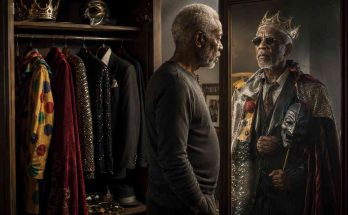
But like every West End run, there comes a point when the performance ends: the actors take their bow and exit the stage. Backstage, the costumes come off—and what’s left is the person underneath.
By 2026, a generational shift is taking the stage—one that privileges emotional stability over emotional distance. The most respected men are no longer the ones who perform toughness, but the ones who can hold the room: who meet conflict with repair rather than ego-survival, and who make it safer for others to drop their armour.
Currency today: the capacity to be authentic and to hold space for others’ authenticity.
2. Credibility Over Numbers in Digital Spaces
In an overcrowded attention economy, what increasingly matters is depth—being a voice people return to because it clarifies reality or gives language to shared experience. As public platforms grow more volatile, credibility accrues not to those who go viral, but to those who cultivate durable digital trust.
Research on queer digital platforms supports this shift. Lex, for instance, is designed as a purely text-based dating space—so connection is organised less through photo-led evaluation and more through language, intent, and tone (Powell & Powell, 2022)[3].
Currency today: reliability over recognition.
3. Cultural Stewardship and Mentorship
Some queer currencies endure because they are rooted in contribution. Ballroom culture remains a prime example: titles such as Legendary and Icon are earned through sustained excellence, mentorship, and community leadership—not aesthetics alone.
As Black queer culture enters the mainstream, a parallel currency rises: stewardship. Elders, archivists, and mentors who preserve lineage and protect meaning from commodification are increasingly revered. Cultural memory itself is becoming a durable form of queer social value, sustaining identity across generations.
Currency today: safeguarding history and mentoring the next generation.
4. Impact Credibility—Activism as Infrastructure
By 2026, activism has become a top-value social currency in queer culture. Leadership that translates community need into material protection—policy change, health access, legal advocacy—carries immense moral and social authority.
In the UK, organisations like UK Black Pride command respect by modelling community-led power through celebration and advocacy. The Global Black Queer Assembly in Paris extends that power onto a global stage.
Currency today: any contribution that converts into care.
5. Beyond-the-Scene Currencies: Community and Shared Belonging
As scene-based status declines, social capital is migrating to spaces organised around shared humanity rather than consumption. Book clubs, walking groups, museum trips, Sunday meals, and creative hangs—where masculinity, desirability, and sexual availability no longer dictate entry—generate bonds that outlast nightlife.
Meanwhile, mutual care evolves from just “being nice” to intentional support systems: scheduled check-ins, resolving conflicts privately rather than gossiping, discreetly referring others to therapy, housing assistance, or job openings. Social value is increasingly attributed to those who create opportunities—individuals who share resources freely, without humiliation, strings, or leverage.
Currency today: building spaces people don’t just attend but return to.
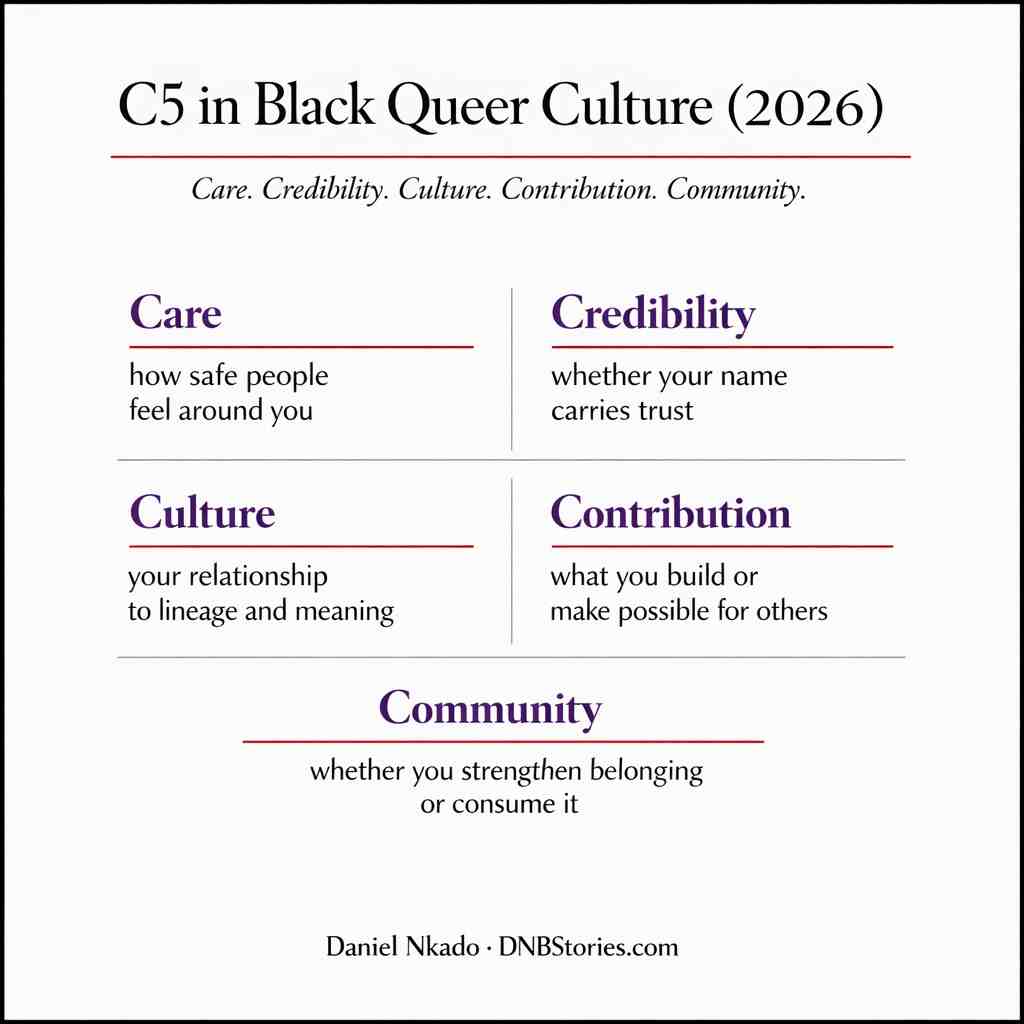
C5 in Black Queer Culture (2026)
By 2026, Black queer clout is increasingly organised around C5: care, credibility, culture, contribution, and community—the currencies that convert visibility into something that actually holds.
- Care is how safe people feel in your presence.
- Credibility is whether your name carries trust when you’re not in the room.
- Culture is your relationship to lineage—how you create, protect, and transmit meaning.
- Contribution is what you build, improve, or make possible for others.
- Community is whether you strengthen belonging—or merely consume it.
Together, C5 marks the shift from being seen to being relied on.
The Audit: Does Your Currency Convert into Capital?
By 2026, Black gay men are redefining what success looks like. Where silence and conformity once ensured survival, today’s landscape rewards courage, care, and accountability to one another.
The test is simple: disappear for 90 days—no posts, no parties, no desirability performance. Who still reaches for you?
If people check in, protect your name, and make space for your return, that is not just social currency. That is capital—the foundation of Black gay power in 2026.
Conclusion
The closure of venues like Brooklyn’s Club Lambda, Denver Sweet, and Soho’s G‑A‑Y Bar has hardened a lesson many Black gay men already understood: In a cheap‑attention economy, Black queer value now lives in spaces built not for consumption, but for care—rooms resting on authenticity and protection where people can exhale after holding their breath all week.
Frequently Asked Questions
No. It responds to the reality that nightlife cannot remain the sole infrastructure for Black queer connection, especially as venues continue to close.
Friendship is emotional; social capital is structural. Social capital captures how networks provide protection, resources, and institutional access—critical factors for marginalised groups.
They can be, when actively moderated by the community. Smaller, non‑algorithmic spaces reduce exposure to harassment and bad‑faith engagement
References
- Campkin, B., & Marshall, L. (2018). London’s nocturnal queer geographies. Soundings, 70(70), 82–96. https://doi.org/10.3898/soun.70.06.2018
- Jaspal, R. (2022). Chemsex, Identity and Sexual Health among Gay and Bisexual Men. International Journal of Environmental Research and Public Health, 19(19), 12124. https://doi.org/10.3390/ijerph191912124
- Powell, L., & Powell, V. (2022). Queer dating during social distancing using a text-based app. SN Social Sciences, 2(6). https://doi.org/10.1007/s43545-022-00345-4
- Thepsourinthone, J., Dune, T., Liamputtong, P., & Arora, A. (2022). It’s a Man’s World: A Qualitative Study of Gender and Sexuality amongst Australian Gay Men. International Journal of Environmental Research and Public Health, 19(4), 2092. https://doi.org/10.3390/ijerph19042092
- Wade, R. M., & Pear, M. M. (2022). Online Dating and Mental Health among Young Sexual Minority Black Men: Is Ethnic Identity Protective in the Face of Sexual Racism? International Journal of Environmental Research and Public Health, 19(21), 14263. https://doi.org/10.3390/ijerph192114263
- Zarwell, M., & Robinson, W. T. (2018). Development of a social capital scale for constructed families of gay, bisexual, and other men who have sex with men. PLOS ONE, 13(12), e0208781. https://doi.org/10.1371/journal.pone.0208781