
Choosing ‘Easy to Be Around’ Over Honest Feeling
In a world that often demands Black queer men be palatable, agreeable, and emotionally accommodating in order to be accepted, respected, or desired, performance and conformity can start to feel like the only available routes to survival.
Many Black queer men grow up under severe conditions of policing and shame, carrying unprocessed scars that can make harmony feel safer than honesty. Over time, being “easy to be around” may begin to seem like the price of being allowed to stay in the room.
This is how some Black queer men begin shrinking themselves just to secure conditional belonging.
In Black queer relationships, politeness can easily be mistaken for safety. But being agreeable or easy to be around does not guarantee trust. This article explores five qualities that better predict safer connections: self-regard, honest dissent, legibility, and known boundaries under pressure.
- Choosing 'Easy to Be Around' Over Honest Feeling
- The Cost of Shrinking Yourself to Gain Acceptance
- 5 Ingredients of Emotional Safety in Black Queer Relationships
- The Hidden Danger of People-Pleasing
- Legibility is Not Simplicity
- How to Use the Framework
- Final Words: Getting Close to a Performer is Risky
- References
The Cost of Shrinking Yourself to Gain Acceptance
Shrinking yourself to gain acceptance may reduce immediate conflict, but it rarely creates real safety. For many Black queer men, becoming agreeable, quiet, pleasing, or emotionally low-maintenance can feel like a way to avoid rejection.
But over time, this kind of self-erasure trains relationships to accept only the performed version of you, while your real needs, limits, and feelings remain unseen. What looks like peace on the surface can become loneliness beneath the surface.
False Peace Does Not Create Safety — It Destroys It
Suppressing genuine emotions to appear agreeable and secure a place in the room only produces false peace. This false peace avoids conflict rather than resolving tension; it prioritises politeness over boundaries, performs affection rather than offering true consent, and harbours resentment rather than speaking the truth.
While this dynamic may keep the room calm, it does not make the relationship safe. Unexpressed emotions do not simply vanish. They sink deeper into the psyche, hardening into bitterness, suspicion, and internalised contempt.
Research on minority stress shows that Black queer men navigate overlapping pressures of racism, homophobia, and gendered expectations that can encourage masking and emotional self-erasure (Meyer, 2003; Bowleg, 2013). These pressures can produce relationships that appear peaceful on the surface yet remain unstable underneath.
5 Ingredients of Emotional Safety in Black Queer Relationships
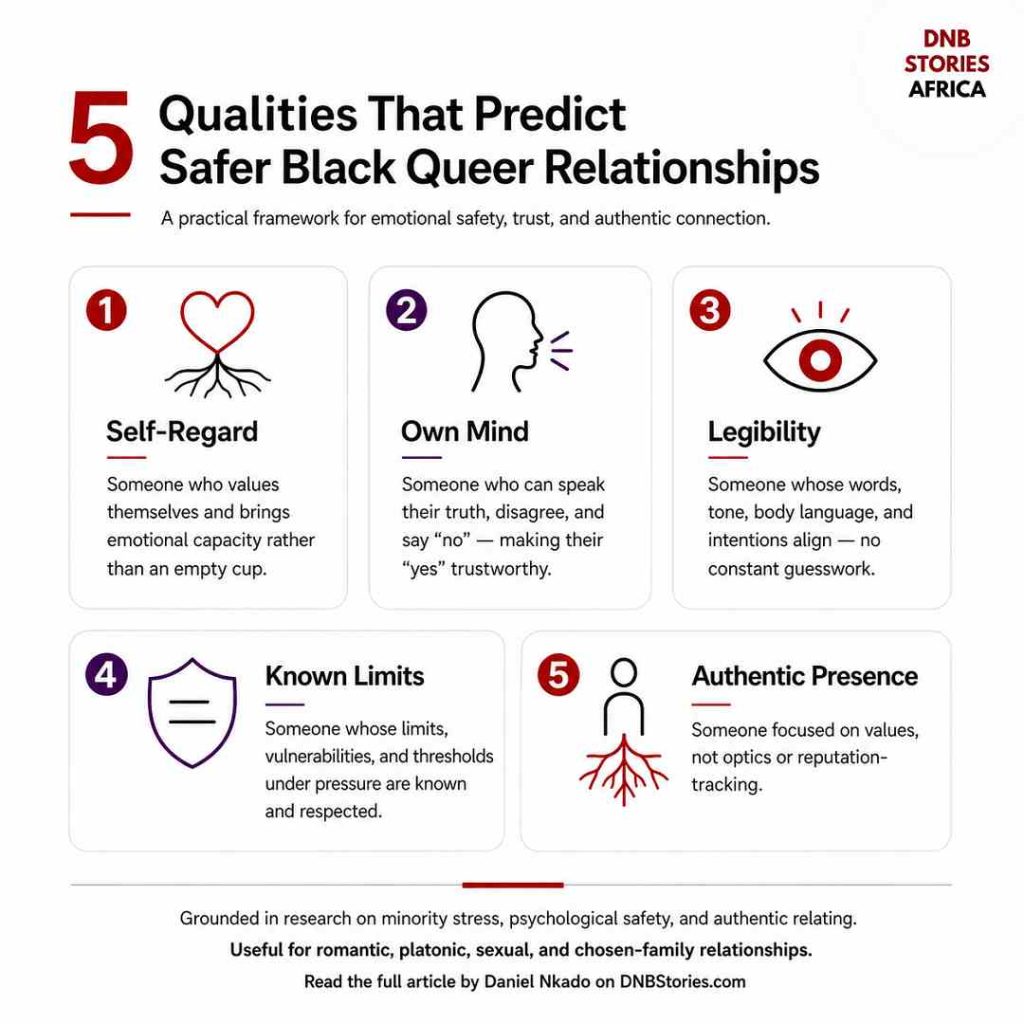
These five qualities offer a practical way to recognise safer relational patterns among Black queer people. They apply across romantic relationships, sexual connections, chosen family, and platonic friendships.
1. Someone Who Loves Themselves
Self-love is not branding; it is capacity. A person who has not cultivated self-regard often approaches relationships with an empty cup, unconsciously asking others to supply meaning, validation, or emotional regulation.
A friend who loves themselves:
- Does not require constant reassurance
- Can withstand disagreement
- Does not resent you for unmet, unspoken needs
Self-love creates structural integrity. Without it, relationships can collapse under a mountain of emotional demands that no one can reasonably meet. Unrealistic emotional expectations leave a heavy trail of emotional debt that eventually congeals into resentment and contempt.
2. Someone Who Has and Speaks Their Own Mind
You cannot trust a “yes” from someone who is incapable of saying “no.” When a person avoids disagreement to preserve peace, they are not offering safety; they are offering fear.
Psychological safety requires bi-directional honesty, not compliance (Edmondson & Lei, 2014).
Real trust depends on believing that a person’s answers reflect their true intentions and emotions. If they cannot dissent, consent becomes unreliable. Their “yes” may sound agreeable, but it may also be shaped by fear, shame or the need to remain accepted.
Someone who keeps their own mind and honours their own needs over external scripts is easier to trust. If they stand by you, their support carries weight because it was chosen, not cajoled.

3. Someone You Can Read
Legibility is an act of care. In many Black queer spaces, men are socialised to mask—to code-switch, perform masculinity, or suppress vulnerability. While this can be protective, it is also exhausting for those in a relationship with them.
Legibility reduces emotional labour because what is clear does not need constant management. When people state their boundaries, they mean their “yes,” and allow their “no.” Others are freed from guesswork.
Safety emerges from predictability, not politeness. Respect becomes possible when no one is forced to infer what should have been spoken. You know someone is legible when you do not have to keep guessing who they are, what they mean, or where they stand. That clarity is what makes trust, consent, and mutual understanding possible.
A readable person aligns:
- Words with body language
- Tone with intent
- Silence with clarity
4. Someone Whose ‘Price’ You Know
Everyone has a limit, a vulnerability, a cost. Knowing someone’s “price” means understanding what they protect under pressure—money, safety, status, belonging, or emotional energy. This is not cynicism; it is informed trust. When things get expensive, people reveal priorities. Trust grows when those priorities are already known.
For Black queer men especially, this shift is liberatory. It replaces a survival-based connection with sustainable intimacy.
I don’t need you to be perfect. I need you to be solid.
5. Someone Who Is Not a Reputation Tracker
A reputation tracker is someone who constantly monitors how they are being perceived and adjusts themselves accordingly. Their attention is outward-facing: How am I coming across? Did that land well? Am I still liked? Have I lost standing?
In some cases, this kind of self-surveillance may not be immediately visible, but it shapes what the person says, how they apologise, when they agree, and what they hide.
Someone who is not a reputation tracker is easier to read because they are not constantly performing. Their behaviour is governed by values and boundaries rather than optics. They can correct errors without excessive defensiveness, disagree without theatrics, and tolerate misunderstanding without rushing to repair their image. What you see is closer to what is actually governing them.
A reputation tracker will almost always pick image and clique over their partners.
The Hidden Danger of People-Pleasing
People-pleasing is not dangerous because people pleasers are bad people. It is dangerous because it distorts reality. The risk is not usually malice, but unreliable signals. When someone says “yes” to avoid conflict, gain approval, prevent rejection, or manage anxiety, their agreement is often more strategic than sincere.
This makes consent unstable. If someone cannot safely say “no,” their “yes” carries little meaning. Others may believe there is agreement, comfort, or capacity where there is actually fear, discomfort, or quiet resistance. Over time, this creates false harmony: problems are hidden, resentment builds, and suppressed emotions later reappear as withdrawal, passive aggression, burnout, or sudden outbursts.
While some of these traits can operate as protective strategies in hostile environments, they often become default relational patterns that undermine intimacy even in safer spaces.
Legibility is Not Simplicity
Legibility should not be confused with simplicity. A person can be layered, complex, private, contradictory, evolving, and still be legible. Being layered means a person has depth: history, nuance, moods, wounds, contradictions, desires, and private interiority. Legibility means that their behaviour is coherent enough that others are not constantly forced to decode who they truly are or where they stand.
A layered person may not reveal everything about themselves, but they do not weaponise confusion either. They can be complex without making other people feel emotionally unsafe. They treat their privacy as boundaries, not traps. Their silence has context, not punishment. Their “yes” and “no” remain reliable even when their inner world is complicated.
Illegibility is an Overload of Signals
Illegibility is not depth. It is a cacophony of conflicting messages: too many meanings, too many performances, and too many possible explanations for what should not need concealing—unless something harmful is being protected beneath it.
Illegibility happens when someone’s words, actions, tone, and intentions do not align. They say they are fine while behaving resentfully; they present themselves as friends while acting in ways that undermine friendship. They claim care while manipulating outcomes; profess loyalty while tracking optics, and create emotional fog to trap others in relentless guesswork.
So the issue is not whether someone is deep, complex, or difficult to summarise. The issue is whether their complexity produces clarity or confusion. Layered people can still be safe. Illegible people make others work too hard to know what is real. And in most cases, what is aggressively obscured is not depth, but danger.
How to Spot Performance in Black Queer Spaces
In Black queer dynamics, one simple way to spot performance is this: it keeps announcing itself, especially when no one asked. Often, it arrives through exaggeration: “I’m just top,” “I’m a real man,” “I’m bi,” “I like women more,” “I’m more dom,” or “I’m not gay like that.” These statements are not automatically dishonest, but when they are repeatedly volunteered, loudly defended, or used to create distance from queerness, they may reveal more about anxiety than truth.
Another sign is the constant “first-time” stories, usually offered without prompting: “My first gay experience was yesterday,” “My first time bottoming was yesterday,” or “My first time meeting a man from Grindr was yesterday.” Again, the issue is not the claim itself. People do have first experiences.
The issue is not the claim itself; people genuinely do have first experiences. The red flag is the repetitive, defensive narration used to distance the speaker from queerness or from any perceived negative meaning attached to the encounter.
When an identity, preference, or sexual role must be repeatedly announced, protected, and wrapped in distance from queerness, it often tells us less about desire and more about performance.

How to Use the Framework
Most people do not always want honesty; they want comfort. But comfort alone does not build trust. Structure does. This framework offers a practical way to assess emotional safety and trust potential, especially in Black queer relationships.
If your priority is trust and safety in a Black queer relationship—not desire, quick sex, connectionless intimacy, or clique access—ask these five questions before giving any new person access to you:
- Do they love themselves?
If not, the relationship may eventually become an uncontracted repair job. - Can they disagree with me?
If they cannot say “no,” you can’t trust their “yes”. - Can I read them?
If their words, tone, and behaviour do not align, you are being asked to do unpaid emotional detective work. - Do I know their limits under pressure?
Everyone has a threshold. Trust requires knowing where it is. - Are they present, or are they tracking optics?
If they are more focused on how they are perceived than on what is actually happening, the relationship may start to resemble a social media dynamic.
These qualities are not only standards for assessing others. They are also capacities we can cultivate in ourselves through personal reflection, community accountability, honest self-inquiry, and, in some cases, therapy.
Final Words: Getting Close to a Performer is Risky
This framework is not about morality; it is about reliability. Black queer spaces do not need perfect people to thrive. They need structurally sound ones: real people anchored in authenticity and honesty.
Emotional safety is not simply about kindness, but coherence. A safe person does not outsource their self-worth, can tell you “no” without disappearing, does not require you to read between the lines, and has clear, known limits under pressure. Anything else is performance.
References
- Bowleg, L. (2013). “Once you’ve blended the cake, you can’t take the parts back to the main ingredients”: Black gay and bisexual men’s descriptions and experiences of intersectionality. Sex Roles, 68(11–12), 754–767. https://doi.org/10.1007/s11199-012-0152-4
- Edmondson, A. C., & Lei, Z. (2014). Psychological safety: The history, renaissance, and future of an interpersonal construct. Annual Review of Organizational Psychology and Organizational Behavior, 1(1), 23–43. https://doi.org/10.1146/annurev-orgpsych-031413-091305
- Hochschild, A. R. (1983). The managed heart: Commercialization of human feeling. University of California Press. https://caringlabor.wordpress.com/wp-content/uploads/2012/09/the-managed-heart-arlie-russell-hochschild.pdf
- Meyer, I. H. (2003). Prejudice, social stress, and mental health in lesbian, gay, and bisexual populations: Conceptual issues and research evidence. Psychological Bulletin, 129(5), 674–697. https://doi.org/10.1037/0033-2909.129.5.674
- Mikulincer, M., & Shaver, P. R. (2016). Attachment in adulthood: Structure, dynamics, and change (2nd ed.). The Guilford Press.
- Mullainathan, S., & Shafir, E. (2013). Scarcity: Why having too little means so much. Times Books. https://psycnet.apa.org/record/2013-37402-000
Frequently Asked Questions
A safer Black queer relationship is built on honesty, clear boundaries, emotional coherence, and mutual respect. Safety is not simply about kindness or attraction; it is about whether someone’s words, actions, and limits can be trusted.
Politeness can hide discomfort, resentment, fear, or people-pleasing. A relationship may appear peaceful while remaining unstable beneath the surface. Real safety requires truth, not just smoothness.
If someone cannot safely say “no,” their “yes” becomes unreliable. Consent and trust depend on knowing that a person’s agreement reflects their real intention, not fear, pressure, or the need to be accepted.
Legibility means a person’s words, tone, behaviour, and intentions are coherent enough that others are not forced into constant guesswork. A legible person can still be private or complex, but they do not create emotional fog.
People reveal their true priorities when they are stressed, ashamed, afraid, or under pressure. Knowing someone’s true limits helps prevent false expectations and makes trust more realistic.