
Bottom-Shaming, Masculinity, and Black Gay Men
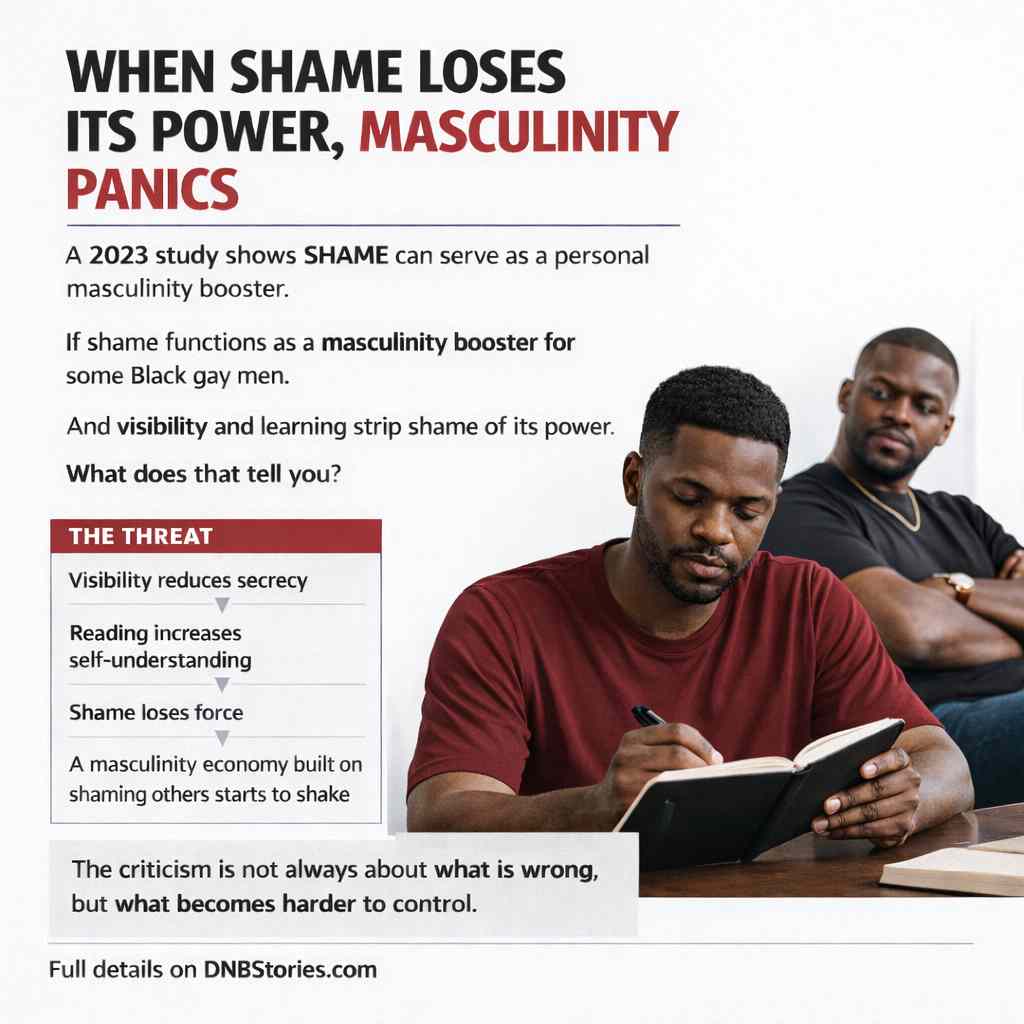
A 2023 study by T. J. A. Winder found that some Black gay men use shaming language—particularly “bottom-shaming,” or mocking the receptive sexual role—to emasculate other men and “shore up” their own masculinity.
Published in Gender & Society, the study argues that sexual-positioning discourse can operate in ways strikingly similar to the “fag discourse” or homophobic slurs used by some straight men to assert their heterosexual identity[8].
For some Black gay men, shaming language functions as a form of masculinity work that elevates one man by degrading another. In this masculinity cult, humiliation is the price of admission.
The article examines these dynamics in depth, rejects humiliation as a false masculinity booster, and outlines practical steps for dismantling harmful hierarchies and nurturing healthier Black queer identities
- Bottom-Shaming, Masculinity, and Black Gay Men
- Calling Another Man a Bottom to Boost Fragile Masculinity
- Background of the Study
- Fag Discourse vs Bottom-Shaming
- Hypermasculinity Performance and Gender Role Strain
- Consequences of Performing Masculinity
- Performing Masculinity for Survival vs for Status
- Rejecting Humiliation as a Masculinity Booster
- Conclusion
- Recommended DNB Frameworks
- References
Calling Another Man a Bottom to Boost Fragile Masculinity
Winder’s research shows that for some Black gay men, calling another man a “bottom,” or even merely insinuating it, is not a neutral sexual description. In some contexts, this humiliating labelling functions as a strategic move aimed at lowering the target’s masculine standing—usually someone he sees as a rival—while elevating the shamer’s position within the immediate masculine hierarchy.
This calculated strategy narrows the range of what feels acceptable in Black gay spaces, binding men who share this masculinity fever into a hierarchy sustained through the humiliation of others and a collective rejection of softness, vulnerability, learning, and visibility.
This practice shapes how these men move through social and sexual worlds, governs how they treat one another—including intimate partners—and punishes deviation through exclusion from the masculine order.
Background of the Study
Winder’s article is not a loose cultural opinion piece. Its conclusions rest on patterned evidence rather than isolated anecdotes. The study was based on participant observation at a Los Angeles HIV-prevention organisation between 2012 and 2017, 50 in-depth interviews with self-identified Black gay, bisexual, and pansexual men aged 18 to 31, and observations of informal interactions among more than 250 young men.
Winder found that “sexual positioning discourse” involved some Black gay men shaming others as “bottoms” while celebrating themselves as “tops.” In this context, calling someone a “bottom” is not merely to describe sexual preference but acts as a way of undermining the target’s manhood while boosting the masculine standing of the person claiming to be “top.”
Fag Discourse vs Bottom-Shaming
The insult works because sexual-positioning discourse—constant talk about who is a top and who is a bottom—has, in some Black gay spaces, socially loaded receptive anal sex or “bottoming” with meanings of softness, femininity, and lower status.
Winder frames this as a form of masculinity boundary-work that mirrors what sociologist C. J. Pascoe[5] calls “fag discourse,” in which straight boys use labels like “fag” or “sissy” to shame any behaviour not deemed masculine enough in other boys.
The difference, however, is telling: Straight boys often use “fag” slurs to reaffirm their own heterosexuality. Some gay men, by contrast, use “bottom” jibes to reassert a masculine hierarchy—implicitly saying, I may be gay, but I’m still more masculine than him.
This dynamic can be especially corrosive because it unfolds under conditions of potential intimacy—among men who might otherwise be partners or lovers, or who share a bed. As a result, trust becomes more fragile, desire becomes more guarded, and connection becomes increasingly loveless.
Hypermasculinity Performance and Gender Role Strain
Winder (2023) also shows that “bottom-shaming”—using anal receptivity to mock another man—functions as ritualistic emasculation, allowing the shamer to bolster his own manhood by positioning the target as less masculine. This hierarchy is maintained by rewarding hypermasculine performance and devaluing traits associated with femininity or softness.
Hypermasculinity refers to the deliberate exaggeration of stereotypically masculine traits such as aggression, emotional stoicism, and dominance, often used as a defensive strategy to hide a perceived weakness, including bottoming.
This performed masculinity, sometimes described as “mascing” or “out-butching,” often involves projecting exaggerated toughness, dominance, emotional restraint, and heterosexual performance in order to gain or boost social status. In some cases, it may also push certain Black gay men towards exaggerated sexual aggression as a way of proving masculinity[6].
Consequences of Performing Masculinity
Hypermasculine performance can generate social capital in some gay spaces, but it often carries a high psychological cost. Such performances can intensify gender‑role strain—the stress that comes from trying to conform to rigid masculine ideals—and contribute to emotional suppression and heightened mental‑health risks among Black gay men (Fields et al, 2015)[2].
Because masking requires suppressing the authentic self, it often obstructs genuine intimacy and connection, leaving the individual feeling unseen, misunderstood, and isolated even when surrounded by others. This creates a conflict between the rigid demands of performed hardness and genuine emotional needs, further compromising well-being.
Performing Masculinity for Survival vs for Status
A participant from the study noted that many Black gay men want a partner who is unclockable, “so they won’t suspect us if something goes down,” suggesting that straight-passing sometimes serves as a protective strategy against discrimination or harm.
This danger is real and not evenly distributed across contexts. In hostile environments, straight-passing remains a necessary survival tactic. In safer countries, however, it can become part of a desirability hierarchy in which hypermasculinity and straight performance are prized not for protection but for status and to attract more sexual partners. Unfortunately, this is often the particular dynamic that sustains the use of shame as a tool of exclusion, because under actual risk, men often recognise the shared logic of survival and protect each other rather than distribute stigma.
In relatively safer contexts, some Black gay men actively contribute to the continued association of queerness with shame, then use the performance of hardness, straightness and secrecy to absolve themselves of that stigma[4] and climb into a hierarchy that stamps them better than others.
Straight-passing for safety and straight-passing for status are not morally or politically equivalent.
Internalised Shame and Sexual Role Anxiety
When a man shames another over sexual receptivity, he often ends up making intimacy harder for himself. Once the mind absorbs the idea that bottoming, softness, or vulnerability makes a man “less masculine,” affection can start feeling dangerous.
The result is often ongoing hypervigilance, concealment, and pressure to perform masculinity rather than experience honest desire. In this climate, any perceived deviation can trigger anxiety, due to fear of embarrassment, loss of status, or exposure. Over time, as shame and sexual role anxiety continue to feed each other, the space for genuine intimacy gradually corrodes.
Sexual Aggression and Dominance Bottoming
Pressures of internalised shame and “mascing” can lead some Black gay men to internalise damaging beliefs about their sexuality, including the false idea that being gay weakens or diminishes manhood.
To mitigate the negative feelings of shame, some Black men may adopt harmful sexual behaviours, including heightened aggression and dominance bottoming, where aggression and hypermasculine cues are used to offset the stigma associated with receptivity.
In extreme cases, some Black gay men may pursue overpowering or excessively forceful encounters as a way of managing shame and alleviating masculine insecurity.
Shame as a Mechanism of Control and Exclusion
Bottom-shaming is effective not only because of what is said, but because of how shame works socially. As Trottier (2018) argues[7], shaming is not merely an individual act of insult. It is an assembled social process in which a network of actors helps circulate denunciation and expose the target to scrutiny, judgment, and social punishment.
Trottier notes that shame does not work in isolation but through a community. The target is made publicly legible in a punitive light, and this exposure can carry psychological harm. Digital media can accelerate this process by expanding the speed, reach, and persistence of exposure.
This helps explain why shame functions as a powerful device of control: often, the threat of exposure alone is enough to push a man back into compliance with the hierarchy.
Breaking free from the power of shame begins with one crucial insight: shame only carries the power you grant it. If someone tells you that bottoming has diminished your manhood, and you respond by performing “Alpha Top” and aggressively policing yourself, then shame has already done its controlling work.
Rejecting Humiliation as a Masculinity Booster
Winder’s research not only highlights the harms associated with hypermasculinity and bottom-shaming but also captures the voices of those who resist these norms. Not all Black gay men accept the idea that masculinity must be asserted through bottom-shaming.
Some participants openly questioned the assumed link between bottoming and masculinity, and challenged the social authority often granted to men who present themselves as “strict tops,” especially given evidence that sexual-role labels do not always align with private sexual behaviour. They recognised that these practices can fracture communities already burdened by broader forces of marginalisation.
This resistance matters because it points towards the cultivation of healthier forms of masculinity—less dependent on hierarchy, shame, and exposure. It also reminds us that these norms are social constructs, not permanent truths.
Because these notions are socially constructed, they can be challenged, reshaped, or discarded once they stop delivering rewards. Every Black gay man should remember that the shame economy he helps sustain will eventually feed him the same products.
Conclusion
A masculinity that needs humiliation in order to stand was never stable in the first place. It is insecurity held together by branding.
Often, the man being shamed as a “bottom” may possess more genuine masculine credibility than the man using ridicule as a quick masculinity booster.
True strength lies in rejecting false masculinity hierarchies and building communities that reward authenticity over shame.
Recommended DNB Frameworks
For readers seeking practical tools for navigating masculinity and its related challenges, these frameworks can offer useful guidance.
- Masculinity Anchors Model (MAM) — for greater understanding of why Black queer masculinity sees so much policing and defending.
- Sexual Role Anxiety — explains how shame around receptivity can interfere with intimacy.
- Absurdity Reps Method (ARM) — for breaking shame and humiliation in real time.
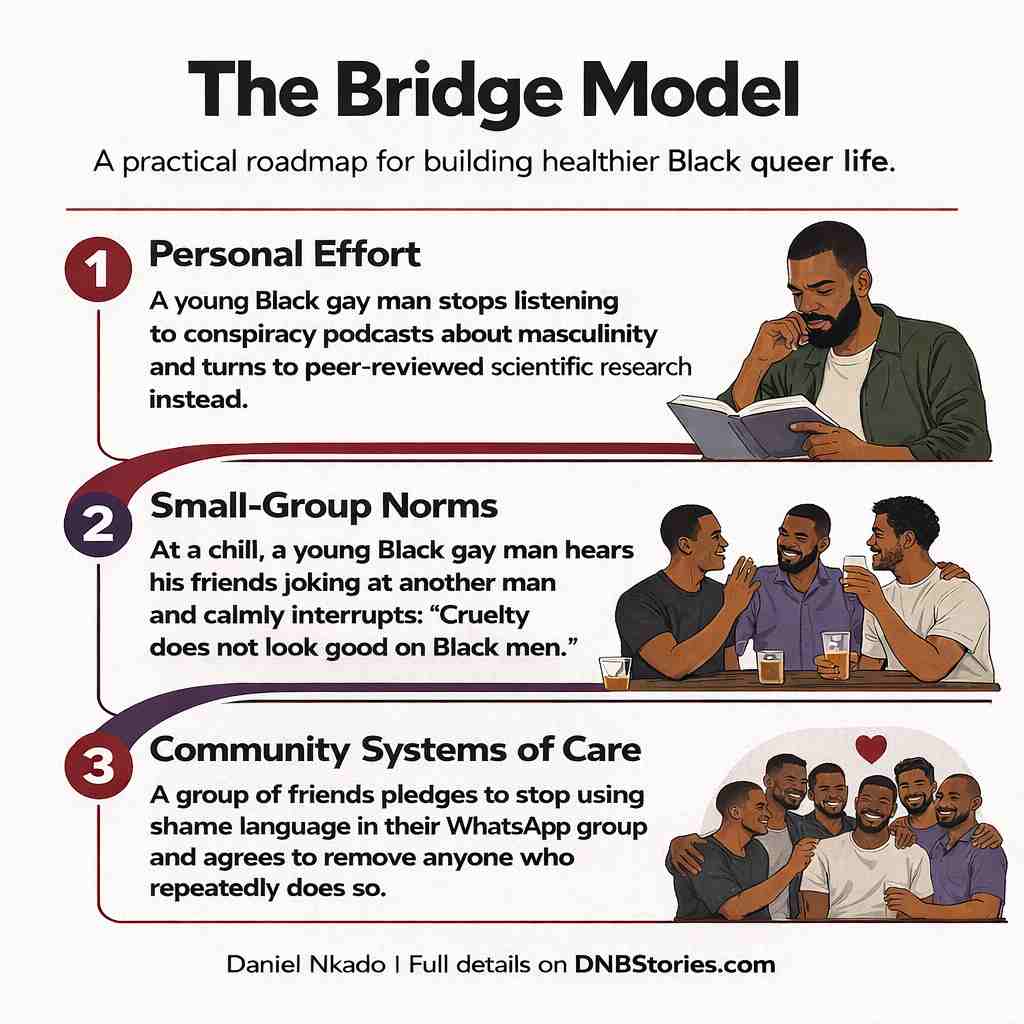
- The Bridge Model — for rebuilding trust and growing healthier Black queer communities.
References
- Adams, L. B., DeVinney, A., Aljuboori, D., Bachman, S., Lateef, H., Habteyesus, A., & Willie, T. C. (2026). Performing strength: Racialised masculinity in the lived experiences of Black men at risk of suicide. American Journal of Men’s Health, 20(1), Article 15579883251408351. https://doi.org/10.1177/15579883251408351
- Fields, E. L., Bogart, L. M., Smith, K. C., Malebranche, D. J., Ellen, J. M., & Schuster, M. A. (2015). “I always felt I had to prove my manhood”: Homosexuality, masculinity, gender role strain, and HIV risk among young Black men who have sex with men. American Journal of Public Health, 105(1), 122–131. https://doi.org/10.2105/AJPH.2013.301866
- Kohm, S. A. (2009). Naming, shaming and criminal justice: Mass-mediated humiliation as entertainment and punishment. Crime, Media, Culture: An International Journal, 5(2), 188–205. https://doi.org/10.1177/1741659009335724
- Mostoller, A. M., & Mickelson, K. D. (2024). Masculinity and mental well-being: The role of stigma attached to help-seeking among men. Sex Roles, 90(3), 353–362. https://doi.org/10.1007/s11199-024-01457-2
- Pascoe, C. J. (2005). “Dude, you’re a fag”: Adolescent masculinity and the fag discourse. Sexualities, 8(3), 329–346. https://doi.org/10.1177/1363460705053337
- Sánchez, F. J., Greenberg, S. T., Liu, W. M., & Vilain, E. (2009). Reported effects of masculine ideals on gay men. Psychology of Men & Masculinity, 10(1), 73–87. https://doi.org/10.1037/a0013513
- Trottier, D. (2018). Coming to Terms with Shame: Exploring Mediated Visibility against Transgressions. Surveillance & Society, 16(2), 170–182. https://doi.org/10.24908/ss.v16i2.6811
- Winder, T. J. A. (2023). The discursive work of “bottom-shaming”: Sexual positioning discourse in the construction of Black masculinity. Gender & Society, 37(5), 774–799. https://doi.org/10.1177/08912432231186999