The Hyper-Sexualisation of Black Bodies
On apps like Grindr, Scruff, or Jack’d, many Black gay and bisexual men notice a distinct pattern: their inboxes fill up faster than those of their peers, but the quality of connection is often vastly different.
Messages range from a generic “Hey” to immediate, explicit propositions. At first glance, this might look like a win in a world that commonly associates Black queer men with invisibility.
However, for far too many, this flood of attention quickly reveals itself as some form of fetishisation, most notably the BBC or Big Black Cock tropes—a racialised narrative that reduces a complex human being to a stereotype born in pornography and anchored on centuries of anti-Black racism (Goss, 2021)5.
The “BBC” fetish isn’t praise — it’s a racialised script that turns Black gay men into a box of consumable traits (big size, aggression, street thug).
This article traces the origins of this fetish, reveals how it harms Black gay men and fractures Black queer spaces, and offers actionable steps to reclaim dignity and rebuild collective strength.
What the ‘BBC’ Fetish Really Means
The acronym “BBC” is rarely just about size. It acts as a shorthand for three intertwined myths that dominate gay hookup culture (Collins, 2005)3:
- Hypersexuality: The portrayal of Black men as primal, aggressive, and sexually insatiable.
- Sexual Objectification: The reduction of complex individuals to their genitalia, turning Black men into sexual objects or commodities for fulfilling the fantasies of others.
- Top-Only Dominance: The expectation that Black men exist solely to aggressively “top” or “breed” non-Black partners. This often carries degrading undertones that mirror historical depictions of Black men as savage brutes.
These concepts are not new. They are direct descendants of the “Black brute” caricature used historically to justify the harsher policing of Black men (Alexander, 2012)1. Today, they are repackaged as sexual “preferences.”
As one Black gay man shared in an online forum:
“One guy literally said, ‘Then what’s the point of you being Black, if you don’t top?’ when I told him I’m a verse bottom who prefers affection over aggression.” (r/BlackLGBT, 2023)
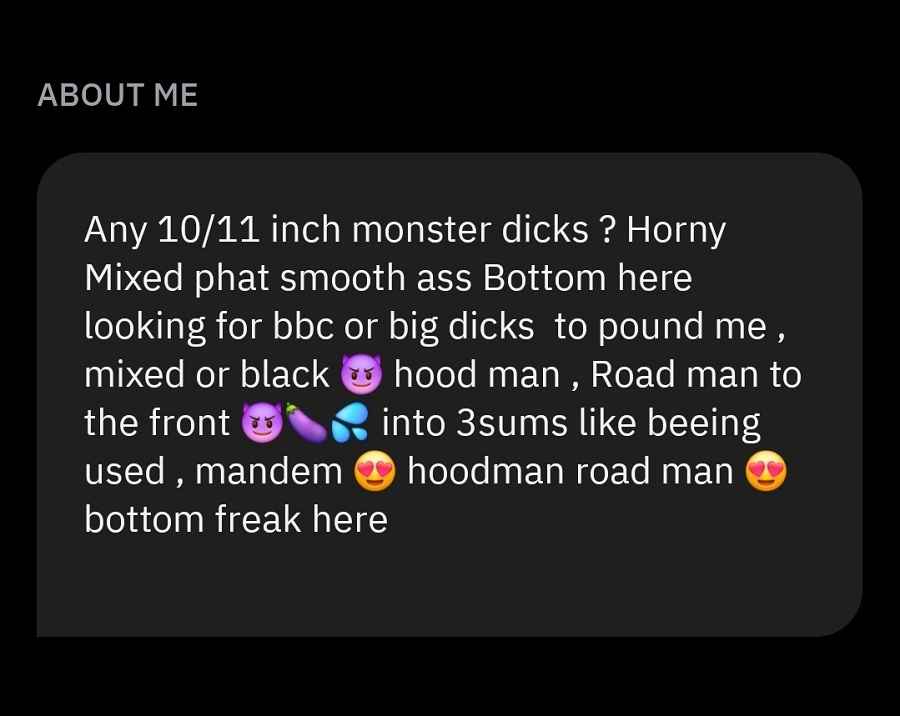
The Fetishisation of Black Gay Men in Digital Spaces
Black men often receive high visibility and engagement in digital spaces, but primarily as sexual fantasies rather than as whole, complex human beings. Research and platform data suggest that many users engage with Black men through racialised assumptions about masculinity, bodies, and sexual function, rather than with the same level of openness, curiosity, and recognition extended to others (Callander, 2016)2.
Attention driven by fetish-coded labels such as “BBC” does not signal deeper respect or genuine interest. Rather, it reveals how digital platforms reward objectification when Black men are presented in ways that promote high-traffic racial fantasies.
Desire Without Recognition:
The psychological impact of this dynamic is real. Repeated exposure to this kind of conditional attention can wear down self-esteem, skew expectations about relationships, and make it harder to form authentic intimacy. The popularity of porn categories such as “Ebony” and search terms like “BBC” makes clear that these experiences aren’t isolated or accidental—they are part of a wider commercial system that turns Black bodies into exotic objects (Wade et al., 2021)9.
✍🏾 A Note To Readers:
While the “BBC” fetish is common on dating apps like Grindr and Jack’d, not every expression of desire from non-Black men falls into this category. Some act on real attraction, while others unknowingly imitate pornographic tropes without understanding their significance. Recognising this harm does not require assuming malice in all cases; it simply involves distinguishing between person-centred desire and dehumanising objectification. ❤️
Preference vs. Fetishisation: Knowing the Difference
A common defence on dating apps when fetishisation is called out is, “It’s just a preference.” However, a true preference is adaptable and personal, whereas fetishisation is inflexible and reductive.
| Question | ✅ Genuine Preference | 🚩 Racial Fetishisation |
|---|---|---|
| Flexibility (How rigid is the desire?) | Flexible & Open. You might have a “type,” but you are open to surprises. “I usually like tall guys, but I really like your vibe.” | Rigid & Mandatory. The attraction relies 100% on race. If the race factor is removed, the interest is gone. “I only like Black guys who are hung and dominant.” |
| Reaction to Variance (What if he breaks the script?) | Curiosity. If he wants to cuddle or bottom, you adapt because you like him. “Totally cool, I’m down for whatever feels good.” | Disappointment/Anger. If he doesn’t fit the stereotype (e.g., he is soft or bottoms), the attraction collapses immediately. “What’s the point of you being Black if you don’t top?” |
| Scope of Interest (What are you looking at?) | The Whole Person. You see his job, his humour, his flaws, and his humanity. “I’d love to hear more about your photography.” | The Body Parts. You see a walking porn category or a prop for your own pleasure. “Send a dick pic. Is it big?” |
| Emotional Aftermath (How does he feel after?) | Connection. He feels seen, validated, and respected as an equal. | Empty & Used. He feels dehumanised, like an object used to scratch an itch. |
💡 Quick Guidance for Better Connections on Grindr, Hinge, Jack’d
- If you’re messaging: Ask about his interests or day before commenting on his race or anatomy.
- If you’re writing a bio: Lead with a human detail (job, hobby) and a short boundary line (e.g., “Not a category. No fetish talk.”).
- If you’re being fetishised: Remember that “No” is a complete sentence. You have the right to block, report, or ignore anyone who makes you feel like a sexual product.
The “In-House” Problem: Black Men Fetishising Other Black Men
Fetishisation doesn’t only come from outside the community. Many Black gay men also internalise and reproduce these same stereotypes.
Intraracial objectification occurs when Black men desire other Black men not for shared culture or genuine connection, but for the same racialised stereotypes seen in porn and media (Ferber, 2007)4.
Why It Happens: Cultural forces like pornography, racial tropes, and internalised models of masculinity shape erotic attraction. These forces influence how Black men assess and are assessed by partners, even within their own racial group.
Healthy Attraction Vs Intraracial Fetish
| Healthy Attraction | Intraracial Fetish |
|---|---|
| “I love our shared culture, our skin, and I feel safest with other Black men.” (Rooted in connection). | “I only date Black guys who look like thugs/hood dudes.” (Rooted in a caricature). |
Consequences: While intersectional differences (such as class, social status, body type, age, and immigration circumstances) influence how Black gay men experience desire and harm, they are not sufficient reasons to justify objectifying one another. Fetishisation—whether internal or external—reduces people to commodities and maintains harmful hierarchies. Clearly recognising this protects vulnerable members and promotes collective accountability.

Harmful Consequences of Racialised Fetishisation
Fetishisation isn’t a “personal preference.” It is a mechanism that sustains many racialised harms that extend from private spaces into community and public life.
a. Promotes the ‘Dangerous Black Man’ Social Script
This narrative and propagation of “hood” and “thug” personas sustain one of the most harmful societal biases against Black men, which makes extra suspicion and harder policing feel justified. Sexual stereotypes spill into workplaces, courts, and public spaces, intensifying surveillance and harsher judgment. The BBC fantasiser at night might be acting hypervigilant when he sees a Black man in the morning (Robinson, 2015)7.
b. Fetishisation Reduces Black Men To Objects
Fetishisation creates a narrow and limiting dynamic where a Black man’s intellect, vulnerability, emotional needs, and other non-sexual qualities receive less attention. It reduces human complexity by flattening Black bodies into sexual objects for consumption, instead of recognising them as complete individuals. Within this dynamic, intimacy often becomes unequal and transactional, centred on the desires of the paying fetishiser while leaving the other person emotionally drained, unheard, and unseen (Husbands et al., 2013)6.
c. The Monetisation of Black Bodies and Mental Health Issues
Constant objectification causes shame, isolation, anxiety, and depression, while also discouraging openness. Media, porn, and dating‑app cultures monetise racialised fantasies, transforming Black bodies into profitable stereotypes. Repeated exposure teaches some Black people to associate their worth with these narrow portrayals (Stacey & Forbes, 2021)8.
How Racial Fetishisation Creates Fragile Self-Worth
Over time, many Black gay men begin to internalise these expectations, especially when they appear to bring social reward. Sexual attention can start to feel like proof of worth, creating pressure to maintain value through performance: always topping, projecting dominance, signalling toughness, or adopting a hypermasculine persona to attract attention and protect status. As these behaviours spread, they become normalised within community spaces, shaping how men judge both themselves and one another. Differences and human variation are no longer treated as normal but as weaknesses or loss of value. In this way, the most dominant, hypermasculine, “total‑top” men often rise to informal status, reinforcing the system through policing, ridicule, and shame.
Over time, this produces a social environment where worth is tied too closely to the body, masculinity, and sexual role.
Instead of being built on steadier foundations—emotional growth, mutual care, long‑term purpose, economic security, or legacy—value is pulled toward competition for desirability and sexual attention. Because these forms of value are inherently fragile, they demand constant defence against perceived inadequacy.
The result is a culture shaped by anxiety, ego‑protection, and surveillance, leaving men easier to shame, easier to destabilise, and less able to build lives grounded in deeper, more durable forms of self‑worth. Community energy is absorbed by the sexual hierarchy, while the slower work of building security, influence, and lasting social position remains abandoned.
I call this system the Strategic Fragilisation of Masculine Status—the deliberate or structural organisation of masculine worth around unstable forms of validation, keeping Black gay men anxious, competitive, and easier to govern through shame, desirability, and status threat.
How to Move Toward Real Connection
a. For Non-Black Gay/Bi Men
Pause and reflect before sending that message.
- Check your language: Are you leading with race or anatomy?
- Check your expectations: Would you still be excited if he wanted to go on a date, cuddle, or be the receptive partner?
- Check your source: Are you consuming Black bodies the way mainstream porn taught you, or are you seeing a full human being?
For Black Gay/Bi Men
Your worth is not tied to a stereotype.
- Block freely: It is okay to block anyone who opens with “BBC,” “mandingo,” or objectifying language.
- Seek reciprocity: You deserve partners who ask about your day before asking for explicit photos.
- Define your pleasure: It is okay to want romance, gentleness, and equality.
Bio Templates for Filtering Fetishisation On Apps
You can copy and paste these profile protection scripts into your apps. Edit accordingly if needed.
| Platform | Option 1: Direct & Firm | Option 2: Casual & Conversational |
|---|---|---|
| Grindr | “Not a category. Here for connection, not porn.” ❌ If your opener says “BBC,” “thug,” or “breeding” you will be blocked. ✅ Into [Hobby] — ask me about it. | “Not a kink. Here for real vibes.” No racial/fetish talk. ✅ Pizza, movies, and actual conversation. |
| Jack’d | “I’m a [Job] who happens to be Black—not a stereotype.” I don’t respond to racialised comments. Ask me about [Interest] instead. | “More than a type.” Swipe left if you’re looking for a ‘BBC’ fantasy. Swipe right if you like [Interest 1] and [Interest 2]. |
| Hinge | “I’m a [Job] who happens to be Black—not a stereotype.” I don’t respond to racialised comments. Ask me about [Interest] instead. | “Looking for the real thing.” Hoping to meet someone who wants to know me, not a fantasy. I love [Interest] and good food. |
Platform Specificity:
- Grindr scripts are short because attention spans are short there.
- Hinge scripts are softer because the app is designed for dating.
- Jack’d sits in the middle, allowing for a mix of directness and personality.
3 “Green Flags” to Look for in Messages
Once you set your bio, look for these signs that a guy actually reads it and respects you:
- He references your interests: He asks about the hobby or job you listed, not just your body parts.
- He talks about himself: Fetishists often hide personal details; genuine guys share who they are because they want a two-way connection.
- The pace is respectful: He doesn’t demand “BBC” photos immediately but is willing to chat for a bit to establish a vibe.
Conclusion
Being desired should not feel like a reduction. The “BBC” fetish is not a compliment; it is a monetised stereotype that harms individuals and divides communities.
True dignity requires identifying and resisting the system profiting from racialised desire, setting clear boundaries, and creating spaces where Black gay men are valued as whole people rather than narrow fantasies.
References
- Alexander, M. (2012). The New Jim Crow: Mass Incarceration in the Age of Colourblindness. The New Press. https://thenewpress.com/books/new-jim-crow
- Callander, D., Holt, M., & Newman, C. E. (2016). ‘Not everyone’s gonna like me’: Accounting for race and racism in sex and dating web services for gay and bisexual men. Ethnicities, 16(1), 3–21. https://doi.org/10.1177/1468796815581428
- Collins, P. H. (2005). Black sexual politics: African Americans, gender, and the new racism. Routledge. https://doi.org/10.4324/9780203309506
- Ferber, A. L. (2007). The Construction of Black Masculinity. Journal of Sport and Social Issues, 31(1), 11–24. https://doi.org/10.1177/0193723506296829
- Goss, D. F. (2021). Race and masculinity in gay men’s pornography: Deconstructing the big black beast. Routledge. https://www.routledge.com/Race-and-Masculinity-in-Gay-Mens-Pornography-Deconstructing-the-Big-Black-Beast/Goss/p/book/9781032138572
- Husbands, W., Makoroka, L., Walcott, R., Adam, B. D., George, C., Remis, R. S., & Rourke, S. B. (2013). Black gay men as sexual subjects: race, racialisation and the social relations of sex among Black gay men in Toronto. Culture, Health & Sexuality, 15(3/4), 434–449. https://doi.org/10.1080/13691058.2012.763186
- Robinson, B. A. (2015). “Personal Preference” as the New Racism. Sociology of Race and Ethnicity, 1(2), 317–330. https://doi.org/10.1177/2332649214546870
- Stacey, L., & Forbes, T. D. (2021). Feeling Like a Fetish: Racialised Feelings, Fetishisation, and the Contours of Sexual Racism on Gay Dating Apps. The Journal of Sex Research, 59(3), 1–13. https://doi.org/10.1080/00224499.2021.1979455
- Wade, R. M., Bouris, A. M., Neilands, T. B., & Harper, G. W. (2021). Racialised Sexual Discrimination (RSD) and Psychological Wellbeing among Young Sexual Minority Black Men (YSMBM) Who Seek Intimate Partners Online. Sexuality Research and Social Policy. https://doi.org/10.1007/s13178-021-00676-6