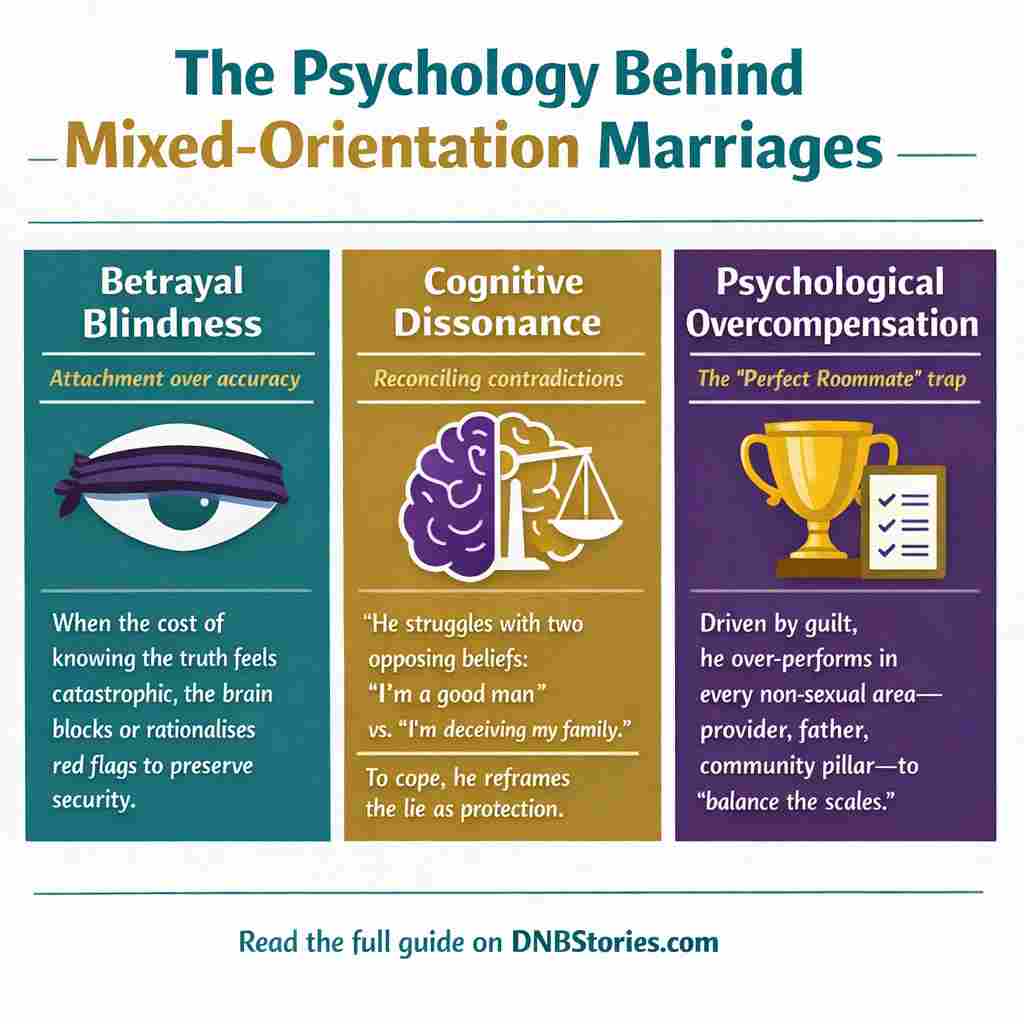
Marriage is built on assumptions of honesty and shared reality. When a woman discovers that key truths were withheld, it can shatter that reality and cause lasting harm. Wives are often blamed for ‘missing the signs,’ but psychology tells a different story. The brain can subconsciously block or minimise red flags to avoid a devastating truth—a mechanism known as betrayal blindness[3].
For many gay men, particularly Black gay men raised in religious or conservative environments, the pressure to marry a woman is not just a social expectation; it often feels like a matter of survival. However, while fear may explain the choice to conceal one’s sexuality, it does not prevent the pain that follows.
This article explains why premarital disclosure is ethically vital and how concealment can lead to betrayal trauma[4]. It calls for Black and African men, facing unique cultural and social pressures, to redefine family protection through honesty, consent, and care, rather than silence.
Secrecy Undermines Informed Consent in Marriage
Informed consent in marriage means that both partners have the necessary information to make a free and informed choice about their relationship. When a gay man marries a woman without sharing his orientation, the lack of disclosure undermines this principle.
Why Disclosure is Important:
- Autonomy: Each partner has the right to make choices based on accurate information.
- Trust: Concealment can crack the foundation of trust, which is central to marriage.
- Impact on Well-being: Both partners may experience harm—identity conflict and betrayal—if disclosure happens later.
Legal Consequences of Withholding Disclosure
The laws in most countries do not explicitly require disclosure of sexual orientation. However, ethical standards emphasise honesty in matters that significantly affect intimacy and trust. Silence can protect one partner in the short term, but often creates deeper harm for both in the long run.
- Philippines: Nondisclosure of sexual orientation has been used in annulment cases as grounds for psychological incapacity or fraud, but the outcome depends on specific facts of the case and the court’s interpretation.
- UK and US: Nondisclosure seldom results in annulment but can affect divorce proceedings when fraud is alleged. Whether nondisclosure amounts to “fraud” varies by case and jurisdiction—individuals should obtain local legal guidance rather than assume a particular outcome.
- Nigeria and Jamaica: While no clear case law treats nondisclosure itself as automatic grounds for annulment, some lawyers may frame nondisclosure as fraud or misrepresentation. However, given that homosexuality is criminalised in both countries (as of the time of writing), disclosure carries additional social and legal risks, making the issue highly sensitive.
Disclaimer: Laws change, and courts weigh cases individually. This overview is illustrative, not legal advice. Concerned persons should consult a qualified lawyer in their country for personalised guidance.
6 Subtle Signs He May Be Hiding Something
- Emotional detachment: Avoids affection or seems emotionally absent during intimate moments.
- Overcompensation in other areas: Constantly buying gifts or over-performing as a provider.
- Unexplained absences: Frequent late nights or solo trips framed as urgent.
- Avoidance of future planning: Hesitates to discuss holidays, home ownership, or retirement.
- Low emotional disclosure: Keeps conversations surface-level, rarely shares deep feelings.
- Overemphasis on appearances: Obsessed with projecting a “perfect couple” image in public or online.
Disclaimer: These signs are not evidence of hidden sexuality and should NEVER be used to “diagnose” or out someone. They are conversation starters, not conclusions. Any serious concerns are best explored with a qualified therapist or counsellor.
Black Gay Men: A Choice Between Safety and Secrecy
In many African and some diaspora contexts, refusing to marry can trigger suspicion, family rejection, spiritual condemnation, or even physical danger.
a. Marriage as a Shield Against Homophobia
For gay men in countries like Nigeria and Jamaica, marriage often becomes a survival strategy rather than a romantic choice. It serves as a shield of heterosexual normalcy, offering protection from legal persecution, social stigma, and even violence[6]. Having children strengthens this defence, cementing safety and silencing speculation—even when intimacy is absent.
As a former journalist in Nigeria, I witnessed how marriage is sometimes used by men suspected of being gay to quell rumours and avert controversy. Children become the ultimate shield, burying suspicions for life.
b. Pressure from Family, Culture and Religion
Gay men raised in deeply religious or conservative environments often face added pressure from family, society, and the church. Remaining single beyond a certain age can invite suspicion, gossip, or even accusations of immorality—making marriage a perceived shield against stigma.
The Dilemma: A Victim Creates Another Victim
Using marriage as camouflage involves another human being—a woman whose life, body, and future become entangled in a strategy she never consented to. What feels like survival for the man creates a reality of entrapment for the woman. This highlights a painful paradox where one victim of oppression inadvertently creates another, showing how survival strategies born out of fear often reproduce cycles of harm rather than breaking them.
Betrayal Trauma: Why Secrecy Hurts So Deeply
Psychologist Jennifer J. Freyd explains through betrayal trauma theory why deception by a trusted partner can be more damaging than the truth itself. (Freyd, 2013)[2].
In undisclosed mixed-orientation marriages, trauma commonly arises from:
a. Prolonged Deception:
The realisation that the lie has spanned years or decades without her feelings being considered.
b. Realising All The Gaslighting:
When the truth emerges—that he is gay—the trauma isn’t really about his sexuality. It’s the realisation that she had been right all along, after years of being dismissed as “dramatic” when she questioned his attraction.
c. Identity Betrayal:
The sudden realisation that everything had been a lie from the beginning. She stays awake, questioning all the memories, events, and photos. This can be profound depending on how long the marriage has lasted.
- When I told him I was pregnant, and he cried… was he crying from joy, or because he felt trapped?
- All the times he stayed over at his friend, Uzo… were they really watching the games or having sex?
Research shows that romantic betrayal can produce symptoms similar to PTSD—intrusive thoughts, anxiety, emotional numbing, and difficulty trusting again—even when the experience does not meet the criteria for a formal PTSD diagnosis (Lonergan et al., 2021)[5].
The Psychological Cost for the Gay Husband
Concealment also takes a serious toll on the gay partner. While the straight spouse bears the brunt of the betrayal, the closeted man often suffers from:
- Chronic Hypervigilance: The exhausting stress of maintaining a double life.
- Internalised Stigma: The shame and hatred he has for being gay deepens.
- Detachment: An inability to form true intimacy with his wife or children because a part of him is always hiding.
- Dissonance: He struggles with mental discomfort from living a lie and hurting his wife.
Cognitive Dissonance Can Manifest as the “Perfect Roommate”
Living a double life creates cognitive dissonance for the gay husband. This is the mental strain that results from a conflict between one’s beliefs and actions: “I am a good man,” but “I am deceiving my wife every day.”
To silence this internal conflict, some men reframe the lie as an act of virtue:
- She became better after marrying me.
- I provide everything she needs.
- I’m a good father—that should be enough.
Driven by guilt, many men will try to “balance the scales” by over-performing in every other area of the marriage —this pattern, called psychological overcompensation, can explain the common observation that gay husbands seem to get everything else right except in the bedroom (Festinger, 1957)[1].
Why Disclosure Before Marriage Matters
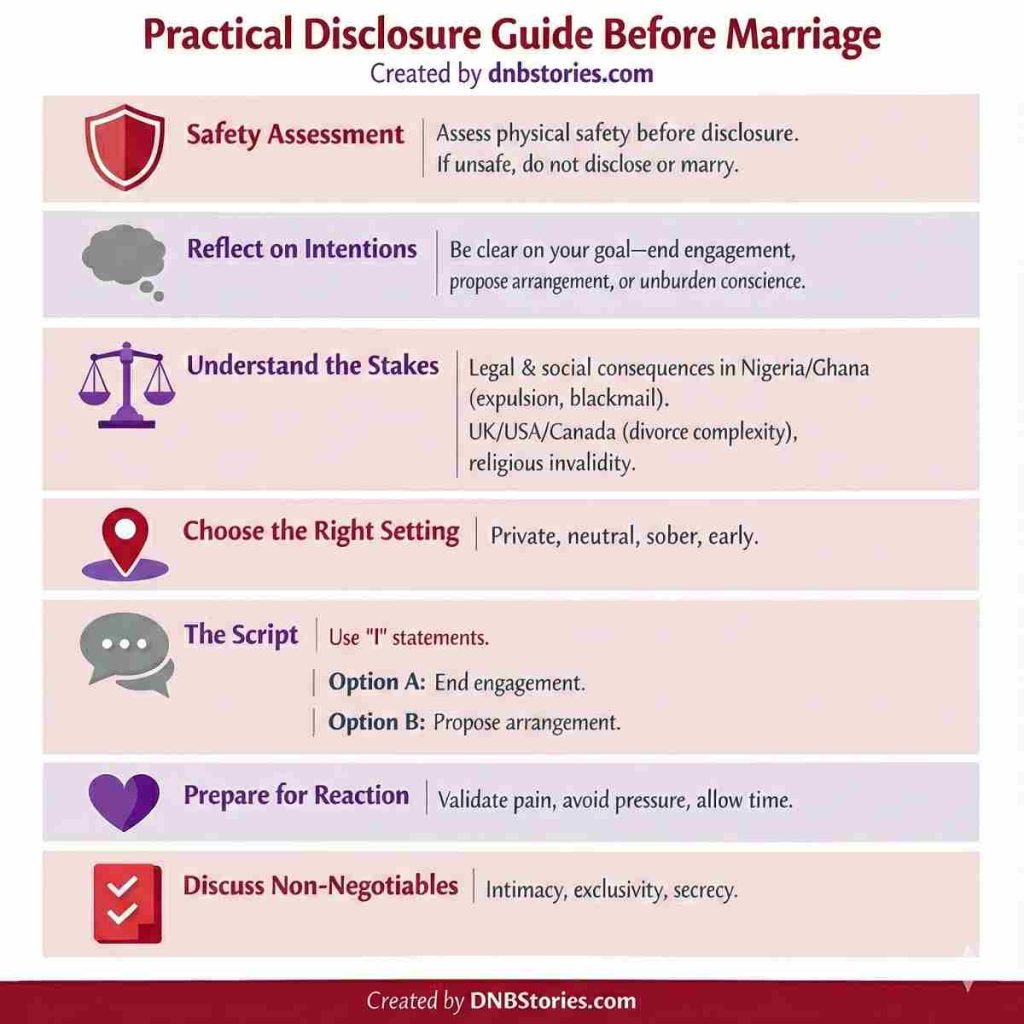
Disclosure before marriage can prevent all of this. It ensures there is informed consent, allowing both partners to make decisions based on honesty and clarity. Disclosure before marriage is not cruelty—it is care and safety.
When Disclosure Clashes With Safety
When disclosure can mean imprisonment, violence, or social exile, what becomes the solution?
Here’s what experts and advocates recommend:
a. Prioritise Safety Over Disclosure: When disclosure can lead to imprisonment or violence, personal safety must come first. Ethical clarity does not require self-endangerment. Individuals should prioritise safety while also avoiding drawing an unsuspecting partner into a union built on false assumptions.
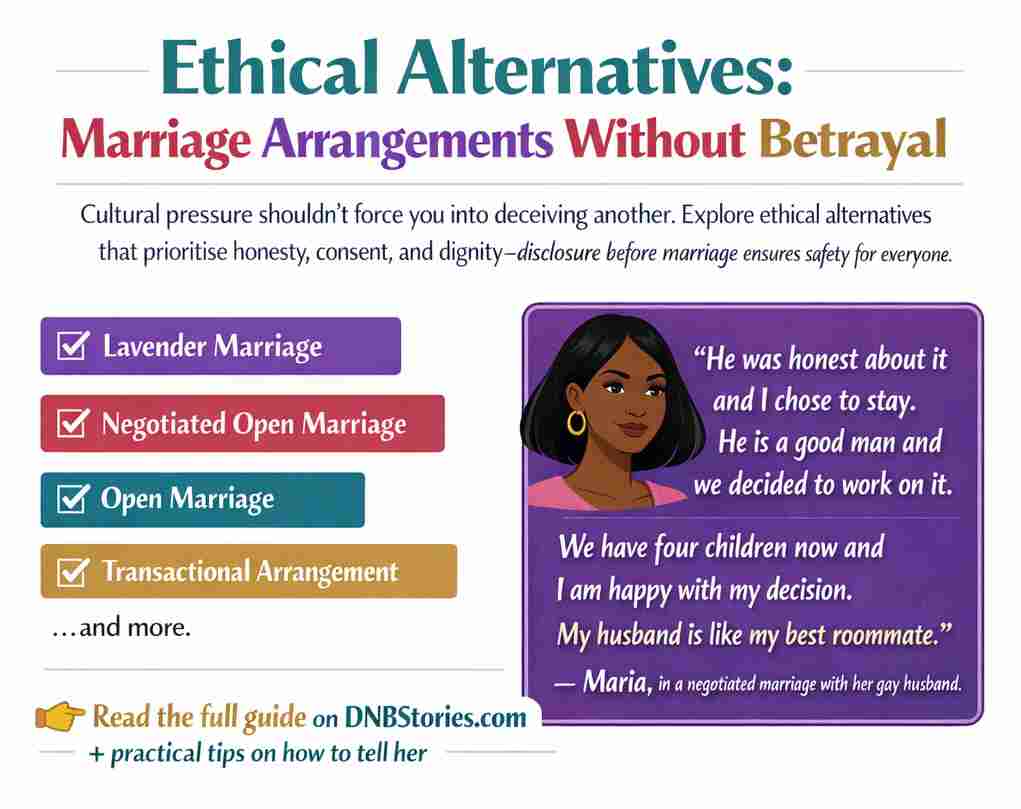
b. Explore Ethical Alternatives: In unsafe contexts, gay men can choose transparent arrangements with partners who understand the situation, minimising risk.
Ethical Alternatives: Marriage Arrangements Without Betrayal
When cultural or family pressure makes marriage seem unavoidable, deception should never be the solution. These alternatives prioritise honesty, consent, and dignity, reducing harm for everyone involved.
Some of these models are complex and emotionally demanding; couples may benefit from ongoing communication and, when needed, professional support.
1. Lavender Marriage
Marriage between a gay man and a lesbian woman or a trusted friend/ally who knows the truth.
Purpose: Social cover with mutual understanding.
2. Transparent Companionate Marriage
Marriage with full disclosure to a straight woman who consents to a non-romantic partnership.
Purpose: Stability and companionship without romantic expectations.
3. Transparent ‘Bearding’ Arrangement
An alliance where the woman acts as a “cover” for a gay man, usually without legal marriage or ceremony.
Purpose: Primarily for appearances; often informal.
4. Transactional Arrangement
Similar to bearding but more structured. Both parties agree on specific benefits—such as financial support or co-parenting—and fully understand the situation.
Purpose: Can be formalised legally as a contract marriage or remain informal, but transparency is key.
5. Negotiated Open Marriage
The wife knows her husband is gay or bisexual and permits him to see male partners under agreed rules (e.g., safe sex, discretion). In most cases, she takes her own lovers.
Purpose: Flexibility while maintaining partnership.
6. Strategic Bachelorhood
Leveraging respected roles—such as priesthood or career ambition—to justify remaining single.
Purpose: A way to avoid marriage without deception.
7. Relocation
Moving to a more accepting environment to reduce cultural pressure.
Purpose: Creates space for authenticity and safety.
For emphasis: None of these arrangements is ethical unless all parties are fully informed, freely consenting, and able to withdraw without coercion.

Final Thought: Truth is Safety
No one should enter marriage under false pretences. We cannot run from harm only to cause harm to someone else.
If safety makes full honesty impossible, the most ethical choice may be to delay marriage rather than ask someone to build their life on a half‑truth.
References
- Festinger, L. (1957). A theory of cognitive dissonance. APA PsycNet; Stanford University Press. https://psycnet.apa.org/record/1993-97948-000
- Freyd, J. J. (2013). Definition of Betrayal Trauma Theory. Uoregon.edu. https://dynamic.uoregon.edu/jjf/defineBT.html
- Freyd, J. J., & Birrell, P. (2013). Blind to betrayal: why we fool ourselves that we aren’t being fooled. Wiley; Chichester. https://csws.uoregon.edu/node/3361
- Gupta, S. (2022, May 18). What is betrayal trauma? Verywell Mind. https://www.verywellmind.com/betrayal-trauma-causes-symptoms-impact-and-coping-5270361
- Lonergan, M., Brunet, A., Rivest‐Beauregard, M., & Groleau, D. (2020). Is romantic partner betrayal a form of traumatic experience? A qualitative study. Stress and Health, 37(1), 19–31. https://doi.org/10.1002/smi.2968
- Rich, A. (1980). Compulsory Heterosexuality and Lesbian Existence. Journal of Women’s History, 15(3), 11–48. https://posgrado.unam.mx/musica/lecturas/Maus/viernes/AdrienneRichCompulsoryHeterosexuality.pdf.