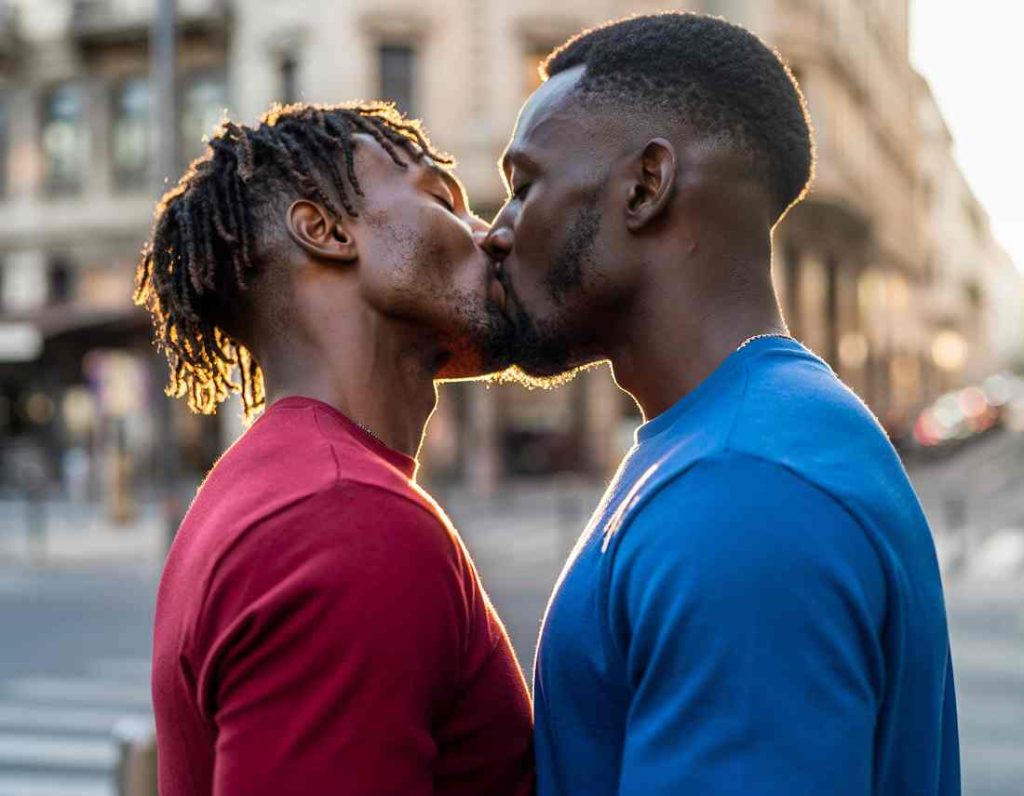
Dating as a Black gay man in London can feel like navigating a maze of contradictory expectations. From the apps that reduce men to bodies and labels, and conversations where people type A to find out B, to the cultural scripts regarding masculinity and sexual performance, connections often ignite quickly—but burn out just as fast.
Platforms like Grindr, Scruff, and Jack’D encourage snap judgements based almost entirely on aesthetics and sexual positioning: top, bottom, versatile. While physical chemistry is vital, it is rarely enough glue to hold a relationship together.
For many Black queer men in the capital, the missing ingredient isn’t attraction, sexiness, or “masc” energy. It is honesty or authentic living.
This article explores why prioritising authenticity and emotional transparency over performative roles is critical for mental health and relationship success, backed by data on the specific challenges Black gay men face in the UK.
The Reality of Black Gay Men in London
To understand why honesty is so difficult to find, we must first look at how the landscape operates. London’s gay scene is celebrated for its diversity, but do not make the mistake of confusing vibrancy with authenticity. Colour captures but does not allow people to see through. Branding and transparency have never been close friends.
The Root: The Unique Case of the UK Black Gay Man
Gay men, in general, face many stressors daily[5]. When one is Black, gay, and first-generation, these stressors double or even triple in impact.
Intersectionality, first theorised by Kimberlé Crenshaw[3], highlights the compounded difficulties faced by individuals with multiple marginalised identities.
For example, first-generation Black gay men in the UK often experience these overlapping pressures:
1. Race-Related Societal Pressures
- Assumptions that Black men must be hyper‑masculine or dominant which restrict authentic self‑expression.
- Pressure to perform “top” or “dominant” roles in dating because of racialised expectations.
- Being reduced to racial fantasies on dating apps or in social spaces, such as “BBC” stereotypes.
- Feeling valued mainly for physical traits rather than personality, individuality, or emotional depth.
2. Homophobia Within the Black Community
- Pressure to conform to hyper‑masculine ideals (mandem), masculinity policing and hostility towards things considered soft.
- Fear of “bringing shame” to the family or community, which pushes many LGBTQ+ members into silence, lying, or forced conformity.
- Limited or discouraged dialogue about sexuality, allowing myths, misinformation, and intolerance to flourish.
3. Culture and Family Expectations
- Families’ strong ties to faith and religions that frame homosexuality as sinful create environments of stigma or rejection.
- The curse burden — some traditional families see queerness as a source of misfortune; a curse that supposedly blocks success, derails destiny, or disrupts the family’s spiritual order.
These pressures don’t just sit side by side—they amplify one another to create harsher and more complicated realities for the individual. This unique situation often pushes many Black gay men into a state of constant performance or what I call constant SSP Mode: Strategic Self‑Presentation—the constant effort to manage how others see you. It often involves constantly editing your behaviour, appearance, and communication to stay “sellable.”

This rarely begins as deception. More often, it’s born from the deep hunger to find your place in a society that didn’t start with people like you as kings. Over time, though, people forget to take off the costume—or forget to wear the right one for the right show. That’s how a community slowly shifts from being a collection of humans to a gallery of characters.
Evidence anchor: A recent qualitative study with Black men at risk of suicide suggests that overlapping pressures can push Black men into a constant performance of strength—“always on,” “masking,” “the costume”—which increases strain and can spill over into intimacy and dating (Adams et al., 2026)[1].
Why Authenticity Feels So Risky — and the Part We All Played
We are all complicit in burying honesty and turning our community into a movie set. For many people who perform, authenticity feels unsafe because past honesty was punished.
Make this a personal rule: never punish an act of honesty, no matter what.
Why honesty triggers danger:
- 🧠 Belonging over truth
Authenticity feels risky because being real exposes you to rejection. Across London’s Black gay scenes—Soho, Vauxhall, Brixton—where status and spectacle matter, this risk is amplified; honesty can cost you social capital, party invites, and dates, so most people learn to avoid it.
Research shows social rejection activates the same brain pathways as physical threat. For people with contingent self-worth (CSW), being authentic risks real emotional pain. Being real takes strength (Kross et al., 2011)[4].
- ⚠️ Authenticity unsettles others
Realness exposes other people’s performances. For those whose social capital depends on a mask, this can feel like a threat—so they respond with judgement, distancing, or moralising instead of curiosity.
- 🎭 We built a culture of branding
Apps, nightlife, and work reward polish and performance. In these spaces, honesty can feel like showing up to an all-black party dressed in white.
How we helped create the problem:
- 📈 We reward performance
Likes, matches, promotions, and invitations often go to the most marketable persona—not the most honest person.
- 🚫 We shame difference
We police norms. Deviation gets corrected or excluded, teaching people to hide.
- 🔎 We punish honesty
To avoid confronting our own masks, we exclude real people and surround ourselves with co‑performers. We mostly punish honesty subtly, but the effects pile up. When someone shares something vulnerable, and it’s met with awkward silence or a sudden change of subject, the brain reads it as danger. And when we gossip or respond with judgment — “That’s why it could never be me” — we teach others a quick lesson: never be vulnerable again.
- 🎯 We misunderstand authenticity
We treat “truth” as fixed instead of flexible. Here’s an example: Someone says “I’m a total top” instead of “I top more” and locks themselves into an absolute identity they later have to lie to maintain or go about shocking partners.
Or this: someone shares a moment of weakness — or you hear a piece of unverified gossip — and you treat it like that’s the person’s whole life (the horns effect).
The Science of Honesty and Connection
Why shift the focus to honesty? Because psychologically, it is the only path to safety.
Honesty in this context isn’t just about “not lying.” It is about authenticity—the ability to be your real self without fear of punishment. Beyond anything else, the connection of authenticity to SAFETY remains a big motivation to prioritise it above all else.
I will explain:
Authenticity creates a state of radical acceptance, where knowing and embracing one’s truths—strengths and flaws alike—becomes a psychological shield against judgment and shame.
Turning to the positives of performing arts this time, Game of Thrones character Tyrion Lannister said: “Once you’ve accepted your flaws, no one can use them against you.”
He is technically saying you can’t shame someone who has already made peace with their truth. That peace dissolves shame‑based anxieties and reduces the need to perform for acceptance. Freed from the strain of constant self‑editing and the anticipation of judgment, individuals gain more space for greater self-esteem and emotional resilience. In this way, living authentically moves from a simple personal preference and becomes a survival strategy that enables not just endurance in the face of prejudice, but the ability to thrive despite it (Wood et al., 2008)[7].
You may ask: how does this translate to safety for others as well? Why am I safer for choosing the honest dude over the hot, macho chocolate?
The Benefits of Prioritising Authenticity in Dating
Authenticity works in a cycle: first, it protects the person, then the partners they get involved with, and then their relationships before flowing into their community.
- Improves Stability in Relationships: More clarity, fewer games, and less confusion because both people are dealing with what’s real.
- Strengthens Conflict Resilience: Disagreements become easier to resolve when neither partner is acting or hiding.
- Reduced Stress, More Peace: Creates a space where marginalised partners can be fully themselves—without constant editing. More consistency, less drama, and fewer unnecessary conflicts.
- Deepens Intimacy Beyond Sex: Opens the door to emotional connection that can last even after sexual desire fades.
- Better Sex: Authenticity removes the pressure to perform and lets two people meet without masks. When you’re not busy managing an image or playing a role, your body relaxes and becomes more ready to embrace pleasure.
Community Benefits of Authenticity
In communities shaped by stigma, racialisation, or hyper‑performance, one person’s authenticity doesn’t just protect them—it creates safer conditions for everyone around them.
1. 🌱 Authenticity Reveals the Real People in a Group
When someone shows up as their real self, it quietly invites others to lower their own armour. It sends a subtle message: you don’t have to perform to belong here. This reduces the collective stress load, moving everyone from SSP Mode back into human mode, where people can finally see each other as they truly are. The princess behind the macho exterior. The unexpected loquacity of the DL guy. The quiet danger of Mr Cool.

2. 🛡️ It Disrupts the Spread of Harmful Norms
Authenticity challenges the scripts of character performances—hyper‑masculinity, racialised roles, “top or nothing” personas—that harm the whole community. When someone refuses to play by those rules, it starts to weaken the rules over time.
3. 🤝 Relational Clarity Prevents Real Harm
When people are honest about who they are, what they really want, and what they can offer, others are less likely to be misled, disappointed, or emotionally blindsided. Clarity here becomes a form of protection.
4. 🧭 Diversity Invites Everyone
Authenticity becomes a reference point that shows others that it’s possible to be Black, gay, soft, complex, vulnerable, ambitious, spiritual—whatever the truth is—without collapsing under the weight of expectation. This modelling builds safety and widens community trust.
5. 🔄 Performance is a Full-Time Job
When people stop performing, others stop reacting to the performance. This breaks the cycle where everyone is responding to someone else’s mask. Not everyone can deliver an Oscar-worthy act—and some performances are so poorly done they create confusion and misreadings. Fewer misreadings mean fewer misunderstandings, and fewer misunderstandings lead to less interpersonal harm. Authenticity simplifies everything.
6. 🧘🏾♂️ Emotional Safety Matters A Lot
Authenticity fosters environments where people feel seen rather than judged, understood rather than categorised. That kind of space reduces shame, increases trust, and makes vulnerability less dangerous.
Personal Observation:
I genuinely feel that the level of distrust in the London Black gay community has reached a chronic high. From my observation, this tends to happen after a community has relied on performance and mask‑wearing for decades, roughly half a century. At this scale, individual acts of authenticity cannot undo the damage alone. The practical goal now is to build small, intentional micro‑communities of honest, truth‑seeking people where members can live with dignity and safety for the long term.
Practical Acts of Authenticity For Black Gay Men in London
Some Black gay men approach the subject of authentic living as something “white and bougie,” often without recognising the profound impact that performative living has on their own well-being and on those around them.
Here are practical, everyday ways Black gay men in London can break out of the script of conformity and performance to embrace authentic living. These small acts chip away at your SSP Mode and make space for real selfhood:
a. Embrace and do you—always!
Name your real preferences out loud. Say what you actually like—music, fashion, hobbies, food, men, roles, vibes. Not the “masc‑approved” version—the you version. Don’t blast J Hus in public and hide your Dua Lipa playlist at home. Don’t perform mandem energy outside and unleash your inner drag queen only in private; let your whole self exist in every room. Let people fall in love with the real you—not the character you play.
b. Go back to your natural voice
No voice deepening, tightening or “London masc” modulation. Your real voice is a declaration of self—and, honestly, far cooler than sounding like you accidentally swallowed a dating coach.
c. Let yourself laugh the way you actually laugh
It’s so sad that laughter is often one of the first things people police. Letting it out is a quiet rebellion. Never give anyone authority to police your joy.
d. Tell the truth about what you want
In dating, friendships, hookups, and community spaces—say what you want without shrinking or performing to avoid rejection. As you may have already noticed, all the editing didn’t get you much either. Leave trash for trash, my brother—you are bigger than that.
A 2015 sociological study on sexual racism among gay and bisexual men found that clear, upfront communication about one’s identity and boundaries helps to protect users from racialised discrimination on dating apps (Callander et al., 2015)[2].
e. Admit when you don’t know something
Hyper‑competence can be a performance, too. Saying “I don’t know” is surprisingly endearing and draws people in. Just don’t stay in the dark, though or start wearing cluelessness like an armour. Say it once, then go find out.
f. Let yourself be seen in moments of uncertainty
You don’t have to be the unshakeable one or play Mr Perfect. Don’t fear being seen thinking, hesitating, choosing, or looking unsure. It’s okay to show what you feel and own the mistakes you recognise. If someone judges you for sharing your truth, they don’t deserve you anyway. Their performance belongs on a stage in the West End, not in your life.
A peer-reviewed review of Daring Greatly finds that vulnerability is central to courage, connection, and meaningful relationships, while shame and fear of judgment drive people toward performance rather than genuine relating (Walter, 2016)[6].
g. Reject the trap of over‑explaining yourself
Not everyone will understand you or even like the real you, and that’s fine. Someone rejecting the real you is far better than them loving a character in costume. No disclaimers from now on, Baby. Don’t be the Joker dressed up as King, when you can stand as the one true Queen!
h. Choose your own spaces
Don’t stay where you pay for your presence with a performance of gratitude. Not every room deserves your presence. Seek out friendships, queer spaces, and communities where you don’t have to shrink or harden to be accepted.
i. Practise micro‑honesty daily
Authenticity is built through small truths. Just as performance grows from hiding them, honesty grows from sharing them:
“You’re my friend, but I don’t agree with your take.”
“I’m tired and need to stop now.”
“That hurt my feelings.”
“I actually prefer this one.”
j. Stop rewarding people who only like your performance
If someone only values the persona, not the person, that’s not connection—it’s consumption. Build relationships where you don’t have to code‑switch. People who let you be your full self—cultural, queer, emotional—are oxygen. Prioritise them.
k. Embrace softness without apology
Softness isn’t the opposite of strength; softness is the opposite of fear. It’s 2026—Black queer people are claiming the Soft Life with full chest. Whoever said we can’t be Black and bougie at the same time clearly wasn’t invited.
l. Always state your boundaries
Clarity is care. Name your emotional needs instead of performing “chill.” Be open about health, sexual boundaries, and conversations around drugs. Don’t bend yourself or fake the truth to match someone’s profile. Authenticity keeps you safer—and attracts people who actually want you.
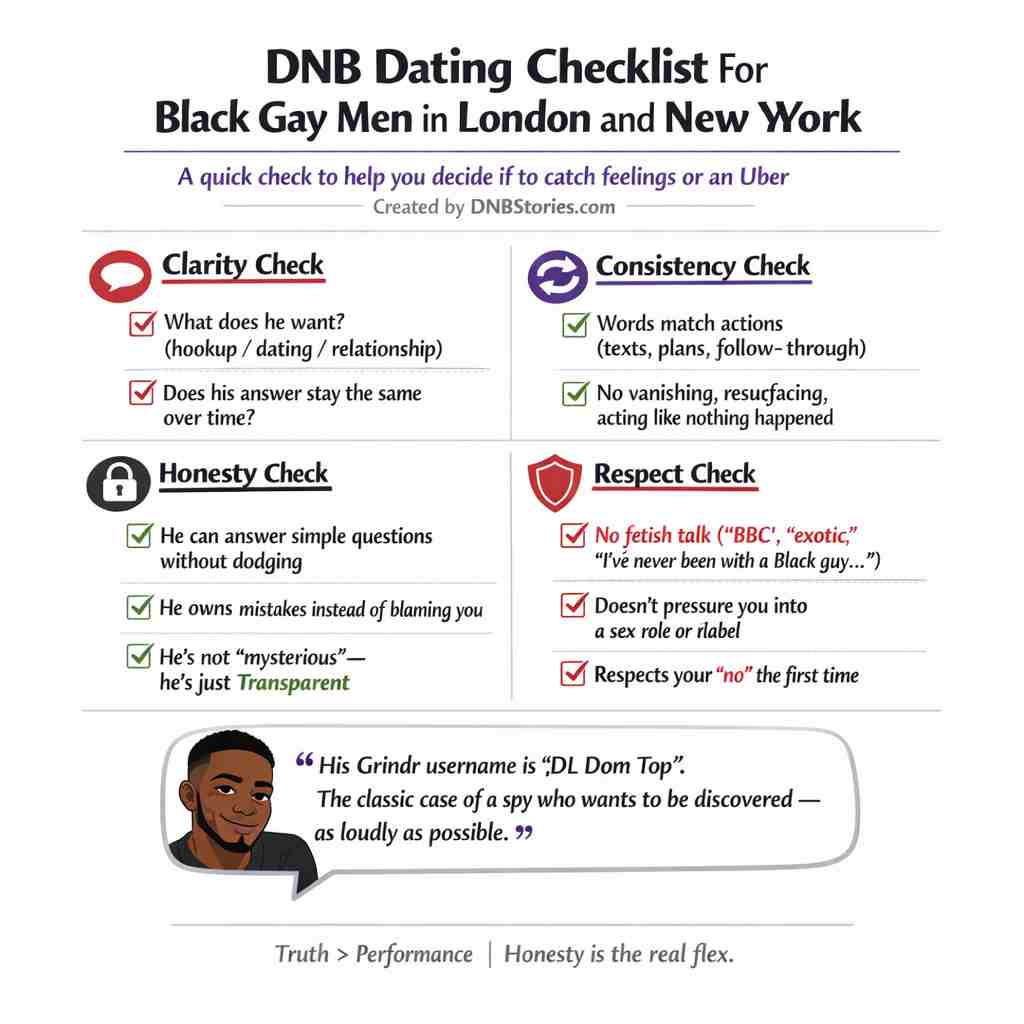
A practical shift for Black gay men in London looking for something serious:
Change the venue. High‑stimulus places like Vauxhall clubs or the Grindr grid encourage snap judgments and performance. To invite honesty, move first dates into low‑pressure settings where conversation, not spectacle, is the point.
Try:
- Walk the South Bank — easy pace, public, natural conversation starters.
- Coffee in Brixton Village — relaxed, local energy, good for lingering.
- Visit the Tate Modern — shared experience, quiet corners for real talk.
- Alternative picks: a daytime market, a bookshop with a café, a neighbourhood park.
Why?
These spaces encourage face‑to‑face engagement without the immediate pressure of sexual performance. They let you read tone, curiosity, and empathy instead of curated photos or club bravado. That clarity helps you spot someone who wants you, not a character.
How to suggest it:
- Direct invite: Let’s meet for coffee in Brixton Village and actually talk.
- Low‑pressure framing: Fancy a walk along the South Bank this weekend — no rush, just a proper chat.
- Shared interest: Want to check the Tate Modern’s new show and grab a drink after.
Black gay dating: Red flag signals and safety
What to watch for — serious red flags. Act fast: block or delete.
If you see any of these, leave the conversation and block. These behaviours signal manipulation and disrespect for consent, safety, or your autonomy.
| Signal | Why it’s a red flag | Action |
|---|---|---|
| Asks you to invite another top/bottom at the first meeting | Pushes sexual escalation and treats you like a prop. | End it immediately; don’t negotiate. |
| Inconsistent stories or repeated small lies (health, relationship status, drug use) | Small lies become bigger breaches of trust; they show a pattern, not an accident. | Cut contact; don’t try to “test” them. |
| Responds to any topic with shame or moralising | Shaming is a control tactic that erodes your boundaries and self‑worth. | Exit and block; you don’t need that energy. |
| Wide mismatch between words and actions (e.g., claims DL but wants threesome; profile says “no drugs” but says okay for chemsex) | This is West End-level performance. SSP Premium. | Delete and move on. |
| Avoids basic questions; gaslights; paints themselves as a saint | Evasion plus moral grandstanding is classic manipulation; they dodge accountability and rewrite reality. | Stop engaging; block. |
| Comes with a manual of expectations (rules, scripts, rigid demands) | Relationship on their terms only; no room for your needs or consent. | Walk away. Leave trash for trash. |
Conclusion: Real over Ideal
Honesty isn’t about perfection or presenting a flawless CV of a human being. It’s about letting a partner see the real you—both strengths and flaws—so they know what they’re choosing.
For Black gay men in London, the dating pool can feel like a minefield of projections and expectations. But when you shift the primary filter from “Is he sexy?” or “Is he a Top?” to “Is he honest?”, you change the game. You stop auditioning for a role and start building a relationship. You’re allowed to be healing, learning, and growing. The right partner is the one who sees your truth and still chooses you—not the fantasy of what you represent.
References
- Adams, L. B., DeVinney, A., Aljuboori, D., Bachman, S., Lateef, H., Aryamawit Habteyesus, & Willie, T. C. (2026). Performing Strength: Racialized Masculinity in the Lived Experiences of Black Men at Risk of Suicide. American Journal of Men’s Health, 20(1), 15579883251408351-15579883251408351. https://doi.org/10.1177/15579883251408351
- Callander, D., Newman, C. E., & Holt, M. (2015). Is Sexual Racism Really Racism? Distinguishing Attitudes Toward Sexual Racism and Generic Racism Among Gay and Bisexual Men. Archives of Sexual Behavior, 44(7), 1991–2000. https://doi.org/10.1007/s10508-015-0487-3
- Crenshaw, K. (1991). Mapping the margins: Intersectionality, Identity politics, and Violence against Women of Color. Stanford Law Review, 43(6), 1241–1299. https://doi.org/10.2307/1229039
- Kross, E., Berman, M. G., Mischel, W., Smith, E. E., & Wager, T. D. (2011). Social Rejection Shares Somatosensory Representations with Physical Pain. Proceedings of the National Academy of Sciences, 108(15), 6270–6275. https://doi.org/10.1073/pnas.1102693108
- Meyer, I. H. (2003). Prejudice, social stress, and mental health in lesbian, gay, and bisexual populations: Conceptual issues and research evidence. Psychological Bulletin, 129(5), 674–697. https://doi.org/10.1037/0033-2909.129.5.674
- Walter, C. (2016). Book review: Brown, B. (2015). Daring greatly: How the courage to be vulnerable transforms the way we live, love, parent, and lead. International Journal of Social Pedagogy. https://doi.org/10.14324/111.444.ijsp.2017.17
- Wood, A. M., Linley, P. A., Maltby, J., Baliousis, M., & Joseph, S. (2008). The authentic personality: A theoretical and empirical conceptualization and the development of the Authenticity Scale. Journal of Counseling Psychology, 55(3), 385–399. https://doi.org/10.1037/0022-0167.55.3.385