If you scroll through Instagram, TikTok, X, or open Grindr or Jack’d, you could be forgiven for thinking gay culture has become one endless loop of perfect bodies, thirst traps, and hyper-sexual performances. Anywhere you find a group of young gay men—whether online in WhatsApp or Telegram group chats or offline at parties and hangouts—the only topics of excitement seem to revolve around hookups, nudes, hot bodies and sex.
It can feel shallow and exhausting, especially when it creates the impression that being gay is just about sex and monitoring desirability metrics, where bodies are ranked, and relevance is reduced to how much attention we can attract.
Sex has always mattered in gay life—desire, visibility, and freedom have historically been political acts in gay life. But the environment around sex has changed. This is simply no longer about demanding rights. It’s the elevation of bodies as markers of attention and status, and the live measurement of worthiness through a desire-scoring screen.
This article unpacks why being gay often feels synonymous with sex, analysing the emotional and structural forces that reward bodies and hookups as the focus of contemporary gay life.
Sexual Capital and the Economics of Desire
The intersection of psychology, technology and economy has transformed modern intimacy into a high-performance marketplace.
According to sociologist Adam Isaiah Green (2008)[3], spaces like apps and gay clubs serve as ‘sexual fields’—environments where social hierarchies, rather than just personal taste, dictate the rules of attraction.
1. The Psychology of Desire – The Root
Under normal conditions, sexual desire is just biological attraction. However, for many gay men who grew up feeling “different” or “less than,” desire takes on a much heavier function—evidence of worth, relevance, impact.
Many gay men grow up with stigma and shame—a constant internal struggle with negative messages, which are steadily reinforced with every new experience of bullying, slurs, rejection, family silence and discrimination from other gay men[4].
Shame creates a void and a strong need to prove, leading to the development of contingent self-esteem. Unlike intrinsic self-esteem, which is stable and comes from inside, contingent self-worth is fragile and relies heavily on external validation.
The inner logic often sounds like:
* I am not enough
* But if I become impressive enough
* I can’t be dismissed.
This internal monologue typifies the desperation to fill the void (a feeling of inadequacy) created by shame, which often leads to overcompensation (the drive to get very impressive).
Many gay men pursue either of these routes:
- High Achievement—getting good grades, being the best in class, and a strong pursuit of success.
- High Desirability—receiving approval from others, walking into the room and being noticed, people wanting to be with you.
Success in these areas boosts self-esteem, while failure plummets it, resulting in emotional volatility and a persistent need for self-validation.

The connection between shame and sexual desire
When a partner — especially one with high status/ seems highly desired — shows interest in you, their attention instantly boosts your self‑worth and quiets the voice that says you’re not enough. But it never lasts. Like a drug high, the validation fades quickly, and the void returns — wider now and demanding more attention, more proof, more “currency” to fill it. The chase restarts: seek desire, feel briefly whole, lose it, and chase again.
This isn’t just theory; a 2022 study in The Journal of Sex Research confirms that sexual compulsivity in gay men is often driven by sexual shame and emotion dysregulation rather than personal desire — essentially confirming that many gay men use sex to cope with the stress of internalised stigma (Cienfuegos-Szalay et al., 2021)[1].
We chase desire to confirm that we are worthy rather than knowing that our worth is already whole, and the void we feel is only imagined.
Now that we understand it’s not just about sex but also the validation attached to it, the familiar cycle makes more sense—gay friends delete Grindr, only to reinstall it days later. The interactions may feel empty and frustrating, yet people return because the platform offers a quick and convenient marketplace for buying temporary relief from shame and loneliness.
This brings us to the second point: Technology.
2. The Grindr Effect – How Apps Amplify The Focus on Sex
Location-based apps didn’t create hookup culture, but they accelerated it by making sexual attention instant, quantifiable, and addictive through an endless, browsable grid.
Apps like Grindr, Scruff, Jack’d, etc., are built to exploit the psychological trigger mentioned above—the persistent emotional need for external validation.
The apps do this by:
a. Providing Quick and Constant Validation:
The grid and its unpredictable notifications—new messages, taps, profile views—deliver quick, addictive dopamine hits that drive compulsive checking. Profiles are constantly edited, not to attract one meaningful connection, but to capture as much attention as possible, as quickly as possible. The entire cycle begins to mimic the pull of a drug.
b. Removing Friction:
Approaching someone offline demands courage and carries the risk of public rejection. Apps remove that friction, enabling quick and low-risk interactions. Some users further reduce the risk by using fake photos or providing misleading information, opting for deception over authenticity.
Catfish—Deception or Survival Strategy?
This captures the logic behind catfishing: by creating a false identity, the catfish can harvest affirmation without risking their true self. If the goal were genuinely to meet, the lie would be a liability. But when the goal is to soothe shame and feel desirable—feelings often scarce in their offline life—the disguise becomes a survival mechanism. The mask usually slips only when the emotional calculus shifts: when the hope of being accepted for who they really are begins to materialise, the sting of potential rejection softens. With the terror of exposure reduced, confession becomes possible.

Role of social media —Instagram, TikTok, X
While dating apps gamify meeting/hook-ups, social media gamifies identity through similar mechanisms. Likes, reposts and follows are interpreted as proof of value, which encourages users to prioritise the creation and posting of content that attracts more of those.
Social media algorithms are designed with one goal: keep you on the app. When it notices that a shirtless photo gets 3x more dwell time than a photo of a book or a landscape, it pushes that shirtless photo to thousands more strangers.
Platform research shows that engagement-based algorithms systematically amplify emotionally charged content over what users actually want to see, which can make hyper-sexualised posts feel like the default online—even when they don’t reflect people’s deeper preferences (Milli et al., 2025)[5].
3. The OnlyFans Effect—The Monetisation of Intimacy
The rise of million‑dollar subscription platforms like OnlyFans and JustForFans means sexual attention has become convertible into cash, not just social currency.
This doesn’t mean “everyone is doing porn.” It means the culture has absorbed a new norm: visibility can be monetised, and sexual content is one of the easiest ways to do it—requiring minimal complications, learning and skill.
Sex as Instant Status in Gay Culture
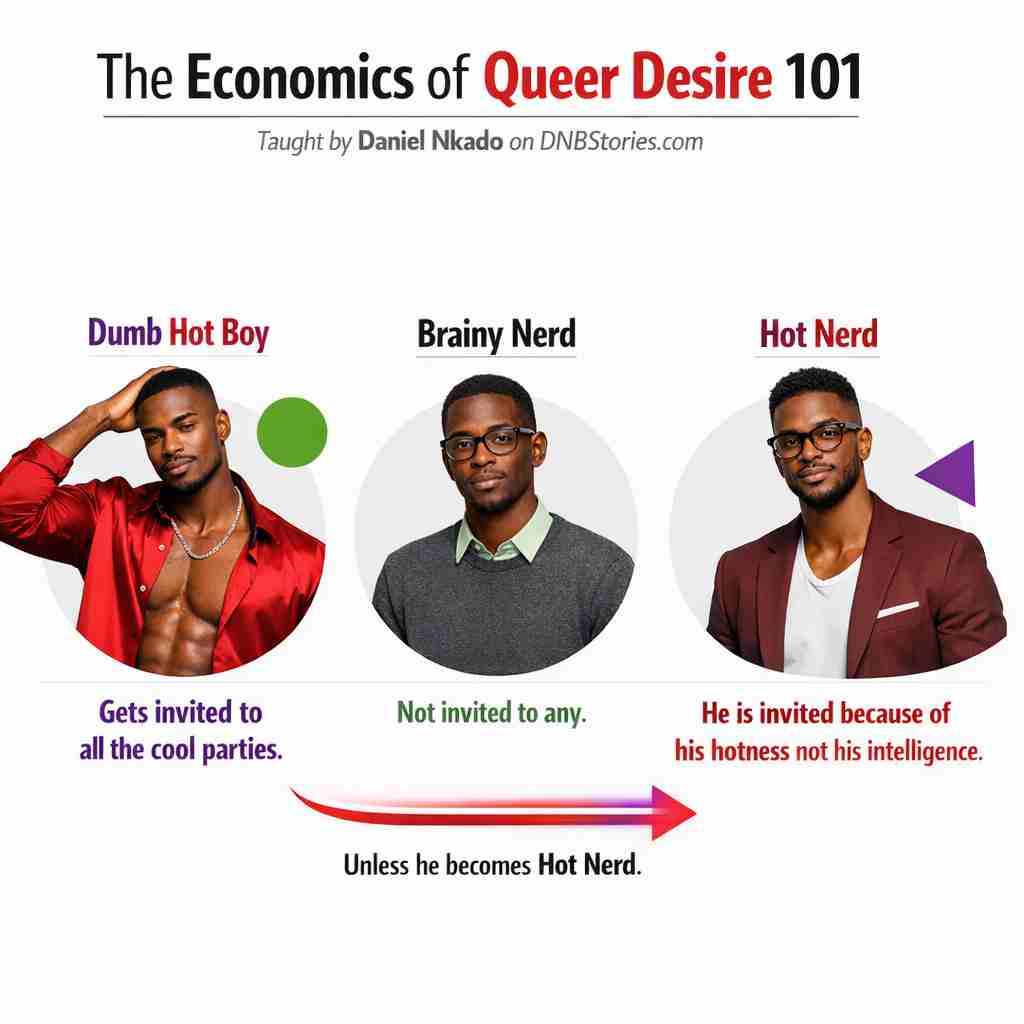
In many gay spaces, being seen as “masc,” fit, young, or sexually in-demand functions as sexual capital. It buys attention, access, and sometimes even a sense of safety. Crucially, this route feels faster than other forms of gaining relevance:
- The Career/Craft Route: Slow, difficult, requiring more effort.
- The Body/Sex Route: An immediate feedback loop. Post photo → get attention → feel valued → repeat.
The Cost: Anxiety and Body Image Disturbance
When desirability is treated like currency, you are never fully “done.” The market changes, bodies age, and trends shift.
This manifests as:
- Chronic comparison and envy.
- Compulsive gym routines or body checking.
- Feeling invisible or worthless when not “on.”
- Burnout and numbness from using sex as a mood regulator.
The Career Route: Status Through Competence
For men who find the “body market” volatile or unappealing, the Career Route offers an alternative, albeit slower, path to validation.
Often rooted in what Andrew Tobias called the “Best Little Boy in the World” syndrome, this strategy attempts to silence early shame through irrefutable excellence—accumulating degrees, titles, wealth, and professional prestige.
Unlike sexual capital, which depreciates with age, career status is durable; it creates a fortress of safety that effectively says, “I am too successful to be rejected.”

However, when the same trauma that fuels gym obsession sits behind professional ambition, it turns your career into a compulsive performance of worthiness, where resting feels like failing and “average” feels unsafe.
Authenticity without being anti-sex
Unplugging from the matrix of sex-based confidence doesn’t mean becoming celibate, deleting apps, or judging people who enjoy sex.
It means building self-worth from within rather than judging your value based on the market signals of sexual desirability. It encourages shifting the mindset from performative displays aimed at proving yourself to others to a human‑value perspective that focuses on presence and sensory connection during sex, so the action becomes an expression of existing wholeness rather than a means to create it.
Alan Downs (2012)[2] describes this shift from shame-driven overcompensation toward authenticity: living from internal alignment where one’s actions, beliefs, and values are in harmony, leading to genuine fulfilment, inner peace, and self-respect, independent of outside approval.
Practical Ways to Shift Your Source of Worth
- Build ‘Slow Status’:
- Invest in compounding, reinvestable assets—career, skills, service, community and creative work. Unlike looks-based validation, slow status deepens with time.
- Edit Your Feed:
- The content you consume shapes your perception of “normal.” Feeds filled with hyper-fit influencers can make average bodies feel inadequate. To counter this, read widely, expand your interests to things you formerly neglected and follow creators/blogs who promote body diversity, normalise ageing, and non-sexual content.
- Identify The Actual Need:
- Pause and ask what you’re really craving—connection, reassurance, relief, boredom, comfort. Direct your actions to meeting that need (text a friend, rest, eat, step outside) instead of chasing a quick hit of attention.
- Choose ‘Soft Spaces’.
- Spend time where your appearance isn’t the main currency—book clubs, volunteering, hobby groups, gaming circles. Pick environments that reward warmth, humour, curiosity and integrity over aesthetics.
Conclusion
Technology’s amplification of sexual content, our inherent need for attention, and the monetisation of desire make being gay seem hyper-focused on sex right now. However, this digital economy masks a deeper need for self-acceptance.
While sexual capital is a powerful currency, it’s a poor basis for self-worth. One can enjoy sex, beauty, and fitness without letting the market define them.
References
- Cienfuegos-Szalay, J., Moody, R. L., Talan, A., Grov, C., & H. Jonathon Rendina. (2021). Sexual Shame and Emotion Dysregulation: Key Roles in the Association between Internalised Homonegativity and Sexual Compulsivity. PubMed, 59(5), 1–11. https://doi.org/10.1080/00224499.2021.1963649
- Downs, A. (2012). The Velvet Rage: Overcoming the Pain of Growing Up Gay in a Straight Man’s World (2nd ed.). Da Capo Press.
- Green, A. I. (2008). The Social Organisation of Desire: The Sexual Fields Approach. Sociological Theory, 26(1), 25–50. https://doi.org/10.1111/j.1467-9558.2008.00317.x
- Meyer, I. H. (2003). Prejudice, social stress, and mental health in lesbian, gay, and bisexual populations: Conceptual issues and research evidence. Psychological Bulletin, 129(5), 674–697. https://doi.org/10.1037/0033-2909.129.5.674
- Milli, S., Carroll, M., Wang, Y., Pandey, S., Zhao, S., & Dragan, A. D. (2025). Engagement, user satisfaction, and the amplification of divisive content on social media. PNAS Nexus, 4(3). https://doi.org/10.1093/pnasnexus/pgaf062